
School-age staff: the permits, hours and pay bands most cafés get wrong
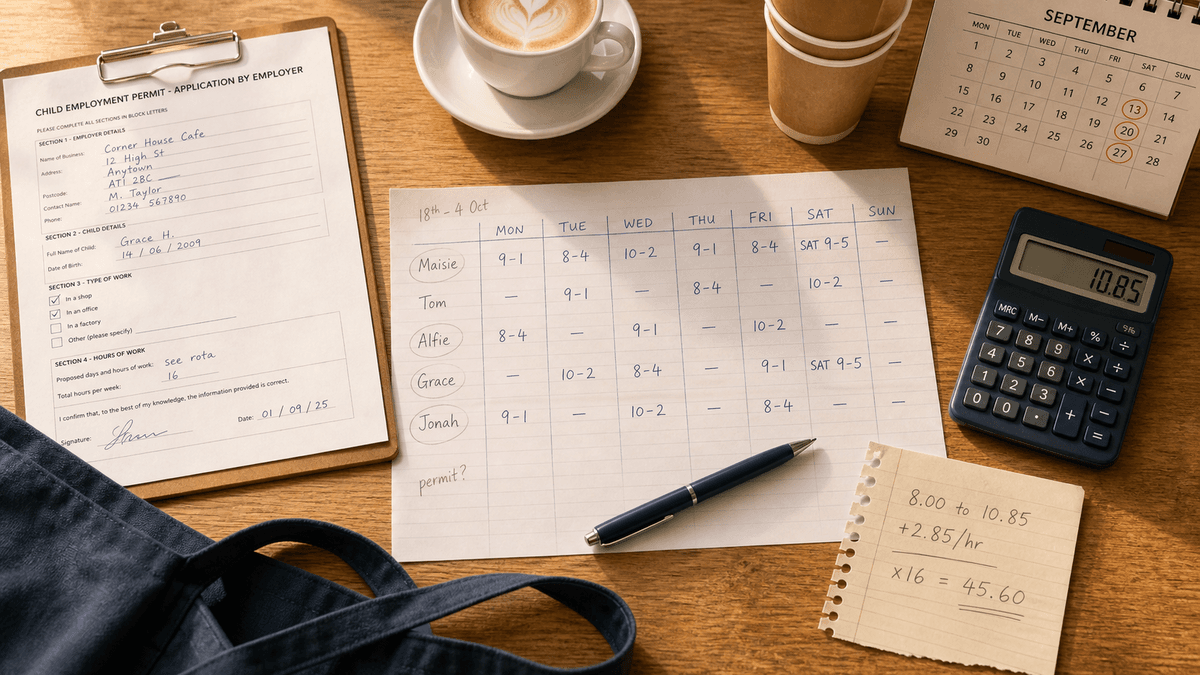
Pull up the September rota and count the names belonging to someone still at school, or who left in June.
In a market town café that number is rarely zero. Saturday students are the backbone of independent hospitality and usually brilliant at it. We have had them at Hunters for years.
Here is the uncomfortable bit. Three of those names might sit in three different legal categories, each with its own hours cap, its own paperwork and its own hourly rate. Your rota does not know that. It sees a person and a shift, and the schools go back in a fortnight.
Three legal categories, one rota
We think of it as "the young ones". The law thinks of it as three separate things.
Children. Anyone still of compulsory school age. They need a permit from your local council, their hours are capped by local byelaws, and the National Minimum Wage does not apply to them at all.
Young workers. Over compulsory school age but under 18. No permit, but the Working Time Regulations young worker protections apply, and so does the under 18 minimum wage band.
18 and over. Adult working time rules, adult pay bands, adult everything.
The date that moves someone from the first box to the second is worth knowing. In England you can leave school on the last Friday in June if you turn 16 by the end of the summer holidays. So the fifteen year old who needed a permit for their May shifts became a young worker on 26 June this year, with no paperwork changing hands and probably no conversation about it.
Under school leaving age: the permit nobody applies for
If someone on your rota is still in Year 10 or Year 11, this is you.
The permit. Most councils require a child employment permit before a school-age child works a single shift, and it is the employer's job to apply, not the parent's. Oxfordshire County Council is explicit that it will not accept applications from parents, carers or the child, and yours will almost certainly say the same. Allow a few days: the form goes to the child's school for signature before the council issues anything.
The minimum age varies. Gov.uk says part-time work from 14, with some councils allowing 13, as Oxfordshire does for light duties. Byelaws are local, so check yours.
They cannot work in the kitchen. This one catches cafés, and it is not an hours rule. Council byelaws list prohibited occupations, and a commercial kitchen, meaning any room where food is prepared or cooked for sale, is on the standard list councils adopt. Oxfordshire's says so in as many words. Front of house, clearing, till and drinks are fine. Prep bench, ovens and a pot wash inside the kitchen are not, permit or no permit.
The hours are tighter than people assume. Gov.uk's restrictions on child employment cap term time at 12 hours a week, and inside that: 2 hours on a school day and on a Sunday, 5 hours on a Saturday for a 14 year old or 8 hours for a 15 or 16 year old, no more than one hour before school unless byelaws allow it, and never during school hours. In the holidays the weekly cap lifts to 25 hours for a 14 year old and 35 for a 15 or 16 year old, Sundays still capped at 2.
Three more rules catch cafés specifically:
- No shift starts before 7am or finishes after 7pm. A 6.30am start to set up before opening is out. So is a Friday close at half seven.
- No more than 4 hours without a break of at least 1 hour. Not twenty minutes. A full hour.
- A 2 week break from all work during the school holidays, every calendar year. If yours worked every week of August, that fortnight has to land somewhere before 31 December.
16 and 17 year olds: the rules cafés pass by accident
Past school leaving age and under 18, someone becomes a young worker under the Working Time Regulations 1998. Stricter rulebook than most operators realise.
- 8 hours a day and 40 hours a week. Unlike the adult 48 hour limit, there is no individual opt-out. They cannot sign it away and neither can you.
- If they have a second job, hours from both count together toward those limits. Ask at hiring, then ask again in September when timetables change.
- A 30 minute break once daily working time passes 4.5 hours, in one go if possible. An adult gets 20 minutes after 6 hours. Different rule, easy to apply the wrong one.
- 12 uninterrupted hours between working days. A 9pm finish means no start before 9am.
- 48 hours off a week, normally as two consecutive days.
Then night work, where the received wisdom is wrong. The restricted period for a young worker is 10pm to 6am, or 11pm to 7am where their contract has them working after 10pm. A carve-out for catering businesses, pubs, restaurants, bars and bakeries narrows the ban to midnight to 4am. Most of us never bump into it, purely because we close at five. Which is fine, until you run a Christmas late night.
Two more sit outside working time.
Education until 18. In England a young person must stay in education or training until 18. The routes are full-time education, an apprenticeship, or 20 hours or more a week of work or volunteering alongside part-time education or training. The duty is theirs, not yours, but a 40 hour café job with nothing attached does not fit any of the three. Ask what their plan is, and if an apprenticeship is the sensible route, better to know in August than November.
A risk assessment before they start. Under the Management of Health and Safety at Work Regulations 1999 you must not employ a young person until you have made or reviewed a risk assessment that specifically accounts for their inexperience, lack of awareness of risk and immaturity. In a café that means writing down where they stand on the slicer, the mixer, the fryer and the hot water tap, and what training comes first. Fifteen minutes, once.
The birthday problem
Now the part that shows up in your P&L and no rota warns you about.
The minimum wage bands from 1 April 2026:
| Age band | Rate |
|---|---|
| 21 and over | £12.71 |
| 18 to 20 | £10.85 |
| Under 18 | £8.00 |
| Apprentice (under 19, or first year) | £8.00 |
The 18th birthday. £8.00 becomes £10.85 overnight. That is £2.85 an hour, about 36 percent, and it is not a review you can defer to April. For a sixth former on 16 hours a week it is £45.60 a week, or £2,371 a year, arriving on a Monday because somebody had a party at the weekend.
The 21st birthday. £10.85 becomes £12.71, a 17 percent rise, with a second hit behind it. Under-21s sit in National Insurance category M, where you pay no employer NI up to £50,270 a year. On their 21st they move to the standard category and you start paying 15 percent above £96 a week.
Someone doing 25 hours:
- At 20: 25 x £10.85 = £271.25 a week, employer NI nil. £14,105 a year.
- At 21: 25 x £12.71 = £317.75 a week, plus £33.26 employer NI. £18,253 a year.
That is £4,148 more a year for exactly the same shifts, a 29 percent jump triggered by a date already sitting in your files. A third, quieter one lands at 22, when automatic pension enrolment starts for anyone earning over £10,000.
Our new hire calculator handles the NI categories if you want to model a specific person, and what a wage rise really costs once NI, pension and holiday stack up has the fuller arithmetic.
The 20 minute September audit
Do this before the schools go back. One coffee, one sheet of paper.
- List everyone under 21 with their date of birth. A missing date of birth is finding number one.
- Sort them into the three categories: under school leaving age, 16 to 17, 18 to 20.
- For every child, confirm a current permit is on file, that no shift puts them in the kitchen, and that their September hours fit 12 a week, nothing before 7am or after 7pm, an hour's break after four.
- For every 16 and 17 year old, check no shift exceeds 8 hours, no week exceeds 40, every shift over 4.5 hours has 30 minutes written into it, and there are 12 clear hours between finish and start.
- Mark the next band-crossing birthday against each name and total the weekly cost of the ones landing before Christmas.
- Check the young person risk assessment exists for anyone under 18, and names the actual equipment in your kitchen.
While the file is open, confirm a right to work check was done before day one for everyone who started this summer, and weigh whoever you are keeping against what a seasonal hire actually costs per productive hour.
Where this should live
None of it is hard. It is just scattered: a permit in a drawer, a date of birth in a WhatsApp message, an hours cap in somebody's head, a birthday nobody has looked at since the interview.
The scattering is the problem. StaffBrik keeps the employee file, the rota and the true cost of every shift in one place, so a rate change you could see coming is a number rather than a surprise. You do not need it for this, though. One spreadsheet holding name, date of birth, category, permit status and next band birthday does the same job, as long as somebody opens it.
Twenty minutes, once, before September. Cheaper than finding out the hard way.
Ed O'Brien has run Hunters Cake Company for 17 years across cafés in Witney, Burford, and a bakery in Carterton, Oxfordshire. He's building Brikly - modular tools that give independent café owners the same data the big chains have, without the big chain price tag.