
Snow day: do you pay staff when you close the café?
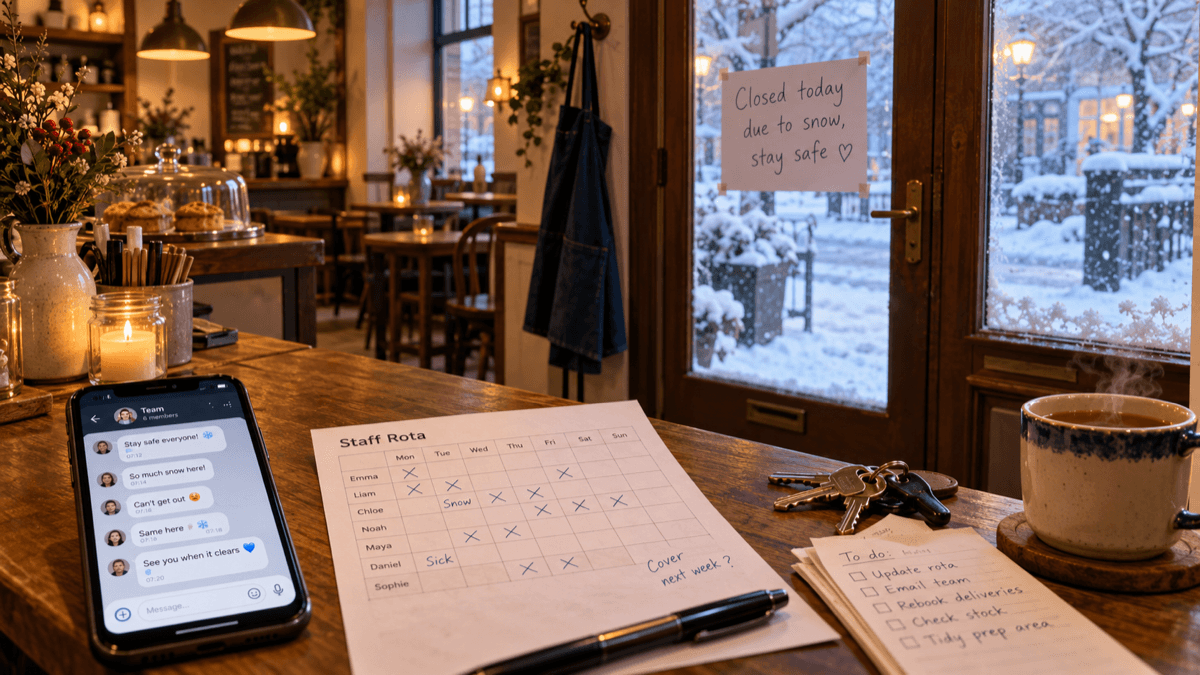
It's 5:40am and the snow came in overnight. Your phone has three messages already. One of the team can't get the car off the drive. Another says the bus isn't running. A third is outside the café, keys in hand, asking whether you're opening.
Somewhere in the next half hour you'll make a decision, and with it a promise about pay that you might not realise you've made.
Most of the confusion about snow days comes from mixing up two different situations. A team member who can't get in is one question. You deciding to close is another. The law treats them very differently, and so should your plan.
Situation one: you're open, they can't get in
If the café is open and someone can't make it in because of the weather, the starting point is that you don't have to pay them.
Acas puts it plainly: if there's nothing in the contract about pay in these circumstances, the employer isn't obliged to pay, because the employee is "not fulfilling their contract of employment." Getting to work is usually the employee's responsibility.
That's the legal floor, not the whole answer. Acas also suggests employers consider paying anyway, because it "could improve staff morale and help retain employees." In a small team, how you handle the first snow day of the winter gets remembered.
The options you actually have
- Unpaid. Perfectly lawful if the contract is silent. Say so clearly that morning, not on payday.
- Holiday, by agreement. Many people would rather use a day of holiday than lose a day's pay. Offer it; don't impose it (more on the notice rules below).
- Make the hours up. An extra shift next week, or a longer day when the roads clear. Agree it there and then and write it on the rota.
- Swap shifts. Someone who lives round the corner may happily take today in exchange for a later shift.
- Pay it anyway. Your call. If you do, Acas advises you "treat staff fairly and consistently" and confirm in writing that it won't set a precedent for next time.
Be consistent, whatever you choose
The trap here isn't the law, it's fairness. Pay the supervisor who couldn't get in but dock the part-timer, and you've created a grievance even if both decisions were lawful. Pick a rule, apply it to everyone, and write it down.
Don't push people to travel
Acas also reminds employers they have a duty of care, so they "should not encourage staff to travel when it's not safe." A message that reads like "everyone else made it in" to someone on an untreated country road is a bad idea for reasons that have nothing to do with pay.
When the schools shut
Snow often closes schools before it closes cafés, and suddenly a parent on your team has no childcare. Employees have a right to a reasonable amount of time off to deal with emergencies involving dependants, and GOV.UK's list includes disruption of care arrangements, such as when "a nursery closes unexpectedly". That time off doesn't have to be paid: GOV.UK says your employer "may pay you... but they do not have to." What you can't do is treat it as a disciplinary matter.
Situation two: you decide to close
This is the one that catches people out. Snow is the obvious example, but the same rules apply to a flood on the high street, a power cut, a burst pipe or a boiler that gives up in January. If you decide not to open, it's your decision, not theirs.
Acas is clear: if employees "were ready, willing and able to work for the day or shift", they're usually entitled to their normal pay if the employer chooses to fully or partly close, or tells them to work fewer hours. GOV.UK says the same from the other side: "You should get your full pay unless your contract allows unpaid or reduced pay lay-offs."
So the key question is what's in your contracts.
The lay-off clause
A lay-off clause lets you send staff home without work, unpaid or on reduced pay, when there isn't work for them. A short-time working clause lets you cut their hours. Acas says the contract must make it "completely clear in the contract when and how these circumstances apply."
Most small café contracts I've seen don't have one. If yours don't, a snow closure means normal pay for anyone who was rota'd and ready to work.
Statutory guarantee pay
If you do have a lay-off clause, there's still a legal minimum. Employees laid off without pay are entitled to statutory guarantee pay. GOV.UK sets out the rules:
- £41 a day maximum. The figure went up from £39 on 6 April 2026 under the Employment Rights (Increase of Limits) Order 2026.
- Up to 5 days in any 3-month period, so a maximum of £205. Someone who normally works fewer than five days a week gets fewer days.
- If they usually earn less than £41 a day, they get their normal daily rate instead.
- They must have been employed continuously for 1 month.
- No guarantee pay for a day they do some work, or if they unreasonably refuse suitable alternative work.
- Under section 30 of the Employment Rights Act 1996, it isn't payable where there are "no normal working hours on the day in question", which matters for casual staff (below).
Your own scheme can be more generous, but it can't be less than the statutory one. And not paying it, GOV.UK warns, counts as "an unlawful deduction from your wages."
How it goes wrong
Imagine a café, call it the Corner Café, that closes for two days in a cold snap. The owner sends a group message: "Shut today and tomorrow, stay safe, obviously no work means no pay." There's no lay-off clause in anyone's contract.
That message is the problem. Every employee who was rota'd and ready to work is owed their normal pay for both days. Holding it back is an unlawful deduction, and in a small team someone usually knows that. The owner ends up paying it anyway, a fortnight later, having also spent a fair bit of goodwill. The cheaper route was to know the answer before the snow arrived.
What a closed day actually costs
Here's an illustrative weekday rota for a café that closes for snow. Basic wages only, before employer NI and pension:
| Role | Hours | Rate | Normal pay |
|---|---|---|---|
| Supervisor | 8 | £14.00 | £112.00 |
| Barista | 8 | £13.20 | £105.60 |
| Barista | 7 | £12.71 | £88.97 |
| Kitchen | 7 | £13.50 | £94.50 |
| Part-timer | 3 | £12.71 | £38.13 |
| Total | 33 | £439.20 |
Without a lay-off clause: you owe the full £439.20, for a day with no takings.
With a valid lay-off clause: statutory guarantee pay is the lower of £41 or their normal day's pay. That's £41 each for the four longer shifts and £38.13 for the part-timer, so £202.13. The difference is £237.07.
That gap is real, but losing a good barista because you docked their pay over weather they didn't cause costs far more. And the lost takings are usually the bigger number anyway: on a £1,100 day at 68% gross profit, that's £748 of gross profit gone, whatever you pay the team.
The wage line on a closed day is simply whatever your pay grades add up to. If you're rethinking those grades before next April, I've written about keeping pay differentials when the minimum wage rises, and a snow day is a good reminder of what each grade costs you for an hour of nothing.
Closing partway through the day
The power goes at 11am. You can't make coffee, so you shut. The same rule applies: people who turned up ready to work are usually owed the rest of their shift unless the contract says otherwise.
What you can do is give them other reasonable work. A deep clean, a stock count, sorting the dry store, prepping for tomorrow if the fridges are holding temperature. It's paid time either way, so you may as well get the jobs done that never fit into a busy day.
Zero-hours and casual staff
For people with no guaranteed hours, the rules today are thinner.
Right now, there's no statutory right to be paid for a cancelled shift. Acas treats a clear cancellation policy (how much notice you'll give and whether you'll pay anything) as good practice, not a legal duty. And because statutory guarantee pay needs "normal working hours", someone on a genuinely casual contract usually won't qualify for that either. Check the contract, though: if it promises payment for cancelled shifts, that promise binds you.
None of that makes cancelling a shift at 6am painless for them. Someone who's arranged childcare or turned down other work is out of pocket either way. If they've already travelled in before you decide to close, paying the shift is the decent thing to do, and it's where the law is heading.
What's coming, with no date yet
The Employment Rights Act 2025 creates a right to payment when a shift is cancelled, moved or cut short at short notice, for zero-hours and low-hours workers. The government consulted over the summer on the details, and how much the payment will be and what counts as "short notice" will be set in regulations.
It is not in force this winter. The government's timeline has given no date for "the right to reasonable notice and payment for shifts cancelled or changed at short notice" since its 22 October update: its timing "will be updated following the consultation process", and "All future dates remain subject to parliamentary processes and may change."
So this winter, current rules apply. Once the right arrives, a snow day could cost a short-notice payment for every zero-hours shift you cancel that morning.
Can you make them take holiday?
Yes, but not at 6am on the day.
GOV.UK says employers can tell staff to take leave, but "The notice period for this is at least twice as long as the leave they want their staff to take." One day of holiday needs at least two days' notice. Your contract can set different terms, so check yours.
In practice:
- A same-day closure can't be turned into compulsory holiday. The notice isn't there. You can offer holiday, and some people will take it, but it has to be their choice.
- A forecast gives you options. If the Met Office is warning of heavy snow on Thursday and you tell the team on Monday that Thursday will be a holiday day if you close, the notice is there.
- Don't use it on the sick. GOV.UK is explicit that "an employer cannot force a sick worker to take leave."
Make the decision before the snow does
Most of the damage on a snow day comes from deciding everything at once, at 5:40am, on a phone. A one-page plan fixes most of it.
Write a bad-weather plan
- Who decides. You, or a named manager if you're not on. One person, so the team doesn't get three different answers.
- By when. Say 6am for an 8am opening. Late enough to see the roads, early enough that nobody has set off.
- What counts. Can at least two people get in safely? Will your key deliveries arrive? Is the heating working?
- How staff hear. The group chat, plus a phone call to anyone who doesn't check it. And say what happens to pay in the same message, so nobody has to ask.
- What gets recorded. Who was rota'd, who was ready to work, who couldn't get in, and what you paid. You'll want it when someone queries their payslip in February.
This is where having the rota and absence records in one place helps. We're building StaffBrik, coming soon, to keep the rota alongside a record of who was off and why, so a snow day is logged once rather than reconstructed from a chat thread at month end.
Tell customers properly
- Google Business Profile. Set special hours for the day, marked closed. As I covered in the post on winter opening hours, special hours are for exactly this kind of temporary change.
- Socials and the door. One post, and a sign on the glass for anyone who walks down anyway.
- Pre-orders and collections. Ring the people expecting a celebration cake today. They'll remember the call far longer than the snow.
Add a lay-off clause to new contracts
If you want the option of unpaid or reduced-pay lay-offs, it has to be in the contract, and it has to be clear. Get an HR adviser to draft it for new starters. Adding it to existing contracts is a change that needs each person's agreement, so treat it as a conversation, not a memo.
Will insurance pay for a closed day?
Usually not, if the only problem is weather.
Business interruption cover is normally triggered by damage. The ABI lists the typical trigger as "Damage caused to your premises or equipment by a named peril such as fire, storm or flooding." Snow on the road outside, with nothing damaged, generally isn't that.
Where it can help:
- A burst pipe or flood that damages the café. That's damage from a named peril, and business interruption may cover lost profit and wages while you're shut. Tell your insurer straight away.
- Restricted access cover. The ABI says some policies cover "people not being able to access the business due to specific circumstances", such as a police cordon. It's "usually an add on to a standard policy that can cost more", and the wording matters.
- Utilities failure. Some policies extend cover to a supply failure, but wordings often exclude weather unless equipment is damaged.
The only way to know is to read your own policy wording, or ask your broker one plain question: "If I close for two days because of snow and nothing is damaged, am I covered?" Then get the answer in writing.
The takeaway
Two questions, two answers:
- You're open, they can't get in: no automatic right to pay unless the contract says so. Offer holiday, swapped shifts or made-up hours, or pay anyway, and treat everyone the same.
- You decide to close: staff who were ready, willing and able to work are usually owed normal pay, unless the contract has a clear lay-off clause. Even then, statutory guarantee pay of up to £41 a day applies.
- Zero-hours shifts: no legal right to pay for a cancelled shift today. Short-notice payments are coming, with no date set yet, so start building the habit now.
- Holiday needs notice: twice the length of the leave. Not usable for a same-morning closure.
- Write the plan now: who decides, by when, how staff and customers hear, and what gets recorded.
- Ask your broker the snow question before you need the answer.
The snow will arrive on a morning you haven't planned for. The pay decision doesn't have to.
Ed O'Brien has run Hunters Cake Company for 17 years across cafés in Witney, Burford, and a bakery in Carterton, Oxfordshire. He's building Brikly - modular tools that give independent café owners the same data the big chains have, without the big chain price tag.