
The clocks go back on 25 October: should your café shorten its winter hours?
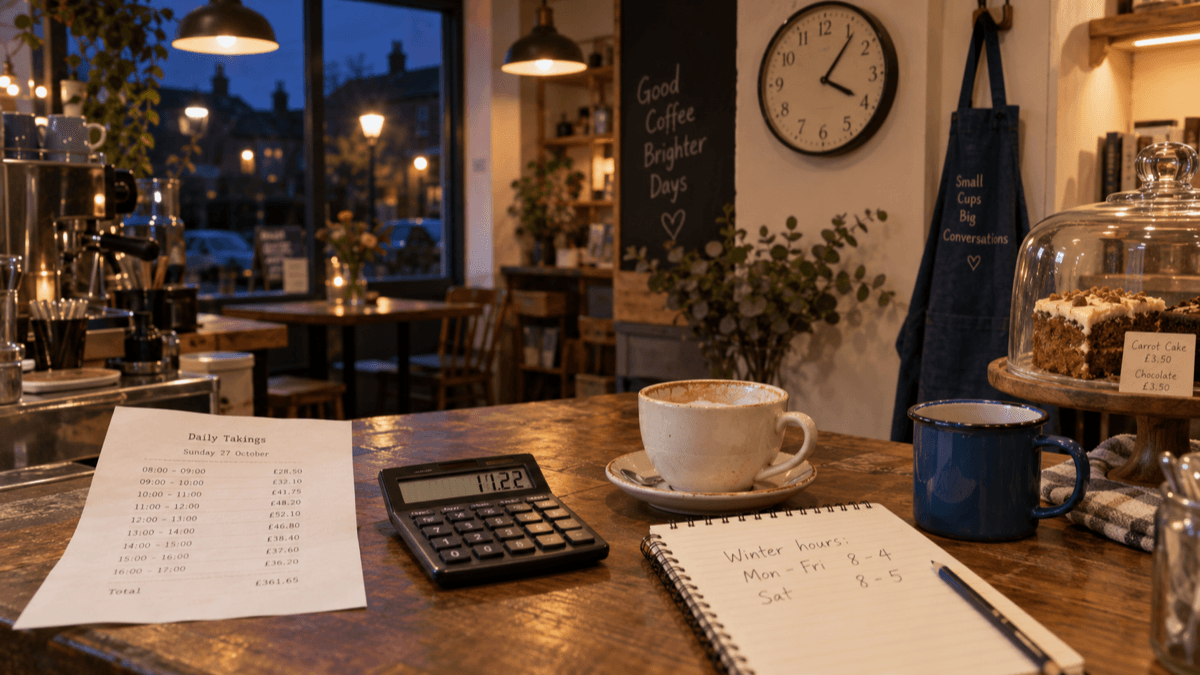
On Saturday 24 October it will be light in Oxfordshire until nearly six. On Sunday it will be dark before five. GOV.UK puts it plainly: the clocks go "back 1 hour at 2am on the last Sunday in October", which this year is the 25th.
Your café doesn't change overnight, but your customers do. The school-run parents stop coming once it's dark on the walk home, and the walkers and day-trippers thin out. By mid-December the sun sets just before four, and that last hour before you close starts to feel very long.
So every year, around now, the same question comes up: should we shorten our winter hours? It deserves better than a gut feel on a quiet Tuesday.
Start with last winter, not this week
The mistake is to judge winter hours on how October feels. October is still half summer. The number you want is what the last hour actually took last November to February, set against what it takes now.
Your till already has it. Every transaction is time-stamped, so pull two reports for the hour you're thinking of cutting, usually the one before you close:
- Last winter: average takings for that hour, by day of the week, 1 November to the end of February.
- Now: the same hour for the last four to six weeks.
Do it by day of the week: a Saturday last hour and a Tuesday last hour are different animals.
I've written separately about whether the extra opening hour actually pays, with the full method: takings, times the gross profit margin for what sells in that hour, minus the true cost of whoever is on. I won't redo it here. What's different in winter is that the takings line drops while the wage line stays put, and the heating and lights come on earlier.
A worked example: the 4-5pm hour
Take a café open 8am to 5pm, two on the floor until close, then half an hour of close-down. The till says the 4-5pm hour looks like this, ex VAT:
| Now (October) | Last winter (weekdays) | |
|---|---|---|
| Average takings | £58 | £36 |
| Blended GP (cake and tea heavy) | 64% | 64% |
| Gross profit | £37.12 | £23.04 |
Now the cost of keeping that hour. Two people at a fully loaded £15.93 an hour (the National Living Wage of £12.71 plus holiday, employer NI and pension) is £31.86. Add the lights, heating and the coffee machine held at temperature: say 9kWh at 27p, which is about £2.40 (use the unit rate from your own bill).
| Now | Last winter | |
|---|---|---|
| Gross profit | £37.12 | £23.04 |
| Wages, two people | £31.86 | £31.86 |
| Energy | £2.40 | £2.40 |
| Left over | +£2.86 | -£11.22 |
In October the hour just about washes its face. On a winter weekday it loses £11.22, every day it runs. Across about 17 trading weeks of five weekdays, once you allow for Christmas, that's £954 for the privilege of being open an extra hour in the dark.
Three things to watch before you act on that figure.
Not all of that trade disappears
If you close at four, some of the 4pm customers simply come at half three instead. If a third of that £36 moves earlier, you only lose about £15 of gross profit, not £23, and closing looks better still. But a regular who can't make it before four may stop coming at all, including on the days they'd have come earlier. Be honest about which kind of customer that last hour serves.
Close-down time doesn't shrink
Close at four instead of five and the team still needs half an hour to clean down. You save the trading hour, not the close. And if your team does slow cleaning jobs during a dead last hour, closing earlier pushes that work back into paid close-down time.
Energy is real but small
The energy line is rarely what decides it. If your bill is the bigger worry this winter, the post on cutting café energy costs has the practical steps. On these numbers, wages are more than nine-tenths of the cost of the hour, which is where the decision really lives.
Options short of closing
Closing an hour earlier is the bluntest tool. Often something smaller works better.
Restaff the hour instead
Run the winter example again with one person on from four o'clock: £23.04 gross profit, minus £15.93 wages, minus £2.40 energy, leaves +£4.71. The hour pays, modestly, and the regulars still find you open. The second person leaves at four, or comes in later in the morning. Shaping the rota to when people actually turn up is the subject of demand-based rotas that protect your wage percentage, and winter is when it pays most.
Lone working at close needs thinking about: cash handling, locking up alone in the dark, and whether one person can serve and clean down safely. If the honest answer is no, that's a reason to close earlier rather than run two people for £36.
Shorten one end only
Dark mornings and dark afternoons don't behave the same. Morning trade is often people on their way to work, who come whatever the light; afternoon trade is more often people out by choice, who go home when it gets dark. Check both ends, but don't assume both need trimming.
Weekdays and weekends can differ
There's no rule that says every day keeps the same hours. Plenty of cafés run 8 to 4 on winter weekdays and keep 5pm on Saturdays, because that's when the till says the afternoon still pays. One extra line on the door sign is a small price for keeping the best hour of the week.
Shut the kitchen before the counter
If you serve hot food, the kitchen is usually the expensive part of the late afternoon: a cook on a higher rate, the grill and oven on, and a deep clean waiting. Say the kitchen sells four toasties after half two on a winter weekday, about £26 ex VAT at 62%, or £16 of gross profit. That doesn't cover the cook's hour, let alone the grill. Stop hot food at half two, keep the counter open for coffee and cake until close, and the cook finishes and cleans down while it's still light.
Treat December as its own month
Winter isn't one season. In many high streets November is quiet, December is busy with shoppers and parties, and January and February are the dead weeks. Your till will tell you whether December deserves summer hours and January deserves the shortest ones. It's fine to run three patterns across the winter if the numbers say so.
The staff side: who you can ask, and who you must agree with
Shorter hours means fewer paid hours for somebody. How you handle that depends on what's in each person's contract.
Contracted hours: you need agreement
If someone is employed on, say, 30 guaranteed hours a week, you can't simply give them 25 because it's winter. GOV.UK is direct: "You must get an employee's agreement if you want to make changes to their contract." Acas says the same, with the one exception: "unless there's a clause in the contract that allows you to make a change without agreement."
Even a flexibility clause isn't a free pass. Acas warns that "Employers must only use flexibility clauses to make changes that are reasonable", and that you could still be in breach if you "fail to inform and consult about any proposed change" or "do not give reasonable notice for changes", "even if there's a flexibility clause that seems to allow the change."
So the practical route is a conversation, not a notice:
- Explain the numbers. Show the person the winter last-hour figures. Most people understand a till report.
- Ask before you assume. A student with exams, or a parent who'd rather finish before dark, may welcome fewer winter hours. Someone saving for Christmas won't.
- Look for other hours first. A contracted person's hours can sometimes move rather than shrink: an earlier start, prep for the next day, a weekend shift.
- If you agree a change, put it in writing. GOV.UK says employers must "write to their employees within a month to tell them exactly what has changed". Say whether it's for this winter only, with a date it reverts.
Imposing a cut without agreement risks claims for breach of contract or constructive dismissal, which Acas lists among the risks of changing contracts.
Fire and rehire gets much harder in January
Dismissing someone and offering them their job back on fewer hours was always a last resort. Under the Employment Rights Act 2025, a dismissal to impose "a variation of the number of hours which an employee is required to work" becomes automatically unfair unless the business faces financial difficulties threatening it as a going concern and genuinely couldn't avoid the change. The government's timeline lists "fire and rehire protections" among the measures taking effect in January 2027, so it bites partway through this winter. Seasonal hours are not that kind of crisis. Agree the change, or don't make it.
Zero-hours and variable-hours staff
For people with no guaranteed hours, you can legally offer fewer shifts today. That doesn't make it painless for them, especially going into December, so give as much notice as you can and tell everyone at the same time, rather than letting the rota quietly thin out.
The rules here are changing too, but not yet. The government's timeline lists "the right to guaranteed hours and the right to reasonable notice and short notice payments" under measures taking effect in 2027, with "timings will be updated after consultation", and adds that "All future dates remain subject to parliamentary processes and may change." None of it is in force this winter, which matters if you close the café for snow and cancel shifts. It's still worth getting into the habit now: rota published well ahead, shifts not cancelled the night before, and a record of how often hours change.
StaffBrik keeps the rotas and each person's true cost of employment in one place, which makes it quicker to price a winter rota against the summer one before you put it on the wall.
Telling customers, in the right order
The worst outcome is a regular turning up at 4:15 to a locked door because Google still says five.
Decide the date, then give notice. You don't have to change hours on 25 October. A start date a week or two later, with notice, is better than a surprise.
Google Business Profile: change your regular hours. Google's special hours are for when a business "temporarily adjusts its hours of operation or remains closed for up to six days in a row", such as holidays. A whole winter is a change to your regular hours, so edit those. Keep special hours for Christmas and New Year.
Your website, the same day. Google's help page on suggested edits says that if you don't respond within four days to one needing review, "Google may automatically publish the update if it is supported by other publicly available information, such as your business website." A website still showing summer hours is exactly the kind of thing you don't want backing someone's edit.
The door, at least two weeks ahead. A printed sign in the window, "Winter hours from Monday 2 November", is what most regulars will actually see. Put it at eye level, not taped low on the glass.
Socials and the till. One post, and one line at the till for regulars: "We're closing at four from November." People are reasonable about winter hours when they're told, less so when they find out from a locked door.
Put the review in the diary now
Winter hours that never get reviewed become permanent hours. Pick a date in mid-February and write it down.
On that date, pull the same reports again: the hour you cut, the hours either side, and whole-day takings against last winter. Did the trade move earlier, or did it leave? Did the shorter day hold its gross profit? Then decide when summer hours come back. The clocks go forward on 28 March 2027, and late March is the natural point, with the same notice to staff and the same Google, website and door routine in reverse.
The takeaway
The clocks going back is a good prompt, not a deadline. Before 25 October:
- Pull last winter's takings for your first and last hours, by day of the week, November to February.
- Run the hour honestly: gross profit, minus the loaded wages of whoever's on, minus heating and lights.
- Try the smaller fixes first: one person instead of two, kitchen closing before the counter, different weekday and weekend hours.
- Talk to the team before the rota changes. Contracted hours need agreement and a letter within a month; zero-hours staff deserve proper notice.
- Change Google, your website and the door sign together, two weeks ahead.
- Review it in February with the same reports.
An hour that took £58 in October and £36 in January is not the same hour. Treat it on its winter numbers, and decide.
Ed O'Brien has run Hunters Cake Company for 17 years across cafés in Witney, Burford, and a bakery in Carterton, Oxfordshire. He's building Brikly - modular tools that give independent café owners the same data the big chains have, without the big chain price tag.