
Christmas pre-orders: deposits, VAT and the cash flow you can bank in September
Almost everything about December happens to you. The weather, the walk-in trade, whether it snows on your biggest Saturday. You cannot forecast any of it.
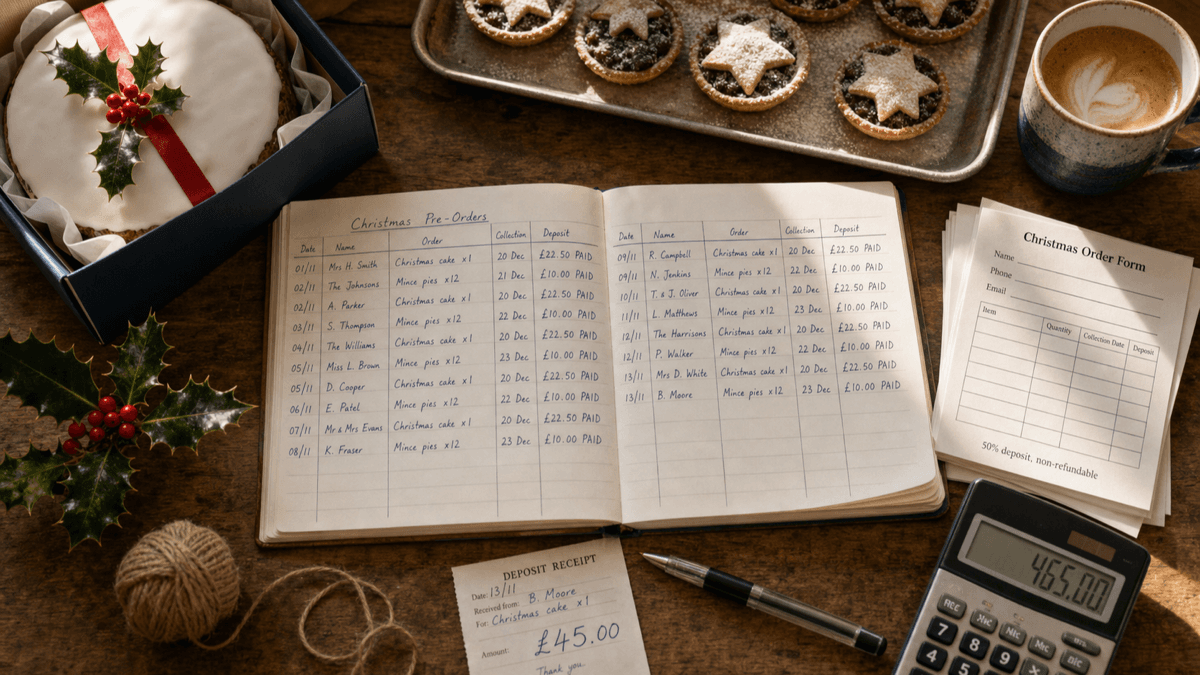
The pre-order book is the exception. Customers tell you what they want and hand you money for it before you have bought a single kilo of butter. And the timing works in your favour: orders taken in September turn into cash in October and November, which is exactly when independents are at their thinnest.
Open the book earlier than feels sensible
The instinct is to start in November, when it feels Christmassy. That is too late twice over. The people who order Christmas cakes are organised and have decided by early November where they are getting one. And a November order gives you a November deposit, by which point the difficult months have already happened.
I open the book in the last week of September. It feels absurd when it is 19 degrees outside. It works anyway, because the customer taking a form off the counter is not buying a cake that day, she is ticking something off a list she is already worrying about.
If you did the groundwork in the summer, this is where it pays out. The point of thinking about Christmas in July was never the decorations. It was so that the September version of you has a list and a price and can open the book.
Keep the list short and the dates hard
A pre-order list should fit on one side of A5.
- Christmas cake, iced or un-iced
- Mince pies, boxed by the dozen or half dozen, priced from a costing that counts the mincemeat, the offcuts and the box
- Yule log, one flavour
- A hamper, one build, one price
- Office catering, one platter spec, priced per head
Five lines. Every extra option doubles your production planning and halves the chance the sheet gets filled in correctly.
Then print hard cut-off dates. Cakes and hampers close in the first week of December because they need the time. Mince pies and logs close about a week out. Office catering closes earliest, because that is the one where somebody rings you on the 18th asking for 40 covers on the 19th.
Deposits are the entire point
An order without money attached is a hope. An order with 50% paid is a forecast.
I take a deposit at the point of order and make it non-refundable, printed on the form in plain English. Between 25% and 50% works: higher on big-ticket and bespoke items, lower on a box of mince pies where the admin outweighs the risk. The cash arrives when you need it, and the no-show rate collapses. People who have paid £22 towards a cake turn up for the cake, the same way a deposit on a table stops a party of twelve quietly evaporating.
That rule catches people out every year, because it feels like the sale has not happened yet. As far as the return is concerned, part of it has.
What rate applies to what
Most of a bakery Christmas book is mercifully simple, and then one line ruins it.
A Christmas cake sold cold to take away is zero-rated. So are mince pies and a yule log, on the ordinary rules for cold takeaway bakery. That is the bulk of the book and it needs no VAT thought at all. Catering you deliver and serve hot is standard-rated, so if office platters are a meaningful line, price them knowing that.
Hampers are where it gets fiddly, because a hamper is several supplies in one box: a cake, a jar of chutney, some biscuits. Mixed contents at different rates follow mixed-supply rules, and the answer depends on what is in the box. Small line, keep the contents simple. Big line, get it checked properly. The guide to VAT on food and drink for UK cafés covers the eat-in and takeaway logic underneath all of this.
Write the non-collection policy before you need it
Every year a handful of orders are never collected. Usually three or four in a hundred, occasionally a whole office order because the person who booked it left the company. Decide the rules in September, print them on the form, and you never have an awkward conversation in December:
- The deposit is non-refundable if the order is not collected.
- Orders are held until close on Christmas Eve, then released.
- Anything released goes to counter sale between Christmas and New Year, or into the freezer.
Think that through by product. An iced Christmas cake keeps and sells fine on the 28th. A yule log will not. Take more up front on the things you cannot resell.
The book is your production plan and your buying list
Once orders come in, stop treating the sheet as admin and start treating it as the schedule. By mid-October you can see the shape: how many cakes, roughly how many dozen mince pies, how much fruit needs soaking and when.
So you can batch properly. Cakes get made in two or three runs rather than nightly panic, and anything freezer-friendly gets made in the quiet weeks rather than the mad ones.
And you can buy early. Dried fruit, butter, chocolate and nuts all get tighter and dearer as the trade buys into Christmas. If your book tells you in October that you need a fixed quantity, you can order it at October prices rather than at whatever December's turn out to be.
Price from a real cost, not last year plus a bit
The default is to take last year's price, add whatever feels right, and print it. That works until one ingredient moves hard and quietly takes the margin with it.
Cost the Christmas cake properly, once, in September. Every ingredient at current invoice prices, plus the box, the ribbon, the cake board and the icing. It is an hour, and you are setting a price you will hold across every order in the book for three months.
Two things get left out and should not: packaging, which on a boxed and ribboned cake is not trivial, and your own labour on the decorating. Skip the labour because it is you doing it and you have quietly decided your time is free, then wondered why December was busy and unprofitable.
This is the job CostingBrik exists for, holding the current invoice price for every ingredient rather than the one you typed in last December. A notebook does it too. The failure mode is not the tool.
The order sheet itself
Keep it dull. Paper on the counter is still the best converter, because it catches the customer at the point they are thinking about it. A Google Form covers the people who ask on Instagram. A pre-order link on your POS gets the deposit into the same system as everything else. Capture six fields: name, phone, item, quantity, collection date, deposit paid. Anything more and people abandon it halfway.
One caution. A gift voucher and a pre-order deposit are not the same thing and should not sit in the same pot, even though both are money now for goods later. Gift cards carry their own cash flow and margin quirks, including breakage. Keep them separate from day one.
What £3,000 of deposits actually does
Say your book closes October with this in it:
| Line | Orders | Price | Value |
|---|---|---|---|
| Christmas cake | 60 | £45 | £2,700 |
| Mince pies, box of six | 75 | £12 | £900 |
| Yule log | 25 | £28 | £700 |
| Hamper | 20 | £48 | £960 |
| Office buffet | 4 | £185 | £740 |
| Total | £6,000 |
At a 50% deposit, £3,000 lands in October. The balance comes in across December as people collect.
Set that against the autumn. The Michaelmas quarter day falls on 29 September, so for a lot of operators a quarter's rent has just gone out. £3,000 arriving in October is not profit, but it is the difference between covering that comfortably and going into December on an overdraft.
There is a discipline that comes with it. That £3,000 is partly other people's cake. Roughly a third goes straight back out as ingredients, and you have committed to producing £6,000 of goods. Spending it as free money is how a good pre-order book turns into a January problem.
So put it in the forecast properly. In a 13-week cash flow forecast, the deposits go in as a receipt in the week they land and the ingredient buy as a payment in the week you order. Done that way, the book stops being a nice surprise and becomes the thing that flattens the September cash flow squeeze that hits independents every autumn.
Do this week
Write the list. Five lines, one price each, two cut-off dates. Print fifty order forms with the deposit terms and the non-collection policy on the bottom, and get them on the counter before the end of September.
You do not need the website updated or the Instagram plan written. You need a piece of paper on the counter while people are still in the habit of walking past it.
The cake gets made either way. The question is whether it is paid for in September or panicked over in December.
Ed O'Brien has run Hunters Cake Company for 17 years across cafés in Witney, Burford, and a bakery in Carterton, Oxfordshire. He's building Brikly - modular tools that give independent café owners the same data the big chains have, without the big chain price tag.