
Coffee prices in 2026: protecting your espresso margins
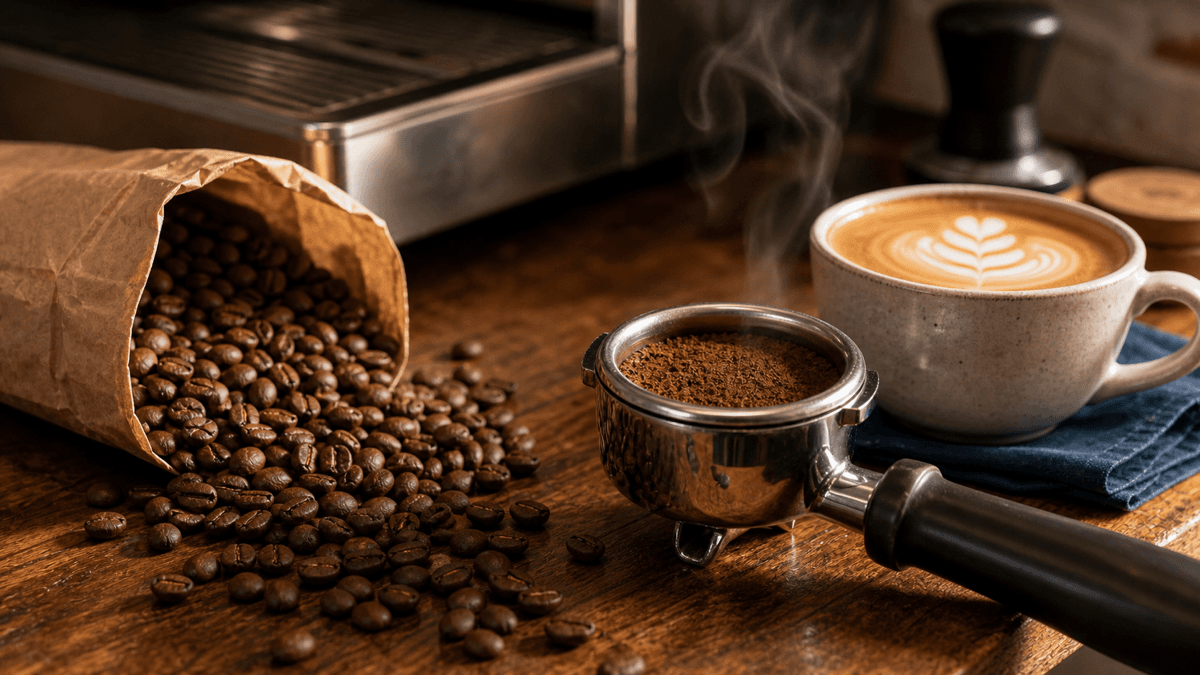
Coffee is the one ingredient a café can't reformulate its way out of. You can swap the chocolate in a cookie. You can't swap the coffee in a flat white. It's your signature, it's most of your covers, and right now it's costing you more than it did a year ago.
Green bean prices have climbed steeply since 2024 and stayed well above the levels most of us planned our menus around. If you costed your espresso menu when beans were cheaper and haven't touched it since, the maths has quietly drifted against you on the drink you sell most.
This is the practical version of the conversation: what happened, what a bean increase actually does per cup, and the levers to reach for before the price gun.
What's happened to green coffee
Two paragraphs of context, then we get to your menu.
The raw material here is green (unroasted) coffee, traded as two main types: arabica and robusta. Both came under real pressure from 2024 onwards. Poor harvests in Brazil and Vietnam, the two giants of supply, collided with climate stress and steady global demand. Robusta in particular hit record highs, and arabica followed it up. Prices have eased and wobbled since, but they've stayed well above any historic norm you'd have built a price list around.
Your roaster buys green, roasts it, and sells you the finished bag. When green climbs, their wholesale price climbs too, with a lag. And like most input costs, it's sticky on the way up and reluctant on the way down. Don't wait for the commodity charts to "normalise" before you act. Work with the price on the invoice in front of you. The same pattern played out with how cocoa prices hit chocolate margins earlier this year, and coffee is following the same script.
What a bean rise actually does to a flat white
This is where it gets real, and where most operators are surprised. Let's trace it from the bag down to the cup.
Say your beans cost £18/kg wholesale. A double shot uses roughly 18g of ground coffee (two 9g doses, or thereabouts depending on your basket). That's about 56 doubles per kilo, so your coffee cost per drink is roughly 32p.
Now your roaster pushes through a 15-20% increase. Those same beans are now around £21.50/kg. Your coffee cost per double climbs to about 38p. That's a 6p jump per cup. On its own it sounds trivial.
It isn't. If you sell 150 milk coffees a day, six days a week, that 6p is around £280 a month straight off the bottom line, on the coffee alone. Multiply across a year and it's the price of a small piece of equipment, gone, quietly, one cup at a time.
And coffee is only part of a flat white's cost. There's the milk, the cup, the lid, the energy, the labour. We broke the full picture down in the real cost of a flat white, and it's worth a read before you decide the bean rise is the whole story. Often it isn't.
The levers, in the right order
Here's the bit that matters. Most operators jump straight to "put the price up". That's a lever, but it's the last one, not the first. Work through these in order.
1. Dial in your dose and yield
Before you change a single price, find out how much coffee you're actually putting in the cup.
Over-dosing is the most common and most invisible leak in a café. A barista who pulls at 19g instead of 18g, or grinds a touch heavy "to be safe", is throwing away a percent or two of every kilo. Across a busy week that's real money, and it's money you're spending to make the coffee slightly worse, not better.
- Weigh your dose. Set a target (say 18g for a double) and check baskets against it during service, not just at calibration.
- Weigh your yield. Inconsistent shots mean inconsistent extraction, wasted retries, and dumped drinks.
- Train the team on it once, then make it routine. This is the same discipline as tightening dose and portion consistency on your food, applied to the grinder.
Tighten this and you can often absorb a chunk of a bean increase without touching the menu at all.
2. Review your roaster contract
You have more standing here than you think, even at indie volume, particularly if you chose your roaster as a partnership rather than a price-per-kilo shootout in the first place - that relationship is exactly what gives you room to talk when the rate moves.
- Talk to your roaster directly. A good one would rather hold a loyal café than chase a new one. Ask what their best rate looks like on a committed monthly volume.
- Ask about the house blend versus the single-origin you might be running by default. The seasonal espresso blend is usually priced more keenly than a flashy single-origin, and for milk drinks most customers can't tell.
- Check the increase is real. Ask what's driven it and by how much. A vague "everything's gone up" is worth pushing back on.
The principles in negotiating supplier price increases apply directly to your roaster, and coffee is exactly the kind of recurring, high-volume line where a small rate improvement compounds fast.
3. Consider a second supplier for leverage
You don't have to switch roasters to benefit from having a choice.
Carrying a credible second option, even just sampling and pricing one, gives you a real comparison every time your primary roaster moves their price. It's a hedge, and it quietly gives your main supplier a reason to keep you happy. Plenty of cafés run a primary house bean and a rotating guest from a second roaster, which doubles as a point of interest on the counter.
4. Audit milk, cups and lids too
While you've got the bonnet up, look at the rest of the cup.
Milk is your second-biggest coffee input and it's had its own inflation story. Cups and lids have crept up with packaging costs. None of these need a customer-facing change to fix. Check you're on the right milk contract, that you're not over-pouring on steaming, and that you're not buying branded cups when an unbranded equivalent does the job.
5. Then, and only then, a measured price rise
If you've done the above and the margin still isn't where it needs to be, raise the price. Carefully.
A flat white going from £3.40 to £3.60 is a non-event for almost every regular, if the product is good and the move is clean. Do it as part of a tidy menu refresh, not a sticker over the old number. Round to sensible figures. And remember coffee is your hero product, so protect the quality through all of this. A cheaper, thinner flat white at the same price is the one change customers genuinely notice and resent.
Build the early-warning system
Here's the thing about a coffee spike: there'll be another one, and after that it'll be dairy, or oils, or something else. The operators who got hurt in 2024 mostly got hurt because nothing flagged the drift until they did a painful manual recost months later.
This is the gap CostingBrik closes. When a new invoice comes in, your bean price updates automatically and every coffee-based recipe recosts in the background, so margin drift on your flat white, latte and mocha surfaces the week it happens rather than the quarter after. It's the same discipline behind solid recipe costing for UK cafés: know your real cost today, not the one you remember from last year.
The takeaway
- Green coffee has climbed steeply since 2024 and stayed well above old norms. Plan around it, don't wait it out - though as we covered when coffee hit an 18-month low in June 2026, the price does eventually turn, and the operators who track their real cost per kilo are the ones who actually capture the relief. And as June's floods in Sumatra showed, a fall on the futures board can be quietly undone by weather on the other side of the world, so keep watching your real cost either way - that low lasted barely three weeks before rain in Brazil handed arabica its biggest one-day jump since 2022, and within a month of that the exchange's stock cushion had thinned by a further fifth.
- A 15-20% bean rise is only a few pence per cup, but across hundreds of cups a week it's real money off your bottom line.
- Pull the levers in order: dose and yield first, then your roaster contract, a second supplier, milk and cups, and a price rise last.
- Over-dosing is the most common hidden leak. Weigh your shots before you blame the bean.
- Coffee is your signature product. Protect the quality through every change you make.
- Build a system that catches the next rise the week it lands, because there will be a next one.
Spend an hour on your espresso menu this week. Start with the grinder, not the price list.
Ed O'Brien has run Hunters Cake Company for 17 years across cafés in Witney, Burford, and a bakery in Carterton, Oxfordshire. He's building Brikly - modular tools that give independent café owners the same data the big chains have, without the big chain price tag.