
Portion control: the margin leak hiding in plain sight
Your recipe card says the brie and bacon sandwich costs you £1.80 to make. Your menu price gives you a tidy 30% food cost on paper. Then the month closes, the invoices land, and your actual food cost comes back at 38%.
You check for theft. Nothing. You check the supplier prices. They've crept up a bit, but not eight points' worth. So where did the margin go?
Most of the time, it didn't go anywhere dramatic. It walked out the door a few grams at a time, on every plate, on every coffee, multiplied by a few thousand covers a month. That's portion drift, and it's the quietest margin leak in hospitality.
Why this leak is invisible
A till that's £40 short gets noticed. A delivery that's missing a case gets noticed. But ten extra grams of cheese on a sandwich? Nobody clocks it. It doesn't show up as a single loss you can point at. It shows up as a slow, structural gap between what your recipes say you spend and what you actually spend.
That gap is the whole game. Your theoretical food cost is the number you priced the menu around. Your actual food cost is what the invoices and the stocktake prove. When they diverge with no theft and stable prices, portioning is almost always the cause.
The maths is unkind because of volume. Say your sandwich spec calls for 40g of cheese, but the kitchen routinely lays on 50g. That's 10g extra, costing maybe 8p. Trivial. Now sell 300 of them a week. That's £24 a week, £1,250 a year, on one ingredient, on one product. Stack that across every sandwich fill, every traybake cut and every flat white, and the eight-point gap stops looking mysterious.
The usual offenders
Portion drift loves anything you can't see being measured. The worst culprits in a typical café:
- Free-poured milk. The single biggest one behind the machine. A barista who pours by eye fills the jug "to be safe" and tips the excess down the sink all day. On a busy bar that's litres of milk binned weekly, which is exactly why it pays to be deliberate about protecting espresso margins as bean prices rise.
- Free-poured syrups and sauces. A glug of vanilla that's really two pumps' worth. Mayo squeezed straight from the bottle. These feel like nothing per serve and add up to real money.
- Eyeballed scoops. Ice cream, tuna mayo, coleslaw, salad. A generous heaped scoop versus a level one can be 30% more product every single time.
- The "go on, make it a good one" build. Staff being kind. An extra rasher, a fuller sandwich, a heavier handful of chips for a regular. Lovely for the customer, quietly expensive for you.
- Oversized traybake and cake cuts. Cut a tray into 11 pieces instead of 12 and you've given away over 8% of every tray, forever.
- Inconsistent sandwich and salad fills. No spec means every team member builds it differently, so your cost per unit is a guess, not a number.
It's not about being mean
Let's be clear, because this is where good operators get it wrong. Portion control is not about shaving the customer or sending out a sad, stingy plate. A mean portion is a one-star review and a customer who doesn't come back. That costs you far more than the cheese ever would.
It's about consistency. It's about costing the portion you actually intended to sell, and then selling that portion every time. If your sandwich is meant to be generous, brilliant, build it generous and cost it generous. The problem isn't a big portion. The problem is a portion that's 40g one day and 55g the next, so you never actually know your margin and your customer never gets the same thing twice.
Decide what the portion is. Cost that. Serve that. That's the whole discipline.
The cheap fixes
The good news is that fixing portion drift costs very little and pays back almost immediately. None of this needs a consultant.
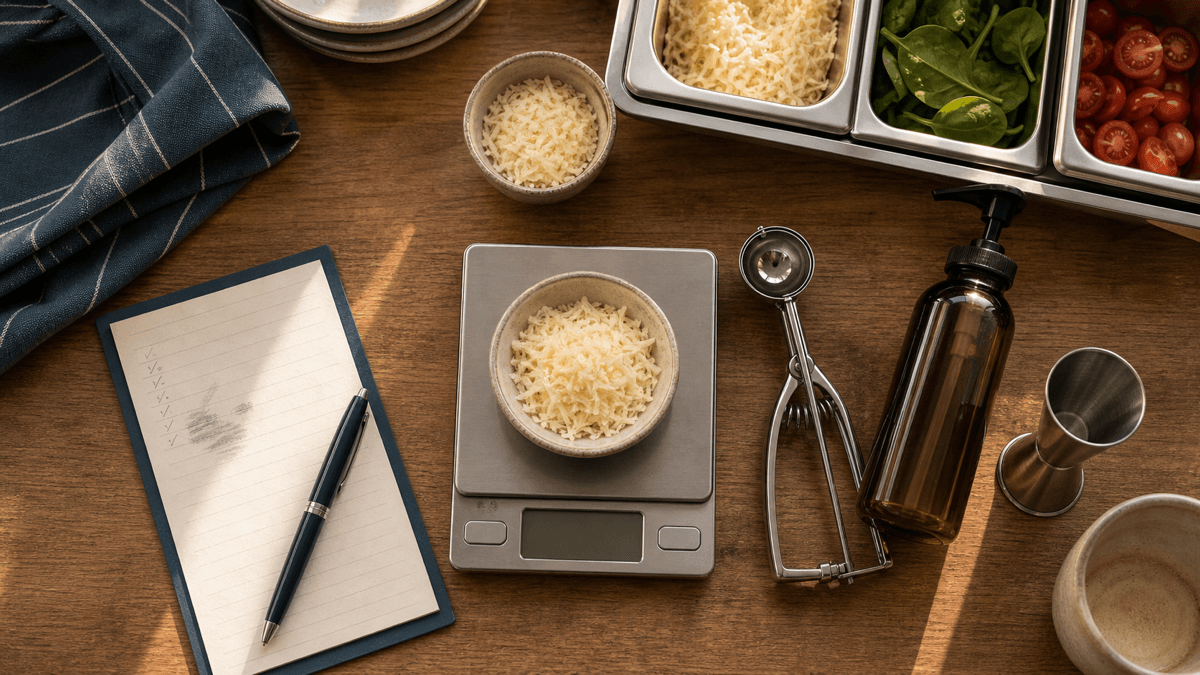
- Portion scoops and spoodles. A colour-coded scoop for each filling turns "a generous heap" into a repeatable, costed amount. The cheapest margin tool in the building.
- Jiggers and pumps for liquids. Syrup pump tops deliver a fixed shot. A jigger or a marked jug standardises milk and sauces. Pour to the line, not to the feeling.
- A set of scales on the prep bench. Not to weigh every plate to the gram on service, but to calibrate the team. Weigh a few builds, show people what 40g of cheese actually looks like, and their eye recalibrates fast.
- Pre-portioning. Portion cheese, meat and high-value fillings into labelled bags during prep. The build becomes "one bag", which is impossible to over-serve and faster on service too.
- Photo build cards. A laminated card by the pass showing exactly what each item should look like, with the spec weights listed. New starters get it instantly, and there's no debate about "how much".
- A quick weigh-check routine. Once a week, weigh a couple of finished builds against spec. Two minutes. It tells you whether your portions are still honest before the stocktake does.
Closing the loop
Tools and training only stick if you measure whether they worked. That means comparing your theoretical cost against your actual cost on a regular cycle, the same way you'd investigate any stocktake variance.
This is where a proper spec earns its keep. If you've built accurate recipe cards, you know your theoretical food cost to the penny. CostingBrik gives you that theoretical cost per portion automatically from your live ingredient prices, so the only number left to find is what you actually spent. When the two drift apart, you've found your leak, and you can usually name the dish.
If you haven't costed your dishes properly yet, that's the place to start. Our guides on recipe costing for UK cafés and how to calculate food cost percentage walk through the whole thing.
A worked example
Take a café doing £60k of food COGS a year, running a theoretical 30% food cost but an actual 36%. That six-point gap is roughly £10,000 a year of margin, most of it portion drift rather than theft.
Say you tackle it with scoops, pumps, a couple of build cards and a weekly weigh-check. You don't fix everything, you're not aiming for perfect. You close the gap from six points to two.
That's four points of food cost recovered. On £60k of COGS, that's about £6,600 a year back in your pocket, for the price of a few bits of kit and ten minutes of training a week. No price rise, no new customers, no harder work. Just serving the portion you already decided to sell.
The takeaway
- Your actual food cost can drift well above your recipe's theoretical cost with zero theft. Inconsistent portioning is usually why.
- The leak is invisible because it's a few grams per plate, multiplied by thousands of covers, never one big loss.
- The worst offenders are free-poured milk, syrups and sauces, eyeballed scoops, generous one-off builds and oversized cake cuts.
- It's not about being mean. It's about deciding the portion, costing that portion, and serving it consistently every time.
- The fixes are cheap: scoops, jiggers and pumps, prep-bench scales, pre-portioning, photo build cards and a weekly weigh-check.
- Staff over-portion out of kindness, speed or simply having no spec to follow. Give them the spec and the tools, not a telling-off.
- Close the loop by comparing theoretical cost against actual spend regularly. A four-point recovery on a typical café is several thousand pounds a year.
Ed O'Brien has run Hunters Cake Company for 17 years across cafés in Witney, Burford, and a bakery in Carterton, Oxfordshire. He's building Brikly - modular tools that give independent café owners the same data the big chains have, without the big chain price tag.