
The cold latte and the hair in the sandwich: complaints, refunds and remakes
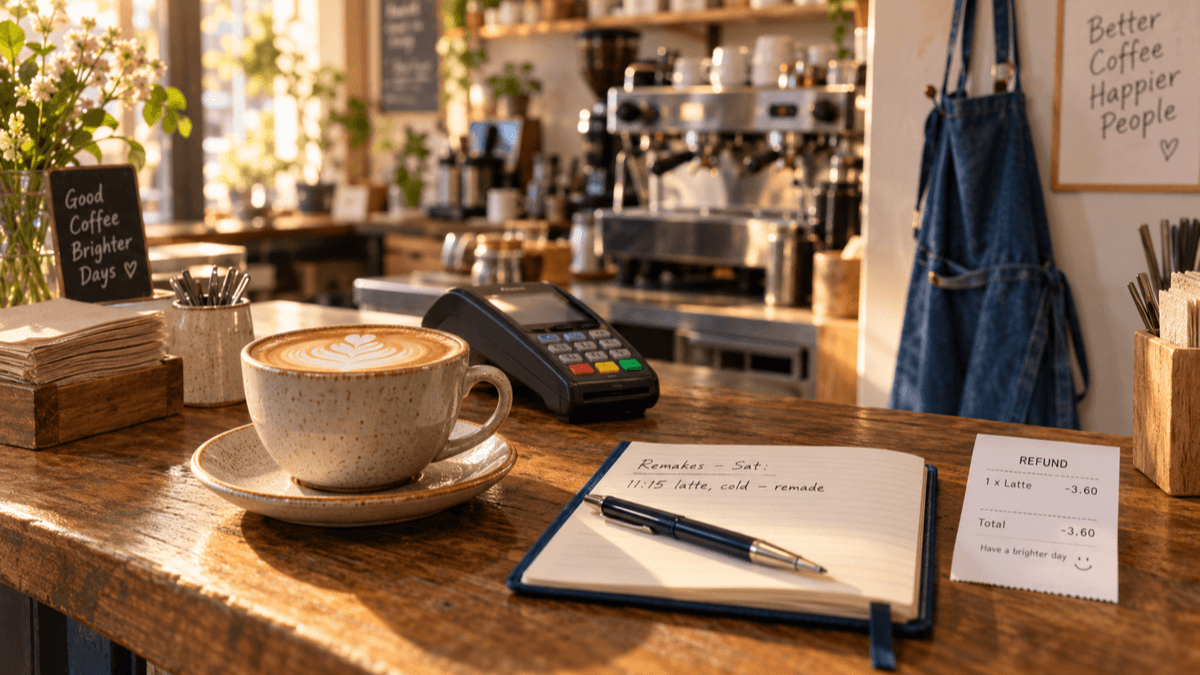
Saturday, quarter past eleven, fourteen people in the queue. A customer comes back to the counter, puts a latte down and says, "This is cold."
Your barista has about three seconds. Remake it? Refund it? Go and find someone? Whatever happens next was decided weeks ago, by whether anyone told them what they are allowed to do.
Most café complaints are small: a cold drink, the wrong milk, a toastie that sat too long. A few are not: something in the food that shouldn't be there, a customer whose lips are swelling, an email saying they were ill all night. The first kind needs a fast, generous habit. The second needs a calm procedure.
General information for cafés in Great Britain, not legal advice. Your insurer's policy wording matters more than anything written here.
What you actually owe under the Consumer Rights Act
When you sell a latte and a sandwich, the Consumer Rights Act 2015 sees two things: goods (the food and drink) and a service (making and serving it).
The food and drink
Goods must be of satisfactory quality (section 9), fit for purpose (section 10) and as described (section 11). A cold latte, a hair in a sandwich, or an "oat flat white" made with dairy all fall short.
Section 19 then gives the customer a ladder: the short-term right to reject (a refund) or a repair or replacement (in our world, a remake), and only after that a price reduction. Two details matter at the counter:
- The customer chooses, not you. You can offer the remake first; you can't insist on it if they'd rather have their money back.
- The window is short for food. The standard limit is 30 days, but section 22 shortens it for goods expected to perish sooner. For a latte, the window is roughly as long as the latte.
The service
Section 49 says a service must be performed with reasonable care and skill, and section 52 adds "within a reasonable time" where none was agreed. A forty-minute wait for beans on toast on a quiet Tuesday is a service failure, however good the beans. The remedy is to do it again properly, or a price reduction that, under section 56, "may, where appropriate, be the full amount of the price".
Any refund that is owed goes back within 14 days, with no fee, by the same means of payment unless the customer agrees otherwise (section 20). Paid by card, refunded to the card.
What you don't owe
Change of mind is not a statutory right for something bought in person, as GOV.UK's refunds guidance confirms. If the latte was made properly and they've decided they don't like oat milk, a remake is goodwill, not law. Likewise, someone who clears the plate and then mentions it was "a bit cold" is in a much weaker position than someone who sends it back after one bite.
Remake or refund?
With the legal floor clear, most decisions get easy:
| What happened | Default response |
|---|---|
| Made wrong (cold, weak, wrong size) | Remake straight away; refund if they'd rather |
| Wrong item or milk, not yet touched | Remake |
| Wrong milk, already drunk, customer has an allergy | Food safety incident (below) |
| Made correctly, they just don't like it | Goodwill remake or swap, once |
| Long wait | Apologise, refund the slow item or offer a drink on the house |
| Mostly eaten, then a complaint | Listen, apologise, use judgement |
| Something in it, a reaction, or illness | Stop. Incident procedure |
The rule I've always given new starters is simpler still: if in doubt, remake it, smile, and log it. A remake costs pennies. An argument in front of fourteen people costs far more.
The authority ladder
Complaints go wrong when the person facing the customer has no authority, so they hesitate, go and find someone, and come back to a customer who is now properly annoyed. Write down what each level can do alone and put it in the induction.
A barista or counter assistant can, without asking:
- Remake anything, once, no questions.
- Refund the item complained about, up to a set limit. £10 covers most single orders; pick your own number.
- Offer a drink on the house next time, if that's your policy.
A supervisor or shift lead handles:
- Refunds over that limit, or on a whole order.
- A second complaint from the same customer in one visit.
- Anyone getting heated. A fresh face and "let me take this" defuses most things.
You, or whoever is in charge that day, handle:
- Anything that might be a food safety incident: a foreign body, a suspected allergic reaction, a claim of illness.
- Compensation beyond the price paid, and anything that arrives in writing.
- Anyone mentioning a solicitor, the council or their insurer, and any request for CCTV or staff names.
The exact limit matters less than its existence. A seventeen-year-old who knows they can refund £10 without asking will do it gracefully.
Ring every remake and refund through the till
This is the part most cafés skip, and it's the part that costs money.
An unrecorded remake doesn't vanish. It turns up later as gross profit that has drifted down for no visible reason. A cash refund handed out of the drawer without being rung through turns up as a short till at close, exactly the noise daily cashing up and a variance log are there to catch, and the sale stays on your till report, so you pay VAT on money you gave back.
What one remake costs
Take a latte at £3.60, or £3.00 ex-VAT. Illustratively, 18g of coffee at £22 a kilo is 40p and 220ml of milk at 55p a litre is 12p: cost of sales 52p, gross profit £2.48 (82.7%).
- Remake it: another 52p, so gross profit falls to £1.96 (65.3%). Add about two minutes of barista time at a fully loaded £15.90 an hour, roughly 53p, though at the peak the real cost is the queue behind. You keep the sale, and probably the customer.
- Refund it: the £3.00 goes and the first 52p is already spent. That cup is 52p in the red.
Where the customer is happy either way, a remake is the cheaper fix. Where they want their money back, it's theirs, and you hand it over with good grace.
What a year of them costs
Five remakes a day across drinks and food, at an average 80p of ingredients, is £4.00 a day. Over 312 trading days that's £1,248 a year: on £250,000 of ex-VAT turnover, half a percentage point of gross profit gone without explanation, unless every one was rung through.
When a complaint is really a food safety incident
Some complaints change category the moment you hear them. The tone at the counter stays kind and unhurried. What happens behind it changes completely.
Something in the food
A hair, a plaster, a bit of shell, a fragment of plastic, an insect. Some are unpleasant but low risk; glass or metal is a genuine hazard. The handling is the same:
- Apologise and check they're all right. Did they swallow anything? Are they hurt?
- Take the plate back and keep it. Don't bin it or pull the object out. Council food teams tell the public to keep the food and refrigerate or freeze it for an officer to examine; do the same.
- Refund in full, and don't charge for anything else left unfinished.
- Write it down while it's fresh.
Then trace it. A hair points to hair restraints and how plates are finished. Packaging fragments point to a supplier or prep step. An insect points to proofing and your pest contract, which is why it's worth knowing what a good pest control contract should cover before you ever need it.
A suspected allergic reaction
Speed beats everything. The NHS anaphylaxis guidance: use their adrenaline auto-injector if they have one, call 999 and say you think it's anaphylaxis, help them lie down (or sit up slowly if breathing is hard), and don't let them stand or walk, even if they feel better. A second injector can be used after five minutes without improvement. Don't wait to be sure.
Afterwards, keep the item, pull the recipe and the actual ingredients used that day, including any supplier swap, and check what the customer was told. This is where an ingredient-level allergen matrix earns its keep.
"I was ill after eating at yours"
These usually arrive a day or two later. Neither of you can tell from a description whether your food was the cause, so don't argue and don't agree. Take the details (what they ate, when, when symptoms started, whether anyone else in their party was ill), then check your temperature records, deliveries and staff sickness for that day. One report is a conversation. Two unconnected reports about the same day or dish is a pattern, and the moment to ring your local authority's food safety team for advice.
Record it, and be careful what you write
For all three, record the date and time, what was served and by whom, what the customer said, what you saw, and what you did and offered, with photos before the item goes into a labelled bag in the fridge or freezer. A food safety diary is the natural home: SafetyBrik lets you add an incident note alongside the day's checks, but a dated page in your SFBB pack does the same job.
Say sorry, and mean it. In England and Wales, section 2 of the Compensation Act 2006 says "an apology, an offer of treatment or other redress, shall not of itself amount to an admission of negligence", and the Apologies (Scotland) Act 2016 keeps most apologies out of evidence on liability.
What you shouldn't do is guess at the cause in writing. "It must have been the new lad on sandwiches" in a late-night email is probably wrong, and it's now a document. Say sorry, say what you're doing to look into it, and say when you'll come back to them.
When to call the council and your insurer
- Your local authority food safety team: if you believe food you've already served or put on sale may be unsafe, such as a batch of sauce with glass in it or a grab-and-go sandwich with the wrong allergen label, the law expects you to withdraw it and tell them. The FSA's general food law guidance sets out that duty. Customers can also report to the council directly, and if you've kept the item and your records, that visit goes very differently.
- Your insurer: if someone is hurt, has a reaction or mentions a claim, tell your public and products liability insurer promptly. Most policies ask you not to admit liability or agree compensation without them, so read your wording now rather than on the day.
Complaints that arrive later
An emailed complaint deserves a same-day acknowledgement ("thank you, I'm looking into this and will reply properly by Thursday") and then a real reply: what you found, what you've changed, and an apology that doesn't grovel.
Online reviews follow the routine in the weekly Google reviews post: wait a day before replying to a bad one, acknowledge, never defend, never share the customer's details. Two extra rules for complaint reviews:
- If it alleges a food safety problem, don't debate it in public. "We take this seriously and want to look into it properly. Please email me at…" is enough.
- Don't trade a refund for a deleted review. The fake reviews rules in force since April 2025 target businesses suppressing genuine negative reviews, and paying someone to take one down sits far too close to that.
The takeaway
Write down three things this week. A remake-or-refund default your team can follow without thinking. An authority ladder with a real number on the barista's refund limit. And a one-page incident procedure: keep it, record it, be kind, don't guess in writing, and know who to call.
Then put a remake button on the till and ring every one through it. The cold latte will still happen. It just won't disappear into your margin without a trace.
Ed O'Brien has run Hunters Cake Company for 17 years across cafés in Witney, Burford, and a bakery in Carterton, Oxfordshire. He's building Brikly - modular tools that give independent café owners the same data the big chains have, without the big chain price tag.