
How many suppliers should a café have? Pricing the admin each one costs
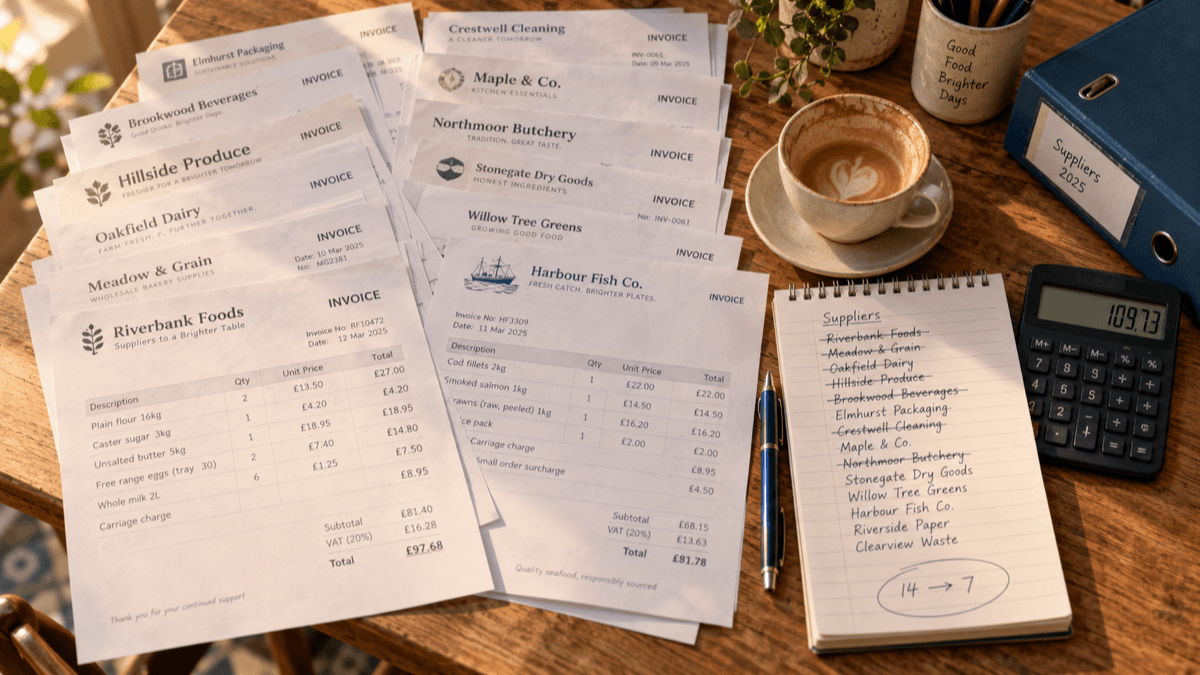
Count the supplier names on last month's invoices. Not the big ones you think of first, all of them. The roaster, the dairy, the baker, the broadline wholesaler, the greengrocer, the packaging people, the cleaning chemicals, the cheese, the cakes, the soft drinks, the tea, the online order for syrups.
Most cafés I talk to land somewhere between ten and fifteen, and almost none of them chose that number. Each supplier was added for a sensible reason, usually a price. Nobody ever adds up what it costs to have a supplier, separately from what you buy from them.
That cost is real, it is mostly your time, and it does not show on any invoice. So let's put a number on it.
Every supplier has a running cost
Line prices are the visible part of a supplier. Underneath them sits a set of jobs that happen whether you buy £40 or £400 a month:
- Ordering. Checking stock against their list, logging into their portal or ringing it through.
- Receiving. Stopping what you are doing when the van arrives, checking the drop, signing, putting it away.
- Processing the invoice. Filing it, entering it, coding it, checking the prices.
- Reconciling the statement. Matching their month-end statement to your invoices and credits.
- Paying. Setting up the payment, checking it went, keeping the bank details right.
- Everything else. Chasing a credit, querying a price rise, a new product code, an allergen spec sheet when they change a product.
Some of these happen per drop and some happen once a month regardless. That split matters, so I'll price them separately.
Putting a £ figure on it
I use the same fully loaded rate as the rest of this blog: a team member on the National Living Wage of £12.71 an hour, 30 hours a week, with holiday accrual, employer National Insurance and pension on top, comes to £15.93 an hour, or about 26.5p a minute.
That is a floor. If you, the owner, do the supplier admin at 9pm, your hour is worth more, but I'll stay at £15.93 so the sums are conservative.
Now some honest, illustrative timings. Yours will differ, so time a week and swap them in.
Per drop (the fixed part, not the per-line checking):
- Ordering: 8 minutes
- Receiving: 6 minutes
- Invoice processing: 4 minutes
- Total: 18 minutes, or £4.78 a drop
Per supplier, per month, regardless of drops:
- Statement reconciliation: 15 minutes, which is about what reconciling a supplier statement takes once your paperwork is in order
- Payment: 5 minutes
- Queries, credits, price checks, spec sheets: 12 minutes, averaged over the year
- Total: 32 minutes, or £8.50 a month
Put those together and the cost of simply having a supplier looks like this:
| Drop frequency | Drops a month | Admin minutes | Admin cost a month | A year |
|---|---|---|---|---|
| Monthly | 1 | 50 | £13.28 | £159 |
| Fortnightly | 2.17 | 71 | £18.87 | £226 |
| Weekly | 4.33 | 110 | £29.19 | £350 |
| Three times a week | 13 | 266 | £70.62 | £847 |
That last row is not an argument against a frequent dairy drop. Milk needs to come often, and the time is the price of not running out. It is a reminder that the time is there.
Why "best price on every line" quietly backfires
The way supplier lists grow is cherry-picking. One supplier is 4p a kilo cheaper on flour, so the flour goes there. Another does the cheapest takeaway cups, so the cups go there.
Run the flour one. You buy 50kg a month. At 4p a kilo that is £2.00 a month in your favour. If it arrives as its own fortnightly drop, the admin alone is £18.87 a month. You are paying nearly £17 a month for the privilege of the cheaper flour.
The fix is not to stop comparing prices. You absolutely should, and comparing suppliers per kilo, per litre or per each is the only honest way to do it. The fix is to compare the whole cost: the per-unit price, plus any carriage, plus the admin of keeping that account alive.
Small accounts are also where delivery charges bite hardest. A supplier you only spend £70 a month with is almost certainly under their free-delivery threshold every time, which is exactly the trap in minimum orders and delivery charges. Spread spend thin across many suppliers and you pay carriage on lots of them.
A worked example: 14 suppliers down to 7
Here is an illustrative café doing around £1,400 a month through its main broadline wholesaler, plus thirteen other accounts. All figures ex-VAT.
The 14 suppliers:
- Coffee roaster, fortnightly
- Dairy, three times a week
- Bakery, six days a week
- Broadline wholesaler, weekly
- Greengrocer, twice a week
- Second dry-goods wholesaler (cheaper flour, sugar, oats), fortnightly
- Packaging and disposables, monthly
- Cleaning chemicals, monthly
- Bought-in cakes, weekly
- Butcher (bacon, ham), weekly
- Cheese specialist, fortnightly
- Soft drinks, fortnightly
- Tea, monthly
- Online plant milks and syrups, monthly
The café keeps the roaster, dairy, bakery, greengrocer, wholesaler, cake maker and butcher. The roaster also sells tea at the same price, so tea moves there. Everything else from suppliers 6, 7, 8, 11, 12 and 14 moves onto the broadline wholesaler's existing weekly drop. That is £780 a month of extra spend on the wholesaler, taking it to £2,180.
What it saves
Admin. Seven accounts gone: three fortnightly at £18.87 and four monthly at £13.28.
- 3 x £18.87 = £56.61
- 4 x £13.28 = £53.12
- £109.73 a month, about 6.9 hours
The extra lines still need checking on the wholesaler's drop, so line-by-line time does not vanish. What vanishes is the fixed per-drop and per-account time, and that is what the figure counts.
Carriage. Several of those small accounts charged delivery because the café never cleared their minimums:
- Packaging: £8.95 a month
- Cleaning: £6.50 a month
- Online plant milks and syrups: £5.99 a month
- Cheese: £5.00 a drop, so £10.85 a month
- The wholesaler itself, which used to fall under its £150 minimum about once a month: £6.50
- £38.79 a month
What it costs
The wholesaler is not the cheapest on everything it now supplies:
| Category moved | Monthly spend | Wholesaler vs old price | Monthly difference |
|---|---|---|---|
| Dry goods | £180 | 6% dearer | +£10.80 |
| Packaging | £110 | 9% dearer | +£9.90 |
| Cleaning | £70 | 4% dearer | +£2.80 |
| Cheese | £195 | 11% dearer | +£21.45 |
| Soft drinks | £140 | 3% cheaper | -£4.20 |
| Plant milks, syrups | £85 | 2% dearer | +£1.70 |
| Total | £780 | +£42.45 |
The honest result
In pure cash, the café is £3.66 a month worse off: £38.79 of carriage saved against £42.45 of dearer prices. Call it level.
What it gained is 6.9 hours a month, around 83 hours a year, worth £1,317 at the loaded rate. Whether that is real money depends on what happens to the hours. If they come off someone's rota, or you stop doing invoices on a Sunday night and spend it on the business instead, it is real. If the time just evaporates, the saving does too.
Then there is the bit that tips it. The café is now worth £2,180 a month to the wholesaler instead of £1,400. That is the moment to ask for better terms. If they will give 2% off the account at that level of spend, that is £43.60 a month, about £523 a year, and the cash side swings comfortably positive. Not every wholesaler will. But you will never get it at £1,400 spread over fourteen people.
When fewer suppliers is the wrong answer
Consolidation is a tool, not a virtue. Here is where I would stop.
You lose your price leverage
A supplier who knows they have all your spend has no reason to sharpen their pencil. Prices drift up a few pence at a time and nobody phones you about it.
The defence is to keep checking. Get a quote from an alternative on your top lines at least once a year, even if you have no plans to move. A supplier who knows you compare behaves differently from one who knows you don't.
One van becomes a single point of failure
If the wholesaler's van breaks down, or the depot is short, everything you moved onto them is short at once. With fourteen suppliers, one failure costs you one category. With seven, it can cost you half the counter.
Keep a fallback you could use tomorrow: a cash and carry card, or a second account left open but quiet. Knowing which channel suits which job helps you decide what that fallback should be. And keep an eye on how much you owe one supplier, because a single overdue balance now stops a lot more of your deliveries.
Specialist items earn their own account
Some suppliers are not really line-item suppliers at all:
- Coffee. It is the product most of your customers come in for. A good roaster relationship often comes with machine advice, barista training and consistency you will not get from a catalogue. I would never trade mine for a few pence a kilo.
- Dairy. Milk needs frequent drops. A broadline weekly drop does not suit something you get through daily, and you end up back at the supermarket on a Wednesday.
- Bread. Same logic, more so. Freshness is the whole point.
- Anything that defines a dish. The cheese in the toastie, the bacon in the roll, the cake people ask for by name.
These belong in the "keep" column whatever the admin sum says, because the sum is only measuring the cost side.
A once-a-year supplier review
None of this needs doing monthly. Once a year, in your quietest month, is plenty.
- List every supplier you paid in the last 12 months. Pull it from your bank, not your memory. The forgotten ones are the point.
- Next to each, write four numbers. Total spend, number of drops, carriage and surcharges paid, and the admin cost from the table above.
- Flag the small ones. Anything under about £150 a month of spend, or anything you pay carriage on most of the time.
- Check per-unit prices on the flagged lines. Compare what you actually paid against what your main supplier charges for the same thing, per kilo or per each, ex-VAT.
- Decide keep, merge or drop. Merge if the price gap is smaller than the admin plus carriage. Keep if it is specialist or defines a dish.
- Go to your main supplier with the new number. "We are moving another £X a month to you. What can you do on terms?"
- Name your fallback. One alternative for your biggest categories, so a bad week is an inconvenience rather than an empty counter.
Step four is where most reviews stall, because nobody has a year of per-unit prices to hand. CostingBrik tracks what you paid each supplier from the invoices themselves, so the like-for-like comparison is already there when you sit down. A spreadsheet of your top 20 lines does the same job, if you keep it up.
So, how many?
There is no right number. A café with its own bakery and a strong local food story might rightly have twelve. A tight grab-and-go might run happily on five.
The right question is not "how many" but "does each one earn its place?" A supplier earns it with a better landed price, a product you cannot get elsewhere, or a delivery pattern you genuinely need. One that does none of those is costing you about £13 to £30 a month in time just to exist, plus whatever carriage you are paying to keep it small.
Count your suppliers this week. Put the admin figure next to each. The ones that cannot justify it will be fairly obvious.
Ed O'Brien has run Hunters Cake Company for 17 years across cafés in Witney, Burford, and a bakery in Carterton, Oxfordshire. He's building Brikly - modular tools that give independent café owners the same data the big chains have, without the big chain price tag.