
Reconciling supplier statements: the 15 minutes that pays for itself
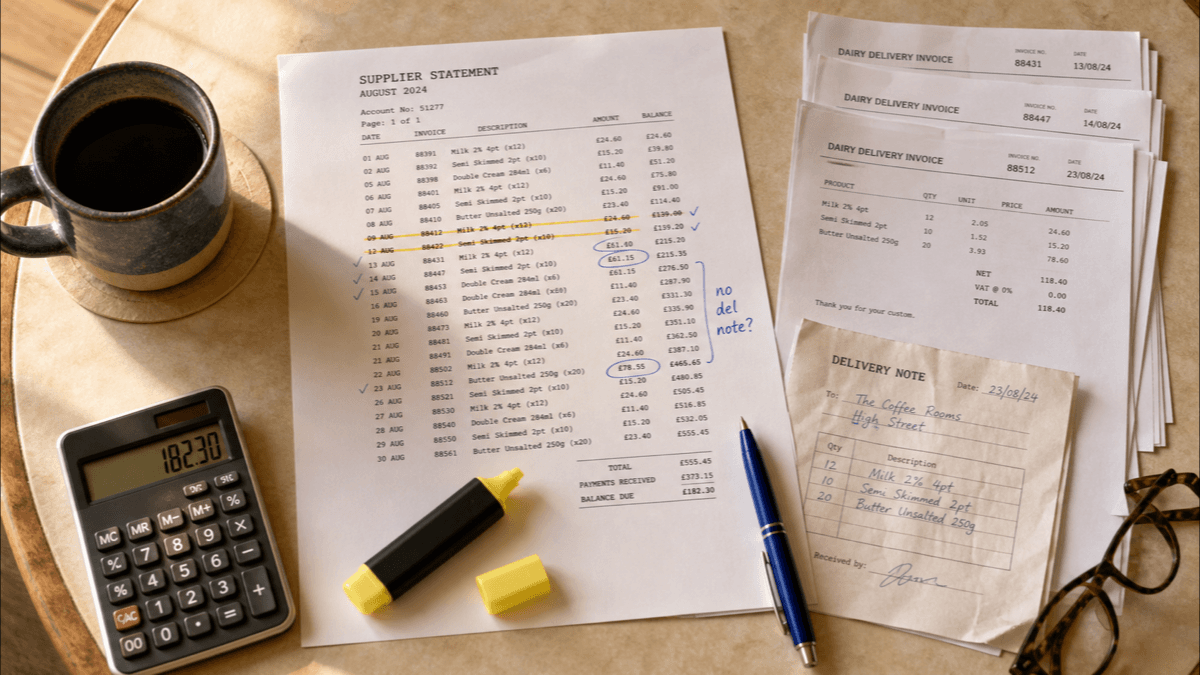
The statement lands on the first of the month. Fourteen lines, one total, and a polite note about payment terms. You glance at it, recognise the supplier's name, and pay the total.
That total is the supplier's version of what you owe. It is not your version. Nobody has checked whether the two agree, and until somebody does, you are paying an unverified number every single month.
The gap between those two versions is where the money hides. Not much per month. Enough over a year to notice.
A statement is not an invoice
The two get treated as the same document and they do very different jobs.
An invoice is a claim for one delivery. What came off the van, at what price, on what date. It's the thing you check against the delivery note, and the thing that tells you what your ingredients actually cost.
A statement is a summary of the account. Invoice numbers, dates, totals, any credits applied, and a closing balance. It carries no line detail at all. You cannot tell from a statement whether butter was £6.85 or £7.55 a kilo, because the statement never mentions butter.
So a statement is a list of claims, not a list of goods. Paying the total feels like diligence. It isn't. It's trusting a summary of documents you never opened.
Why the two drift apart
Nobody is trying to defraud you. Supplier accounts departments are busy, understaffed and running software that was old when you opened. Drift happens for boring reasons.
- Timing. A delivery on the 31st lands on this month's statement or next month's, depending on when the driver's paperwork got keyed in.
- Credits process slower than charges. A charge posts the day it's raised. A credit has to be approved, then keyed, then applied. That lag is where credits go to die.
- Manual keying. An invoice number typed twice, or a delivery keyed to the wrong account. Multi-site operators get this constantly, with a Witney drop landing on the Burford account.
- Depot versus head office. The depot knows the driver came back with two crates. Head office only knows an invoice was raised.
None of it malicious. All of it invisible, unless somebody lines the two documents up.
The four things reconciliation catches
Every discrepancy I've found on a statement falls into one of four buckets. Knowing them makes the job faster, because you stop looking for problems in general and start looking for four specific things.
1. Credit notes that never landed
This is the big one. You returned a case of out-of-date cream, the driver took it, someone said "no problem, we'll credit that." Six weeks later, has it appeared?
If you've been claiming the credit notes you're owed at the door, you already have a list of promised credits. The statement is where you find out which of them are real. A credit that was verbally agreed and never raised is worth exactly nothing, and you'll never notice it missing unless you go looking.
2. The invoice you paid twice
Duplicates are commoner than you'd think. The same delivery gets invoiced under two numbers because the docket was keyed at the depot and again at head office. Or the same invoice number appears twice, a day apart.
Pay on the statement total and you pay both. Pay invoice by invoice against your own file and you catch it, because you only have one delivery note.
3. Charges for goods that never arrived
An invoice on the statement with no matching delivery note is a serious flag. Usually a keying error, with someone else's drop landing on your account. Occasionally a delivery that was loaded, invoiced, and never made it off the van.
This is where checking deliveries against what you actually ordered pays off a second time. If nobody signed for it, you have grounds. If everyone signs everything without counting, the charge sticks.
4. Price changes nobody mentioned
The statement won't show this directly. But reconciling forces you to open the invoices, and once they're in front of you, month-on-month movement is obvious in a way it never is when they arrive one at a time.
Butter at £6.85 on the 4th and £7.55 on the 18th is a 10% rise nobody phoned you about. Same with the pack that quietly went from 500g to 450g, which is why it's worth watching pack sizes as closely as prices on your invoices. Neither shows up in a statement total. Both show up the moment you have a month of invoices side by side.
The method: tick, gap, investigate
The job is dull, not difficult. You're matching two lists and paying attention only to what fails to match.
- Get your own list. Every invoice and credit note from that supplier for the period. Number, date, total. If they live in a lever arch file, this is the slow part. If they're digitised, it's thirty seconds.
- Tick the matches. Work down the statement with a highlighter. Statement line, find it in your file, tick both. Same number, same date, same total. Most lines match, and matched lines need no further thought.
- Circle the gaps. Three kinds. On the statement but not in your file. In your file but not on the statement. On both, but the amounts disagree.
- Investigate only the circled lines. Usually three or four out of twenty. Small.
- Check the arithmetic. Add the invoices, subtract the credits, compare to the closing balance. Statements do occasionally just add up wrong.
The discipline is in step two. Don't read the statement and think "that looks about right." Tick every line against a document you physically have. The whole method rests on that.
A worked example: one month on the dairy account
Illustrative UK 2026 numbers, ex-VAT. August statement from a dairy and chilled supplier, closing balance £4,318.75 across fourteen invoices and one credit.
You pull your own file for August and total it: £4,136.45. A difference of £182.30. Here's where it went.
Gap one: a credit that was agreed but never raised
You returned a case of whipping cream on the 12th, short-dated on arrival. The driver took it and the depot confirmed a credit. The statement shows one credit note, for a shortage on the 5th, and nothing for the cream.
- Case of 12 x 1L whipping cream: £26.40
- Plus a butter short of 2kg from the 20th, also promised, also absent: £16.20
- Missing credits: £42.60
Gap two: the same delivery, invoiced twice
Invoices 88431 and 88447 both show £61.15, dated the 13th and the 14th. You have one delivery note, for the 13th. The 14th was a Thursday you had no scheduled drop.
- Duplicate charge: £61.15
Gap three: an invoice with no delivery behind it
Invoice 88512, dated Saturday the 23rd, £78.55. No entry in the goods-in book, no signed note, no intake on the fridge log. It turns out to be another café's drop keyed against your account.
- Phantom delivery: £78.55
The total
£42.60 + £61.15 + £78.55 = £182.30, which is the whole difference. Nothing left unexplained, which is what a good reconciliation looks like.
That's 4.2% of the month's spend on one supplier, for a job that takes a quarter of an hour once your paperwork is in order.
The fourth thing, which isn't in the £182
While the invoices were open you also spotted butter moving from £6.85/kg on the 4th to £7.55/kg on the 18th. Not recoverable. Suppliers are entitled to raise prices.
But you get through roughly 12kg a week. That's £8.40 a week, about £437 a year, and it went through without a phone call or an email. Now you know, you can query it at the next review or price it into the dishes that lean on butter. Either way you're no longer absorbing it blind.
Do it before you pay, not after
This is the part most operators get backwards, and it's the difference between a conversation and a favour.
Before payment, you're holding money the supplier wants. "There's £182 on this statement I can't account for, so I'm paying £4,136.45 and we'll sort the rest out" is a normal thing to say. It gets dealt with quickly, because someone in credit control wants the account clean.
After payment, you're asking for a refund. Different conversation, different urgency, bottom of somebody's pile. The duplicate is now their money. The credit is now a promise about next month's statement, which becomes a promise about the month after.
The leverage disappears the moment the payment clears. Reconcile in the window between the statement arriving and the payment run going out, even if that window is a couple of days. If an email in that window says the supplier has changed banks, ring them on a number you already hold before paying the new account.
Why this gets skipped, and how to make it 15 minutes
Nobody skips reconciliation because they think it's pointless. They skip it because it arrives at the worst possible moment. Month end, VAT looming, a rota to finish, and a job that means walking to the office, pulling a lever arch file and cross-checking twenty lines by hand for forty minutes.
Forty minutes of tedium loses to almost anything else on the list. The answer isn't more discipline. It's a shorter job.
The forty minutes is almost entirely retrieval. Finding the invoices, not comparing them. The comparison itself is five minutes once both lists are in front of you. So the whole question is: how fast can you produce a list of every invoice from one supplier for one month?
Three things that shrink it:
- One place for invoices, searchable by supplier and date. A scanned folder, an accounting package, something purpose-built. It just has to be a search rather than a rummage.
- A running claims log. One line per promised credit: date, supplier, what, roughly how much. Check the log first when the statement arrives and the missing credits identify themselves in a minute.
- Consistency in how invoices are filed. The same thinking that goes into coding supplier invoices to the right account codes makes them findable later. A tidy file is a fast reconciliation.
Raising it without souring the relationship
You want the £182 and you want the supplier to keep liking you. Those are compatible if you handle it as admin rather than accusation.
Be specific. "Invoice 88512, 23rd August, £78.55. We have no delivery note and no goods-in entry for that date. Can you check whether it's been keyed to the wrong account?" That's everything they need to look it up.
Send it in writing, in one message. All three queries together, to whoever handles your account. Not three phone calls across a fortnight.
Say what you're paying. "Paying £4,136.45 today, holding £182.30 pending these queries." Clear, reasonable, no drama.
Assume error, not malice. Nine times in ten it's a keying mistake, and the person reading your email had nothing to do with it. Then follow it up: a query left a month is a query nobody remembers.
Suppliers respect operators who check. It quietly makes yours an account where errors get fixed faster, because somebody knows you'll spot the next one.
Where Brikly fits
The bottleneck here is retrieval, not judgement. You already know how to spot a duplicate. What kills the job is that finding fourteen invoices from one supplier means going through a folder, a drawer or an inbox.
CostingBrik holds every invoice you've uploaded, with its supplier, date, total and line items, in one searchable place. When the statement arrives, pulling up that supplier's month is a filter rather than an archaeology exercise. The line detail is there too, so the price movement the statement can't show you sits in the same view.
It doesn't reconcile statements for you. That's still your fifteen minutes with a highlighter, and honestly the ticking is the part where you notice things. What it removes is the half hour of hunting that stops most people getting to the ticking at all.
The statement is the supplier's opinion of what you owe. Your invoice file is the evidence. Once a month, for your three biggest accounts, put the two side by side before the payment goes out.
Most months you'll find nothing and it'll feel like a wasted quarter of an hour. The months you find something more than cover the ones you didn't.
Ed O'Brien has run Hunters Cake Company for 17 years across cafés in Witney, Burford, and a bakery in Carterton, Oxfordshire. He's building Brikly - modular tools that give independent café owners the same data the big chains have, without the big chain price tag.