
Supplier's out of stock: what a substitution really does to your margin
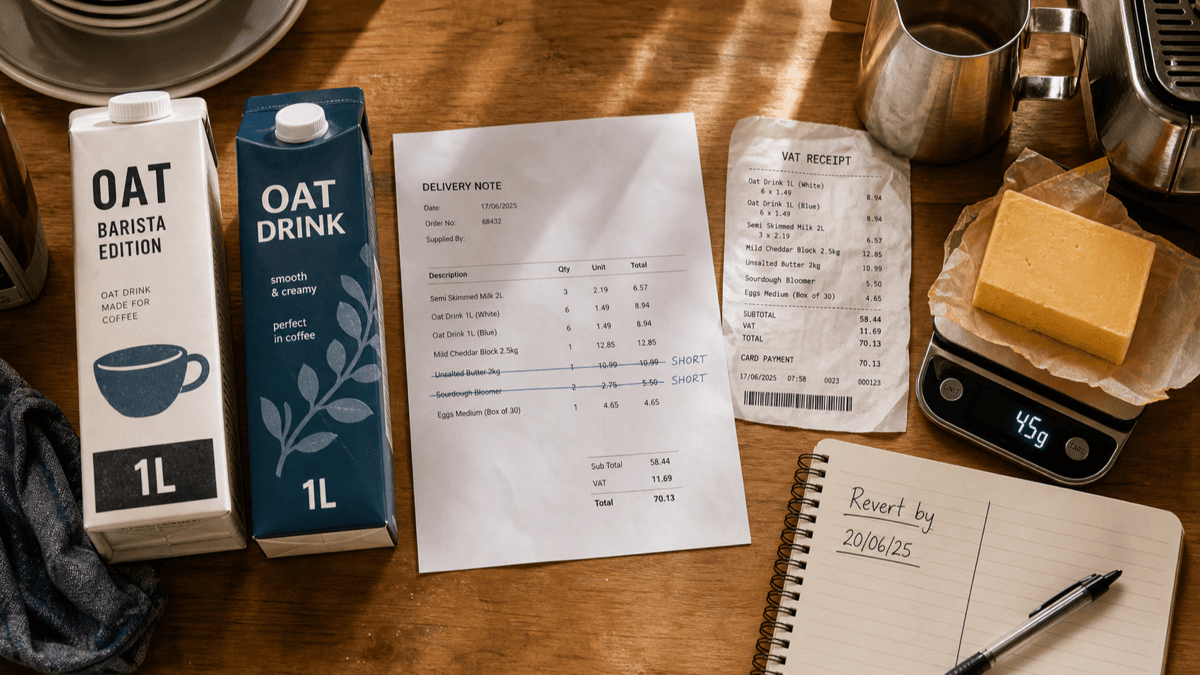
The delivery lands at half six. Three cases short. The oat milk did not come, the butter is a brand nobody recognises, and the free-range eggs have arrived as a 15-dozen tray of something the driver cannot explain.
You take what came, you send someone to the supermarket on the way in, and you open at eight. Nobody costs any of it, because there is no moment in that morning where costing it is possible.
That is fine for a day. The problem is that a substitution has no end date attached, so the temporary swap quietly becomes the permanent recipe, and your costed margin describes a dish you stopped making in June.
The swap nobody logs
Ask an operator how many ingredient substitutions they made last month and you get a shrug. Ask how many they costed and you get an honest zero.
It is not laziness. Substitutions happen at the worst possible moment: mid-service, one person down, with a delivery note in one hand. The decision takes four seconds and the consequence runs for months.
Shortages are not always the supplier's fault, either. If you have been put on stop over payment terms, the shortage is a credit control decision arriving as a missing case of milk.
What makes it expensive is that a substitution touches four things at once, and most of us only check the first.
The two-minute check before you swap
You do not need a process. Four questions, asked while the box is still on the bench.
1. What does it cost per unit, properly compared?
Not per case, not per pack. Per gram, per litre, per portion. A 2.5kg bag against a 3kg bag tells you nothing until both are on the same footing, which is the whole point of a like-for-like per-unit comparison. Ten seconds on a phone calculator is enough.
2. Is the portion actually the same?
This is where the money hides. A different bun is a bigger bun. A different cheese has a different fat and moisture content, so it grates lighter and covers less, and the chef puts more on without deciding to.
Say your usual cheddar is £10.60 for a 2kg block, so £5.30 a kilo, and a toastie takes 40g. That is £0.212 of cheese. The substitute is £9.80 for 2kg, £4.90 a kilo, which looks like a win. But it needs 45g to cover the same bread. That is £0.2205.
Four per cent cheaper per kilo. Four per cent dearer per toastie. The invoice says you saved money and the dish says you did not.
3. Does it yield the same?
Trim, bake loss, water content, drip. A cheaper chicken breast that loses more weight in the oven is not cheaper. If the swap sits inside a component, check the sub-recipe or batch it feeds too, because one substitution in a mayo base or a scone mix cascades into every dish that uses it. That is the version that does real damage: the cost lands in five recipes and shows up in none of them.
4. Does the label change?
A different brand is a different label. May contain, made in a factory that also handles, a different oil, a soya lecithin that was not there before. You cannot carry the old allergen answer across on the assumption that cheese is cheese, and your allergen matrix has to reflect the ingredient you are actually using today, not the one on the original spec sheet.
Menu claims count too. If the board says free-range, British, or gluten-free, the substitute has to earn those words or the board comes down until the right stock lands.
VAT is usually the easy one. Swapping the milk in a latte does not change the VAT on the latte. What can change is the VAT you paid, which matters most when the substitute came from a supermarket.
The Friday supermarket run
Everyone does this and almost nobody accounts for it.
Retail is dearer, and the gap is bigger than people assume. On the lines I have checked over the years, a supermarket price against a wholesale account price tends to land 30% to 60% dearer per unit once both are on the same measure. Occasionally a promotion beats the account. Mostly it does not.
Two things to get right on the way out of the shop:
- Ask for a VAT receipt. On standard-rated goods, which is packaging, cleaning products, foil, confectionery and soft drinks, the 20% is reclaimable if you have a proper VAT receipt. A card slip is not one. Customer service will print you the real thing in a minute.
- Do not assume there is VAT to reclaim on food. Most of what you panic-buy is zero-rated anyway, so the receipt does not save you anything on the flour or the milk. Reclaiming nothing on a zero-rated item is not a mistake, but expecting to reclaim it is.
What a week of it actually costs
Say oat lattes are your second-biggest drink.
Your contract oat milk is £14.40 a case of 12 litres, so £1.20 a litre. The supermarket barista oat you grab on Friday is £1.75 a litre. That is 46% dearer.
A 220ml serve costs £0.264 on contract and £0.385 on the substitute. Twelve pence a drink.
Now put volume on it. Say you sell 180 oat drinks a week, which is about 40 litres.
- One week of substitution: about £22.
- Sell that oat latte at £3.80, and it is standard-rated as a hot drink, so £3.17 ex VAT. Ingredient cost with cup and lid goes from £0.76 to £0.89. Gross profit drops from roughly 76% to 72%.
Four points of GP on a bestseller. Twenty-two pounds is a rounding error and you would never chase it.
But substitutions do not last a week. They last until someone notices. Run that swap for a quarter and it is £283. Run it for a year, which happens more often than anyone admits, and it is £1,133 off one drink, on a decision that took four seconds on a Friday morning. Milk is the line where this compounds fastest, because it is already the single biggest recurring ingredient bill in most cafés.
The temporary that stuck
The fix is embarrassingly low-tech. Keep a substitution log, one line per swap, on paper by the delivery door if that is what gets used.
Date. What should have arrived. What you used instead. Cost per unit of each. And the column that does all the work:
Revert by.
Put a date in it. Next delivery, or next Monday. Without that column the log is a diary. With it, it is a list of open items, and open items get closed.
Walk the log once a month. Most lines will have reverted on their own. The ones that have not are the ones costing you money, and they are usually the ones everybody stopped noticing weeks ago.
When the substitution is the better answer
Sometimes the accident is an upgrade, and it would be daft to revert out of habit. Switch for good when all four hold after two or three weeks:
- It is genuinely cheaper per unit, compared properly, not per case.
- The portion and the yield are the same or better.
- The kitchen prefers it, or at minimum does not complain about it.
- The allergen and label position is clean and written down.
If that is where you land, do it properly. Change the recipe, recost the dishes it touches, update the matrix, and tell your original supplier why you moved. The price you get quoted after you have already switched tends to be the price you should have been paying all along.
This is the one place software genuinely saves you an afternoon. CostingBrik's what-if scenarios let you swap an ingredient and see the margin impact across every recipe that uses it before you commit, which matters most when the swap sits three layers down in a batch and you cannot hold the cascade in your head.
One thing this week
Go and find the substitutions you are already running without knowing it.
Pull the last four weeks of delivery notes and look for shortage lines and credits. For each one, ask what you used instead and whether you ever went back. My guess is you find two or three that never reverted.
Cost one of them, at the volume you actually sell. If the number is small, good, you have bought peace of mind for ten minutes' work. If it is four figures, you have found your afternoon.
Ed O'Brien has run Hunters Cake Company for 17 years across cafés in Witney, Burford, and a bakery in Carterton, Oxfordshire. He's building Brikly - modular tools that give independent café owners the same data the big chains have, without the big chain price tag.