
Can you claim the VAT back? What makes a valid VAT invoice
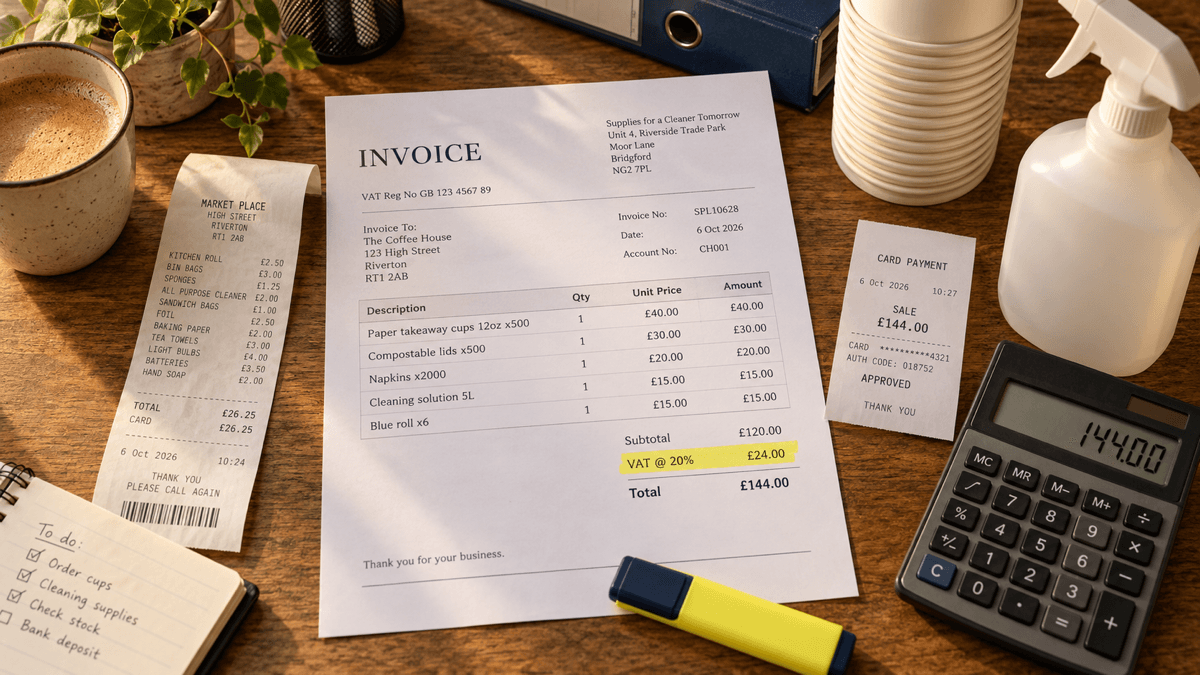
Most cafés have a drawer with a rubber band round a wad of paper: card slips from the hardware shop, a supermarket receipt for emergency bin bags, a delivery note from the packaging supplier, the engineer's job sheet for the dishwasher. In 17 years of running cafés I have rarely met an owner without one. Somewhere in there is VAT they are entitled to and will never see.
The usual excuse is that food is zero-rated, so there is little VAT to reclaim. True of most of your ingredients. But most of the VAT was never on your ingredients. It sits on everything around them, and HMRC only gives it back against the right piece of paper.
VAT is UK-wide; Northern Ireland has extra rules for goods bought from the EU, not covered here.
Where the VAT actually sits
Most food is zero-rated when you buy it: flour, butter, milk, eggs, coffee beans, tea. No VAT on the invoice, nothing to reclaim. The VAT lives in a different set of lines.
An illustrative year of purchases for a VAT-registered café, ex VAT:
| Purchase | Spend ex VAT | VAT reclaimable |
|---|---|---|
| Food ingredients, milk, coffee and tea (zero-rated) | £60,000 | £0 |
| Soft drinks, bottled water, crisps and confectionery for resale | £8,000 | £1,600 |
| Packaging and takeaway cups | £6,000 | £1,200 |
| Cleaning products and paper | £2,500 | £500 |
| Business energy | £12,000 | £2,400 |
| Repairs and small equipment | £5,000 | £1,000 |
| Software billed from the UK | £1,800 | £360 |
| Delivery platform commission | £6,000 | £1,200 |
| Card processing fees (exempt) | £4,500 | £0 |
| Total | £105,800 | £8,260 |
Food is 56.7% of that spend (£60,000 of £105,800, to one decimal place) and carries no VAT. The standard-rated lines, £41,300 or 39.0%, carry all £8,260: about £159 a week (£8,260 ÷ 52 = £158.85). Alcohol, if you are licensed, is standard-rated too.
Some lines need care:
- Energy. Usually 20%. A very small user pays less under VAT Notice 701/19: 5% on gas, and on electricity a temporary 0% in Great Britain from 1 October 2026 to 31 March 2027 (5% in Northern Ireland). Any VAT you are charged is still reclaimable.
- Card fees. VAT Notice 701/49 exempts "the charge made to merchants (retailers) by credit card companies", the per-transaction percentage. Terminal rental usually carries VAT unless it is part of the card service, so check each line on your provider's invoice.
- Rent, insurance and wages. Rent only carries VAT if your landlord has opted to tax the building. Insurance is exempt. Wages carry none.
No valid invoice, no reclaim
HMRC's record-keeping guide, VAT Notice 700/21, puts it plainly: "The VAT invoices you receive are the primary evidence for you to recover VAT you have incurred as input tax".
There is a fallback, but not a safety net. Under the VAT guide, Notice 700, without a VAT invoice "the first thing you must do is go back to your supplier and request a VAT invoice". Only if that fails do you turn to other evidence, and then it is HMRC's call: where you took reasonable steps and there is no fraud risk, "HMRC will consider exercising discretion to accept alternative evidence." "Will consider" is not "will accept".
Two more limits. "You cannot claim more VAT than is shown on a valid VAT invoice" (gov.uk), so if the supplier got it wrong, ask for a corrected invoice. And Notice 700 says you must repay reclaimed VAT "if you have not paid your supplier within 6 months" of the supply date, or of the payment due date if that is later.
What a full VAT invoice must show
Notice 700/21 lists the contents. On a supplier invoice, look for:
- A unique sequential invoice number
- The time of supply (the tax point), and the date of issue if that is different
- The supplier's name, address and VAT registration number
- Your name and address
- "a description sufficient to identify the goods or services supplied"
- For each line: the quantity or extent, the VAT rate and the amount excluding VAT
- The total excluding VAT
- The rate of any cash discount offered
- The total VAT, in sterling
- The unit price
Notice 700 adds that unit price applies to countable goods or services, such as an hourly rate, and can be left off only where your trade does not normally show it and you have not asked for it. Your wholesaler's invoice ticks all of this. In my experience the gaps turn up with one-off suppliers: the repair engineer, the sign-writer, the contractor who unblocked the drain.
The simplified invoice, for £250 or less
For a supply of £250 or less including VAT, a simplified, less detailed invoice will do. It must show:
- the supplier's name, address and VAT registration number
- the time of supply (tax point)
- a description which identifies what you bought
- for each VAT rate, the total including VAT and the rate charged
No invoice number or customer name, and the VAT need not be shown separately; where it is not, work it out from the VAT-inclusive total for each rate: one sixth at 20%, one twenty-first at 5%. Over £250, you need a full invoice or a "modified" one showing VAT-inclusive values.
Till receipts, cash and carry and card slips
Supermarket receipts are often built to work as simplified invoices, which matters if you buy from supermarkets and cash and carry between deliveries. Check yours shows the store's name, address and VAT number, the date, what you bought, and for each VAT rate the total including VAT and the rate.
If not, ask for a VAT receipt: Notice 700 warns retailers they "may be liable to a financial penalty" for refusing a VAT-registered customer. Over £250, ask customer services for a full VAT invoice.
Cash and carry till rolls can be full VAT invoices. If yours uses product codes rather than descriptions, Notice 700 requires the wholesaler to give you an up-to-date code list, so ask for it and keep it with the receipts. Splitting a mixed receipt into zero-rated and standard-rated lines is the same job as coding it to the right accounts.
Card slips are the trap. An ordinary slip shows the shop, the amount and the date, so on its own it is not a VAT invoice. Illustrative:
- £180 of cleaning supplies, including VAT, with only a card slip: £180 ÷ 6 = £30 of VAT you cannot support.
- A £600 oven repair, including VAT, with only a card slip: £600 ÷ 6 = £100. At over £250, it needed a full invoice anyway.
Paper that looks like an invoice but is not
The gov.uk guide to keeping VAT records is blunt: "You cannot reclaim VAT using an invalid invoice, a pro-forma invoice, a statement or a delivery note."
- Pro forma invoices. Notice 700 says they cannot be used "even if they show all the details required for a VAT invoice". The same goes for anything marked "this is not a tax invoice". Pay it, then wait for the real one.
- Statements. Fine for checking what you owe, but every line must trace back to an invoice you hold.
- Delivery notes. Proof the goods arrived. If the invoice never follows, chase it.
- Order confirmations and quotes. Same logic: they describe a supply, they do not evidence one.
Suppliers who are not VAT registered
"Only VAT-registered businesses can issue VAT invoices," says gov.uk. The farm shop, the small baker supplying your sourdough and the market trader may all be under the threshold. That is fine: no VAT charged, none to reclaim.
The problem is VAT charged by someone not entitled to charge it, which you cannot reclaim. Notice 700 says that if you receive an invoice from an unregistered person "and knowingly use it to reclaim VAT, you're committing an offence."
So check. HMRC's Check a UK VAT number service shows the name and address a number is registered to, though "You cannot use this service to check if a business or organisation is registered for VAT by searching its name." A number registered to a different business is worth a phone call before you pay.
Online marketplaces are the same: only a VAT-registered seller can issue a VAT invoice, so no invoice means no reclaim, whatever the price includes.
CostingBrik reads the VAT or company registration number on an invoice when matching it to a supplier, costs every line ex VAT, and remembers whether each supplier prices including or excluding VAT. It does not check the number is valid, so the gov.uk checker is still the step for a new standard-rated supplier.
Overseas subscriptions and ads: the reverse charge
Your ads, booking system or design software may be billed from abroad. Check the invoice, not the brand: some big platforms bill UK customers from a UK company with UK VAT, others from Ireland or the US with none.
For the second kind, you apply the reverse charge. VAT Notice 741A says "you, the customer, must act as if you are both the supplier and the recipient of the services". Illustrative: £300 a month of ads billed from overseas with no VAT is £900 a quarter.
| What this charge adds to your return, per quarter | Amount |
|---|---|
| Box 1, output VAT added (£900 x 20%) | £180 |
| Box 4, input VAT added | £180 |
| Added to Box 6 (sales ex VAT) | £900 |
| Added to Box 7 (purchases ex VAT) | £900 |
| Net effect on VAT to pay | £0 |
If you can reclaim in full, "the reverse charge has no net cost to you." It still has to go on the return. And if an overseas supplier wrongly charges UK VAT, "you must still apply the reverse charge as it is not an optional adjustment" and ask them to correct the invoice.
Not VAT registered yet? These count towards your £90,000 registration threshold: gov.uk includes "services you received from businesses in other countries that you had to 'reverse charge'" in taxable turnover. £300 x 12 = £3,600 a year on top of your takings, which matters close to the line.
Entertaining: staff yes, customers no
Notice 700/65: "You cannot recover input tax incurred on the provision of business entertainment expenses." Lunch with a supplier's rep gets no VAT back. Staff entertainment is reclaimable, though only the staff share once staff bring guests such as their partners; how VAT works on the staff Christmas party has the worked apportionment.
On the Flat Rate Scheme? Different rules
On the Flat Rate Scheme, Notice 733 says "you do not recover input tax": your flat rate already allows for it. The exception is a single purchase of capital expenditure goods "where the amount of the purchase, including VAT, is £2,000 or more."
Illustrative:
- A coffee machine at £2,400 including VAT, from one supplier at one time: qualifies. VAT reclaimable: £2,400 ÷ 6 = £400.
- A fridge and a dishwasher at £1,200 each including VAT from two suppliers: two purchases, neither reaches £2,000, nothing back. From one supplier at one time, Notice 733 counts them as one £2,400 purchase.
- Services never qualify: an engineer's repair or a builder's refit gets nothing back.
You still need a valid VAT invoice for the coffee machine.
Credit notes take VAT back off you
When a supplier credits you for a short delivery or a price error, the VAT on the credit comes off your reclaim in the period the price reduction happens, which for a refund is when the money is paid back to you (Notice 700, section 18.2). A credit note marked "This is not a credit note for VAT" means neither of you adjusts the VAT. Getting suppliers to issue the credit notes they owe you is its own job.
Found one you missed? Time limits and records
An unclaimed invoice cannot go on whichever return you like. Notice 700 treats missed input tax as an error to correct, with a cap: "The time limit for claiming deduction of input tax is 4 years from the due date for the return on which you were first entitled to claim deduction of the input tax."
Most café-sized corrections can go on your next return: Notice 700/45 allows it where the net value of errors "does not exceed £10,000". An invoice that simply arrived late is different: Notice 700 says claim it on the return "for the period during which you receive that evidence."
Notice 700/21: "Generally, you must keep all your business records for VAT purposes for at least 6 years." A scan or photo is fine where "the image is retained and contains all the detail required for VAT purposes". Typing selected figures into software does not replace the original, so photograph the whole receipt, VAT number in shot.
From April 2029, VAT invoices between businesses are due to be sent as structured e-invoices carrying these same details, and what e-invoicing means for cafés from 2029 covers what is known so far.
This week
- Empty the drawer. Sort it into full invoices, simplified invoices and card slips, then chase a proper invoice for every slip with real standard-rated spend.
- Check the VAT numbers on your top ten standard-rated suppliers with HMRC's checker.
- Ask every engineer and contractor for a full VAT invoice, not a job sheet, before you pay.
- Fix your overseas subscriptions. Find which company and country each ad and software invoice comes from, and put the reverse charge on the return.
- Photograph supermarket and cash and carry receipts the same day, whole and legible.
The VAT was never on your flour and milk. It is on the cups, the cleaner and the call-out, and it comes back one valid invoice at a time.
Ed O'Brien has run Hunters Cake Company for 17 years across cafés in Witney, Burford, and a bakery in Carterton, Oxfordshire. He's building Brikly - modular tools that give independent café owners the same data the big chains have, without the big chain price tag.