
Sub-recipes: costing the sauce, sponge or base used in ten dishes
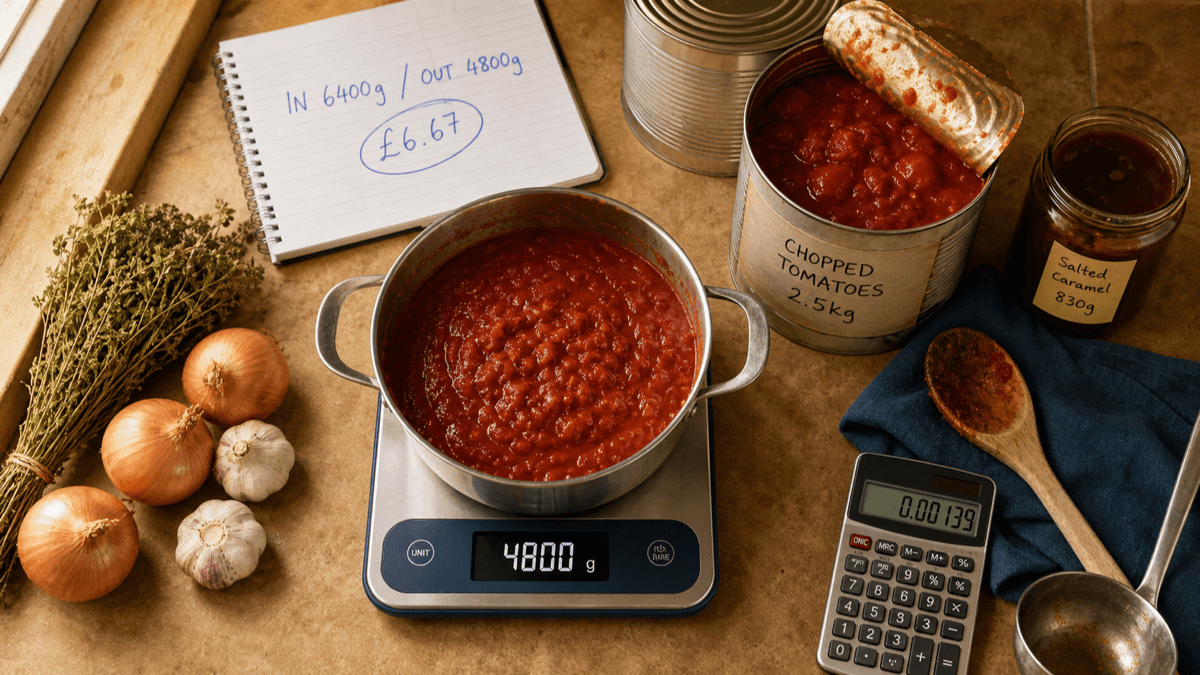
Nobody makes a portion of tomato sauce. You make a pan of it, and it turns up in the lasagne, the meatball sub, the shakshuka, the veg bake and whatever the special is on Thursday.
Yet most cost cards are built as if you started from tins every time. The lasagne card lists tomatoes, onions, garlic and oil. So does the meatball sub card. So does the bake. Same ingredients, typed five times, each one slightly different because you rounded differently on a Tuesday.
That costs you twice: once in the hour spent re-entering the same lines, and once in the quiet drift between five versions of a number that should be identical.
The fix is to stop treating the sauce as a list of ingredients and start treating it as an ingredient.
What a sub-recipe actually is
A sub-recipe is anything you batch, hold and then use in more than one finished dish. House tomato sauce, a curry base, a stock. A sponge, a shortcrust, a brownie base. Hummus, a house dressing, a pesto. A granola, a compote, a caramel, a buttercream.
Each one has the same shape. You buy raw ingredients, you make a quantity of something, then you dispense it into dishes by the spoon, the ladle, the slice or the scoop.
Costing it properly is four steps.
- Cost the whole batch. Every ingredient in the pan, at invoice prices.
- Weigh what comes out. Finished yield, after cooking, reducing, cooling and scraping the bowl.
- Divide. Batch cost by finished grams, or by finished portions.
- Use it as a line in the parent recipe. 120g of house sauce, not four tins and an onion.
Step two is the one that gets guessed, and it decides whether the rest is right.
The worked example: a house tomato sauce
Illustrative UK 2026 trade prices, ex-VAT. Say you make a batch on a Monday.
| Ingredient | Quantity | Cost |
|---|---|---|
| Chopped tomatoes (2.5kg tin, £2.20) | 2 tins, 5,000g | £4.40 |
| Onions (£0.95/kg) | 1,000g | £0.95 |
| Garlic (£6.40/kg) | 80g | £0.51 |
| Rapeseed oil (£1.90/L) | 100ml | £0.19 |
| Tomato purée (£2.00/kg) | 200g | £0.40 |
| Dried oregano (£14.00/kg) | 10g | £0.14 |
| Salt, pepper, pinch of sugar | - | £0.08 |
| Batch cost | £6.67 |
Everything that went in the pan weighs about 6,400g. That is the number people divide by, and it is wrong, because you then simmer it for an hour and a half to get it thick enough to hold on a plate. When it cools, you weigh the tub. 4,800g. A quarter of the weight has gone off as steam and none of the cost went with it. This is the same cooking loss that inflates the cost of every reduced or roasted dish, and a sauce is the purest example of it.
- Divide by raw weight: £6.67 / 6,400g = £0.00104 per gram
- Divide by finished weight: £6.67 / 4,800g = £0.00139 per gram
A third more per gram, and that gap sits inside every dish the sauce touches.
On a 120g serving, the raw-weight version says 12.5p and the finished-weight version says 16.7p. Four pence a dish sounds like nothing. If those five or six menu items shift 260 portions a week between them, it is about £570 a year you thought you had and did not.
Then it cascades, which is the good news and the bad news
Now the tinned tomato price moves. The case goes from £13.20 to £15.30, so a tin goes £2.20 to £2.55.
Batch cost goes £6.67 to £7.37. Cost per finished gram goes £0.00139 to £0.00154. Your 120g serving goes 16.7p to 18.4p.
Under seventeen pence to just over eighteen. You will not spot that on a plate, or on a bank statement, or anywhere else. Across those same 260 portions a week it is roughly £230 a year, from one line on one invoice.
Run the sub-recipe properly and that cascade works for you: change the tin price in one place and every dish downstream is correct that afternoon. Do it the old way and you have five recipe cards to find, five sets of tin maths to redo, and a decent chance you update three of them.
The flip side is the risk. One wrong sub-recipe cost is wrong in ten menu items at once. Fat-finger that finished yield and you have not made one dish wrong, you have made the whole savoury section wrong by the same percentage, in the same direction, invisibly. Sub-recipes concentrate accuracy and they concentrate error just as efficiently.
So the ingredients feeding a sub-recipe deserve more care than the ones feeding a single dish. If your tinned tomatoes exist twice under two spellings, half the price history sits under each, and duplicate ingredients quietly wreck the costing of everything the sauce touches rather than just one card.
Labour: pick one answer and keep it
Batching is labour. Ninety minutes of someone's time went into that pan, and it is fair to ask whether it belongs in the cost.
My answer is to leave it out, and be loud about leaving it out. Sub-recipe cost means ingredients only, same as every other recipe cost you hold. Labour sits in your wage percentage where you can see it.
What matters more than the answer is picking one and holding it. The failure mode is mixing: labour baked into the sauce, then a labour percentage applied again at menu-pricing time, so the lasagne carries the prep cost twice and looks worse than it is. Half your dishes loaded, half not, and nothing comparable.
The one place batch labour genuinely earns its keep is a make-or-buy decision. Ready-made sauce at £3.40/kg against your £1.39/kg is a big gap, but not a 60% gap once you value the ninety minutes. Do that as its own sum, because the batch size is what decides make or buy.
Nesting: caramel inside a buttercream inside a cake
Two levels deep is common in a bakery and it works exactly the same way, just twice.
Level one, salted caramel. Caster sugar 500g at £1.10/kg, double cream 300ml at £3.20/L, butter 100g at £6.80/kg, sea salt. Batch cost £2.22. In at about 905g, out at 830g once it has boiled and you have scraped the pan. So £0.00268 per gram.
Level two, caramel buttercream. Butter 400g (£2.72), icing sugar 700g (£0.98), and 250g of that caramel (£0.67). Batch cost £4.37, finished yield 1,325g after what stays on the beater. £0.0033 per gram.
Level three, the cake. It takes 480g of buttercream, so £1.58 in the cake, with the caramel priced off the cream and sugar invoices rather than a guess.
Two rules keep nesting honest. Never nest deeper than you can explain out loud. And take a finished yield at every level, including the boring ones: the buttercream only loses a couple of percent to the bowl, but uncosted losses at three levels stack up on a cake you sell four hundred of.
If the component is portioned rather than dispensed, cost per portion is often clearer. A sponge base cut into twelve slices is twelve portions, which is the same arithmetic as costing a cake slice or a traybake. Per gram when it leaves the tub by ladle, per portion when it leaves by knife.
When not to bother
Sub-recipes are structure, and structure has an upkeep cost. Do not build one you will not maintain.
Skip it when the component goes in exactly one dish, when you make it once for a special, or when it is trivially small. If the granola only ever goes in the granola pot, just cost the granola pot. A 40g garlic butter does not need its own yield study.
Build one when the component appears in two or more parent recipes, or when you batch it often enough that the finished yield is a real, repeatable number. Two parents, or a repeating batch. Everything else stays as ingredient lines on the dish card, which is the ordinary recipe costing method for pricing every dish on your menu and is perfectly sufficient. The same logic works beyond food: a takeaway packaging sub-recipe costs the cup, lid and sleeve once and attaches to every takeaway drink.
One batch, this week
Pick the component that appears in the most dishes. Almost every café has one obvious answer, usually a sauce, a base or a dressing.
- Cost the whole batch from invoices, not memory.
- Make it as normal, and weigh what actually comes out.
- Divide batch cost by finished grams.
- Multiply by your serving weight, and compare it with what the recipe cards say now.
The gap between those two numbers, times the portions you sell in a year, is the size of the problem. The free recipe costing calculator will do the per-portion arithmetic while you stand at the bench. If you keep your costings in a spreadsheet, the sub-recipe row is one of the four places a recipe costing template breaks.
CostingBrik does the structural bit: a recipe can be used as an ingredient inside another recipe, so the sauce is one line in the lasagne, and when a new tin price lands on an invoice the cost moves through every dish that uses it. Useful, but not the point. The point is the weighing, and no software does that for you.
Weigh one batch this week. If the finished weight surprises you, every dish that batch touches has been wrong for a while.
Ed O'Brien has run Hunters Cake Company for 17 years across cafés in Witney, Burford, and a bakery in Carterton, Oxfordshire. He's building Brikly - modular tools that give independent café owners the same data the big chains have, without the big chain price tag.