
Make it or buy it in? The batch size that decides
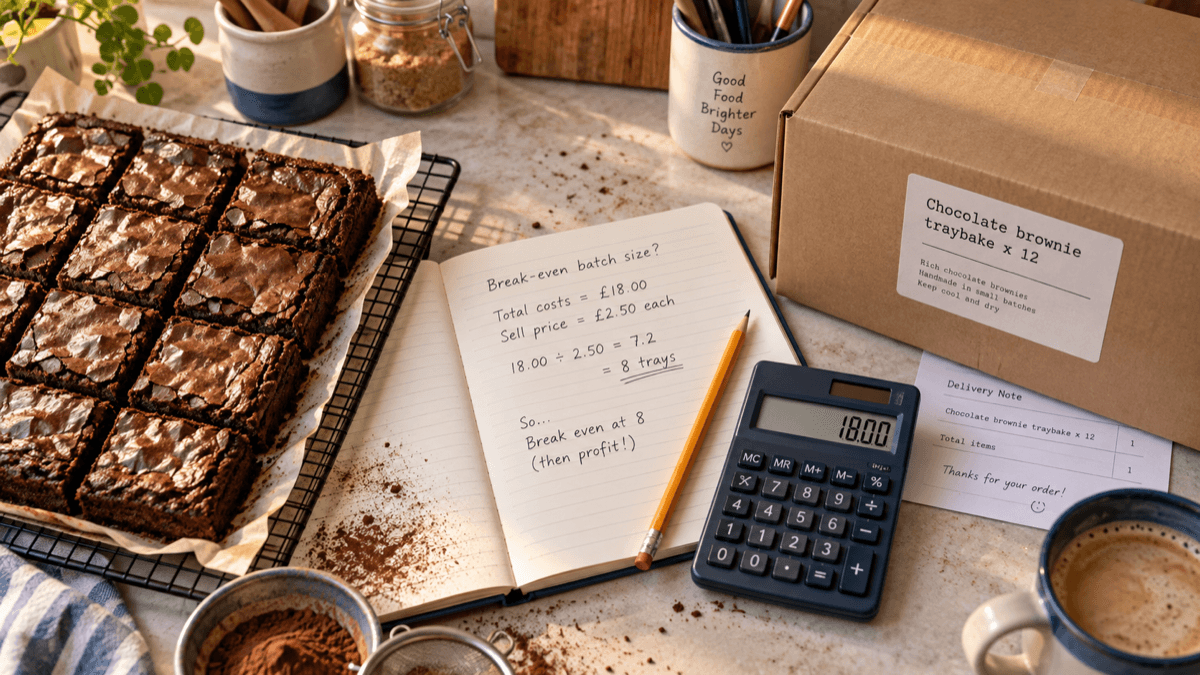
Two trays on the bench. One arrived this morning with a price printed on the invoice. The other one you made.
That is the whole problem. The bought-in tray shows its full cost in one number. The homemade one shows its ingredients and hides its labour in somebody's shift, so the time feels free. It is not free. It is just not itemised.
In the post on costing sub-recipes and batches I said the one place batch labour genuinely earns its keep is a make-or-buy decision, and to do it as its own sum. This is that sum. The answer is not yes or no but a number of units in one batch: the size a batch must reach before the time you spent is paid for.
First, put a real number on the hour
You cannot value the mixing until you know what an hour of that person costs, and a batch needs that as a per-minute figure.
Take a team member on the National Living Wage, £12.71 an hour for anyone 21 and over since 1 April 2026, on a 30-hour week over 52 weeks: 1,560 hours actually worked and £19,827.60 of gross pay.
Three things sit on top, built the way the labour half of prime cost is built:
- Holiday accrual at 12.07%. £12.71 x 0.1207 = £1.53 an hour.
- Employer National Insurance, 15% above the £5,000 a year secondary threshold. (£19,827.60 - £5,000) x 0.15 = £2,224.14, over 1,560 hours = £1.43 an hour. That is 11.2% of base, not 15%: the first £5,000 is exempt.
- Employer pension, 3% of qualifying earnings, the band from £6,240 to £50,270, not all pay. (£19,827.60 - £6,240) x 0.03 = £407.63, over 1,560 hours = £0.26 an hour, or 2.1% of base.
£12.71 + £1.53 + £1.43 + £0.26 = £15.93 an hour. Call it £15.90, or 26.5p a minute.
The lazy shortcut adds the headline percentages together and gives £16.53, overstating by 60p because it ignores both thresholds. Load NI and pension onto the holiday element and you get £16.21, so the honest range is £15.93 to £16.21. I am using the bottom of it.
A baker on a £14.00 base comes out at £17.61 on the same sum, which is where the cake and traybake costing post gets its fully loaded baker cost of around £18 an hour.
The rate leaves out training, uniform and sick pay, so if anything it is on the low side. But check who is actually mixing: employer NI is nil for an under-21 or an apprentice under 25 up to £50,270, which drops the loaded rate to about £14.51 and turns the five-tray answer below into four.
Both sides of the comparison, per saleable unit
I am picking the brownie tray up where the traybake post left it.
Made in-house. Illustrative ingredient cost for the whole tray, ex-VAT: £8.65. You cut it into 15, trim the crisp edges off all four sides, the corners are never right, and you get 12 good squares. £8.65 ÷ 12 = £0.72 a square.
Bought in. A pre-cut frozen wholesale tray of 12 portions at £14.40 ex-VAT, so £1.20 a portion. Illustrative, not a quote: substitute your own and the whole thing re-runs.
Here is the bit people skip: bought-in portions are pre-cut and uniform, so 12 of 12 are saleable. Compare per saleable unit on both sides, or you hand the homemade tray three squares it never earned.
Saving per saleable unit: £1.20 - £0.72 = £0.48.
One line on VAT. Brownies count as cake, and cakes and flapjacks are zero-rated as groceries, so there is no input VAT to reclaim on that wholesale tray: the invoice price is the cost. The eat-in sale is standard-rated, so keep both sides ex-VAT.
The sum
Time one session honestly, from weighing out to wash-down. Say 45 minutes of hands-on time for one tray. That is an assumption, not a measurement, so time your own before you trust it.
Batch labour cost: £15.90 x 45/60 = £11.93.
Break-even batch size = batch labour cost ÷ saving per unit = £11.93 ÷ £0.48 = 24.85, so 25 saleable squares.
One tray gives you 12, delivering 12 x £0.48 = £5.76 of saving against £11.93 of labour: £6.17 worse off than if you had opened the box. About 51p a square, on the item everyone assumes is cheaper to make.
Then check what an extra tray actually costs
Twenty-five only holds if every tray costs a fresh 45 minutes, and it does not. As the freezer post puts it, it takes very nearly the same time to make one tray as three.
Split it. About 30 minutes is session-fixed: kit out, oven up, weigh the shared dry goods, melt the butter and chocolate, wash down. The other 15 is per tray: line, fill, trim, cut, box.
At 26.5p a minute, fixed labour is £7.95 and marginal labour £3.98 a tray, or £3.975 before rounding, which is the figure every sum below uses. Each tray saves £5.76 and costs that £3.975, netting £1.785 towards the fixed cost.
£7.95 ÷ £1.785 = 4.45, so five trays. Sixty saleable squares.
That is how 25 and 60 sit together. Twenty-five is the batch size if every tray had to pay for its own 45 minutes. Sixty is the batch size once the 30 fixed minutes are shared across the session, and it is the real one, because nobody heats an oven per tray.
Run five trays end to end, assuming the oven takes the lot in one go. That is 105 minutes, £27.83 of labour, plus 5 x £8.65 = £43.25 of ingredients: £71.08 for 60 squares, or £1.18 each, against £72.00 to buy the same 60 in.
You are ahead by 92p. Ninety-two pence, for 105 minutes and five trays. Drop to four trays and it is £1.22 a square, so that session lands 85p worse than buying the 48 in.
Run the structural test first
Marginal labour per square is £3.975 ÷ 12 = about 33p. If your saving per unit is below that, every extra tray loses money and no batch size ever breaks even. The top row of the table is that case: no answer exists.
| Bought-in per portion | Saving per unit | Net per tray | Trays to break even | Break-even batch |
|---|---|---|---|---|
| £1.00 | £0.28 | -£0.615 | never | no batch size works |
| £1.20 | £0.48 | £1.785 | 4.45, so 5 | 60 squares |
| £1.50 | £0.78 | £5.385 | 1.48, so 2 | 24 squares |
| £1.80 | £1.08 | £8.985 | 0.88, so 1 | 12 squares |
All illustrative, at £0.72 a square in-house and £3.975 of marginal labour, so every division reproduces. Eighty pence of movement in the bought-in price takes you from never worth making to one tray is worth making, so re-run it whenever either price moves. Add 35p of oven energy to the session, or redo it at the £16.44 bank-holiday rate, and it is still five trays.
Now hold 60 against the counter
Sixty squares out of one session. How many do you actually sell?
Brownies stretch to two days if you are lucky, three at a push. That is my operational judgement, not a rule: best-before dates are about quality and each business sets its own. I am assuming three below, generously. At two the arithmetic only gets worse.
Say you sell 20 a week. Even selling a week's worth off one bake, you bin 40, and £71.08 over 20 sold squares is £3.55 a square. Against a £3.60 counter price, £3.00 ex-VAT, you lose 55p on every one you sell, and the "cheaper" homemade square costs nearly three times the bought-in one.
Realistically it is worse. Three days of counter life at roughly 2.9 a day is 9 sold and 51 binned: £7.90 a sold square. Buying 20 a week costs £24.00, no labour, nothing in the bin.
The fix is not a smaller batch, which fails the break-even test. It is the freezer. Bake the five trays, counter 12, and wrap and freeze the other 48 on bake day, while they are obviously fresh.
To borrow the freezer post's line: freezing on bake day is a strategy, freezing on day three is a rescue. Do that and the 60 is real, and so is the 92p.
A two-week bin log at close is the cheapest way to get an honest weekly sales figure.
What the number is actually for
Ninety-two pence for 105 minutes is not a business case. At these prices, making brownies in-house is a quality and story decision, not a money one, which is a perfectly good reason as long as you know it is the reason. Nor does the sum say buy everything in: at £1.80 a portion, one tray clears it. It decides per product, at today's prices.
Bring in bought-in cakes and labour drops while cost of sales climbs; bake in house and the reverse happens. Food cost percentage and wage percentage each hide that trade from the other, which is why prime cost, food and labour combined, is the referee.
CostingBrik holds hands-on minutes against a labour rate and shows the after-labour figure beside gross profit rather than inside it, so ingredient costs stay comparable and the labour stays visible. The division is still yours, and the free recipe costing calculator does the per-unit arithmetic at the bench.
So pick the thing you bake most out of habit. Time one session, get a real bought-in price, and do the division. You will find either a line worth defending or one worth handing over.
Ed O'Brien has run Hunters Cake Company for 17 years across cafés in Witney, Burford, and a bakery in Carterton, Oxfordshire. He's building Brikly - modular tools that give independent café owners the same data the big chains have, without the big chain price tag.