
Matcha is not the margin you costed last year
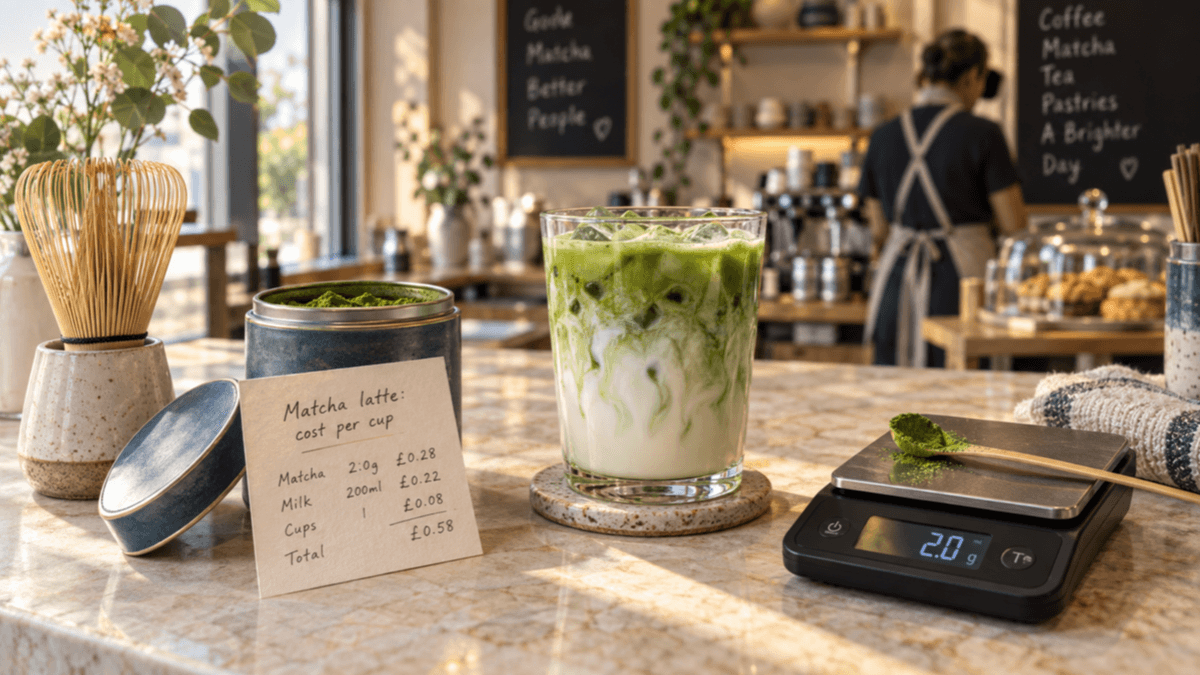
The matcha powder I buy went from 7.035p a gram on 11 March this year to 10.3275p by 1 July, 7.0p to 10.3p in round numbers. That is a 47% rise, in three separate moves, on an ingredient that goes into a drink I sell all summer. Nothing in the headline inflation number told me. My invoices did.
I published those figures in August as part of a 20-minute audit of how stale your recipe costs are. What I did not do at the time was follow the number through to the drink. Three moves in 112 days is roughly one every 37 days: an annual re-cost would have caught none of them, a quarterly one would have caught two, and a six-month rolling average would have had you costing matcha at a price you had not paid since spring.
Matcha went on most boards because it sells to people who do not drink coffee and it looked like a lovely GP. Then the cost moved three times and nobody touched the costing. So here is the cup built properly, hot and iced.
Why the powder moved, and why that is not your cost
At the first tencha market of the year, held on 13 May at the JA Zen-Noh Kyoto Uji Tea Distribution Centre in Joyo City, machine-picked tencha averaged 13,972 yen a kilogram, about 1.7 times the previous record of 8,235 yen set the year before. A session in Kagoshima the next day averaged around 19,000 yen, roughly 1.8 times the year before. The Global Japanese Tea Association's August report closed out the Uji market season: 595 tons of tencha, hand-picked and machine-harvested together, the largest volume since that market opened in 1974, with machine-harvested tencha averaging 17,250 yen a kilogram, the highest since price records began there in 1996.
Those are single trading markets, not national totals, so read them as the shape of the season rather than its size. Volume through the market went up. Price went up harder. That is demand rather than a crop failure, and demand does not correct the way weather does.
The hot cup, line by line
A 180ml hot matcha latte, eat-in, in a ceramic cup, at an illustrative £4.20 inclusive of VAT. Pull the VAT out first: ex-VAT turnover is £3.50.
Dose is 2g in both builds, so the only variable is price and grade. One UK barista-grade supplier's guidance is 2g to 3g per 12oz cup, which makes 2g generous in a 180ml ceramic and lean in a 16oz iced cup. If your iced spec is 3g, add half again to every matcha line below. Milk is whole dairy at an illustrative £1.28 a litre.
| Per cup, ex-VAT | At March's matcha price | At July's matcha price |
|---|---|---|
| Ex-VAT turnover | £3.50 | £3.50 |
| Matcha, 2g | £0.141 | £0.207 |
| Milk, 180ml | £0.230 | £0.230 |
| Total ingredient cost | £0.371 | £0.437 |
| Ingredient gross profit | £3.129 | £3.063 |
| Ingredient gross margin | 89.4% | 87.5% |
The whole 47% rise is worth 6.6p a cup and 1.9 margin points on this build. You can check it the other way round: 6.6p divided by £3.50 of turnover is 1.88 points. Both routes agree.
For the labour line, a barista at £12.71 an hour costs roughly £15.80 fully loaded on the April 2026 rates, once employer NI, pension and holiday accrual are in: 46p for an illustrative 105 seconds of make and reset. Time your own three at service speed. That £15.80 is up from the £14 the flat white P&L was built on, which is the same argument turning up in my own back catalogue.
The iced build is a different drink, and it is the one that is wrong
Among under-35s, around half of matcha orders are iced, per the 2026 café drinks trend report, and it is the build most people cost least carefully. A 16oz iced matcha latte with barista oat, takeaway, at an illustrative £5.20.
Note what does not happen here: a takeaway cold drink that is a milk or tea preparation is zero-rated, so £5.20 is the ex-VAT turnover. There is no VAT to pull out. Add fruit purée and you are into smoothie territory, where that saving disappears.
| Per cup, ex-VAT | At July's matcha price |
|---|---|
| Turnover (zero-rated takeaway) | £5.20 |
| Matcha, 2g | £0.207 |
| Barista oat, 250ml at £1.90/l | £0.475 |
| Water and ice | £0.010 |
| 16oz cup, dome lid, paper straw | £0.320 |
| Total cost | £1.012 |
| Gross profit | £4.188 |
| Ingredient and packaging margin | 80.5% |
Oat, cup, lid and straw are illustrative too. Run the same build at March's matcha price and you get £0.946 of cost and 81.8%, so the 47% rise costs 1.3 points here.
Two things fall out of that table. The oat at £1.90 a litre is doing more damage than the matcha is, an argument I have already had at length in the piece on whether you should charge extra for oat milk. And the packaging is 32p, nearly a third of the cost of the drink.
Then there is the VAT line. Sell that same £5.20 drink to someone sitting in and it is standard-rated catering. Ex-VAT turnover drops to £4.333, gross profit to £3.32, margin to 76.7%. That is 3.9 margin points and 87p a cup, purely on where the customer sits.
Three levers, and two of them are traps
Price: 8p restores the cash, 75p restores the percentage
To recover 6.6p of ex-VAT cost you need 8p on the menu inclusive of VAT. £4.20 becomes £4.28, practically £4.30. At £4.30 you make £3.146 of ingredient gross profit against £3.129 in March, so you are 1.7p a cup better off in cash than before the rise.
But you are still on 87.8% against March's 89.4%. To restore the percentage you need an ex-VAT price of £4.12, which is £4.95 on the board: a 75p rise to chase a 6.6p cost increase. That is the markup-versus-margin trap, and you buy back 1.6 points with a volume drop that never shows up on the recipe card.
Dose: the saving lands on the wrong drink
Cut 2g to 1.5g and you save 5.2p, which recovers 78% of the rise. On the concentrated 180ml hot build, most people would not call it. In 250ml of oat over ice it is pale and thin, and 2g in a 16oz cup is already under that supplier's 12oz guidance before you cut anything. The lever works on the small cup and fails on the build that is at least half the mix.
Grade: the one that actually pays
Checked on 21 September 2026, the London wholesaler Moicha lists latte grade matcha at £130 for a 1kg bag, which is 13p a gram, and Premium Ceremonial at £145 for 500g, which is 29p a gram. I am using one supplier's own two grades so the spread is like for like.
The gap varies a lot by supplier, and that matters more than the headline. Heapwell, checked the same day, lists Ceremonial Grade AA for barista at £200 a kilogram and a latte grade bulk pack at £71 for 453g: 20p a gram against 15.7p. All of those are published list prices on a stated date, not trade or negotiated rates. Price your own two grades before you assume anything.
On a 2g dose the Moicha pair is 58p of ceremonial against 26p of latte grade, so 32p a cup. On the tighter Heapwell pair it is 40p against 31p, so under 9p. Your own spread sits somewhere in that range.
What the grade decision is actually worth
Same 16oz iced oat build, same £5.20, three different matcha prices:
| Matcha price used | Cost of the 2g | Total cost | Gross profit | Margin |
|---|---|---|---|---|
| My March price, 7.035p/g | £0.141 | £0.946 | £4.254 | 81.8% |
| My July price, 10.3275p/g | £0.207 | £1.012 | £4.188 | 80.5% |
| Ceremonial at Moicha list, 29p/g | £0.580 | £1.385 | £3.815 | 73.4% |
The top two rows are the same powder on two dates, not two grades. I am not naming what grade I buy; the third row is a published ceremonial list price, in there for comparison.
The price move took 1.3 points. The grade decision takes 7.2, more than five times as hard. And look where the bottom row lands: 73.4% is inside the 70% to 75% band we publish for cold drinks and smoothies, which is rather the point. The same drink at latte grade is 80.5%. Pour ceremonial into a 16oz iced oat build and you hand back seven points to land exactly where an ordinary cold drink already sits. Matcha is not automatically a high-margin drink. It depends entirely on the build.
At an illustrative 30 iced a day across a 100-day summer, that is 3,000 cups. On the Moicha pair the grade swap is worth £960 over those cups. Over the same 3,000 cups, the entire 47% price rise came to about £198. On the narrower Heapwell spread the swap is nearer £260, still ahead of the price rise. The thing nobody chose deliberately is worth anywhere from a third more to nearly five times the thing everybody is annoyed about.
So put the good stuff where it can be tasted. A single-origin ceremonial in a 180ml hot cup is a credible £5 to £6 drink even outside London, and the drinks trend report carries the sourcing advice. Whisked into oat and ice, it is money poured down a straw.
This week
- Find your last matcha invoice. Work out the price per gram, not per bag.
- Weigh the dose. Not the scoop you think you use. Three drinks, on scales, at service speed.
- Build both cups at that price: hot with dairy, iced with whatever milk actually goes in, and put cup, lid and straw in as a line.
- Check the grade against the cup. If ceremonial is going into iced, price the hot version up and move the iced one to latte grade.
- Diary it for the first of December. Three moves in 112 days is not a one-off.
The free recipe costing calculator will do the per-gram and per-portion arithmetic without a login. If the answer comes out ugly, the same question applies to everything else behind your counter, which is the ground the make-it or buy-it-in break-even maths covers.
Matcha did not stop being a good drink. It stopped being the drink you costed. Look at the last invoice, then look at what grade is going in the iced cup, because that second number is the one quietly doing the damage.
Ed O'Brien has run Hunters Cake Company for 17 years across cafés in Witney, Burford, and a bakery in Carterton, Oxfordshire. He's building Brikly - modular tools that give independent café owners the same data the big chains have, without the big chain price tag.