
New staff induction: the first two weeks that decide whether they stay
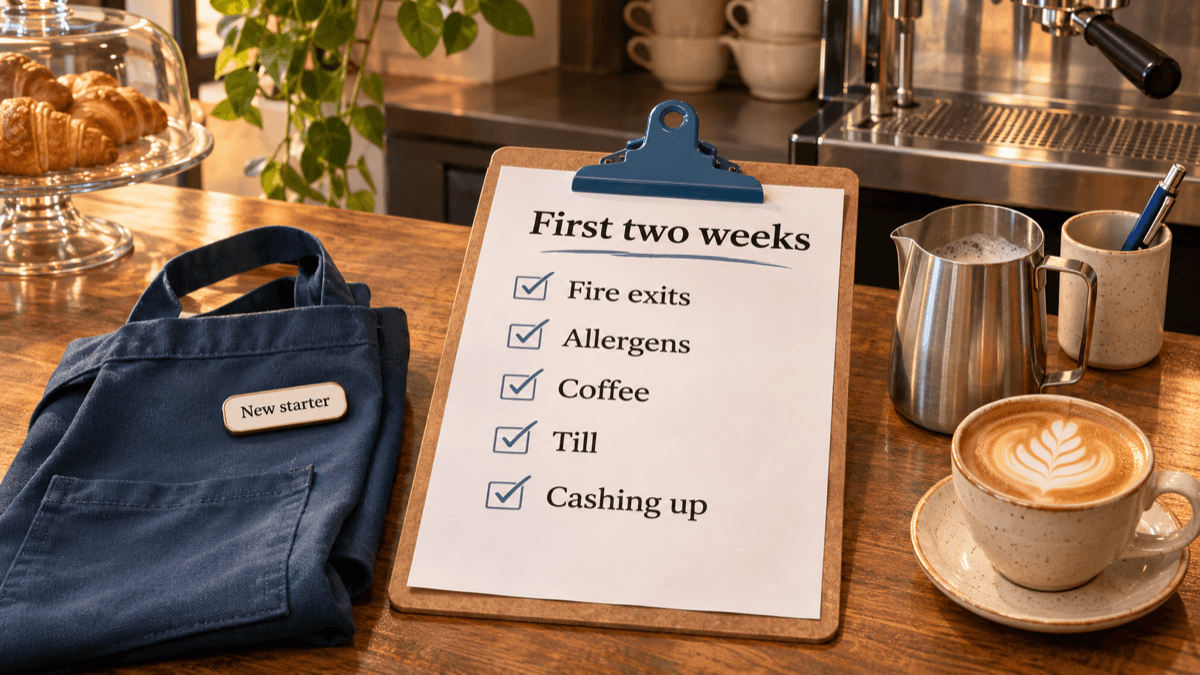
A new starter turns up on a Saturday in late November. Someone shows them the coffee machine between orders, points at the till, and says "just shout if you get stuck". Nobody mentions the fire exit, the allergen folder or what to do if a customer asks whether the brownie has nuts. By the end of week two they've had three shifts on their own and one telling-off for something nobody told them. In week three they send a text: "Sorry, I don't think it's for me."
That text is expensive. Everything you spent getting them through the door is gone, and you're back to the job ad in the busiest month of the year.
Here's an induction plan for a café, from before day one to the end of week two, with the legal must-dos kept apart from the good practice, and the honest cost of doing it properly.
This covers England, Wales and Scotland. The health and safety, food hygiene, minimum wage and pension rules quoted apply across Great Britain. The fire safety law quoted is England and Wales; Scotland sets the same duty in its own regulations, noted below. Northern Ireland has its own employment and health and safety law.
What a bad first fortnight costs
When I worked through what staff turnover really costs a café, replacing one full-time team member came to £2,875 to £5,325, with most independent cafés landing around £3,000 to £3,500. The training line alone was £1,000 to £1,800.
An early leaver is the worst version of that. Someone who goes in week three has already cost you the recruitment line (£425 to £675 on that post's figures) and the onboarding admin (£100 to £150): £525 to £825 before a penny of training, with nothing to show for it except a gap on the rota.
There's a safety cost too. HSE's guidance for people new to the job says new starters are "as likely to have an accident in their first 6 months at work as during the whole of the rest of their working life", and calls the first days and weeks "vital".
So the induction does two jobs. It covers you legally, and it gives a new person a reason to come back for shift four.
Must-do or good practice?
Before the plan, the split. The left column is the law. The right column is what makes people stay.
| Legal must-do | Good practice |
|---|---|
| Right to work check before they start | A buddy for the first two weeks |
| Written statement on or before day one | A written first-shift checklist |
| Payroll details, and HMRC told on or before first payday | Tasks signed off one at a time |
| Health and safety training on being recruited | A check-in at the end of week one and week two |
| Fire safety training when first employed | A probation period with clear reviews |
| Food hygiene supervision and training for the job | Paying even a short trial shift |
| Allergen training | Building up from simple jobs to the espresso bar |
| Pension assessment, and a letter within six weeks | A named person to ask, every shift |
| A risk assessment covering under-18s before they start | |
| Pay at least the minimum wage for every training hour, and for any trial that is real work |
Before day one
The legal bit
Right to work. GOV.UK is plain: "You must check that a job applicant is allowed to work for you in the UK before you employ them." The right to work checks guide covers how to do it and what to keep.
The written statement, drafted. GOV.UK says the employer "must provide the principal statement on the first day of employment". It must list "obligatory training, whether or not this is paid for by the employer" and "how long any probation period is and what its conditions are", so a week-one allergen course goes in it. The full list is in what the written statement must say.
Payroll. If they don't have a P45, GOV.UK says to use HMRC's "starter checklist", which lets you work out "the tax code to use" on their first pay. Then: "You must tell HMRC about your new employee on or before their first pay day."
An under-18's risk assessment. The Management of Health and Safety at Work Regulations 1999 say you must not employ a young person unless you have "made or reviewed an assessment" that takes "particular account of" their "inexperience, lack of awareness of risks and immaturity". Regulation 19 bars work "which is beyond his physical or psychological capacity", with narrow exceptions for supervised training. In a café, write down who uses the slicer, the fryer and the hot water tap. HSE's page on risks to young people says that if you already employ under-18s, your existing arrangements should cover a newcomer of similar maturity; if it's your first, "you should review your risk assessment before they start."
The trial shift
GOV.UK's minimum wage eligibility guidance says there are "no definitive rules or tests", but in the government's view someone "conducting work in a trial lasting longer than one day is likely to be entitled to the minimum wage" in all but very exceptional circumstances.
Shorter isn't automatically safe. The guidance accepts that "an unpaid trial work period lasting a few hours may be reasonable", and its example is a supervised two-hour trial in "a local café", which it calls "proportionate to the job on offer". But it also weighs how closely the person is watched and whether the work has "a value to the employer beyond testing the individual". A candidate serving a real Saturday queue, unwatched, is doing your work.
So pay it. A three-hour trial at the £12.71 adult rate is £38.13, cheaper than an argument about whether the queue counted.
The good practice
- Pick the buddy. One named person on most of their shifts for two weeks. Your most patient person, not necessarily your best barista.
- Rota the first fortnight together, with the first shift at a quiet time, not Saturday lunch.
- Text them the basics: start time, where to come in, what to wear, who to ask for.
Day one
The legal bit
Health and safety training. Regulation 13 says every employer "shall ensure that his employees are provided with adequate health and safety training" and the first trigger is "on their being recruited into the employer's undertaking". It must "take place during working hours". HSE's training guidance adds that it "must be free for employees".
HSE's advice for new starters is to "walk around the workplace or site with new workers" and "show them where the main hazards are". In a café: the first aid kit and accident book, hot surfaces and the steam wand, knives and the slicer, wet floors and stairs, and the cleaning chemicals, which get their own first-shift COSHH brief.
Fire safety training. In England and Wales, article 21 of the Regulatory Reform (Fire Safety) Order 2005 requires "adequate safety training" and the first trigger is "at the time when they are first employed". Scotland's Fire Safety (Scotland) Regulations 2006 set the same duty at the same point, requiring "adequate fire safety training" when staff are first employed. Ten minutes: the exits, the alarm, which extinguisher is for what, that nobody tackles a fire if it puts them at risk, and where everyone meets outside.
Food hygiene, before they touch food. The retained Regulation (EC) 852/2004 says food handlers must be "supervised and instructed and/or trained in food hygiene matters commensurate with their work activity". Note the "and/or". GOV.UK's staff training guidance is clear that "Food handlers do not have to hold a food hygiene certificate", and lists "training on the job" and "self-study" among the routes. What you need is supervision until they're trained, and proof: "You must be able to show that your staff have the right skills and up-to-date training for their role."
Day one is handwashing, clean clothing and the illness rule. The same page says staff "must tell their manager if they are not feeling well", must tell you if anyone they live with has diarrhoea or vomiting, and "must not return to work until they have had no symptoms for 48 hours". Say it out loud. A new starter on a tight budget is the person most likely to come in ill rather than lose a shift.
Allergens. GOV.UK says "Staff must be trained to manage allergies." Day one is the basics: where the allergen information lives, and that nobody guesses. The allergen matrix walk-through takes five minutes, ending with the phrase "give me one second, I'll check that for you". Practising real customer questions at the till comes later in week one.
The written statement. Hand it over on the first day at the latest.
The good practice
- A written first-shift checklist. One side of A4: the walk-round, the fire brief, the illness rule, the allergen rule, break times and who's in charge today. Tick each item, and both of you sign it. That signature is your training record.
- Simple jobs only. Till, clearing, washing up, restocking, plating cake. Not the espresso bar at 12.30.
Week one
The legal bit
Proper allergen training. The FSA's free online food allergy training, which GOV.UK's allergy guidance points businesses to, is six modules with a test each, "expected to take approximately three hours to complete". The course itself says its certificate "does not constitute accreditation": it's evidence of training, not a licence. If you require it, you pay for it, as below.
Food safety training for their job. Your food safety management system, Safer Food, Better Business or your own, sets out the safe methods. Go through the ones that apply to what they'll actually do, and record which and when.
The good practice: sign-offs, one task at a time
The buddy shows a task, watches the new starter do it, and when they've done it right without help, both initial the sheet. A café's list might be:
| Task | When to aim for it |
|---|---|
| Till: taking payment, refunds, a voided item | Week one |
| Allergen questions at the till, using the matrix | Week one |
| Filter, americano, tea, hot chocolate | Week one |
| Fridge and display temperature checks, written down | Week one |
| Cleaning schedule: their tasks, and signing for them | Week one |
| Espresso: dialled-in shot, steamed milk, the standard drinks | Week two |
| Opening and closing routines | Week two |
| Cashing up and the till count | Week two |
A sign-off is not "they've seen it". It's "they've done it, right, on their own, and someone watched".
The end of week one check-in. Twenty minutes, sitting down: what's going well, what's confusing, and whether the hours work. Acas's probation guidance recommends "regular informal check-ins" and says "A review should be a two-way conversation". This is the one that catches the person who'd otherwise text you in week three.
Week two
The legal bit
Pension. The Pensions Regulator says you must "monitor the ages of your staff and the amount you pay them (including new starters)". Anyone aged 22 up to State Pension age earning over £10,000 a year (£192 a week) must go into a scheme, and you must "write to them within six weeks from the day they meet the age and earnings criteria". You can postpone assessment for up to three months from their first day, which suits a probation or a temp, but TPR says "You will have six weeks to write to them from the date after postponement starts." The auto-enrolment guide has the detail. Set it up in the payroll software before the first pay run.
The good practice
The harder sign-offs. Espresso, opening, closing and cashing up. Get these right before anyone's alone with them: a closing routine learned wrong is repeated wrong every night.
The end of week two check-in. Go through the sheet: what's signed off, what isn't, when the rest will be, and plainly how they're doing. Acas says reviews help "make sure the probation outcome is not a surprise to the employee", and says managers should keep records of reviews and share them with the employee after each one.
Probation: the basics
Acas says "There's no legal requirement to have a probation period. And they can be any length of time." If you have one, the written statement must give its length and conditions.
What changes is the backdrop. From 1 January 2027, the qualifying period for ordinary unfair dismissal drops from two years to six months, and statutory notice, one week for anyone employed between a month and two years, counts as service whether or not it's given. The government says to "consider how it will operate with a 6-month qualifying period in force". A six-month probation now ends right where the protection begins, so hold the real review by month five. Someone starting this week reaches six months in May.
Training time is paid time
GOV.UK's guidance on working hours for minimum wage lists "time spent training" among the hours that count, and the health and safety and fire training must, by law, take place "during working hours".
The rates from 1 April 2026, per GOV.UK:
| Age | From 1 April 2026 | Announced for 1 April 2027 |
|---|---|---|
| 21 and over | £12.71 | £13.21 |
| 18 to 20 | £10.85 | £11.27 |
| Under 18 | £8.00 | £8.31 |
| Apprentice | £8.00 | £8.31 |
The classic trap is the online course. "Do the allergen course at home this week" is still training you've required. Three hours at £12.71 is £38.13, and I'd pay it on the next payslip rather than leave a minimum wage question in your records. The same goes for coming in early "to watch".
What a proper induction costs
Here's an illustrative two-week induction for a new barista in a hypothetical café, counting only the time spent on training, not the shadow shifts that are on the rota anyway. Time is costed at the house fully loaded rate of £15.93 an hour, which is 26.5p a minute, for both the new starter and the buddy.
| Induction item | Starter | Buddy |
|---|---|---|
| Paperwork and welcome | 30 min | 30 min |
| Walk-round: fire, first aid, hazards, chemicals | 30 min | 30 min |
| Food hygiene: illness rule, handwashing, safe methods for their role | 60 min | 60 min |
| FSA allergen course | 180 min | 0 min |
| Allergens: day-one matrix walk-through (5 min), then till practice with real questions (25 min) | 30 min | 30 min |
| Task sign-offs, 8 at 15 minutes | 120 min | 120 min |
| Check-ins, end of week one and two, 20 minutes each | 40 min | 40 min |
| Total | 490 min | 310 min |
- Starter: 490 x 26.5p = £129.85
- Buddy: 310 x 26.5p = £82.15
- Total: 800 minutes, £212.00
The allergen course line alone is 180 x 26.5p = £47.70 at the fully loaded rate. The £38.13 above is the same three hours at the bare £12.71 wage, before holiday pay and employer costs.
That's about 7% of the £3,000 at the bottom of the typical replacement cost, and well under half the £525 an early leaver costs before training starts. I can't tell you how many early leavers a written plan prevents, and I wouldn't trust anyone who claims to. But at £212 a hire, keeping one person in a dozen more than covers it: twelve inductions cost £2,544.
The productivity gap, the weeks of slower drinks and longer queues, comes on top whatever you do. A structured fortnight shortens it rather than removing it. To cost the whole hire before you offer the hours, the free new hire cost calculator does the sums.
Christmas temps: the short version
If you're taking on Christmas temps, they'll start in the next week or two, and nothing in the legal column gets shorter for a short contract.
What can shrink is the good practice column. Skip the espresso sign-off and keep them on till, clearing, boxing pre-orders and plating cake. Do the day-one sheet, the allergen walk-through and one check-in at the end of week one. And be firm on the illness rule: December is when a bug goes round, and a temp worried about losing a shift is the one who'll come in with it.
If you'd rather keep the training records somewhere other than a folder, SafetyBrik, which is coming soon, is being built to log who has been trained on each safe method, when, and when a refresher is due, alongside a certificate log with expiry dates.
This week
- Write the first-shift checklist. One side of A4: walk-round, fire brief, illness rule, allergen rule, break times, who's in charge.
- Write the sign-off list for your café's tasks, and decide which belong in week one and which in week two.
- Pick a buddy for each new starter, and rota them together for two weeks.
- Pay the trial shift. Three hours at £12.71 is £38.13.
- Check the paperwork order: right to work before day one, statement on day one, payroll details before the first pay run.
- Pay for required training, the allergen course included, wherever they do it.
- Put two check-ins in the diary, at the end of week one and week two, and write down what was said.
- If you use a probation period, set the final review for month five, ready for the January change.
The first two weeks are short. The person who gets through them feeling looked after is the one who's still on your rota in the spring.
Ed O'Brien has run Hunters Cake Company for 17 years across cafés in Witney, Burford, and a bakery in Carterton, Oxfordshire. He's building Brikly - modular tools that give independent café owners the same data the big chains have, without the big chain price tag.