
Café staff contracts: what the written statement must say from day one
This covers England, Wales and Scotland. Northern Ireland has its own rules: there, the written statement is for employees only and is due within two months of starting.
The Saturday casual who did four shifts in August. The sixth-former who covers the school holidays. The full-time supervisor who started in the spring. In law, all three were owed the same thing before their first shift: a written statement of their main terms.
Most cafés I know have a proper contract for the full-timers, a template nobody has touched for years, and not much at all for the casuals. It's understandable, and it's exactly the gap that turns an ordinary disagreement about hours or holiday into a question for a tribunal.
Who has to get one
Everyone who is an employee or a worker. Since 6 April 2020, section 1 of the Employment Rights Act 1996 has required a written statement "not later than the beginning of the employment". There's no qualifying period and no minimum number of hours. That includes:
- Casual and zero-hours staff, however few shifts they do.
- Saturday and holiday staff, including under-18s. School-age staff also bring their own permit and hours rules.
- Summer and fixed-term hires, whose statement also needs the end date.
- The baker who invoices you. Someone genuinely running their own business gets no statement, but an invoicing weekend baker is often a worker in law, and worker status brings the statement with it.
The exception is anyone who started before 6 April 2020. Workers from before then have no statutory right to one. Employees from before then sit under the older rules, though the 2020 changes let them ask once for an up-to-date statement, which you then have a month to provide.
GOV.UK says the statement "is not an employment contract", but you don't need two documents. Under section 7A, a written contract or offer letter given by the first day counts, as long as it contains everything the statement must. Content and date matter, not the heading.
What the day-one document must contain
These must be in a single document, given on or before the first day:
| Area | What it must say |
|---|---|
| Who | Your name, their name, the start date and, for employees, the date continuous employment began |
| The job | Job title or a brief description of the work |
| Pay | The rate or how it's worked out, and how often it's paid |
| Hours | Normal hours, the days of the week they're required to work, and whether and how hours or days can vary, including any Sunday, night or overtime working |
| Holiday | Entitlement including public holidays, and holiday pay, in enough detail to work out exactly what's owed, including on leaving |
| Sickness | Rules on absence through sickness or injury, including sick pay |
| Other leave | Any other paid leave |
| Place | Where they'll work, or the various places, plus your address |
| Length | How long it's expected to last if not permanent, or the end date of a fixed term |
| Probation | Any probationary period, its conditions and how long it is |
| Notice | The notice each side must give |
| Benefits | Any other benefits you provide |
| Training | Training you require them to complete, and any required training you won't pay for |
If nothing applies under a heading, such as no probation period, section 2 says "that fact shall be stated". Sick pay and other paid leave can be covered by pointing to another document the person can reasonably get at, such as a staff handbook, and notice can point to the law. If you do point elsewhere, say exactly where.
What can follow within two months
Four things can wait, and only four. Section 2(4) lets them be given in instalments, "not later than two months after the beginning of the employment", even if the person has left by then:
- Pensions and pension schemes.
- Collective agreements affecting their terms (rare in independent cafés).
- Optional training you offer but don't require.
- Disciplinary rules and procedures, and who to go to with a grievance.
Note what isn't on the list: required training is a day-one item, whether or not you pay for it.
Seven things café statements usually miss
1. Hours for casual staff
"Zero hours" on its own doesn't meet the rule. The statement needs normal hours (or a clear statement that there are none), the days they may be required to work, and whether and how those vary. An illustrative casual clause: "You have no guaranteed hours. Shifts are offered on the weekly rota, published each Thursday for the following week, and usually fall between Friday and Sunday." What's fixed, what varies and how they find out.
2. How holiday is worked out for irregular hours
"5.6 weeks pro rata" doesn't let anyone calculate anything for a casual. Say which method you use: accrual at 12.07% of hours worked, or rolled-up holiday pay (below). And say whether bank holidays sit inside or on top, because the "plus" or "inclusive" wording decides what you owe on a bank holiday.
3. Sick pay and leave rules that pre-date April 2026
A template that mentions three waiting days or a lower earnings limit for Statutory Sick Pay is out of date. Since 6 April 2026, employees get SSP from the first day of absence, at the lower of £123.25 a week or 80% of average weekly earnings, as the government announced (the April 2027 rate hasn't been published yet), and I've covered what the SSP changes cost a café.
SSP doesn't follow the employment-law worker label: GOV.UK says workers "may also be entitled to" Statutory Sick Pay, and casuals you pay through PAYE usually qualify. The worker statement should say how to report sickness and that SSP applies where they qualify.
The same date made paternity leave a day-one right, so a leave section saying it needs 26 weeks' service is wrong too, although statutory paternity pay still does.
4. Probation with no detail
"Subject to a probationary period" isn't enough. The law asks for its conditions and its duration. More below.
5. Training you require
Induction, food hygiene, allergen training. If it's compulsory, GOV.UK lists it as day-one: "obligatory training, whether or not this is paid for by the employer". A week-one food hygiene course goes in the first document, with whether you're paying.
6. Place of work for multi-site staff
If someone might be sent to your other café or the production kitchen, list the places, or say they may work at various places, plus your address. GOV.UK also asks "whether they might have to relocate". A statement naming one site makes moving someone harder than it needs to be.
7. Staff food, drinks and discounts
GOV.UK's own example of "any other benefits" is "childcare vouchers and lunch". A free drink on shift, a staff meal, a discount: if you provide it, write it down. Acas separates contractual benefits from non-contractual ones, "benefits the employer may provide but can choose not to", which saves an argument the day you change the staff food policy.
Rolled-up holiday pay on the statement
For irregular-hours and part-year workers, rolled-up holiday pay is lawful for leave years beginning on or after 1 April 2024. GOV.UK's guidance sets it at 12.07% of pay for work done, paid at the same time, and wants it "clearly marked as a separate item on each payslip". For regular-hours staff it's still not allowed.
An illustrative week for a casual barista on 20 hours at the April 2026 National Living Wage of £12.71:
| Payslip line | Amount |
|---|---|
| Pay for hours worked (20 x £12.71) | £254.20 |
| Rolled-up holiday pay (12.07%) | £30.68 |
| Total | £284.88 |
£254.20 x 0.1207 = £30.68, rounded to the penny. If that's how you pay, the statement should say so. A statement promising "5.6 weeks" beside a payslip showing one blended hourly rate is the mismatch that ends up being argued over.
Probation: what the clause should say
There's no statutory probation period. Acas says "There's no legal requirement to have a probation period" and it can be "any length of time". If you have one, the statement must give its conditions and duration.
What has changed is the date that matters. Today an employee needs two years' service to claim unfair dismissal. Where the effective date of termination is on or after 1 January 2027, that falls to six months, under commencement regulations already made, and the government's timeline, updated on 22 October, still lists that date. Anyone continuously employed since on or before 1 July 2026 is protected from 1 January, as my guide to the Employment Rights Act explains.
There's a catch. After a month's service, someone is owed at least a week's statutory notice, and if you dismiss without giving it, section 97 counts their service to the date that notice would have ended, which can push a dismissal just short of six months past it. Mishcon de Reya advises probation of no more than five months, or four with a one-month extension. That's one law firm's advice, not a rule.
A probation clause worth having says:
- How long it lasts, in weeks or months.
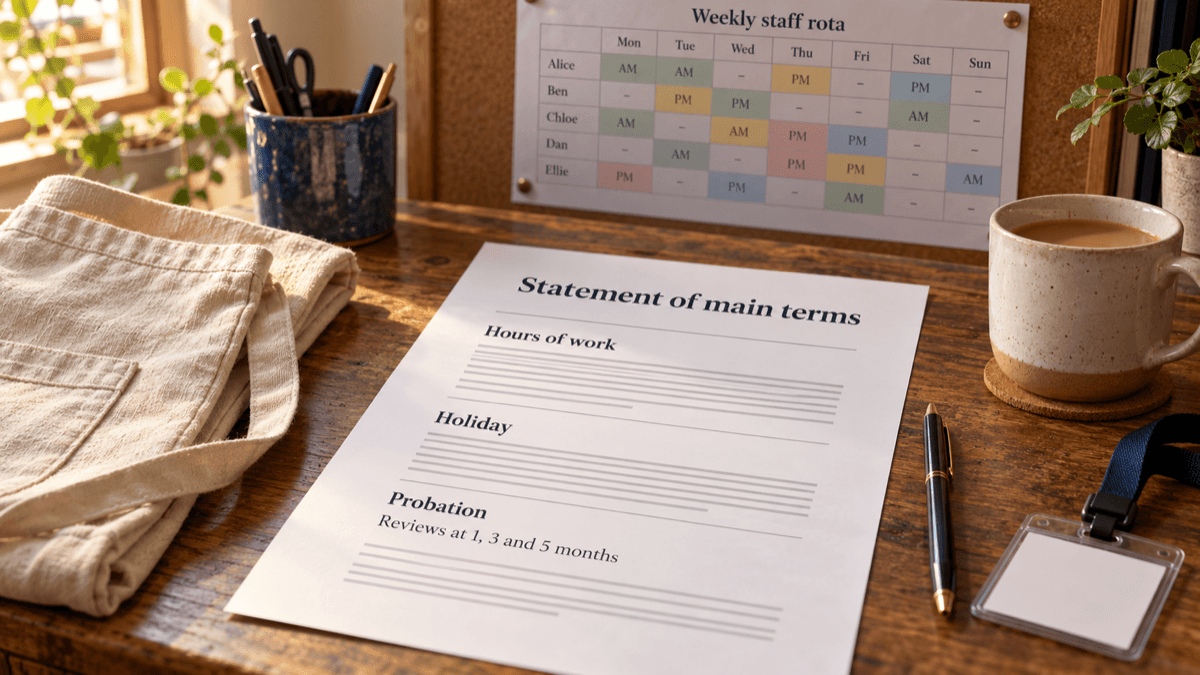
- When you'll review it, for example at one, three and five months, with a short written note each time.
- What passing looks like: the standards, tasks or training to meet.
- The notice each side gives during probation, if it differs from later.
- How an extension works. Acas says an employer must "confirm an extension before the original probation period ends" and "update the employee's written statement of employment particulars within one month".
Probation doesn't switch off day-one rights. Acas lists the minimum wage, paid holiday and protection from discrimination among the rights that apply throughout, and warns that ending probation before six months "does not avoid legal risks".
What the Employment Rights Act 2025 changes, as of 22 October
The list of what goes in the statement isn't changing on any date the government has published. Three things around it are:
- Unfair dismissal after six months from 1 January 2027, as above.
- A statement of the right to join a trade union. Section 58 of the Act adds a duty to "give the worker a written statement that the worker has the right to join a trade union", at the same time as the written statement. The government's guidance for employers describes "a standardised statement", so expect a separate page rather than a new line in yours, though its form will be set by regulations "expected to be laid before Parliament in November 2026". The timeline lists it under 1 January 2027. The employer guidance adds that staff already in post on 1 January must get it by 5 April 2027, then a statement or reminder by each 5 April after that.
- The zero-hours reforms (guaranteed hours, shift notice, pay for cancelled shifts) have no date. The timeline says timings "will be updated following the consultation process", so there's nothing to rewrite for them yet.
Changing terms: in writing within a month
When a particular changes, section 4 says you must confirm it in writing "at the earliest opportunity" and no later than one month after the change. A new pay rate, another site, different days, a probation extension: each counts. Acas's guidance on changing written terms says a letter or email will do, and you might reissue the whole statement, "But they do not have to."
What happens if you don't issue one
There's no fine. The consequences come through a tribunal, in two ways.
The tribunal can decide what it should have said. Under section 11, a worker with no statement, or an incomplete one, can ask an employment tribunal to determine the particulars. There's no time limit while they work for you. After they leave, they have six months from the date the employment ended, up from three for employment ending on or after 1 October 2026.
It adds to any other claim they win. Under section 38 of the Employment Act 2002, if a worker succeeds in certain other claims and you were in breach of the duty when proceedings began, the tribunal must award two weeks' pay, unless there are exceptional circumstances, and can award four weeks' pay where it's "just and equitable in all the circumstances". The qualifying claims include unfair dismissal, unauthorised deductions, holiday pay and discrimination. It isn't a standalone claim, and issuing the statement once a claim is lodged is too late.
A week's pay is capped at £751 for this from 6 April 2026, under the Employment Rights (Increase of Limits) Order 2026. The cap is reset each April by order, not at the Budget. Illustrative, using the same casual barista's pay for hours worked, before the rolled-up holiday line:
| Award | At £254.20 a week | At the £751 cap |
|---|---|---|
| Two weeks' pay | £508.40 | £1,502.00 |
| Four weeks' pay | £1,016.80 | £3,004.00 |
£254.20 x 2 = £508.40 and £254.20 x 4 = £1,016.80. For someone with no normal hours, section 224 averages their pay over the last 12 weeks in which they were paid, so the real figure follows their pattern.
Those sums are modest next to the disputes a missing statement makes harder to settle. How many hours were promised? Were bank holidays on top? Could you take the till shortage out of their wages?
Tax and overpayments aside, a deduction is only lawful if you'd given them a written term allowing it, or they'd agreed in writing, before the thing you're deducting for happened, as I set out in what you can deduct from café wages. The statement is the natural home for that term. Without the document, it's your memory against theirs.
Start from the Acas template
The GOV.UK page has no template, but Acas publishes free ones, one for employees and one for workers. The worker version has an optional clause for hours or days that vary, and its holiday note reminds you entitlement must be "precisely calculated". It has no zero-hours or rolled-up holiday option, so for casual staff you'll need to add those yourself.
This week
- List everyone you pay, including Saturday staff, casuals, under-18s and anyone kept on from the summer.
- Note each start date. Anyone who started on or after 6 April 2020 should have had a statement on day one. Find each one.
- Check them against the day-one list, starting with the seven gaps above.
- Update the template from the Acas employee or worker version, and use it for every new starter.
- Put changes in writing. Anything not yet confirmed, such as a pay rise or new days, goes in a letter or email now, and future changes within a month.
- Fix the order for new starters: right to work check before day one, statement on or before the first shift, then the rota.
- Put January in the diary for the union statement, and look out for the regulations in November.
Getting the statement right takes an afternoon, once. It's the document you'll want on the day someone remembers what they were promised differently from you.
Ed O'Brien has run Hunters Cake Company for 17 years across cafés in Witney, Burford, and a bakery in Carterton, Oxfordshire. He's building Brikly - modular tools that give independent café owners the same data the big chains have, without the big chain price tag.