
The tourist paying with a US card costs you 86% more to process
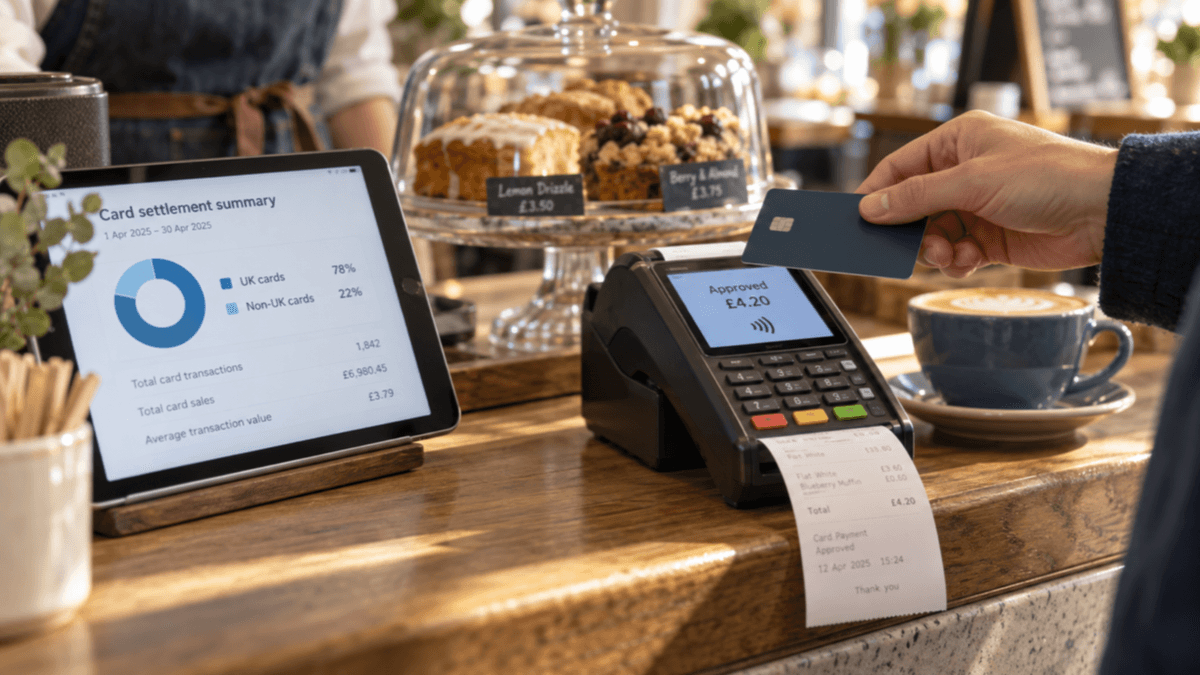
Two people at the counter order the same thing and pay the same price. One taps a debit card from a bank in Swindon, the other a card issued by a bank in Ohio.
It is a Saturday in July in Burford, the car park full of coaches, the till not stopped since ten. Nobody working the counter can tell those two cards apart.
Square charges you 1.75% on the first. On the second it charges 1.75% + 1.5%, which is how it is written on Square's UK pricing page and in the UK Fee Schedule that governs your account, last updated on 2 February 2026. Both pages checked on 21 September 2026. Add them and you get 3.25%.
Divide 3.25 by 1.75 and you get 1.857, so 85.7% more. Call it 86% more to process on an identical sale, purely because of where the card was issued. Read that slowly, because it is the bit everyone garbles: 86% more to process, not 86% of the sale, a gap of 1.50 percentage points.
What it costs on one ticket
An illustrative £12.50 cream tea, not a menu price of mine.
- UK card: 12.50 x 0.0175 = £0.21875, so about 22p
- Non-UK card: 12.50 x 0.0325 = £0.40625, so about 41p
- Difference: 18.75p, which is exactly 12.50 x 0.015
Same scone, same jam, same clotted cream, same £12.50. Eighteen and three quarter pence is the honest scale of it, and precisely why nobody has ever gone looking for it.
What 1.5 percentage points does to the only number that matters
Back in April I wrote that your blended rate is the one figure worth knowing: total card fees divided by total card turnover. That post gave international cards one bullet, a surcharge of 1% to 2% on top. There is a published number behind that bullet, and on a flat rate it is grimly predictable.
Extra blended cost, in percentage points, equals your non-UK share of card value multiplied by 1.5.
| Non-UK share of card value | Added to your rate | Blended rate, card-present |
|---|---|---|
| 10% | 0.15 pp | 1.90% |
| 20% | 0.30 pp | 2.05% |
| 25% | 0.375 pp | 2.125% |
| 30% | 0.45 pp | 2.20% |
The fee lands on value, not on the number of payments, so bring your non-UK share of card value to that table. In a visitor town that is not your share of transactions: tourists buy the bigger ticket.
Walk an illustrative year through it: £300,000 taken on cards, 20% of that value (£60,000) on non-UK-issued cards.
- UK cards: £240,000 at 1.75% = £4,200
- Non-UK cards: £60,000 at 3.25% = £1,950
- Total: £6,150, against £5,250 had every card been UK-issued
- Cost of the mix: £900 a year, or £60,000 x 0.015 the short way
Blended rate: £6,150 divided by £300,000 = 2.05%. Mix alone adds 0.30 percentage points over the headline, and none of it is a bad deal badly negotiated.
That April post put a healthy blended rate at 1.4% to 1.9%, and north of 2.2% you are overpaying. On Square's published flat rate a 30% non-UK share puts you at 2.20% on card-present business alone, and past it the moment terminal rental, PCI fees or monthly minimums are added.
You can be overpaying because of who walks through your door.
That same post put a tourist or business mix at 0.3% to 0.5% over the headline without separating the causes. Non-UK issuance alone accounts for 0.3 pp at a 20% share and 0.5 pp at a 33% share. On a flat rate there is no credit or commercial card premium on top, so it can be most of that band by itself. On tiered pricing it is one strand of several.
What actually triggers the higher rate
It is the country that issued the card, not where the customer is standing. Square's developer documentation is explicit on that. So a British expat home for a fortnight on a US-issued card triggers it, and a French tourist on a UK-issued card does not.
The surfaces do not all work the same way:
- In person, covering contactless, chip and PIN and Tap to Pay, is the 1.75% + 1.5% case.
- Online, Square's UK rates are already tiered by issuer: 1.4% + 25p for UK cards, 2.5% + 25p for non-UK cards, with no further 1.5% stacked on top.
- Alternative payment methods such as Clearpay sit outside the fee entirely.
Two things I am deliberately not telling you: how a non-UK card inside Apple Pay or Google Pay behaves, and what a keyed-in non-UK transaction comes to all in. Square's own sources read differently on both, and a gap beats a guess.
Why you cannot simply pass it on
Every visitor-town operator has the same next thought. Fine, I will put it on the bill.
Most write-ups name the wrong statutory instrument. The rules sit in regulation 6A of the Consumer Rights (Payment Surcharges) Regulations 2012, inserted on 13 January 2018 by the Payment Services Regulations 2017. Regulation 6A(1) bans any surcharge on a consumer card. On a UK consumer card the answer is a flat no, and that is the rule everyone has heard of.
The part nobody has heard of is regulation 6B. The ban in 6A(1) only applies where both payment service providers, the bank that issued the card and your acquirer, are located in the UK. Where only one of them is, and a card issued in Ohio taken on a UK acquirer is exactly that case, 6B(3) switches the ban off and leaves the cost cap in 6A(2) standing in its place. So a non-UK-issued consumer card is not banned from a surcharge. It is capped at what that card cost you. Commercial cards were never inside the ban either, only the cap.
So the accurate answer is not "illegal". It is capped at what that card cost you, evidenced per transaction, shown in the price before the customer commits, and only where your scheme rules and acquirer agreement allow it. Check your own merchant agreement.
Then weigh it as an operator. Even at the full 41p, you are building a signage, training and evidence job to recover pennies from a stranger on their only visit, with a queue behind them.
Pull one month and get your actual number
All of this is guesswork until you look at what share of your card value was non-UK issued. Square separates it out already, so it is a ten-minute job.
- The Fees Report lists International Transaction Fees as their own fee category
- The Payment Methods Report shows which payments were processed with international cards
- Individual receipts split the processing fee and the international fee onto separate lines
Take August. It shows you the worst of it.
My own figures are the part worth your attention. In August 2026, about 26.5% of the card payments at my Burford café were on foreign-issued cards. That is a count of transactions rather than a share of value, so it is not a number to read straight off the table above. At Witney it was 1.5%, and at the Carterton bakery none at all.
Across the business the fee costs me roughly £750 a year, almost all of it from one site.
That three-way split is the argument. This is a site-level number, not a business-level one: average it across an estate and it disappears while one shop quietly carries the lot. In a Cotswolds tourist town, expect 25% or more across the summer.
It moves month to month while turnover sits still, because it tracks visitor mix rather than sales. Worth knowing when you are reconciling card takings against the gross POS total.
What to do with it
The pricing model, if you are big enough for it to matter. Square's documentation states that sellers on Cost Plus or Interchange Plus pricing are not charged the additional international fee, because international card costs are passed through there. The cost changes shape rather than disappearing, but a high non-UK share pulls the flat-rate crossover point below the roughly £400k the April post identified. If you go out for quotes, give providers your non-UK share alongside turnover and average transaction size. It changes which model wins.
The menu, which is where most of you will get the money back. A costed fixed set in a visitor town absorbs 18.75p inside a known margin in a way no bolt-on fee ever will. If it is costed properly, in CostingBrik or a spreadsheet, you already know whether it can carry it. To see which items earn their place, the free Square category analyser reads your category sales export. It reads sales, not fees.
Under about £150k of card turnover, a 25% non-UK share of card value comes to roughly £560 a year (150,000 x 0.25 x 0.015). Real money, and still not enough to justify renegotiating a pricing model over. Know it, price for it, leave the contract alone, and stop blaming a provider for a number your postcode created.
The takeaway
Both rates are published, so check them in a minute. The gap is 1.50 percentage points, 86% more to process on a card you cannot identify by looking at it. Invisible on any one ticket, real money across a summer in the right postcode.
Pull August's Fees Report, find your non-UK share of card value, and decide once whether it changes your pricing model or only your expectations. For most of you it will be the expectations. One or two are about to find out why their blended rate never matched the headline.
Ed O'Brien has run Hunters Cake Company for 17 years across cafés in Witney, Burford, and a bakery in Carterton, Oxfordshire. He's building Brikly - modular tools that give independent café owners the same data the big chains have, without the big chain price tag.