
Should labour go in your recipe cost? Beside it, not inside it
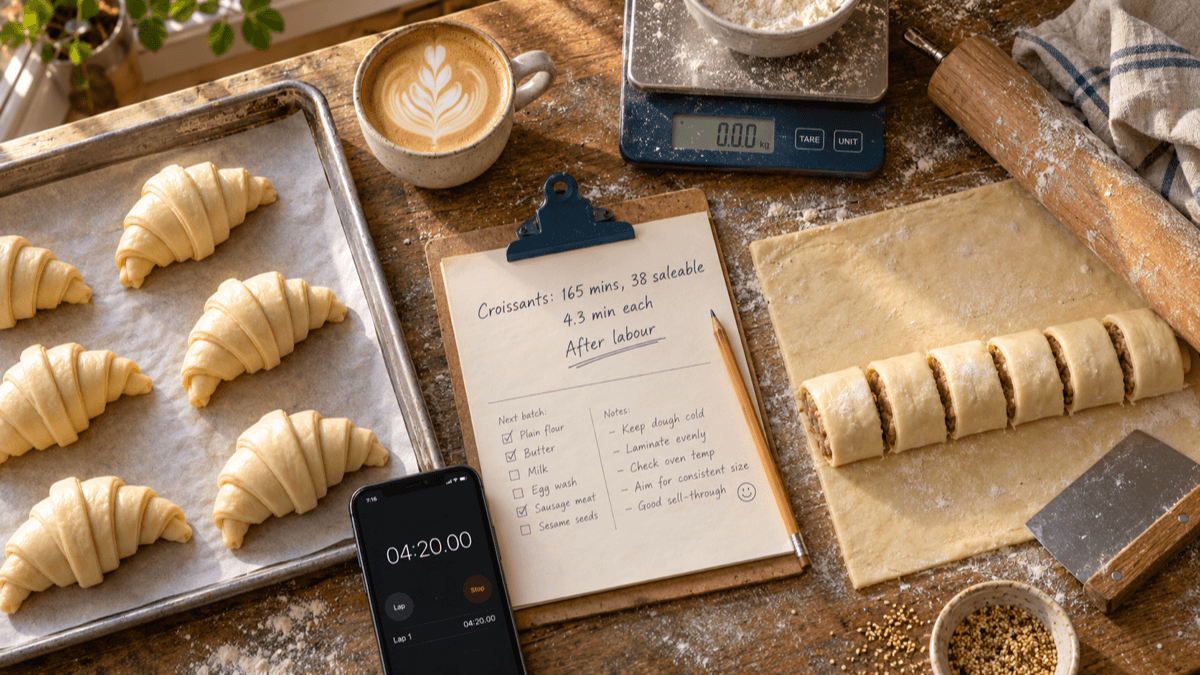
At ten to seven on a Saturday, someone in your kitchen is rolling sausage meat into pastry by hand, and has been for the best part of an hour. Out front, the barista is pulling flat whites in about 90 seconds each.
Look at both on your costing sheet and they sit within eight points of each other. Both above 70% gross profit, both "good margin items". One of them took the morning shift to make. The other took less time than it takes to find the right lid.
Gross profit percentage cannot tell those two apart, and it is not supposed to. That is not a flaw in GP%. It is a reason to keep a second number next to it.
Why GP% stays before labour, and should
GP% is selling price ex-VAT, minus ingredients, as a percentage of that price. Labour is deliberately left out, and there are good reasons to keep it that way.
- Benchmarks are built before labour. Every food cost and GP figure you compare yourself against, from your accountant or anywhere else, excludes it. Put labour in and you can no longer compare.
- Labour is already counted. It lives in your wage percentage, and the two together make prime cost, food and labour combined. Load it into recipes as well and you count the same hours twice.
- It muddies the price signal. When a butter invoice moves, you want to see the recipe cost move because of butter. If every recipe also jumps each April when the wage rate rises, ingredient changes disappear in the noise.
- A minute is not a gram of butter. Butter you do not use stays in the fridge. A staff member on the rota is paid whether they are rolling pastry or wiping tables.
This is the line I drew in the post on costing sub-recipes and batches: pick one answer on labour and hold it everywhere. Mine is ingredients only, inside every recipe cost.
So labour stays out of the recipe cost. The real question is whether you can see it at all when deciding what to sell and at what price.
What GP% cannot see
Here is a small, illustrative menu. Prices are ex-VAT on the eat-in price, ingredient costs are invoice prices ex-VAT, and labour is hands-on minutes per saleable portion at 26.5p a minute. Where that rate comes from is further down.
| Item | Price ex-VAT | Ingredients | GP% | Hands-on mins | Labour | After labour | After labour % |
|---|---|---|---|---|---|---|---|
| Croissant, laminated in-house | £2.75 | £0.48 | 82.5% | 4.34 | £1.15 | £1.12 | 40.7% |
| Flat white | £3.17 | £0.62 | 80.4% | 1.50 | £0.40 | £2.15 | 67.8% |
| Brownie, five-tray session | £3.00 | £0.72 | 76.0% | 1.75 | £0.46 | £1.82 | 60.7% |
| Sausage roll, hand-rolled | £3.50 | £0.95 | 72.9% | 2.50 | £0.66 | £1.89 | 54.0% |
| Brunch plate, made to order | £8.75 | £3.10 | 64.6% | 7.00 | £1.86 | £3.79 | 43.3% |
The table is sorted by GP%, and the croissant sits proudly at the top. Butter, flour and a bit of yeast against a £3.30 counter price: 82.5% looks like the best thing you sell.
Now read the last column. After labour, the croissant drops from first to last. It keeps £1.12 of a £2.75 sale once you have paid for the 4.34 minutes of hands-on time in each one. The flat white keeps £2.15.
Same menu, two completely different orders. The first tells you about your buying. The second tells you about your kitchen.
There is a third view worth a glance: after-labour contribution per hands-on minute. The flat white returns about £1.43 for every minute of someone's time. The brownie £1.04, the sausage roll 76p, the brunch plate 54p, the croissant 26p. When your baker's morning is the scarce thing, that is the number that tells you where their minutes go furthest.
Which dishes actually need an after-labour figure
Not everything. For a lot of lines the labour per portion is near enough nil.
My rule of thumb: if an item takes more than about a minute and a half of hands-on time per portion, or its labour comes to more than about 15% of the ex-VAT price, it gets an after-labour figure. The flat white sits just under both. Everything else in the table above is over.
Usually worth it:
- Anything laminated, shaped or crimped by hand. Croissants, Danish, hand-raised pies, plaited loaves.
- Hand-rolled or hand-filled savouries. Sausage rolls, pasties, filled focaccia.
- Decorated cakes. The piping, the drip, the fresh flowers, the lettering.
- Made-to-order plates. Anything that ties up the hot section for five minutes or more.
- Festive bakes. Mince pies with hand-cut lids, stollen shaped, buttered and dusted, gingerbread iced one by one. December is when the counter fills up with them.
Usually not worth it:
- Drinks from the bar. Fast, and labour per cup barely varies.
- Bought-in and resold. Canned drinks, crisps, bought-in cakes you only plate.
Putting a cost on a minute
You need one rate, and it needs to be the full cost of employing someone, not the number on their payslip.
The National Living Wage has been £12.71 an hour for anyone 21 and over since 1 April 2026. For a team member on it working a 30-hour week, the fully loaded figure is £15.93 an hour: wage, plus 12.07% holiday accrual, plus employer National Insurance at 15% above £5,000 a year, plus 3% employer pension on qualifying earnings. I built that line by line in the make-or-buy break-even post, and it sits at the bottom of the fully loaded range in our café wage percentage benchmarks.
Divide by 60: 26.5p a minute.
Three decisions to make once:
- One rate across the menu. A baker on a £14.00 base comes out at £17.61 loaded, or about 29.4p a minute. The point of this view is comparing items, so one rate keeps it honest. If your team is mostly on a higher rate, use that, everywhere.
- Your own minutes count. If you are the one shaping croissants at six, those minutes cost what you would have to pay someone else to do them. Leaving them out is how owner-baked lines end up looking cheaper than they are.
- Hands-on time only. Proving, chilling and the 20 minutes the tray spends in the oven are not labour unless someone is standing over it. A croissant takes two days elapsed. The hands-on part, mixing, locking in the butter, three folds, rolling, cutting and shaping, is what goes on the card.
Per batch or per portion
How you time it depends on how the item is made.
Batch items: time the session, divide by what you can sell
For anything made in one go, time the whole session from weighing out to wash-down, then divide by saleable units, not how many you cut.
The croissants: 165 minutes of hands-on time across the two days, cut into 40, two come out lopsided and go to staff. 165 ÷ 38 = 4.34 minutes each. Divide by 40 and you would understate it, because the two that went to staff still took the time.
The sausage rolls: one hour for a batch of 24, so 2.5 minutes each. The brownies: the five-tray session from the make-or-buy post, 105 minutes for 60 saleable squares, so 1.75 minutes each.
Made-to-order items: time it at the pass, then add a share of prep
A brunch plate has two kinds of time. Around six minutes on the pan and at the pass per order, plus a share of the morning's batch prep: the pickled onions, the dressing, the washed leaves. If that prep takes 30 minutes and covers 30 plates, it adds a minute each. Seven minutes a plate.
Time it properly, three times
Anyone being watched for the first time is slow. Time three normal sessions with a normal member of the team, not your fastest baker or the new starter, and take the middle one.
"They're on the clock anyway"
This is the fair objection, and it deserves an honest answer.
A minute only becomes money saved if it shortens a shift, frees someone for work that earns more, or stops you hiring. If your team rolls the sausage rolls during a dead hour on a Tuesday afternoon, when they would otherwise be polishing the coffee machine for the third time, the real extra cost of those rolls is close to nil.
But look at what sets your rota. The 6am start exists because the croissants need shaping and the sausage rolls need to be out of the oven by eight. The extra pair of hands on a Saturday morning exists because the brunch plates take seven minutes each in the rush. Over a quarter, the labour-heavy items are what decide how many hours you rota, even if no single sausage roll costs you anything on the day.
So use the after-labour figure to rank the menu and to set prices, not to pretend you will save four minutes off someone's shift tomorrow. And notice the lever hidden in the objection: moving prep into the quiet hours is one of the cheapest ways to make a labour-heavy item pay.
What changes when you rank the menu after labour
Once the last column is in front of you, there are five things you can do about an item near the bottom of it.
1. Price the minutes
The in-house croissant is a quality item, and customers who want a properly laminated one will pay for it. Take it from £3.30 to £3.80 and the ex-VAT price goes from £2.75 to £3.17. After labour goes from £1.12 to £1.54, more than a third better from a 50p change.
A price rise on a 90-second drink and one on a four-minute pastry are not the same decision, and GP% alone will push you towards the wrong one.
2. Cut the minutes
Not by cutting quality, by cutting repetition. Laminate a double batch of croissant dough in one session and freeze half of them shaped and unbaked. If 76 saleable croissants take 240 minutes instead of two separate 165-minute sessions, the hands-on time drops to 3.16 minutes each, labour falls to 84p, and after labour rises to £1.43 at the old price. Do both, the price and the double batch, and it lands at £1.85, just ahead of the brownie.
The same logic applies to the sausage rolls. Roll 48 in 85 minutes and freeze half raw, and it is 1.77 minutes each instead of 2.5: 47p of labour instead of 66p. How far bigger batches pay off, and where they stop paying, depends on how much of the session is fixed time, which the make-or-buy post works through tray by tray. Freezer space and shelf life set the ceiling.
3. Simplify the finish
A lot of hands-on time hides in the finish: individual scoring, three shapes, hand-piped rosettes on every slice. One shape and a scattered finish take minutes straight off every portion, and customers notice less than you would think.
4. Make it a special, or drop it
Some items will never pay for their minutes at a price customers will accept. A weekend-only or pre-order line keeps them on the menu without asking for a 6am start every day. If the honest answer is that someone else can make it better for less, that is a make-or-buy question, and that post has the sum.
5. Look after the fast ones
The items at the top of the after-labour column, like the flat white turning each minute of someone's time into £1.43, are the quiet earners. Do not discount them to drive footfall, and make sure they are the first thing people see. They are carrying the slow ones.
Where Brikly fits
CostingBrik can carry prep time on each recipe, per batch or per portion, at your hourly labour rate, and shows an "After labour" figure under GP% alongside a "Contribution after labour" card. GP% itself stays before labour, so your ingredient margins stay comparable with every benchmark and every other recipe. You still need to time the batch yourself.
Time three things this week
Pick the three items you suspect are hardest work: the one that sets your earliest start, the one that ties up the hot section in the rush, and the one you only make because you always have.
- Time a normal session, from weighing out to wash-down, hands-on only.
- Divide by saleable units, not what you cut.
- Multiply by 26.5p a minute, or your own loaded rate.
- Take that off the GP in pounds, and put the figure in a column next to GP%.
Then sort the menu by that column instead. Whatever drops furthest is either underpriced, overworked, or a decision you have been making out of habit. Keep GP% exactly where it is. Just stop reading it on its own.
Ed O'Brien has run Hunters Cake Company for 17 years across cafés in Witney, Burford, and a bakery in Carterton, Oxfordshire. He's building Brikly - modular tools that give independent café owners the same data the big chains have, without the big chain price tag.