
The clopen problem: rest breaks, the 11-hour gap and the rota that breaks the law
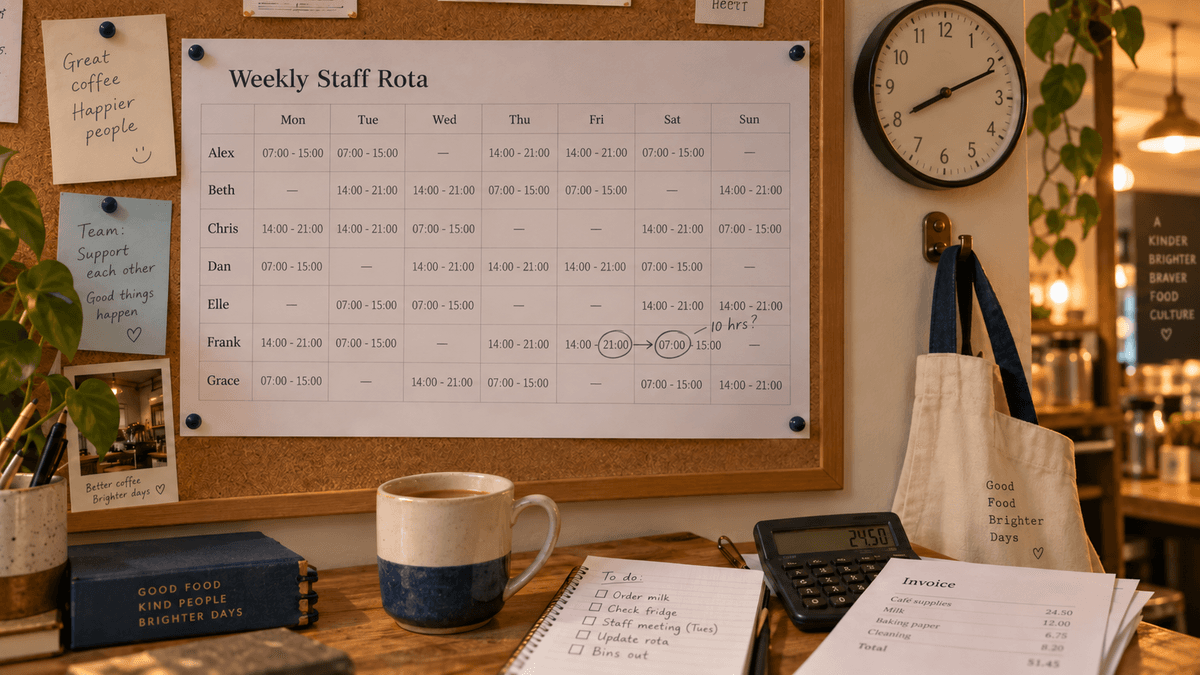
Picture the second Friday in December. The late-night opening went well, the last mince pie went at five to nine, and by the time the floor is mopped it is half past. Your supervisor locks up. She is also on the rota to open tomorrow at seven.
That is a clopen, a close followed by an open, and it is one of the easiest ways a café rota quietly breaks the law. GOV.UK's own example of the daily rest rule could have been written for us: "if they finish work at 8pm, they should not start work again until 7am the next day." Close at 9pm and open at 7am and the gap is 10 hours. Once the mop is back in the cupboard at 21:30, it is nine and a half.
Most cafés close at five, and 17:00 to 07:00 is 14 hours, nowhere near the line. The clopen bites when you trade into the evening: supper clubs, private hire, December late nights, or a production baker who finishes evening prep at eight and is back at five for the morning bake. Nine hours, hidden in a rota that otherwise looks fine.
This covers England, Scotland and Wales under the Working Time Regulations 1998. Northern Ireland has its own Working Time Regulations (Northern Ireland) 2016, with the same core rest rules and its own tribunal time limits.
Three rest rules, three different clocks
A café rota has to respect three separate rest rights.
Daily rest: 11 hours, or 12 for under-18s
Regulation 10 gives an adult "a rest period of not less than eleven consecutive hours in each 24-hour period". A young worker, over school leaving age but under 18, gets twelve.
The gap runs from when work actually ends, not from when the sign flips to closed.
| Actual finish | Earliest start, adult | Earliest start, young worker |
|---|---|---|
| 20:00 | 07:00 | 08:00 |
| 21:00 | 08:00 | 09:00 |
| 21:30 | 08:30 | 09:30 |
| 22:00 | 09:00 | 10:00 |
Weekly rest: 24 hours in seven days, or 48 in fourteen
Regulation 11 gives adults "an uninterrupted rest period of not less than 24 hours in each seven-day period". You can choose to average it instead: two separate 24-hour periods, or one 48-hour block, in each 14 days.
Regulation 11(7) stops the day off swallowing the daily rest: it "shall not include any part of" the 11 hours, unless objective, technical or work-organisation reasons justify it. Close at 21:00 on Friday, take Saturday off, and the earliest Sunday start is 08:00, 35 clear hours. Young workers get 48 hours in each seven days, reducible for technical or organisational reasons but "not to less than 36 consecutive hours".
The break inside the shift: 20 minutes, after more than six hours
Regulation 12: "Where a worker's daily working time is more than six hours, he is entitled to a rest break." For adults that is 20 uninterrupted minutes. Young workers get 30 minutes once they work more than four and a half hours, "consecutive if possible".
Note the words "more than". Exactly six hours needs no statutory break; six hours and one minute does.
School-age children work to a different rulebook, an hour's break after four hours, and the post on employing school-age staff covers that, along with night work for 16 and 17 year olds.
What actually counts as a break
GOV.UK lets you decide when breaks happen, as long as the break is "taken in one go somewhere in the middle of the day (not at the beginning or end)" and the worker can spend it away from where they actually work. Acas adds that breaks should be "planned in advance". Two café habits fail those tests:
- The break tacked onto the end. Leaving 20 minutes early in place of a break is not a break. Neither is starting 20 minutes late.
- The break with one eye on the queue. The same GOV.UK page is blunt: "It does not count as a rest break if an employer says an employee should go back to work before their break is finished." Sitting at the end of the counter, ready to jump on the till, fails too.
Pay is a separate question. GOV.UK again: "The break does not have to be paid - it depends on their employment contract." Unpaid is lawful and normal in hospitality, unless the contract says otherwise.
The unpaid break that was really work
This is where a rest problem becomes a pay problem. Under the National Minimum Wage Regulations 2015, "The hours a worker spends taking a rest break are not hours of time work." But regulation 32 counts the hours a worker is "available, and required to be available, at or near a place of work for the purposes of working". A break spent minding the counter is the second kind.
Deduct 20 unpaid minutes spent serving and you owe 20 minutes of pay: (20 ÷ 60) x £12.71 = £4.2367, about £4.24 each time at the National Living Wage. For someone already on the minimum, that is an underpayment, not a rounding error. The break drift section of the rota versus actual hours post shows how quickly skipped breaks add up.
The duty is to make breaks happen
If nobody asks for a break, has anybody been refused one? The Employment Appeal Tribunal answered that in Grange v Abellio London Ltd, decided in November 2016 and reported at [2017] ICR 287.
The judgment says an employer refuses the right "if it puts into place working arrangements that fail to allow the taking of 20 minute rest breaks", whether or not anyone asked. In words the tribunal quoted with approval from an earlier case, "an employer cannot withdraw into a passive role". You cannot force someone to take a break, but they "are to be positively enabled to do so".
So the rota is the evidence. An 08:00 to 16:00 shift with no break time, on a day with one person on the floor, does not allow a break. A written break time, covered by a staggered start like those in the demand-based rota post, does.
The exceptions are narrower than they sound
The Regulations do have exceptions, and they get stretched in kitchens.
- A foreseeable surge. Regulation 21 switches off adult daily rest, weekly rest and the rest break "where there is a foreseeable surge of activity", naming agriculture, tourism and postal services. A café in a tourist town in August might arguably rely on it; one that is simply busy on Saturdays is a stretch.
- Shift changes and split days. Regulation 22 lifts adult daily and weekly rest for a shift worker who "changes shift" and cannot take the rest in between, and for "periods of work split up over the day, as may be the case for cleaning staff", the nearest it comes to a café split shift. It does not touch the rest break or anyone under 18, and a clopen you chose to roster, when someone else could have opened, is a weak fit.
- Agreements. A collective or workforce agreement can modify the adult rules, with formal requirements most small cafés never meet.
Even then, the rest does not vanish. Regulation 24 says the employer "shall wherever possible allow him to take an equivalent period of compensatory rest". Acas says working through rest "should not happen regularly" and needs a valid reason, with the rest made up at the same length and type. For young workers, GOV.UK allows it only for an exceptional event no adult can cover, and the rest "must be taken within the following 3 weeks".
The opt-out is a different rule
Regulation 4 caps average working time at 48 hours a week, normally over 17 weeks, unless the worker agrees in writing to opt out, and GOV.UK is clear that "you cannot be sacked or treated unfairly for refusing". Under-18s cannot opt out and are capped at 8 hours a day and 40 a week. The opt-out only switches off the 48-hour average: daily rest, weekly rest and breaks still apply.
What breaks cost, and what skipping them costs
Paying for breaks, illustrated
Illustrative: a 7-hour shift, 09:00 to 16:00, with a 30-minute break, at the April 2026 National Living Wage of £12.71.
| Paid hours | Wage | |
|---|---|---|
| Break unpaid | 6.5 | £82.62 (£82.615, rounded to the penny) |
| Break paid | 7 | £88.97 |
| Difference | 0.5 | £6.35 (0.5 x £12.71 = £6.355, but each row is rounded to the penny) |
For a small team, say five people on five such shifts a week, paying breaks adds 25 x 0.5 = 12.5 hours a week. At £12.71 that is £158.875, call it £158.88 a week, and £158.875 x 52 = £8,261.50 a year in wages alone. At the true cost of around £16.14 an hour once employer NI, pension and holiday are added, it is 12.5 x £16.14 = £201.75 a week, or £10,491 a year.
Paid breaks are a choice, not a recommendation, and they help with hiring. But paying for a break does not remove the duty to give it: a paid break spent on the till is still a missed break. The new hire calculator works out the hourly true cost on your own rates.
The cost of getting it wrong
Rest rights are enforced by the worker, through an employment tribunal claim under regulation 30. For any breach on or after 1 October 2026 they have six months to bring it, up from three, one of the changes in the Employment Rights Act 2025. Earlier breaches keep three months under the commencement regulations. The clock runs from the date the rest should have been allowed, so a habit of missed breaks keeps starting new clocks.
The award is whatever the tribunal "considers just and equitable in all the circumstances". The bigger risks sit elsewhere:
- Minimum wage. A worked "break" deducted from pay is an underpayment, and minimum wage is enforced by HMRC for the Fair Work Agency, launched in April to cover "pay-related rights including national minimum wage and national living wage". The Agency does not enforce rest breaks, and nor do the HSE or councils, whose regulation 28 powers cover things like the 48-hour limit and young workers' hours.
- Treating someone badly for insisting. Section 45A of the Employment Rights Act 1996 protects anyone who refuses to give up a Working Time right, and dismissing an employee for it is automatically unfair under section 101A, however long they have worked for you.
- Tired people near hot equipment. Nine and a half hours, minus two commutes, is not a night's rest before the steam wand and the oven.
Building a rota that respects all three
Check every close followed by an open. The earliest next start is the actual finish plus 11 hours, or plus 12 for a young worker. Do it by hand every time the rota changes.
Put the break on the rota, with a time. "30 mins" is a length. "Break 12:30 to 13:00", mid-shift with cover, is an arrangement that allows a break, and your Grange evidence.
Watch the six-hour line. A barista rostered 09:00 to 15:00 needs no break. If closing jobs routinely run to 15:15, they have worked more than six hours without one, so hold the finish or roster the break anyway.
Saturdays and under-18s. Friday close at 21:00, Saturday start at 08:00: 11 hours, fine for an adult, an hour short for a 17 year old. Their 09:00 to 15:00 Saturday needs a 30-minute break, because it runs past four and a half hours; for an adult, the same shift needs none.
Split shifts. A pattern like 07:00 to 11:00 and 16:00 to 19:00, from the post on rotas and labour costs, leaves 12 hours before a 07:00 start the next day. Make the gap in the middle genuinely theirs: free to leave, not on call.
StaffBrik applies your paid or unpaid break policy and warns at shift creation when a shift of six hours or more has no break or one under 20 minutes, so it flags an exactly six-hour shift too, a touch stricter than the law. It applies the 4.5-hour threshold for under-18s from their date of birth and prints break details on the noticeboard rota. It does not check the gap between a close and the next open; that check stays with you.
This week
- Mark every close followed by an open on the next four weeks' rota and any December late night.
- Time closing for a week, door sign to last person out. That is the finish that counts.
- Write break times on every shift over six hours, or four and a half for under-18s.
- Check last month's timesheets for unpaid breaks that were actually worked, and pay them.
- Read your contracts on paid or unpaid breaks, and make the rota match.
Ten hours between a close and an open feels like plenty until you count it. Count it before the rota goes up.
Ed O'Brien has run Hunters Cake Company for 17 years across cafés in Witney, Burford, and a bakery in Carterton, Oxfordshire. He's building Brikly - modular tools that give independent café owners the same data the big chains have, without the big chain price tag.