
Staff meals and free drinks: the perk you've never costed
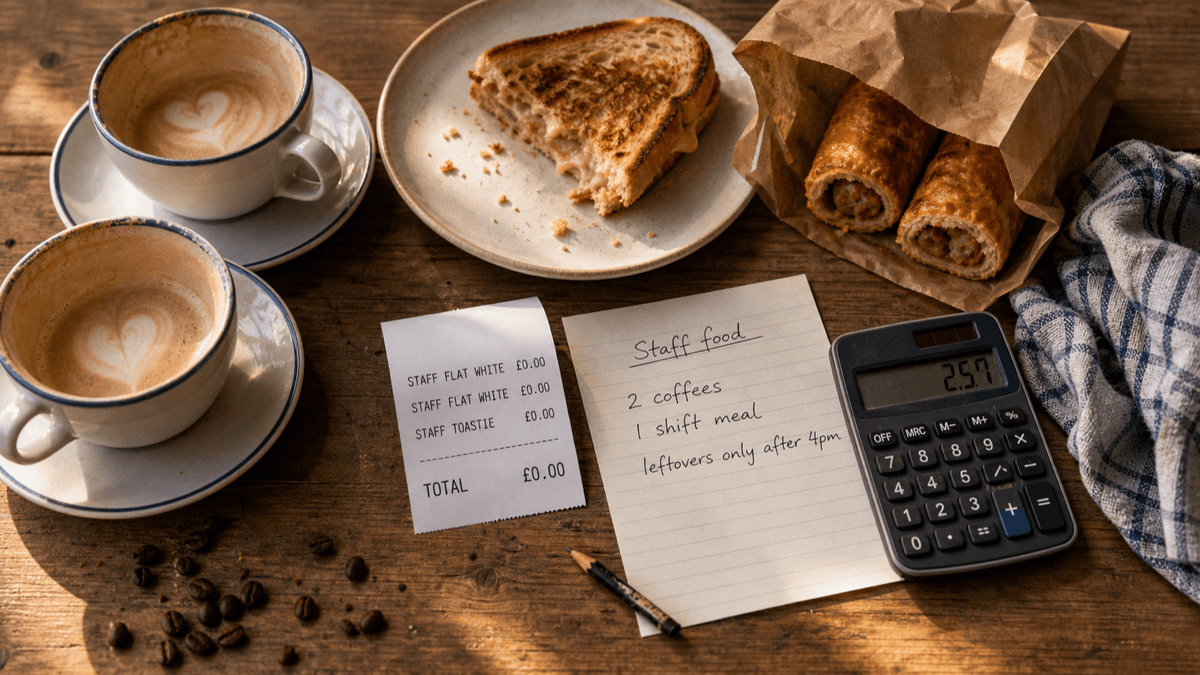
Half four on a Tuesday. The bar is wiped down, the last customer has gone, and your barista pulls themselves a flat white before they cash up. Nobody rings it through. Nobody thinks about it. It is a coffee.
Someone takes the last two sausage rolls home because they would only go in the bin. A full-timer eats a toastie on their break, and you tell them not to be daft when they offer to pay.
None of that is wrong. All of it is real cost, and almost no café I know has put a number on it.
This is not a post about stopping. It is a post about knowing.
Menu price is the wrong number, and it will panic you
The first instinct, when someone finally does add it up, is to price staff food at what a customer would have paid. That gives you a terrifying number and a bad decision.
A flat white is not £3.60 of cost. In our full breakdown of what a flat white actually costs a café, the ingredients come out at about 51p: roughly 32p of beans at 18g, 19p of milk. Everything else in that £3.60 is rent, labour, card fees and the profit you need to stay open.
When your barista makes themselves a coffee at 4.30pm, you have not lost £3.60. You have lost 51p of beans and milk. The rent was being paid anyway, the machine was already on, and nobody in the queue was turned away.
The same goes for the shift meal. A toastie on the menu at £7.50 might be £1.15 of bread, cheese and ham. That is what leaves your bank account.
Cost price, always. Menu price makes the perk look like £26,000 a year and pushes you into a policy change you never needed.
Work it out per head, per shift, then across the rota
Here is the calculation, and it takes about ten minutes.
Take one typical shift and write down what one person actually consumes:
- Two coffees at 51p of ingredients: £1.02
- One shift meal, say a toastie or a filled roll at cost: £1.15
- Odds and ends - a cookie, a slice at close, a cold drink on a hot day, averaged across the week: £0.40
Per head, per shift: £2.57.
Now count staff shifts, not staff. A café open seven days with four people on is 28 staff shifts a week.
28 shifts x £2.57 = £71.96 a week = £312 a month = £3,742 a year
That is the number. Not enormous, not nothing. On the same rota priced at menu value you would have got £2,208 a month, which is fiction, because not one of those items would otherwise have been sold to a paying customer.
Two things move that figure. Four coffees a shift instead of two adds another £1 a head and pushes the year past £5,000. And a shift meal built from fresh stock rather than something heading for the bin costs you full ingredient price, every time.
Where it actually shows up in your numbers
That £312 a month does not sit in a box marked "staff food". It goes somewhere, and where it goes changes what your accounts appear to be telling you.
Say you turn over £20,000 a month ex-VAT with a cost of sales of £5,600. That is a 28% food cost, which looks a touch high and sends you off hunting for a supplier problem.
Take the staff food out and your customer-facing food cost is 26.4%. The other 1.6 points are a staff benefit that has been quietly filed as ingredients.
If it is never recorded at all, it is worse. The stock left, the sale never happened, and the gap turns up as shrinkage you cannot explain. So you go looking for theft, portioning drift or a short delivery, when the answer was four flat whites a day. It is exactly the ghost that makes a stocktake variance investigation run in circles.
Ring it through the till at zero
The fix is not a spreadsheet. It is a button.
Set up a staff item on your till at £0.00, or a 100% staff discount that still records the item. Every staff drink and shift meal goes through it, the same as a customer order. Three things happen at once:
- Your stock reconciles. The item is recorded as leaving, so it stops showing up as unexplained variance.
- You get a real number instead of an estimate, broken down by day and by item, and you can multiply the cost yourself.
- It becomes normal. Nobody feels watched, because everybody rings everything through. The awkwardness only exists while it is informal.
Once staff items are their own category, you can watch the number move when you change the rota or the policy, rather than finding out at the year end.
Write the policy down, in four lines
Most staff food policies live in the owner's head, which makes them inconsistent, and inconsistency is what costs you. One person has a sandwich, the next assumes they can too, and by the time you notice it is a conversation nobody wants to have.
Four questions, on one side of paper, pinned up in the back:
- What is included? Drinks and a shift meal, usually. Say whether that covers speciality milks, extra shots and cold drinks, or you will end up arguing about oat milk.
- When? A meal on shifts over a certain length. Drinks any time, or before and after service only.
- Leftovers or fresh? End-of-day product that would be binned costs you nothing extra. Pulling a fresh chicken breast at 11am costs full price and takes a sellable item off the counter.
- Family and friends? Decide now, in writing, rather than at the counter on a Saturday.
Point three is where most of the money is: same perk, wildly different cost, purely down to timing. And a written portion size for the staff meal stops it creeping the way customer portions do, which is the whole argument in portion control and where café margins leak.
The tax bit, briefly
Worth knowing, and worth checking properly.
Free or subsidised meals provided to staff on the premises are generally exempt from tax as a benefit in kind under HMRC's rules, provided they are available to all employees. That is why most café staff meals cause no payroll problem at all.
Cash is a different matter. An allowance paid instead of feeding someone is pay, and it goes through payroll like pay. The same split decides what the staff Christmas party, a £50 gift and a cash bonus cost you in tax.
Now the honest counterpoint
Having found the number, the temptation is to cut it. I would think hard about that.
£3,742 a year, across a six-person team, is roughly what it costs to replace one of them. Our breakdown of the true cost of staff turnover in cafés puts a single full-time replacement at £3,000 to £3,500 once you count recruitment, training, the productivity gap and the regulars who quietly drift.
So a whole year of feeding everybody costs about one leaver. If the perk keeps a single person for an extra six months, it has paid for itself and change.
There is a second argument that shows up on no spreadsheet. A team that has eaten knows what the food tastes like, and describes the special properly because they had it. Fed teams sell better, and they are pleasanter to be around.
Costing it was never about stopping it. It was about making it visible, so that when you do change something you are choosing between a fresh chicken sandwich at 11am and an end-of-day one, rather than between generous and mean.
One thing to do this week
Put a sheet of paper by the till. For seven days, everyone writes down what they take: drink, meal, snack. No judgement, no names needed.
At the end of the week, price the list at cost, not menu price. Multiply by 4.3 for the month.
Most independents land between £150 and £600. Then you decide, with the number in front of you, whether that is a bargain or a leak. If your recipe costs already live in CostingBrik, the per-item figures are sitting there and the tally sheet is the only new work.
My guess is you will look at it, shrug, and carry on feeding your team. That is fine. Doing it on purpose is the whole point.
Ed O'Brien has run Hunters Cake Company for 17 years across cafés in Witney, Burford, and a bakery in Carterton, Oxfordshire. He's building Brikly - modular tools that give independent café owners the same data the big chains have, without the big chain price tag.