
Uniforms, breakages and till shortages: what you can actually deduct from café wages
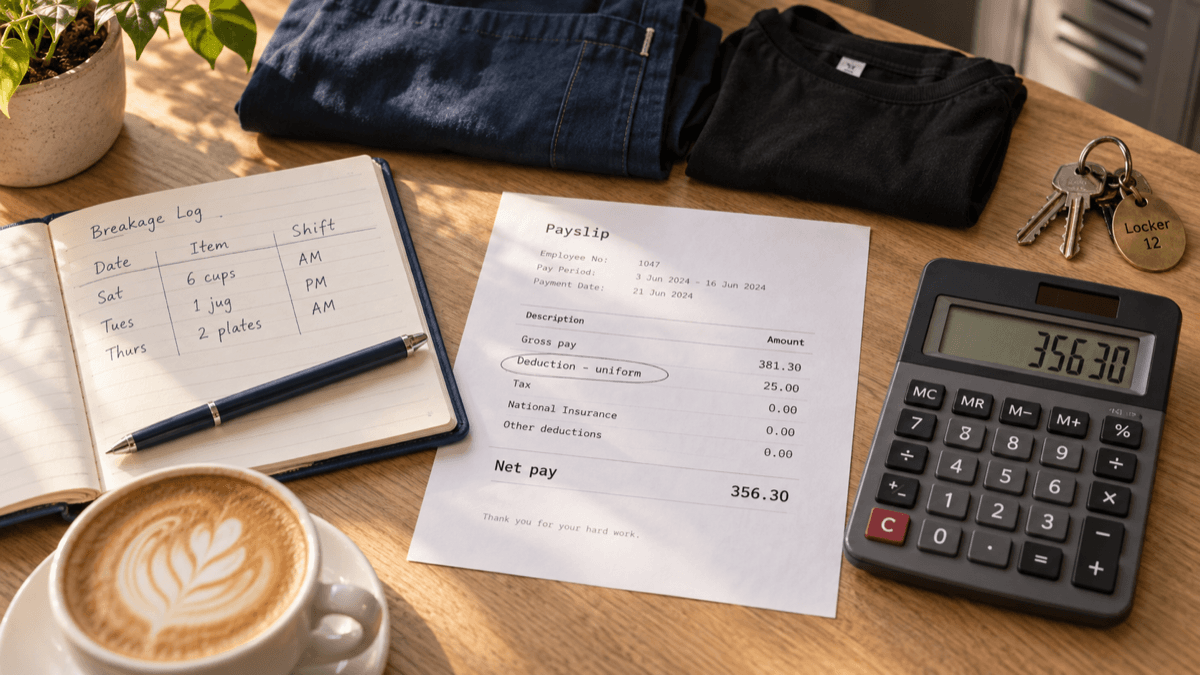
A tray of six cups goes down on the tiles at half past eleven. The Saturday drawer counts £20 short. The barista who left last month still has the branded apron in a bag at home.
Three moments, one instinct: you reach for the payslip. Somebody else's mistake has cost you money, and the only lever you have on a Friday is the pay run.
But the rules run the opposite way to instinct. The till shortage is often recoverable. The charge for the shirts almost never is.
The rule almost nobody knows in full
A deduction from wages is unlawful unless one of three things is true:
- A law requires or allows it: tax, National Insurance, an attachment of earnings order.
- A written term in the contract allows it, and you gave the worker a copy of that term before the deduction.
- The worker agreed in writing before the thing you are deducting for happened.
That is the Employment Rights Act 1996, section 13, and two points in it do the real work.
Timing beats paperwork. A clause you added last Tuesday cannot cover a breakage from last Monday, and neither can a consent form. A signature on Sunday does not fix Saturday night.
A term nobody was handed does not count. You must first have given them the written term, or explained in writing what it does.
Overpayments are the exception: recovering wages or expenses you genuinely overpaid sits outside that gateway.
Sections 13 to 22 cover England, Wales and Scotland. Northern Ireland has near enough identical rules in the Employment Rights (Northern Ireland) Order 1996: Article 45 for the basic gateway, Articles 49 to 54 for the retail cash shortage limits. Minimum wage law is UK wide.
The retail rule that covers your café
There is a second layer for businesses that sell to the public. The Act calls it retail employment: work involving the sale or supply of goods or services directly to members of the public. A café counter sits inside that.
Where a deduction relates to a cash shortage or stock deficiency, two extra limits apply:
- No more than one tenth of gross wages on any pay day, before tax and National Insurance, covering every shortage deduction on that payslip added together.
- Twelve months from the date you established the shortage existed, or ought reasonably to have done. The deduction, or the first of a series, must fall inside that window.
Acas adds a practical step: tell them in writing what they owe and how you will claim it back.
The minimum wage trap is not where you think
Minimum wage pay starts from gross pay. Anything you take off for your own use and benefit, meaning money you are then free to spend as you like, comes out of that figure, and the worker agreeing makes no difference.
These always reduce minimum wage pay:
- Uniform. If you require specific items and do not supply them, deductions for those items reduce minimum wage pay, whether bought from you or a third party, and whether or not it is in the contract.
- Required clothing the worker buys themselves, such as the black trousers you told them to turn up in, unless you reimburse the cost.
- Cleaning, laundering or repairing a supplied uniform through ordinary wear and tear.
- Training you require or impose, deducted at the time or clawed back from final pay.
- Staff food and drink taken as a deduction. If they pay for lunch after wages are paid, fine. Take the same off the payslip and it reduces minimum wage pay, even with a signed agreement.
Living accommodation is the only benefit in kind that counts the other way, and only to a limit: from April 2026, £11.10 a day or £77.70 a week. Nothing else counts.
And here is the surprise. A deduction for the worker's own conduct, or another event where they are contractually liable, does not reduce minimum wage pay. The guidance uses two examples that could not be more on the nose: a restaurant worker who breaks a glass and has wages docked, and a shop worker required by her contract to make up a till shortfall she caused.
So breakages and till shortages caused by the worker's own conduct, where the contract makes them liable, are limited by the contract term and the 10% cap, not the minimum wage. Without that conduct and liability link, a shortage deduction is treated like any other and does reduce minimum wage pay. Uniforms are limited by the minimum wage, and no contract clause gets round that.
A worked example, illustrative throughout
Take a barista aged 21 on the April 2026 National Living Wage of £12.71 an hour, working 30 hours in the pay period. Every figure below except that rate, the 10% cap and the penalties is illustrative.
Zero headroom. Minimum wage pay required is 30 x £12.71 = £381.30. Deduct £25.00 for two branded shirts and you are at £356.30, or £11.88 an hour, £0.83 below the rate. Arrears owed: £25.00. Someone paid exactly at the rate has no headroom, so any uniform deduction is an underpayment of the same amount. The rate was legal. The deduction broke it.
With headroom. Say the same barista is on £13.20 an hour, so £396.00 against a floor of £381.30. Your whole budget for uniform deductions is £14.70 - one shirt, with £2.20 to spare. Deduct the full £25.00 and you are at £371.00, or £12.37 an hour, with £10.30 of arrears.
Penalties run to 200% of arrears, halved if you comply fully with a notice of underpayment within 14 days, and capped at £20,000 per worker. Trivial once. Less so when the same charge went through for nine new starters: the cap is per worker, and arrears are revalued at the current rate.
Now the till shortage. Same barista at £12.71, £381.30 gross, drawer £20 down. Ten per cent of £381.30 is £38.13, so the whole £20 fits inside one pay day, and the minimum wage floor does not bite because it is a shortage she is contractually liable for.
So at exactly the rate, the £20 till shortage is recoverable in full and the £25 shirt charge is not recoverable at all, the opposite of what most owners assume. Above the rate, the shirt charge is recoverable only up to the headroom you have. And the £20 works only if the written term was in place and handed over before Saturday, the shortage was established within twelve months, and she is told in writing what she owes.
Training, overpayments, notice and holiday
- Training costs. Repayment works only if agreed in writing before the course started. Acas's example is repayment if the person leaves within six months. It can take pay below the minimum wage only if they agreed in writing, the training was voluntary, and they chose to leave or were dismissed for conduct. Training you require reduces minimum wage pay whatever the contract says.
- Overpayments. You have the right to the money back, but Acas is clear you should not simply take it. Talk first, agree a repayment plan.
- Notice not worked, and holiday taken in excess. You owe time worked plus accrued untaken holiday. Deducting the cost of cover, or holiday beyond what they built up, needs a clause agreed in writing beforehand. Worth reading alongside how absence and sickness feed into pay.
Tips can never fund any of this
This line is harder than the wages rule. For tips allocated to workers, neither a contract term nor prior written consent can authorise a deduction. Both gateways are switched off, and the statutory code says pass on all tips and service charges without deductions, except in very limited scenarios such as income tax.
So the float top up habit, holding back £20 a week from tips to cover the float or till shortages, is a breach every time. As the guide to the Allocation of Tips Act for cafés puts it: if your till is short, that is a management problem, not a tip problem. Tips do not count towards minimum wage pay either, so they cannot plug the gap.
What to do instead
Till shortages: fix the routine, not the payslip. Most variance is training or process, and a drawer short by a clean £5, £10 or £20 is a different animal from one out by £3.47. The ten minute daily cashing up routine, with one fixed float counted at open and close, finds the cause faster than any deduction.
Breakages: keep a log with a tolerance. What broke, when, who was on. Not to build a case: a fear based system hides breakages rather than reducing them, and the chipped cup quietly goes back out to a customer. Six cups on a Saturday is the cost of trading.
Uniform: provide it free. Supplying it means no deduction and no minimum wage exposure. Add a return on leaving clause: a reasonable charge where a worker negligently damages, loses or fails to return a supplied uniform does not reduce minimum wage pay, provided it is a contractual requirement. For generic clothing, the guidance suggests setting a reasonable amount you will reimburse and paying it as expenses.
And weigh the cost. Two shirts is under two hours of a full time worker on the National Living Wage, who costs closer to £16.14 an hour than £12.71 once NI, pension and holiday are stacked on.
Get it right on paper
The written statement of employment particulars must be given on day one and cover how much and how often the person gets paid. Inside it, put a plain deduction clause, acknowledged before their first shift: overpayments of wages or expenses; cash shortages and stock deficiencies from the worker's own conduct, subject to the 10% limit; and the reasonable cost of uniform or keys negligently damaged, lost or not returned.
If you have already got it wrong, fixing it yourself is far cheaper than waiting. An employer who identifies an underpayment and pays the arrears through HMRC's voluntary declaration process is, other than in exceptional cases, not named and not penalised. And this is a live target: HMRC's December 2025 Check Your Pay campaign for seasonal workers, hospitality included, called out uniform and equipment deductions as a cause of underpayment.
All of it starts upstream, with clean, confirmed hours per person per pay period. That is what we are building StaffBrik to hand to whoever runs your pay run.
This week
- Read your contract template. Is there a deduction clause, and has every member of staff been given a copy? If not, it covers nothing that has already happened.
- Check any uniform charge. If you deduct for shirts, aprons or branded anything, stop, and work out the hourly rate in those periods.
- Pick your uniform position. Supply it free with a return on leaving clause, or set a reimbursable limit and pay it as expenses.
- Start the breakage log. A page in the cashing up book: date, item, shift. No consequences for the first month, just data.
The payslip is the most expensive place to solve an operational problem. The £20 you dock buys you a colder team.
Ed O'Brien has run Hunters Cake Company for 17 years across cafés in Witney, Burford, and a bakery in Carterton, Oxfordshire. He's building Brikly - modular tools that give independent café owners the same data the big chains have, without the big chain price tag.