
Coffee subscriptions: recurring revenue or discounting in disguise?
There's a sign in a competitor's window: £25 a month, unlimited coffee.
Your first reaction is that they've lost their minds. Your second reaction, about four days later, is that three of your regulars have stopped coming in.
So which is it? Genius customer-acquisition play, or a slow bleed dressed up as innovation?
It depends on one number most operators never work out: what a cup actually costs you at the margin, and how many cups a member drinks before the maths turns against you. Get that right and a membership is one of the better tools an independent café has. Get it wrong and you've sold an all-you-can-eat pass to the hungriest people in town.
The three models, and how differently they behave
They look similar on a chalkboard. They are not remotely the same business.
Unlimited. A flat monthly fee, drink as much as you like. Maximum appeal, maximum downside. Your cost scales with consumption while your income doesn't, so your worst case is defined by your most enthusiastic customer rather than by your pricing.
Capped. A flat monthly fee for one drink a day, or ten a month, or unlimited before 11am. Your exposure is bounded, you know the absolute worst a member can cost you, and you can price against it. This is the model that works for most independents.
Prepaid credit bundles. Pay £50, get £57.50 of credit. Or ten coffees for £32. No open-ended commitment, cash upfront, and the discount is a known fixed percentage. The least exciting model and the easiest one to survive.
The worked maths: a capped membership at £45 a month
A takeaway flat white at £3.80 including VAT is £3.17 of turnover once you strip the VAT out.
Your marginal cost per cup - beans, milk, cup, lid, sleeve - typically lands around 60p to 80p for an independent in 2026. Call it 70p. That leaves £2.47 of contribution on every cup you sell at full price.
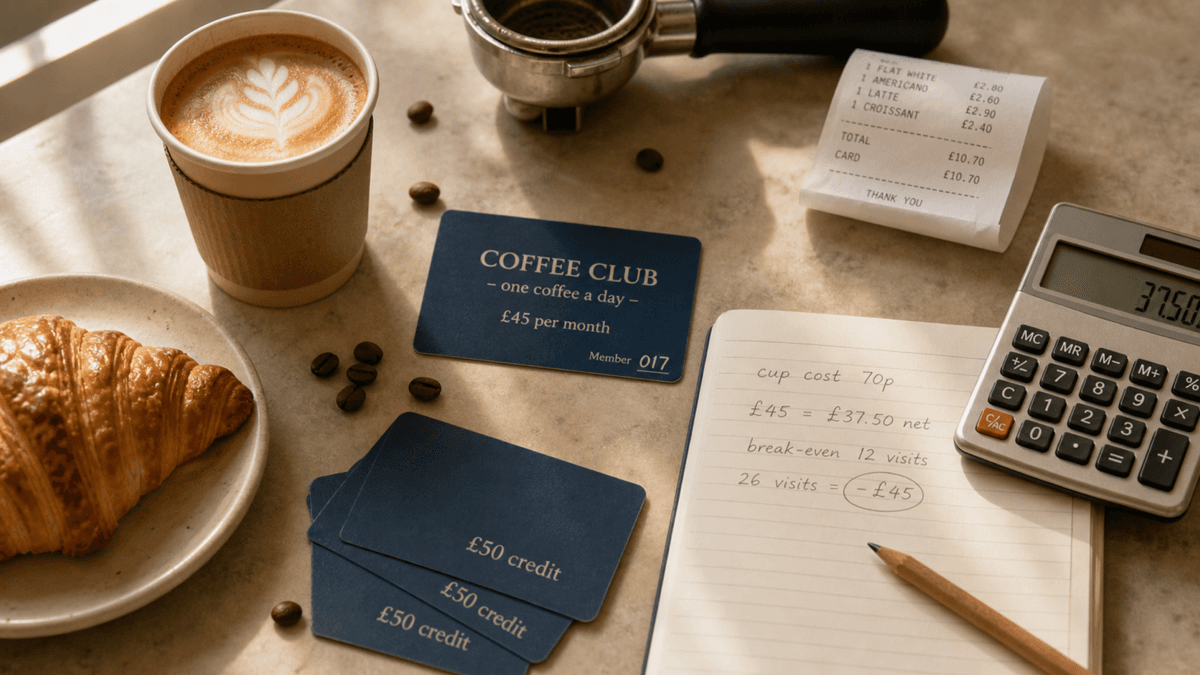
Now the membership: £45 a month for one coffee a day. That's £45 including VAT, so £37.50 of net income per member per month.
Where the cash floor sits
At 70p a cup, £37.50 buys 53 cups before you're out of pocket on ingredients. A one-a-day cap means a member can physically take about 30. So on a capped pass you cannot lose cash on the coffee itself, even from someone who never misses a day. That's the whole point of the cap.
Where the real break-even sits
Ingredients aren't the interesting number. What that person would have paid you anyway is.
A member visiting n times contributes £37.50 minus 70p per cup. A non-member visiting the same n times contributes £2.47 per cup. Those two lines cross at about twelve visits a month.
That's your indifference point:
- Below 12 visits, the member is more profitable than the same person paying cash. You're banking a fee they didn't fully use.
- At 12 visits, it's a wash.
- Above 12 visits, you're subsidising them.
A member coming in 26 times contributes £37.50 minus £18.20, so £19.30. At full price those visits would have contributed £64.22. On the coffee alone, you're £45 down on that one person.
Where unlimited breaks
Run the same logic on the £25 unlimited pass in the competitor's window. £25 including VAT is £20.83 net, which at 70p a cup is 30 cups before the cash runs out.
One a day and they've drained it. Someone doing two a day costs you roughly £42 in cups against £20.83 of income. You are paying about £21 a month for the privilege of having them, before rent, wages, card fees, or the two hours they spend on your best table with a laptop.
Frequency is the actual prize
Here's the part that makes memberships worth considering despite all of the above. You are not really selling coffee. You are buying visits, and a customer standing in your café is a customer who might buy a croissant.
Say a pastry at £3.20 including VAT, so £2.67 net, at a 65% gross margin. That's about £1.73 of contribution, and roughly 30% of visits pick one up.
Now take a regular who visited 9 times a month and, once they've paid for a pass, visits 18 times:
| Before (9 visits, cash) | After (18 visits, member) | |
|---|---|---|
| Coffee contribution | £22.23 | £24.90 |
| Pastry contribution | £5.19 | £10.38 |
| Total per month | £27.42 | £35.28 |
The coffee line barely moves. The food line doubles. Net, you're about £7.90 a month better off on that customer, plus their £45 is in the bank on the 1st rather than dribbling in over four weeks. Scale that to 40 members averaging 14 visits against a prior average of 8, and the gain lands around £400 to £450 a month. Not life-changing. Not nothing either, especially in February.
But look what's carrying it. It isn't the coffee, it's the attachment spend, which means a membership only pays if your food is good enough to get picked up on the way past. Everything in lifting average spend per customer applies double to members, because you've already got the visit and the drink is a sunk cost to them.
Subscription versus stamp card, honestly
A stamp card discounts in proportion to visits. Buy nine, get the tenth. However heavy the user, the discount stays at a fixed percentage. It's self-limiting, it costs nothing upfront, and there's no commitment either way. It is also, as I've argued in what actually drives repeat visits in an indie café, very often a quiet price cut handed to people who were coming anyway.
A subscription discounts in inverse proportion to visits. The heavier the user, the deeper their effective discount goes. Light members are pure margin, heavy members are the problem. That's a riskier shape.
What a subscription buys you that a stamp card doesn't:
- Cash upfront, every month, on a predictable date
- A commitment that changes behaviour - people walk past the other place to use the thing they've paid for
- A named, contactable customer instead of an anonymous card in a wallet
- A hard ceiling on the discount, if you cap it
What it costs you: a much worse worst case, and a real chance of cannibalising your best regulars.
The boring bits that catch people out
Prepayment cash is not profit. When someone pays £45 on the 1st, that isn't turnover on the 1st. It's money you owe in coffee. You recognise it as they drink it, or evenly across the month, depending on how your accountant wants it treated. Same trap as gift cards and vouchers, and the same upside applies: prepaid credit that never gets redeemed eventually becomes income.
VAT on prepayments is worth a five-minute conversation, not a guess. A membership spendable on a sit-in latte, a takeaway loaf or a slice of cake typically behaves like a multi-purpose voucher, with VAT accounted for at redemption rather than at sale. A pass that only ever buys one standard-rated drink may be treated differently. Ask your accountant before you launch, not after your first quarter.
Churn decides it. A membership customers keep for eleven months is a different product from one they cancel in six weeks. Track it from day one.
Keep cancellation honest. No hidden links, no phone-only cancellation, no auto-renewal a customer didn't understand. A resentful ex-member in a market town is expensive publicity. One clear email address, cancel by the end of the month, done.
Ring it through the till properly
You need three things separated in your EPOS: the membership sale (deferred income, not trade), the redemption (a member's coffee, rung as a £0 or fully discounted line against a dedicated Membership button), and everything else the member buys at full price.
If your team rings member coffees through the misc key or as a straight void, you've deleted the only data that answers the question. As covered in what your till buttons are costing you in sales data, the misc key is where good decisions go to die. Set the buttons up before you sell the first pass.
Then you can pull the two figures that matter: redemptions per member per month, and non-membership spend per member visit. The first tells you your exposure, the second tells you whether the attachment spend is actually showing up.
How to pilot one without betting the margin
- Work out your true marginal cost per cup first. Not a guess. Your beans, your milk, your cup, at current invoice prices. This is exactly what CostingBrik keeps honest, because the number moves every time a supplier puts a price up, and a membership priced against last year's costs is priced wrong.
- Cap it. One drink a day, or ten a month. Never unlimited on a first pilot.
- Cap the member count. Thirty to fifty. It creates scarcity, makes the launch feel like an invitation rather than a discount, and bounds your downside to something you can absorb.
- Set a three-month term, clearly stated, with no promise of the same price after. Renewal is your decision.
- Baseline the joiners. Note roughly how often each signup already visits. If they're already coming 20 times a month, you're about to hand them a discount, not build a habit.
- Review at three months against the numbers, not the vibe. Redemptions per member, attachment spend per visit, churn, and total contribution against the same cohort's pre-pilot behaviour. MenuBrik will show you what those extra visits actually bought.
A coffee membership isn't automatically a good idea or a bad one. It's a pricing decision that lives or dies on marginal cost, frequency lift, and whether your food is good enough to get picked up on the way out.
The competitor with the £25 sign may well be running a brilliant scheme. Or they may be funding two coffees a day for forty people and calling it growth. The difference is about twenty minutes with a calculator, done before the sign goes in the window rather than after.
Ed O'Brien has run Hunters Cake Company for 17 years across cafés in Witney, Burford, and a bakery in Carterton, Oxfordshire. He's building Brikly - modular tools that give independent café owners the same data the big chains have, without the big chain price tag.