
Lifting average spend without raising prices
Most café owners trying to grow think about two things: more customers, or higher prices. Both are hard. Footfall is largely out of your hands, and putting prices up in 2026 is a good way to watch your regulars hesitate at the counter.
There's a third lever, and it's the quiet one. It's how much each customer spends when they're already standing in front of you. Nudge that up a little and the effect compounds across every single cover, every single day.
One caveat before the levers: if you trade in a visitor town, a good slice of your summer customers will only ever stand in front of you once, and tourist-season economics play by slightly different rules.
What average transaction value actually means
Average transaction value, or ATV, is simply your takings divided by the number of transactions. If you took £1,500 over 250 sales, your ATV is £6.
It tells you what a typical customer is worth when they walk up to the till. And unlike footfall, it's something you can genuinely influence from behind the counter.
The companion number is your attach rate. That's how often an add-on actually goes on the order. If 100 people buy a coffee and 30 of them also take a pastry, your pastry attach rate is 30%. Coffee plus something to eat is the classic café attach, and for most independents it's nowhere near as high as it could be.
These two numbers move together. Lift the attach rate and ATV follows.
The maths nobody does
Here's why this matters more than it first looks. Small numbers per head turn into large numbers per year.
The figures below are an illustrative example. Swap in your own.
Say you serve 150 covers a day and trade six days a week, roughly 312 trading days a year. Now imagine you lift average spend by just 40p per customer. Not £4. Forty pence.
- 40p x 150 covers = £60 a day
- £60 x 312 trading days = £18,720 a year
Nearly nineteen thousand pounds of extra turnover, and you never touched a single shelf price. The customer who wanted a flat white still pays the same for their flat white. Some of them just left with a brownie as well.
That's the whole game. A tiny, almost invisible shift per head, multiplied by a number you forget is enormous.
The levers that lift spend without raising prices
None of these involve changing your headline prices. They're about adding value the customer happily pays for.
Train staff to actually ask
The single biggest lever is the prompt at the till, and most teams either skip it or do it badly. "Anything else?" is a dead question. It invites a no.
Specific, warm and confident works far better. Name the thing. "We've got warm cinnamon buns out of the oven, fancy one with that?" lands very differently to a mumbled "anything else?". Same with sizing: "make that a large?" on a coffee adds 30p to 50p in a heartbeat.
The barrier is almost never the customer. It's that staff feel pushy, or they forget under pressure. Make it a normal part of the order, model it yourself, and it stops feeling like a sales tactic.
Build bundles that feel like value
A meal deal works because it removes a decision and feels like a saving, even when it lifts the basket. A coffee, a pastry and a piece of fruit at a tidy combined price gets people spending more than they would item by item, and they walk away feeling looked after rather than upsold.
The trick is to build the bundle around your high-margin items, not your cheapest. A drink plus a baked good you make in-house is usually a far healthier combination than anything involving bought-in stock, and before you chalk one up it pays to check what a takeaway lunch deal really earns once VAT and cannibalisation are in.
Put the right things in the right place
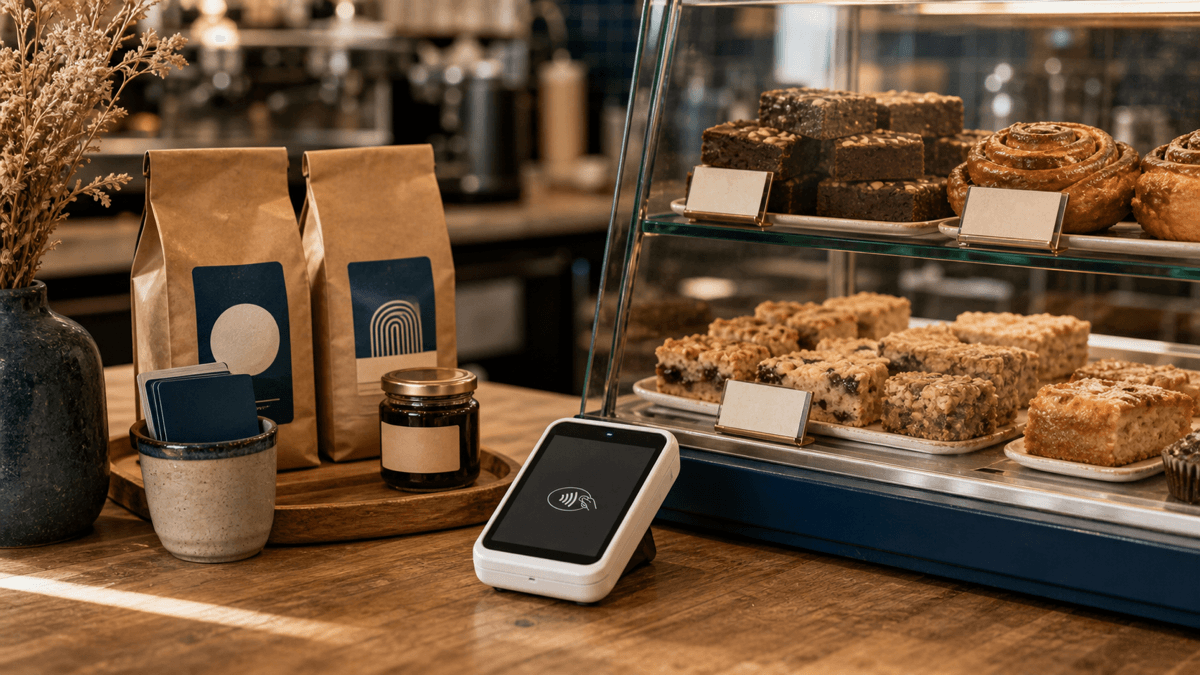
Impulse buys happen at the point of decision. The flapjacks and the tray bakes belong next to the till, at eye level, not tucked away on a back shelf. The card machine is prime real estate, so a small "treat yourself" display beside it earns its keep.
Your menu does the same job. The way you lay it out, group items and draw the eye decides what people notice and order, which is exactly why it pays to design your menu to steer spend toward the things you want to sell rather than leaving it to chance.
Use loyalty and retail at the counter
A loyalty scheme that rewards visits keeps people coming back, but it also gives you a natural reason to suggest the add-on. Retail lines at the counter, your beans, a jar of jam, a branded tote, lift spend from customers who are already sold on you. They cost little to stock and turn a £4 coffee run into a £12 one a couple of times a week.
Measure it, then test one thing
You can't lift a number you're not watching. Your POS already holds the answer in its sales mix report, where ATV and attach rates sit waiting to be looked at.
The honest way to do this is to change one thing and watch the number move. Pick a single prompt or a single bundle. Run it for a fortnight. Compare ATV and attach rate against the two weeks before. If it moved, keep it. If it didn't, drop it and try the next.
This is where having the data joined up helps. MenuBrik reads your sales mix and attach behaviour straight from your POS, so you can see which add-ons actually go on orders and which combinations pull their weight, rather than guessing from the till roll. If you'd rather start by hand, our free Menu Profit Calculator lets you stack items side by side and see what genuinely makes money before you decide what to push.
It also pays to know which lines are worth the effort in the first place. Most of your profit comes from a small handful of items, so it's worth reading your sales mix the Pareto way before you build a bundle around the wrong thing.
One caution
There's a wrong way to do all this, and it bites you.
Lifting ATV should mean adding value, not shrinking it. Quietly cutting portion sizes, slipping in a service charge, or pushing add-ons so hard that regulars feel hustled will cost you far more in goodwill than you gain at the till. Time-poor operators sometimes reach for the sneaky version because it's quick. Don't. Your regulars notice, and they're the customers you can least afford to annoy.
The good levers all share one thing: the customer ends up happier, not just poorer. A warm pastry they didn't know they wanted. A bundle that genuinely saves them money. A larger coffee they'll actually enjoy.
And remember, spend per cover is only half the picture. The other lever is getting more covers through the same seats in a day. The two stack.
The takeaway
Pick one attach lever this week. The take-away food prompt is the place I'd start. Train your team on the exact words, do it yourself on the floor so they see it's normal, and then watch your ATV and attach rate in your POS every Monday morning.
Forty pence a head sounds like nothing. By the end of the year, it's a new oven, or a month's rent, or the difference between a tight year and a comfortable one. All of it from customers who were already standing in front of you.
Ed O'Brien has run Hunters Cake Company for 17 years across cafés in Witney, Burford, and a bakery in Carterton, Oxfordshire. He's building Brikly - modular tools that give independent café owners the same data the big chains have, without the big chain price tag.