
Costing free-from: what gluten-free and vegan bakes really cost to make
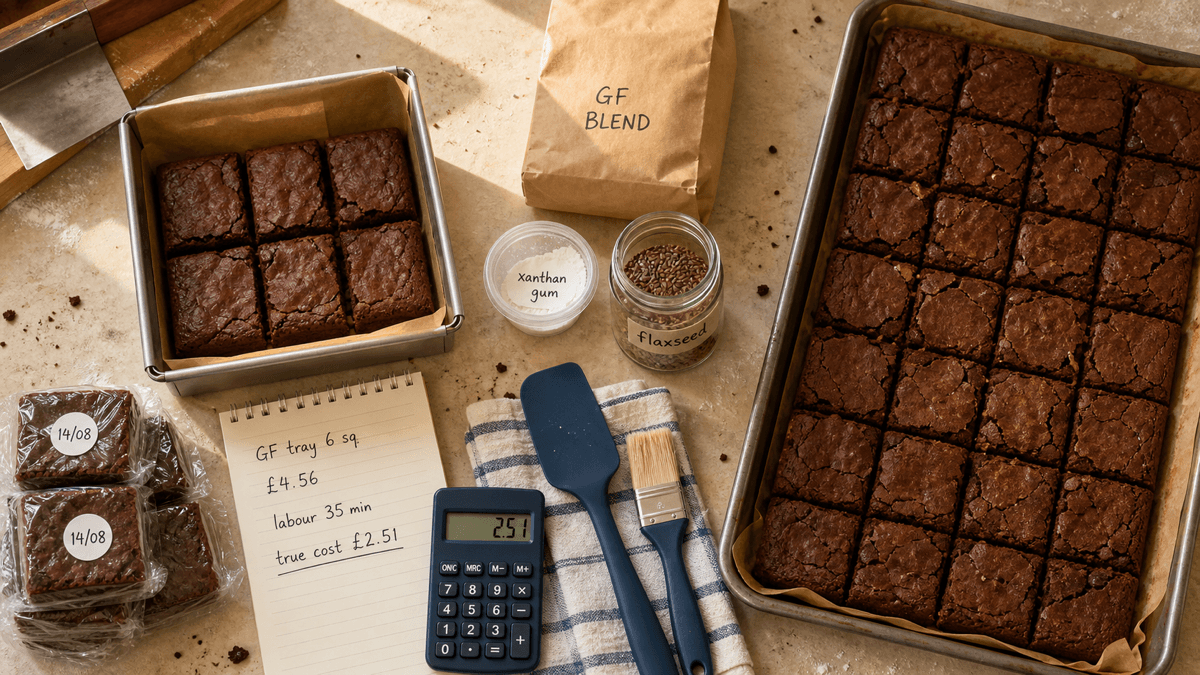
The gluten-free brownie sits next to the regular one in the cabinet and sells for 20p more. The flour in it costs around three times as much, the batch is a quarter of the size, and somebody spent twenty minutes wiping down the bench before they could even start.
That 20p is not covering any of it.
Most cafés price free-from the same way: take the standard cake price, add a token amount because it feels like it should cost a bit more, and move on. What you end up with is usually the worst margin in the whole display, sitting quietly next to your best one.
Here's where the money actually goes, and it is probably not where you think.
The ingredient premiums, honestly
Let's deal with the flour first, because it's the thing everyone points at.
Gluten-free flour blends typically run two to four times the price of standard wheat flour. Check your own invoices rather than taking a number off a blog, but that's the shape of it. Xanthan gum sounds like the expensive bit and isn't: you use a few grams at a time, so even at a scary price per kilo it lands at pennies per bake.
Plant butters and whippable plant creams do carry a genuine premium over block butter and dairy double cream. Not a catastrophic one, but real.
And then the honest surprise nobody mentions: egg replacements are cheap. Flaxseed costs very little per bake, and aquafaba is the drain water from a tin of chickpeas you already had. So a vegan sponge can actually come out cheaper on ingredients than its dairy cousin.
Here's an illustrative swap on a two-layer sponge, using ex-VAT trade prices of the kind you'd see in 2026. Your suppliers will differ, so check yours.
| Swap | Standard | Vegan version | Difference |
|---|---|---|---|
| 8 medium eggs to flax/aquafaba | £1.87 | £0.36 | -£1.51 |
| 400g block butter to plant block | £2.88 | £3.80 | +£0.92 |
| 200ml double cream to plant whipping cream | £0.68 | £0.84 | +£0.16 |
| Net effect per cake | about 43p cheaper |
Gluten-free rarely does this. Swap 400g of wheat flour for a GF blend on the same sponge and you're paying somewhere around £1.00 more per cake, which is roughly 10p a slice.
Which brings us to the awkward bit. Ten pence a slice does not explain why your free-from line feels like it makes no money. Because the flour was never the problem.
The real cost is batch size and labour
Free-from lines sell in smaller volumes. That is the whole issue, and everything expensive flows from it.
You sell fifteen standard brownies a day and three gluten-free ones. So you bake a full tray of standard and a sad half tray of GF. But the baker still weighs, mixes, lines, watches the oven, cools and cuts. The labour barely changes when the tray gets smaller. It just gets divided over far fewer squares.
Then add the things a shared kitchen needs for genuine free-from: a separate prep run, a proper clean-down before you start, dedicated tins, a dedicated spatula, its own bit of bench.
Let's put illustrative numbers on it. A fully loaded baker cost of around £18/hour, wage plus employer NI and pension.
Standard brownie tray
| Line | Figure (ex-VAT) |
|---|---|
| Ingredients, whole tray | £8.65 |
| Saleable squares after trimming | 12 |
| Ingredient cost per square | £0.72 |
| Hands-on labour, 25 min | £7.50 |
| Labour per square | £0.63 |
| True cost per square | £1.35 |
Gluten-free half tray
| Line | Figure (ex-VAT) |
|---|---|
| Ingredients, half tray | £4.56 |
| Saleable squares after trimming | 6 |
| Ingredient cost per square | £0.76 |
| Labour, 35 min including clean-down | £10.50 |
| Labour per square | £1.75 |
| True cost per square | £2.51 |
Four pence of ingredient difference. £1.12 of labour difference.
Then waste takes its cut
A slow-moving line has a higher waste percentage per slice sold. Six GF brownies out on Monday, you sell three. Tuesday you sell two. One goes in the bin.
That is roughly 17% waste, against maybe 5% on the standard tray that sells out by two o'clock. Which means your true cost per square actually sold isn't £2.51, it's closer to £3.02.
Now price it. Standard brownie at £3.60 eat-in is £3.00 ex-VAT. You've been brave and put the GF one at £3.80, which is £3.17 ex-VAT.
- Standard: £3.00 minus £1.35 = £1.65 gross profit, about 55%
- Gluten-free: £3.17 minus £3.02 = £0.15 gross profit, about 5%
The line you thought was a nice little earner is working for fifteen pence a square while the one next to it makes £1.65.
Fix the batch, not the price
Bake the full GF tray, once a week. Portion it, wrap it, freeze it. Defrost three squares at a time to match what actually sells.
Same recipe, same clean-down, same forty minutes of labour. But now:
- Labour spreads over 12 saleable squares instead of 6, so it drops to around £1.00 a square
- Ingredients stay at about £0.76
- True cost falls to roughly £1.76
- Waste goes to near zero, because nothing sits in the cabinet dying
At £3.17 ex-VAT that's £1.41 gross profit, about 45%. A real line, on a real margin, without touching what you charge. This is the whole argument for treating your freezer as a margin tool rather than a graveyard, and free-from is the clearest case for it in the building.
A frozen-and-defrosted brownie is also, frankly, indistinguishable.
Cross-contact: say what's actually true
Worth being straight about this, because it affects what you're allowed to charge for.
You cannot call something "gluten-free" without genuine controls behind it. The legal threshold is 20 parts per million, and in a shared kitchen with a flour-dusted bench and one set of tins, you are almost certainly not meeting it by accident.
The honest alternative is "made without gluten-containing ingredients". It tells a coeliac customer the truth, which is what they need to make their own decision. Most of them will thank you for the clarity.
If you do want a properly gluten-free line, the controls are the cost: dedicated equipment, separate storage, a scheduled prep slot, and staff who understand why. That's exactly the labour we costed above, and exactly why the premium is legitimate. The compliance detail sits in the allergen matrix work that goes beyond a "contains nuts" note, so I won't rehash it here.
Price it as its own product
The mistake is treating free-from as a variant of the standard cake. It isn't. Different ingredients, different batch size, different labour, different waste curve. It's a different product that happens to look similar.
So cost it as one. Run the recipe properly, set a realistic sellable yield off the tray, and get to a true cost per slice the same way you would for any cake or traybake in the cabinet. If you want to do that for one line right now without setting anything up, the free recipe costing calculator will get you a cost per portion in a couple of minutes.
Then price it on its own numbers.
Free-from customers are, in my experience, less price-sensitive than almost anyone else at the counter. Somebody who has been offered a shortbread finger and an apology in four cafés is delighted to find a proper brownie, and a fair premium backed by real costs does not offend them. What offends people is a bad product, not a 60p difference.
One VAT note so it doesn't muddy the comparison: cold takeaway cake is zero-rated whether it's gluten-free or not. The VAT treatment is identical, so it never explains a margin gap between the two.
Matching the standard price and hoping is not modest. It's just a decision you made by not deciding.
Two great lines beat a sad range
The last trap is range creep. A GF brownie, a vegan flapjack, a GF lemon drizzle, a vegan cookie, a dairy-free scone. Five lines, all selling two a day, all costing a clean-down, all binning half.
Two excellent free-from lines will out-earn a wide, apologetic range every time.
Pick one great gluten-free bake, ideally a naturally low-flour one like a brownie or a flourless orange cake, where the premium is small and the texture is genuinely good. Then pick one "accidentally vegan" bake most customers would choose anyway: a good flapjack, a jam-filled shortbread, a proper chocolate cake. Don't label it apologetically. Label it as a cake that happens to be vegan.
Both live happily in the freezer bank. Both get baked in one proper run a week. Both make money.
What to do this week
- Cost your free-from lines separately. Not as a variant, as their own recipe with their own yield.
- Add the labour. Include the clean-down and the fact that the batch is small. That's the number that will shock you.
- Count the bin for one week. Waste percentage on a slow line is the hidden multiplier on cost.
- Move to weekly batch and freeze. Full tray, portioned, frozen, defrosted to demand.
- Then set the price. A fair premium on honest costs, not a token 20p.
If you'd rather the ingredient prices kept themselves current instead of you re-costing every time the GF flour goes up, that's the job CostingBrik does off your invoices. But the thinking above works fine on a sheet of paper, and the thinking is the part that matters.
Free-from is not charity and it shouldn't be a loss leader. Done properly, with a sensible batch and an honest price, it's one of the better margins in the cabinet and the reason a whole table books with you instead of walking past.
Ed O'Brien has run Hunters Cake Company for 17 years across cafés in Witney, Burford, and a bakery in Carterton, Oxfordshire. He's building Brikly - modular tools that give independent café owners the same data the big chains have, without the big chain price tag.