
Your freezer is a margin tool, not a graveyard
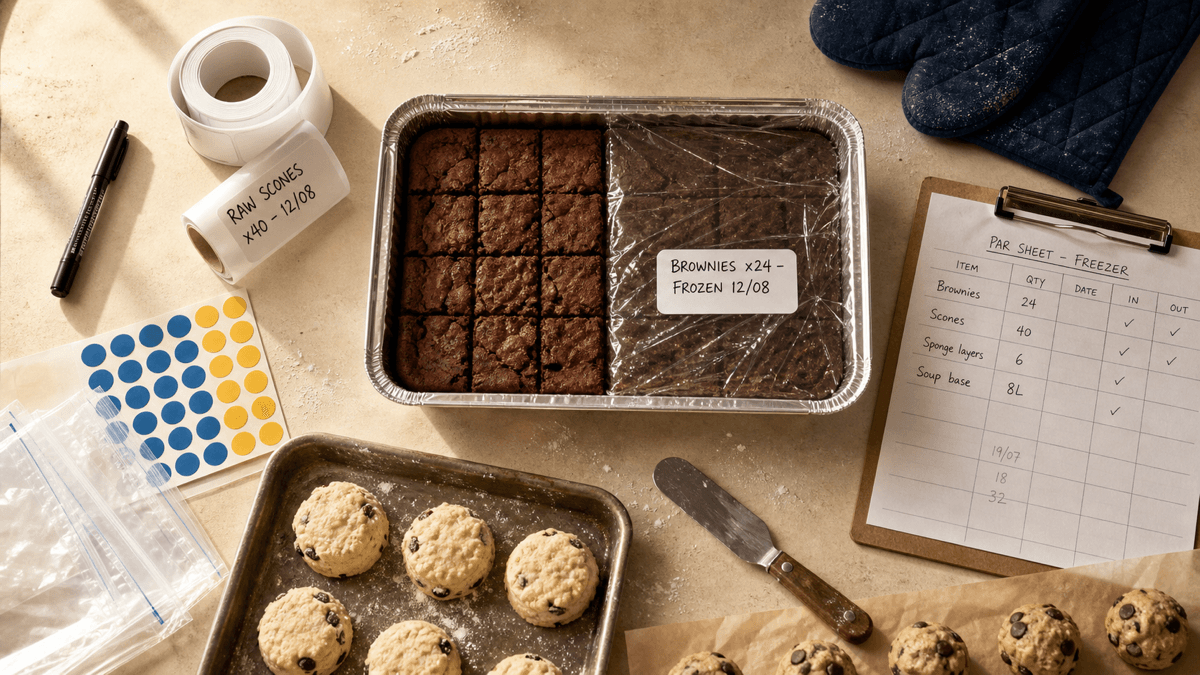
What is sitting in your display counter at 4pm decides your waste line. And what goes into the display counter is decided, days earlier, by how you bake.
Most cafés use the freezer as the place things go to be forgotten. A tray of something under cling film, no label, no date, found six weeks later and binned with a shrug.
Used deliberately, it is one of the best production tools in the building. After 17 years running a bakery and cafés, it is the piece of kit that has done the most to flatten both my waste and my labour bill.
A full oven costs barely more than a half-empty one
This is the bit that gets missed. The cost of a bake is not just ingredients.
Bring the oven up to temperature, set up the bench, weigh out, mix, scale, portion, bake, cool, wash down. Most of that is fixed effort. It takes very nearly the same time to make one tray of brownies as three.
Ingredient cost per slice stays flat, but labour and energy per slice falls sharply with batch size. A half-empty oven is the most expensive way to bake anything.
The obvious answer is to bake bigger. The obvious problem is that a bigger bake, sitting in a counter that needs today's quantity, is just tomorrow's bin liner. That is where the freezer earns its place.
Bake to the economic batch size. Sell what today actually needs. Freeze the rest.
Freeze at peak freshness, not as a rescue
Here is the rule that separates a working freezer from a graveyard.
Freezing on bake day is a strategy. Freezing on day three is a rescue.
A brownie wrapped and frozen an hour out of the oven defrosts to something a customer will happily pay full price for. A brownie that has done two days on the counter, gone dry at the edges, and then been frozen, defrosts to exactly that: a dry two-day-old brownie, only colder.
The freezer does not improve anything. It pauses whatever you put in it. So decide at the point of bake, not at the point of panic.
What freezes brilliantly, and what really does not
Being honest about this matters. Freezing the wrong things is how operators decide "freezing doesn't work for us" and quietly go back to overbaking.
Freezes brilliantly
- Brownies and traybakes. Dense, high fat, low water. Some are arguably better after a freeze.
- Un-iced sponges. Freeze the layers, ice fresh on the day. Buttercream freezes fine too, separately in a tub.
- Raw portioned cookie dough. Scoop, freeze on a tray, bag up. Bake from frozen in small numbers through the day.
- Raw scones. Cut, freeze, bake straight from frozen. Twenty minutes to a fresh scone at 2pm with no morning prep.
- Part-baked pastries and breads. Finish off as needed, which is how the chains keep a full counter all day.
- Soups, sauces, braises and fillings. Freeze flat in bags, stack like books, defrost fast.
Really does not
- Finished cakes with fresh cream. The cream splits and weeps.
- High-water salads and veg. Cucumber, lettuce, tomato, anything crisp. Ice crystals wreck the structure and you get mush.
- Custards and set creams. They separate and go grainy.
- Anything that has already sat in the display. You are freezing the problem, not solving it.
The pattern is simple enough: high fat and low water freezes well, high water and delicate structure does not. Raw usually beats finished, and components usually beat assembled products.
The system that makes it work
A freezer full of anonymous cling-filmed mysteries is exactly the graveyard we are trying to avoid. The discipline is not optional, and most of it is the food safety practice you should be running anyway.
- Wrap properly. Air is the enemy. Double wrap, use lidded containers, or vacuum pack if you have the kit. Freezer burn is a quality problem, and quality is what you are selling.
- Label every single item. Product name and freeze date, no exceptions. Coloured day dots are cheap and readable across the room.
- Strict FIFO. Oldest at the front. If your team has to dig, they grab whatever is nearest and your oldest stock quietly ages out.
- Defrost in the fridge, overnight. Not on the bench, not in a warm kitchen. Plan the day before.
- Never refreeze. Portion before freezing so you only ever take out what you need.
- Keep it at minus 18°C and check it. A freezer drifting warm is a slow, invisible loss of everything inside it.
Bake Tuesday for Saturday
The second win is production smoothing, and for a lot of cafés it is worth more than the waste saving.
Your oven and your bakers have quiet hours. Tuesday morning, midweek afternoons, the flat spots in every café week. Meanwhile Saturday is chaos, somebody is in at 5am doing a panic bake, and the counter reflects it.
Use the quiet hours to bake for the rush. It gives you:
- A calmer weekend. No 5am scramble, no baking to the sound of the queue building.
- Flatter labour. You are paying for those quiet hours anyway. Better to get product out of them than to pay overtime on Saturday.
- Consistent product. Baked unhurried on a Tuesday beats baked in a panic on a Saturday, every time.
- A fuller counter at 3pm, which is the biggest single driver of afternoon takings.
This is the same argument as sizing production to real footfall rather than habit, covered in more detail in cutting end-of-day waste through production planning. The freezer gives you somewhere to put the difference between what you bake efficiently and what you sell today.
Give the freezer its own par levels
This is the step almost nobody takes, and it turns a freezer from storage into a system.
Your dry store has pars. Your fresh orders have pars. The freezer needs them too: a minimum bank of each line, topped up during quiet hours, drawn down at the weekend. Something as plain as this, written on the freezer door:
- Brownies: minimum 24 portions
- Un-iced sponge layers: minimum 6
- Raw scones: minimum 40
- Cookie dough balls: minimum 60
- Soup bases: minimum 8 litres
Check it on a fixed day. Anything below par goes on the next quiet-hours bake list. Anything well above par means you are overbaking that line and should pull production back.
The thinking is identical to the way par levels stop ordering from tying up cash and creating waste: a floor and a ceiling, so decisions get made by the system rather than by whoever happens to be in that morning.
Pars also stop the other failure mode, which is a freezer so rammed that nobody can find anything and everyone bakes fresh anyway.
The waste maths
Numbers make this real. These are illustrative, so run yours, but the shape holds.
Say you bin 8 slices a day on average, at an ingredient cost of around £1.10 a slice.
- 8 × £1.10 = £8.80 a day
- Over a 7 day week = £61.60 a week
- Over a year = roughly £3,200
And that is ingredients only. At a £3.60 selling price, those same 8 slices are over £10,000 a year of turnover that never happened, before the labour and energy you sank into making them. Working out what a binned slice genuinely costs is exactly the exercise in costing a cake slice and understanding traybake yield, and the answer is always bigger than people expect.
Now switch the model. You run a smaller afternoon display, topped up from a frozen bank rather than baked speculatively at 6am. Say that takes daily bin loss from 8 slices to 3.
- 3 × £1.10 = £3.30 a day
- £1,200 a year in ingredients, down from £3,200
- Around £2,000 a year recovered, on one product category, in a small café
That £2,000 is close to pure profit, because the rent, the wages and the electricity are already paid for. Scale it across pastries, sandwiches and soups and you can see why it is worth an afternoon of setting up.
What the freezer actually does
It does not make waste disappear. Nothing does. You will still overproduce sometimes, and that is where surplus apps like Too Good To Go come in, though they mop up overproduction rather than prevent it. They are the last line of defence, not the plan.
What a properly run freezer does is move the production decision away from hope and towards data. Instead of baking a full tray at 6am and hoping the day turns up, you bake to the efficient batch size, put today's quantity on the counter, and hold the rest where it is still worth full price next Saturday.
The takeaway
- Bake to the economic batch size, not to today's forecast. Labour per unit falls sharply with batch size.
- Freeze at peak freshness, on bake day. Day three is a rescue, not a strategy.
- Be honest about what freezes. Traybakes, un-iced sponge, raw dough and scones, part-bakes, soups. Not cream, salad, custard, or anything that has already sat out.
- Label everything, run strict FIFO, defrost in the fridge, never refreeze.
- Use quiet hours to bake for the rush. Flatter labour, calmer weekends, better product.
- Give the freezer its own par levels and check them on a fixed day.
- Do the maths on your own bin. A few slices a day compounds into thousands a year.
Start with one line. Pick your highest-waste traybake, bake a proper batch, freeze half on the day, and see what the bin looks like in a fortnight. That is usually all the proof anyone needs.
Ed O'Brien has run Hunters Cake Company for 17 years across cafés in Witney, Burford, and a bakery in Carterton, Oxfordshire. He's building Brikly - modular tools that give independent café owners the same data the big chains have, without the big chain price tag.