
E-invoicing arrives in April 2029: what changes for your supplier invoices
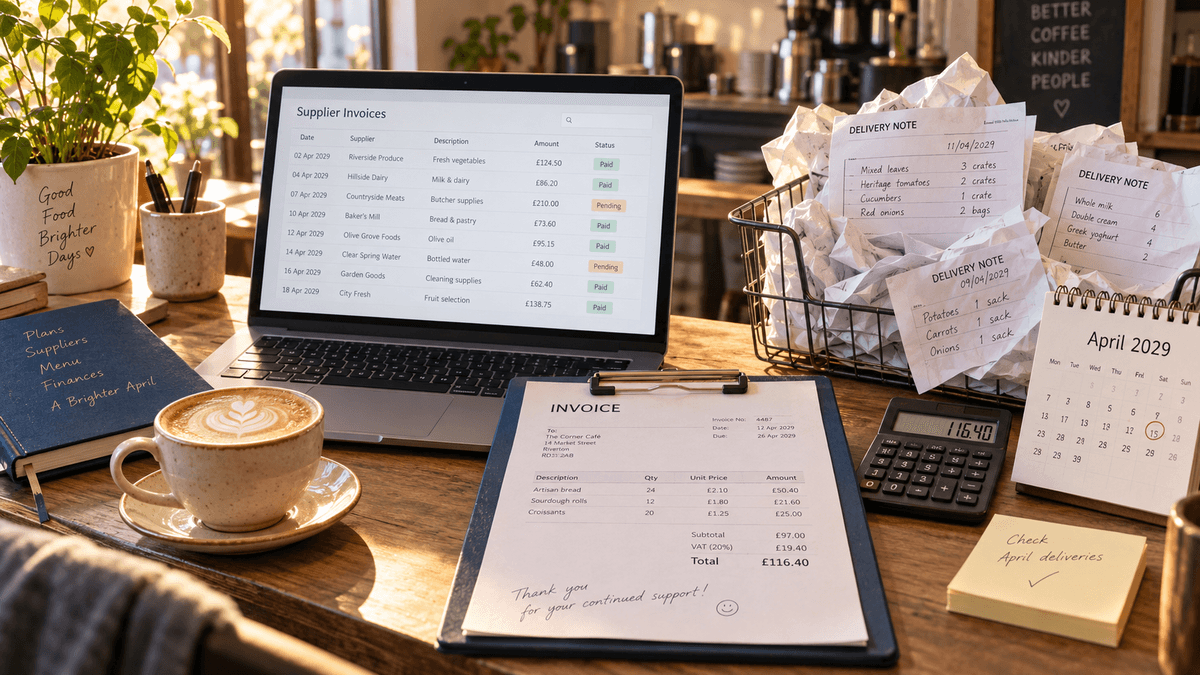
This morning's dairy invoice came folded in the driver's hand. The roaster's arrived as a PDF on an email. The cash and carry receipt is a photo on your phone, taken in the car park before the thermal print could fade.
The government's consultation response lists formats it does not treat as e-invoices for the purposes of the consultation, including "invoices in PDF or word formats, images such as JPEG" and "HTML invoices on a webpage or in an email". That is nearly every invoice a café receives. The government has said that from April 2029, VAT invoices between businesses have to be the other kind.
Most café owners I speak to have not heard of this, and the ones who have assume it means emailing PDFs. It does not. Here is what has been decided, what has not, and why the right amount to spend on it this year is nothing.
What an e-invoice actually is
The government's definition, from the HMRC and Department for Business and Trade consultation document: "E-invoicing is the digital exchange of invoice information directly between buyers' and suppliers' financial systems." Then the line that matters: "The outcome is an invoice which is automatically written into the buyer's financial system without manual processing."
So think data, not document. Your supplier's system sends its VAT number, the invoice number and date, and each line's quantity, price and VAT rate as separate labelled fields, and yours receives them as fields. A PDF is a picture of an invoice that software has to read, sometimes wrongly. An e-invoice has nothing to read and nothing to type.
| What arrives | A valid VAT invoice today? | An e-invoice from April 2029? |
|---|---|---|
| Paper invoice from the driver | Yes, if it has the right details | No |
| PDF attached to an email | Yes, with the right details, if you agreed to receive invoices electronically | No |
| Structured data sent from the supplier's system to yours | Yes, on the same terms | Yes |
What has been decided
Budget 2025, on 26 November 2025, settled the big question. The consultation response puts it in one line: "Budget 2025 announced all VAT invoices must be issued as an e-invoice from 2029." HMRC's transformation roadmap update for 2026 gives the month: e-invoicing for business-to-business and business-to-government transactions "will become mandatory from April 2029".
Behind it sits a consultation run by HMRC and the Department for Business and Trade from 13 February to 7 May 2025, which drew 342 responses. Here is where things stand, from the response and what has been announced since.
- It covers VAT invoices between businesses, and to government. These are "typically issued for business to business (B2B) and business to government (B2G) transactions where VAT is due", the response says, "(though not for business to customer transactions)". Your till receipts to the public are not the target.
- Both ends are in. The stated aim is "requiring all VAT invoices to be issued and received electronically". Your suppliers send them, and you receive them.
- Not VAT registered, probably not obliged to issue them. Because the mandate attaches to VAT invoices, the response says "many of the smallest businesses who are not required and choose not to be registered for VAT will not be obliged to adopt this technology". Note the "many of". If your turnover is under the £90,000 VAT registration threshold and you have not registered, you will probably not have to issue e-invoices, but how unregistered businesses receive them has not been settled.
- No central hub, on current plans. The 2025 consultation document described a decentralised model, where "there is no central 'hub' through which invoices are routed": your supplier's software provider sends the invoice to yours. It calls this a "4-corner model", as used in Belgium and Australia. The response says the UK "has focused its work on understanding how a decentralised model of e-invoicing would benefit the UK", and that "this position has not changed". Naming Peppol in June 2026, below, points the same way.
- Peppol is the network. On 23 June 2026, HMRC's Tax update 2026 summary confirmed that "the electronic procurement system Peppol will be the core interoperability network for e-invoicing in the UK".
- No real-time reporting to HMRC at the start. Some countries make every invoice pass through the tax authority as it is issued. The government "will continue to explore the potential benefits of RTR", its shorthand for real-time reporting, "but will not introduce it alongside the e-invoicing mandate in 2029". So it is not coming at the start, and it might come later. Nothing beyond that has been decided.
Peppol is not new to the UK. The 2025 consultation document noted that suppliers to NHS England are already "required to issue e-invoices via the Pan-European Public Procurement On-Line (PEPPOL) network".
What is still open
The government's own line is calm: "The UK mandate will not take effect until 2029 and we will publish a roadmap to implementation at Budget 2026." That Budget is on Wednesday 28 October, as HM Treasury confirmed on 31 July. HMRC says the roadmap will "set out the milestones to implementation in April 2029", and that full guidance, standards, technical specification and legislation will follow "by the end of 2027 to 2028".
This post goes out before the Budget, so I am not guessing what the roadmap will say. These are the questions it, or the guidance after it, has to answer.
- Phasing. Some respondents wanted "a phased or sector-specific rollout, starting with B2G transactions". Others argued that "having one date where all VAT invoices must be issued electronically removes this challenge". Nothing has been decided, whatever you read about big businesses going first.
- A threshold or easement. Some respondents "suggested that e-invoicing should only be required for businesses with turnover above a certain threshold". No turnover threshold or easement has been announced.
- Penalties. "There was interest in whether penalties will mirror those under MTD or take a different form." No answer yet.
- The standard. The government will "review the risks and benefits of adopting an existing standard or designing a UK-specific standard". Public bodies covered by the Procurement Act 2023 already have to accept e-invoices that comply with BS EN 16931, but nobody has said that is the 2029 standard.
- The café edge cases. The simplified invoice a cash and carry gives for sales of £250 or less. How a café that is not VAT registered receives invoices from suppliers who are. A business customer asking for a VAT invoice at your counter. None of these has a published answer yet.
Receiving: what changes for your supplier invoices
When the mandate starts, planned for April 2029, a VAT-registered supplier's invoice to you should arrive as data, through their provider to yours, and land in your accounting software or a service connected to it. You will need a provider that can receive it.
The folded invoice from the driver is the obvious casualty: a paper VAT invoice will not be an e-invoice, and nor will the emailed PDF. I would expect drivers to keep handing over a delivery note, because somebody still has to check what came off the van, but the VAT invoice itself will come through the system.
The upside is less typing. An illustrative sum, assuming a team member keys the invoices in at about £15.93 an hour, the loaded National Living Wage hour from the make-or-buy break-even sum: £12.71 for someone on 30 hours a week, plus holiday, employer NI and pension, rounded to the penny. On that rate:
- 60 supplier invoices a month at 2 minutes each to key the header (supplier, date, net, VAT, total) into your accounting software: 120 minutes, or 2 hours a month
- 2 x 12 = 24 hours a year, and 24 x £15.93 = £382.32
That is the header only. If you also key every line for recipe costing, it is more like 10 to 15 minutes an invoice. Lines that arrive as data take the typing out of that too, but not the work of matching each line to an ingredient, which comes up below.
The keying is what e-invoicing can take away. Checking each invoice against the delivery and the agreed price, at a minute each, is another 60 minutes a month, 12 hours a year and 12 x £15.93 = £191.16, and that part stays whatever format turns up. Your counts will differ, so time a week of invoices before you trust mine.
Sending: if you invoice other businesses
Most of a café's sales are to the public, outside the mandate. But plenty of us also sell to businesses: wholesale bakes to another café or a farm shop, lunch for an office, catering for an event, a monthly account for a firm's sandwich order. If you are VAT registered then, on the current plan, the VAT invoices you raise for those customers will need to go out as e-invoices from April 2029, so your sales invoicing needs software that can send them.
One wrinkle. Most cakes are zero-rated, and VAT Notice 700 says "an invoice for a zero-rated supply will not constitute a VAT invoice". Whether a cakes-only wholesale invoice falls inside the mandate is another detail to wait for. Put anything standard-rated on it, hot food say, and it is a VAT invoice, so assume the rules apply.
What it will fix, and what it will not
E-invoicing fixes the typing: no transposed digits, no invoice keyed in twice, no photo too blurry to read. Matching against what you ordered gets faster when the numbers arrive as numbers.
It can help with fraud too. The consultation response says e-invoicing can automate checks, such as "automatically flagging if an invoice requests payment to a bank account not previously associated with that supplier". Whether you get that depends on your software.
What it will not do by itself:
- Check the price. Illustrative: you agreed butter at £72.00 for a 10kg case and the invoice says £75.60, 5% up. Two cases a week is 2 x £3.60 = £7.20 a week, or 52 x £7.20 = £374.40 a year, on a perfectly formed e-invoice. Butter is zero-rated, so there is no VAT to net off either way.
- Check the delivery. A short delivery or a substitution is invisible in the data. Only the person who unpacked the van knows.
- Stop bank-detail fraud on its own. If a supplier's systems are hacked, the fraudster's invoice can be a valid e-invoice. The ring-before-you-pay rule still stands: changed bank details wait for a call on a number you already hold.
- Match lines to your recipes. Your supplier's product codes and pack sizes are not your ingredients. Somebody, or something, still has to know that "BUTTER UNSLTD 40X250G" is the butter in your scones. Extracting the text was always the easy part, as I wrote in the post on ingredient matching and pattern learning, and structured data only makes the easy part easier.
CostingBrik today reads supplier invoices that arrive as PDFs or images, whether dragged in, captured from a supplier portal with a browser extension or forwarded to an Invoice Inbox email address. Paper ones can be photographed with Quick Capture, a QR code on the wall that whoever is on shift scans when the driver hands over the invoice. The job of checking prices and matching lines to ingredients is the same whatever format the invoice comes in.
What to do now
Mostly, nothing expensive.
Get every supplier invoice arriving digitally. Ask the suppliers who still hand over paper to email it as well. It fits the digital record-keeping that Making Tax Digital for Income Tax already asks of sole traders with qualifying income over £50,000, and it makes the invoice step in a 30-minute weekly bookkeeping routine far easier.
Keep applying the VAT invoice rules. Format and content are separate questions. Notice 700/63 is plain about it: "Electronic invoices must contain the same information as paper invoices." Today, the details on the invoice decide whether you can reclaim the VAT, so it is worth knowing what makes a valid VAT invoice before you file one.
Ask your accounting software provider about Peppol. Will you be able to receive e-invoices? Send them? Is it in your current plan or extra? When will they say? The consultation response says "simple, low-cost solutions available for small and micro businesses will need to be a priority", so do not accept a big bill as the only answer. If you are weighing packages anyway, start with how Xero, Sage and QuickBooks integrate, then put the Peppol question to each of them directly.
Ask your biggest suppliers the same. When they plan to start sending e-invoices tells you when your receiving end needs to be ready.
Do not pay anyone for "e-invoicing compliance" yet.
If you want it from the source, after Budget 2025 the Office of the Small Business Commissioner said the joint HMRC and Department for Business and Trade e-invoicing team would host webinars for small and large businesses, with briefings on progress and on "how businesses can start to prepare for mandation". To ask about attending, email einvoicingengagement@hmrc.gov.uk.
This year
- List every supplier and how their invoice arrives: paper, PDF, portal or app.
- Ask the paper ones to email it too.
- Ask your accounting provider, in writing, whether it will send and receive e-invoices over Peppol, and at what price.
- List who you invoice: wholesale, catering, offices, councils. That is your sending side.
- Put 28 October in the diary, read the roadmap when it lands, and buy nothing before it.
The invoice will stop being a piece of paper, or a picture of one. Checking it will still be your job.
Ed O'Brien has run Hunters Cake Company for 17 years across cafés in Witney, Burford, and a bakery in Carterton, Oxfordshire. He's building Brikly - modular tools that give independent café owners the same data the big chains have, without the big chain price tag.