
Wholesale: selling your bakes to other businesses
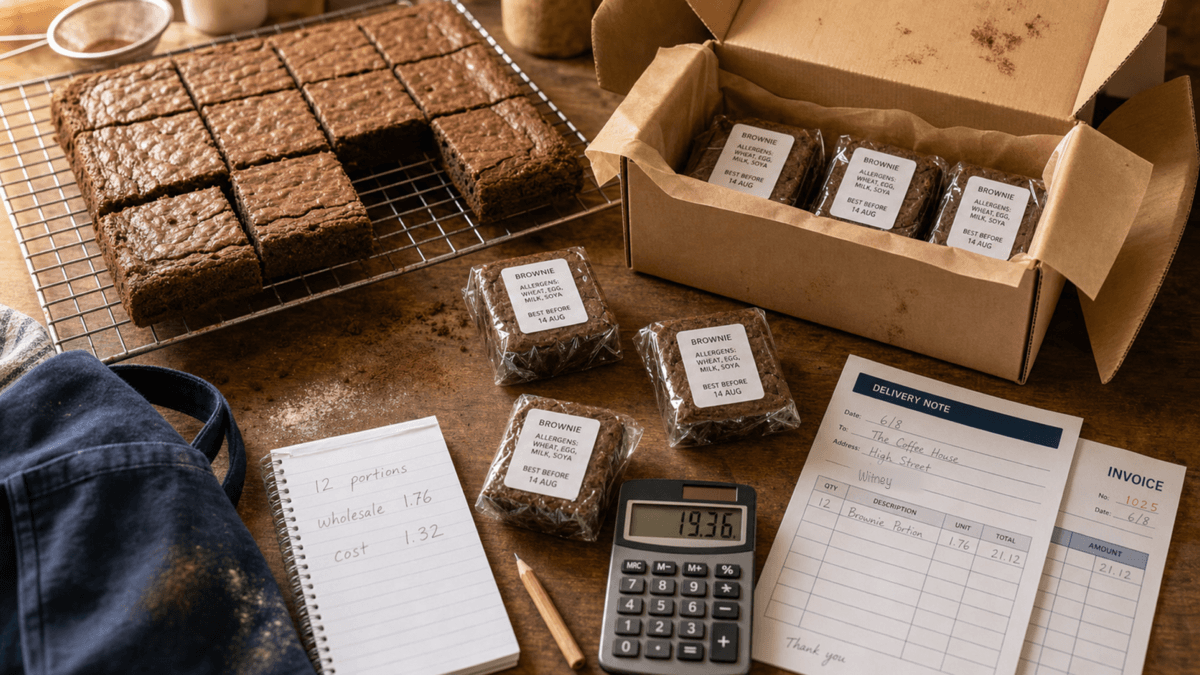
The café down the road asks if you would supply their brownies.
It is a lovely feeling. Someone who sells cake for a living has looked at your cake and decided yours beats theirs. The instinct is to say yes on the spot and sort the price out later.
Please do not. Saying yes before you have done the maths is the fastest route I know to baking for nothing every Tuesday morning.
We bake in Carterton and supply our own cafés from there, so I have lived the production side of this for years. Baking for someone else's counter is a different business from baking for your own. Not harder. Different.
Why wholesale is so tempting
- Your oven is idle for most of the day. You get it to temperature and then it sits half empty. Wholesale fills space you are already paying to heat.
- Standing orders are predictable turnover. Forty brownies every Tuesday and Friday is a number you can buy for, roster for and forecast. Walk-in trade is never that obliging.
- One customer, one invoice. A month of wholesale might be forty deliveries and one payment, against three hundred transactions for the same turnover on your counter.
- No new kit, no new front-of-house. You have the mixer, the trays, the fridges and the bakers. Wholesale sweats assets you have already bought.
It has a lot in common with catering and corporate orders as a margin-rich channel: volume made in dead hours, on capacity you already own.
The difference is the price. Catering customers pay close to retail for convenience. Wholesale customers cannot, because they need their own margin on top of yours. That is where the whole thing lives or dies.
The pricing maths, and why you cost the product first
The trade convention is that wholesale sits at roughly 50-60% of the price the buyer will retail at. Sometimes lower for volume, occasionally higher for something genuinely hard to copy.
That is not your buyer being mean. If they sell your brownie at £3.20 and pay you £1.76, they make about 45% gross on a product they did not have to make. That is roughly what it takes to be worth the shelf space.
So the price is largely set by the market. The only lever you control is your own cost, which makes the sequence non-negotiable: cost the product properly, then see whether the wholesale price clears it. Not the other way round.
If you have not already costed your traybake honestly, whole tray down to the sellable slice, do that before you quote anyone. Retail forgives a fuzzy cost because the margin is fat enough to hide it. Wholesale does not.
A worked example: the brownie tray
Illustrative UK 2026 numbers, ex-VAT. Yours will differ. The method is the point.
The product: one traybake, £6.20 of ingredients, cut into 12 portions that you retail at £3.20 each on your own counter. At 55% of retail, your wholesale unit price is £1.76 a portion.
Wholesale cutting is stricter, though. Your buyer wants twelve portions that look like each other, so the wonky end piece stays with you. Call it 11 sellable portions, giving £19.36 of wholesale turnover per tray.
Now the honest cost of getting it there.
| Line | Cost per tray |
|---|---|
| Ingredients | £6.20 |
| Packaging - individual wrap and label, 12p a portion | £1.32 |
| Outer box or tray for transit | £0.45 |
| Labour - 20 min hands-on mixing, cutting, wrapping, labelling at ~£14/hr loaded | £4.67 |
| Delivery allocation - share of a one hour van run | £1.90 |
| Total cost per tray | £14.54 |
So you turn over £19.36 and it costs you £14.54. Gross profit is £4.82 a tray, about 25%. Per portion, £1.32 of cost against £1.76 of price. You keep 44p a brownie.
It clears. Just. And notice how little headroom is left: butter moves 15%, or the van run takes ninety minutes instead of sixty, or a bad cut gives you 10 clean portions instead of 11, and that 25% is closer to 15%.
One more number worth carrying: that tray on your own counter, at a realistic 10 clean slices at £3.20, is £32 of turnover on £6.20 of ingredients. Wholesale is not a worse business. It is a thinner one, and it only makes sense on capacity you were never going to use. It is also not the only way to soak that spare capacity - a market stall runs on the same idle oven hours, with its own maths.
What actually changes at wholesale scale
The maths is the first shock. The operational stuff is the second.
Packaging
A slice on your counter needs a plate. A slice going out the door needs wrap, a label, an outer box that survives a van, and somewhere to store all three. A real cost line and a real storage problem.
Labelling and allergens for B2B
This is the part people underestimate, so read it twice.
Food you wrap on your own premises for your own counter falls under PPDS rules. Food supplied to another business is a different regime. If it is prepacked, it generally needs full commercial labelling: name of the food, full ingredients list with the 14 allergens emphasised, weight, a durability date, storage conditions, and your business name and address.
Supply a whole tray for them to cut and sell loose and you must still give them the ingredient and allergen information in writing. Their compliance now runs through your paperwork.
Worth a call to your environmental health officer too. Wholesaling changes your risk profile and can change the scope of your inspection. Better they hear it from you.
Delivery runs
Someone has to drive. That is wages, fuel, insurance and a van doing nothing else for an hour. Delivery is the cost that quietly kills wholesale margin, because it is fixed and spread across whatever happens to be aboard.
The fix is geography. Two accounts on the same road on the same morning is a business. Two accounts twenty minutes apart in opposite directions is a hobby with a fuel bill. Set a minimum drop value and a fixed delivery day, and hold the line on both.
Invoicing
You now raise invoices, number them and match them to delivery notes. If you have ever argued with a supplier about a short delivery, you know how that goes when the paperwork is loose.
You are the creditor now
You have spent your whole career on the other side of this, watching your own supplier payment terms and the very real threat of going on stop. Now you are the supplier. You bake it, you deliver it, and you wait for the money.
What holds up in practice:
- Agree terms in writing before the first delivery. Not a handshake. An email stating price, delivery day, minimum order and payment terms.
- Know what terms actually mean. Thirty days end of month is not thirty days. Invoice on the 2nd and you might wait until the 30th of the following month. That is nearly sixty days of you funding their cake.
- Start tighter than feels comfortable. Weekly invoice, 14 days net, is a normal ask from a small supplier. Loosen it later for an account that has earned it.
- Statement on the 1st, every month, without fail. Most late payment is not malice. It is an invoice nobody entered.
- Have a chase ladder and use it. Polite nudge at day 15, firm email at day 30, supply stops at day 45. Say it up front so it never feels personal later.
An account that does not pay is worse than no account. You bought the ingredients, burnt the gas, paid the wages and gave the product away. That is not a slow month. That is a loss.
The risks, stated honestly
Retail cannibalisation. If your wholesale customer is four hundred yards away, you are selling at £1.76 what you could sell at £3.20 on your own counter, to someone who might otherwise have walked to you. Ask first whether that tray would earn more sold as a retail line on your own shelf. Exclusion zones are a normal thing to negotiate.
One big customer. A single account at 40% of your wholesale turnover is not a customer, it is a shareholder. They will know it, and it will show up in the next price conversation. When they change chef or decide to bake in-house, you lose a chunk of the business in one phone call.
Capacity crowding. The morning your wholesale order runs long is the morning your own counter opens half empty. Cap the volume at what genuinely fits in the quiet hours, and mean it.
Sticky prices. You can change a counter price on a Monday. Changing a wholesale price list takes a conversation, notice and sometimes a fight, so you carry ingredient inflation for longer than you would like.
How to start small
Two accounts. That is the whole plan.
- Two accounts, both on standing orders. Fixed quantity, fixed day. No ad hoc orders while you are learning.
- Three product lines maximum. The ones that travel well and cut cleanly. Bespoke comes later, if ever.
- A written price list with a review date on it. Six months, so the first rise is expected rather than a shock.
- Track the hours honestly. Not what you think it takes. What it actually takes, from mixing to the van door.
Then review properly at three months. Did the margin survive contact with reality, did they pay on time, and did it ever get in the way of your own counter? Two good answers out of three is a keep. One is a polite exit.
Where Brikly Fits
Wholesale is a costing problem long before it is a sales problem. It rarely goes wrong because of the recipe. It goes wrong because nobody knew the real cost per portion when they agreed the price.
CostingBrik keeps that number current. Recipes carry live ingredient costs pulled off the invoices you already receive, so when butter or cocoa moves, your cost per portion moves with it and you can see which wholesale lines have quietly stopped clearing. Supplier price tracking matters more here than at retail, precisely because there is so little margin to absorb a rise.
Say yes to wholesale with your eyes open, or say no with a clear conscience. Both are fine. Saying yes without the maths is the only bad option.
Ed O'Brien has run Hunters Cake Company for 17 years across cafés in Witney, Burford, and a bakery in Carterton, Oxfordshire. He's building Brikly - modular tools that give independent café owners the same data the big chains have, without the big chain price tag.