
Fairy lights, heaters and fire doors: your café's fire risk assessment before Christmas
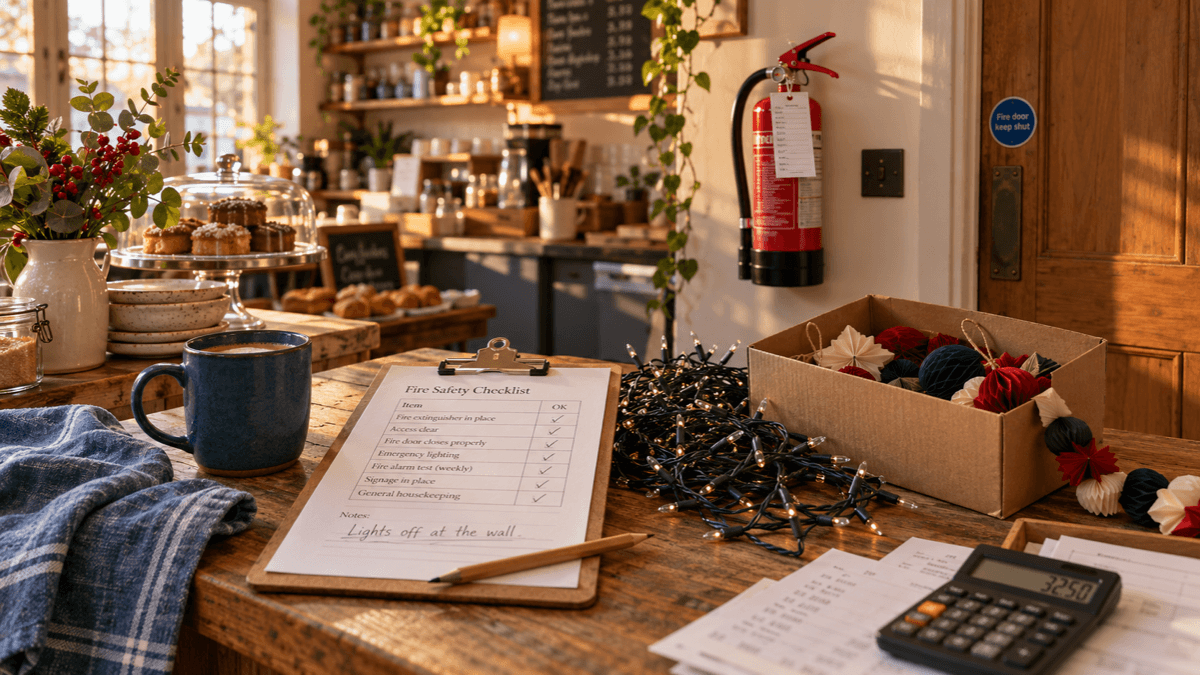
In a few weeks the boxes come down from the loft. Fairy lights round the window, garlands over the counter, a tree by the back door because that's the only space left. A fan heater appears under the till, and two extra tables go in for the Christmas bookings.
None of that feels like a fire safety decision. Every bit of it is.
Your fire risk assessment was written for the room as it was when someone sat down with a clipboard. December is a different room. Before the decorations go up, it's worth knowing what the law now asks of you, and walking the café with fresh eyes.
You are the "responsible person"
In England and Wales, fire safety in a café comes under the Regulatory Reform (Fire Safety) Order 2005, usually just called the Fire Safety Order. GOV.UK says you're responsible for fire safety in business premises if you're "an employer", "the owner", "the landlord", "an occupier" or anyone else with control of the premises. That person is "known as the 'responsible person'."
If you run the café, that's you, whether you own the building or rent it. If there's more than one, say a landlord with the shared stairs and you with the café, "you have to work together to meet your responsibilities." The core duties are short. You must "carry out a fire risk assessment of the premises and review it regularly", tell staff about the risks, put in place and maintain fire safety measures, "plan for an emergency", and "provide staff information, fire safety instruction and training."
Scotland (the Fire (Scotland) Act 2005 and Fire Safety (Scotland) Regulations 2006) and Northern Ireland (the Fire Safety Regulations (Northern Ireland) 2010) run separate but similar regimes. The recording rules below differ there, so check with your fire and rescue service.
What changed in October 2023
On 1 October 2023, section 156 of the Building Safety Act 2022 amended the Fire Safety Order in England and Wales. Hospitality barely noticed, but it changed what every café has to keep on file.
Every café must record the whole assessment
Before October 2023, you only had to write down the significant findings, and only if you had five or more employees, held a licence, or had an alterations notice. The London Fire Brigade sums up the new rule: responsible persons "must record all findings from their fire risk assessment, regardless of the size or purpose of the premises."
So the two-person café with no licence is in the same position as the 40-cover restaurant. If it isn't written down, as far as an inspector is concerned, it wasn't done. Scotland and Northern Ireland still have a five-employee threshold for recording, but writing it down is good practice anyway.
Your arrangements, and who did it
LFB again: "All Responsible Persons must record their fire safety arrangements." That means how you manage fire safety day to day: who checks the exits, who tests the alarm, what happens when it sounds. You must also record "the identity of the individual employed, or contracted by them, to undertake or review" the assessment: their full name, and their organisation name if they have one. The Home Office's guide for small premises explains why: "if fire safety responsibility passes to someone else then you will be required to give this information to them." Sell the business or hand back the lease, and the fire safety file goes with it.
Anyone you appoint must be competent
In England, the amended Order says you must not appoint a person to help with your assessment "unless that person is competent", meaning they have "sufficient training and experience or knowledge and other qualities" to do it properly (legislation.gov.uk). Your mate who did a fire marshal course once isn't automatically that.
Shared buildings: introduce yourself
If your café is under flats or offices, you now have to take reasonable steps to find the building's other responsible persons and tell them your name, a UK address for notices, and which part of the premises you're responsible for. Keep a record that you did. Where there are two or more homes, residents must also be told about fire risks and the measures in place, so expect the managing agent to ask about your unit.
The fines went up
Some offences under the Order, such as failing without reasonable excuse to do what an inspector requires, "such as by not providing a copy of the fire risk assessment when requested", were capped at a level 3 fine (£1,000). Since October 2023 the cap has gone, and LFB notes "you can receive an unlimited fine". For the serious offences, GOV.UK puts it plainly: "Major penalties can have unlimited fines and up to 2 years in prison."
Why Christmas means a review
GOV.UK's guidance for small and medium places of assembly, which covers cafés and restaurants, lists the reasons you should review your assessment. Several of them are simply what December looks like in a café:
- "alterations to the building, including the internal layout"
- "substantial changes to furniture and fixings"
- "significant changes to displays or quantities of stock"
- "a significant increase in the number of people present"
It also says, specifically, that your fire risk assessment "should also consider any additional risk generated by seasonal products such as fireworks and Christmas decorations."
The same guide says "Do not amend your assessment for every trivial change." But a new layout, extra covers and a room full of paper and lights is not trivial. Walk it, and add a dated note of what's changed and what you're doing about it.
The six December hazards
1. Decorations near exits and heat
Paper garlands, tinsel, foil, dried oranges, crêpe paper and the cardboard boxes they came in are all fuel. The guidance suggests you "use fire-retardant display materials wherever possible (suppliers should be able to provide evidence of this)" and keep storage and display areas "adequately controlled and monitored."
- Nothing on or across escape routes. No garland low over the back door route, no tree in front of the fire exit.
- Keep decorations off heat: the coffee machine, the toaster, light fittings.
- Ask for the flame-retardant label when you buy, and keep the evidence with your file.
- Store the empty boxes away from the public area and the routes out.
2. Fairy lights on extension leads
The guidance says to "ensure electrical lighting used as part of the display does not become a potential source of ignition." That mostly comes down to how it's plugged in.
Electrical Safety First advises "only use one socket extension device per socket" and "don't plug an extension lead into another extension lead (known as 'daisy chaining')". Most extension leads are rated at 13A in total, not per socket, so four sockets don't mean four times the load.
Check every set before it goes up: last year's lights, squashed in a box, are the ones with the split cable. And put "Christmas lights off at the wall" on the December closing list.
3. Plug-in heaters
The Home Office small premises guide says "The use of portable heaters should be avoided as far as possible." If you do use one, "only use heaters fitted with automatic cut-off switches", and "Do not place heaters close to combustible materials or place them on exit routes." Avoid "radiant bar fires or LPG heaters" where you can.
A fan heater on a four-way lead that already carries the fairy lights, under a counter full of paper bags, is the classic December combination.
4. Fryers, ovens and the extract duct
Christmas menus mean more cooking, and more grease. The guide says "Any filters or ducts, over cooking appliances, should be cleaned on a regular basis to avoid the build-up of flammable deposits," and if you have fat fryers, "a fire blanket and a Class F fire extinguisher" should be in the kitchen.
The industry standard for kitchen extract cleaning is TR19 Grease. BESA gives minimum intervals by how long the kitchen runs each day:
| Kitchen use | Hours a day | Clean at least every |
|---|---|---|
| Light | 2 to 6 | 12 months |
| Moderate | 6 to 12 | 6 months |
| Heavy | 12 to 16 | 3 months |
A café cooking from 8am to 3pm sits at the bottom of "moderate". If your last duct clean was a year ago and you're about to run a busy December, book it now. Keep the certificate; BESA warns that insurers increasingly ask for proof, and that non-compliance "can result in insurance claims being denied, even if a cleaning contractor had been employed."
5. Propped-open fire doors
When it's cold out and hot in the kitchen, the fire door between them gets a wedge under it. A fire door only works if it closes. The places of assembly guide lists "fire doors being wedged open" among the ways fire and smoke spread through a building, and expects staff to understand "the importance of maintaining the safety of the escape routes, e.g. by ensuring that fire doors are not wedged open."
If a door genuinely needs to stand open during service, the proper fix is an automatic hold-open device that releases it when the alarm sounds. Ask your assessor or alarm engineer.
6. Blocked exits: extra tables and deliveries
December is when you squeeze in two more tables and the dry goods delivery doubles. Both tend to end up in the quiet corridor to the back door. The guide's daily check is to "make sure all exit doors are unlocked at the start of each day" and that "exit routes are not obstructed and are kept clear of storage."
Walk the route with the Christmas layout in place, chairs pushed out as if people are sitting on them. If you have to turn sideways to get past, so will everyone else, in the dark, with smoke.
A December that goes wrong
Take a hypothetical café, the Corner House: thirty covers, a front door, and a back exit through the kitchen corridor.
For December the owner adds two tables and moves the high chair stack to the corridor. The packaging delivery lands on a Friday, so the boxes go there too, "just for the weekend". The kitchen door is wedged because the extract makes the café cold. A fan heater runs off the same lead as the window lights.
On a busy Saturday, a tea towel left on the grill catches. The fire itself is small and the cook puts it out with the blanket. But for two long minutes, smoke rolls straight through the wedged door into a full café, and the back exit is behind a wall of cardboard. Everyone goes out the front, past the source of the smoke.
Nobody is hurt. Then the fire service asks for the fire risk assessment: three years old, a different layout, no mention of the corridor or the heater. Then the insurer asks when the duct was last cleaned.
None of those decisions was reckless on its own. Each was a sensible fix for a December problem. That's exactly why the review exists.
New staff need training before their first shift
Christmas means new faces: students home for the holidays, extra weekend help. GOV.UK says employers must "train new staff when they start work", and the Home Office guide says all staff "must receive adequate fire safety training when first employed", refreshed typically every year.
For a small café that's ten minutes on the first shift: where the exits are, what the alarm sounds like, which extinguisher is for what (Class F for the fryer), that nobody tackles a fire if it puts them at risk, and where everyone meets outside. Sign and date it. The guide says "a suitable record of staff training and fire drills (if any) should be kept in the form of a logbook or an electronic record." It's the same habit as the induction sheet in the licences and registrations every café needs.
On drills, GOV.UK's workplace page says to hold "at least one fire drill per year and record the results." If yours was in the summer, half your Christmas team weren't there for it.
Servicing and testing records
These are the routine checks the Home Office guide sets out for small premises. Some you can do yourself; the contractor ones need a competent contractor, ideally one certificated by an independent body.
| How often | Check | Who |
|---|---|---|
| Daily | Exits unlocked and easily opened; routes clear of storage | You or staff |
| Weekly | Test the fire alarm from a different call point; check stairway fire doors self-close | You or staff |
| Monthly | Functional test of emergency lighting; visual check of extinguishers | You or staff |
| Six-monthly | Fire alarm inspected and tested; fire doors checked for damage and fit | Contractor (alarm), you (doors) |
| Annually | Emergency lighting and extinguishers inspected and tested | Contractor |
| Annually | Heating systems maintained | Competent person |
| Every 5 years at least | Fixed electrical installation inspected and tested | Competent electrician |
Not every café has every item; a small single-storey café may raise the alarm by shouting "fire". Whatever you have, test it and write down that you did, in one log with a name and a time against each check, not on a scrap of paper behind the till. It's the same principle we're building into SafetyBrik, our free food safety Brik (coming soon): if a check has a time and a name, you can prove it happened. And those checks sit neatly on a closing checklist that actually gets done.
Do it yourself, or pay someone?
GOV.UK says "You can do the fire risk assessment yourself with the help of standard fire safety risk assessment guides." The Home Office guide says that for simple premises it "can often be completed, without specialist knowledge, by following the simple steps set out in this Guide", and includes a template.
That guide covers simple premises in England: no more than basement, ground and first floor, sole control of the building, no more than 25m to an exit, and "cooking processes are remote from exits". Plenty of cafés fit. Plenty don't.
Pay a competent assessor if you share the building with flats or other businesses, have basement or upstairs seating, have a kitchen between the café and an exit, have had building work or a notice, or simply don't feel sure. The guide says if you don't feel able, "you should engage the services of a competent fire risk assessor". The Fire Sector Federation's free guide to choosing one is linked from the Home Office guide. Your fire service can advise, but GOV.UK notes "they cannot carry out risk assessments for you."
What inspectors and insurers ask to see
Fire and rescue authorities visit "to check the fire risk assessment and fire prevention measures are appropriate", and GOV.UK says officers "should help you understand the rules and comply with them". Either way, you'll be asked for paperwork. Keep one folder, paper or digital, with the dated assessment and action plan, your fire safety arrangements, training and drill records, the test logs, contractor certificates (alarm, emergency lighting, extinguishers, electrics, gas and heating, extract cleaning) and details of any other responsible persons in the building.
Your insurer is likely to want much of the same after a claim. A kitchen fire is exactly what your buildings, contents and business interruption cover is for, and the policy may carry conditions on duct cleaning or electrical testing. Read them now, not after a fire. And the fire file sits alongside the accident book, RIDDOR and first-aid assessment, the other safety records a café is expected to keep.
Your one-page Christmas fire checklist
Paperwork
- Fire risk assessment is written in full, dated, and names who did it
- Fire safety arrangements are written down
- Christmas layout and decorations added as a dated review note
- Other responsible persons in the building identified and contacted
Decorations and lights
- Nothing hanging over or standing in escape routes
- Decorations clear of heat sources and light fittings
- Flame-retardant materials where possible, evidence kept
- Lights checked for damage before going up
- One extension lead per socket, no daisy chains
- Lights off at the wall on the closing list
Heat and kitchen
- Portable heaters only if needed, with auto cut-off, away from combustibles and exits
- Extract duct cleaned within its TR19 interval, certificate filed
- Fire blanket and Class F extinguisher by the fryer
- No candles on tables unless your assessment covers them
Doors and exits
- Fire doors closed, no wedges
- Exits unlocked and clear every morning
- Extra tables don't narrow the route to the exit
- Deliveries and empty boxes stored away from routes
People
- Every new seasonal starter trained on day one, signed and dated
- Fire drill done in the last year, recorded
- Everyone knows the assembly point
Testing
- Weekly alarm test logged
- Monthly emergency lighting test logged
- Annual extinguisher and emergency lighting service in date
The takeaway
Since October 2023, every café in England and Wales has had to record its full fire risk assessment, its fire safety arrangements and who did it, and the fines for getting it wrong are now unlimited.
Christmas is exactly the kind of change the assessment is meant to catch. A new layout, more people, paper and lights everywhere, heaters on extension leads and doors wedged against the cold. Walk the café this week with the Christmas plan in your head, write down what's changed and what you're doing about it, and train the new starters before they serve a single mince pie.
Ed O'Brien has run Hunters Cake Company for 17 years across cafés in Witney, Burford, and a bakery in Carterton, Oxfordshire. He's building Brikly - modular tools that give independent café owners the same data the big chains have, without the big chain price tag.