
Table turn and covers: getting more from every seat
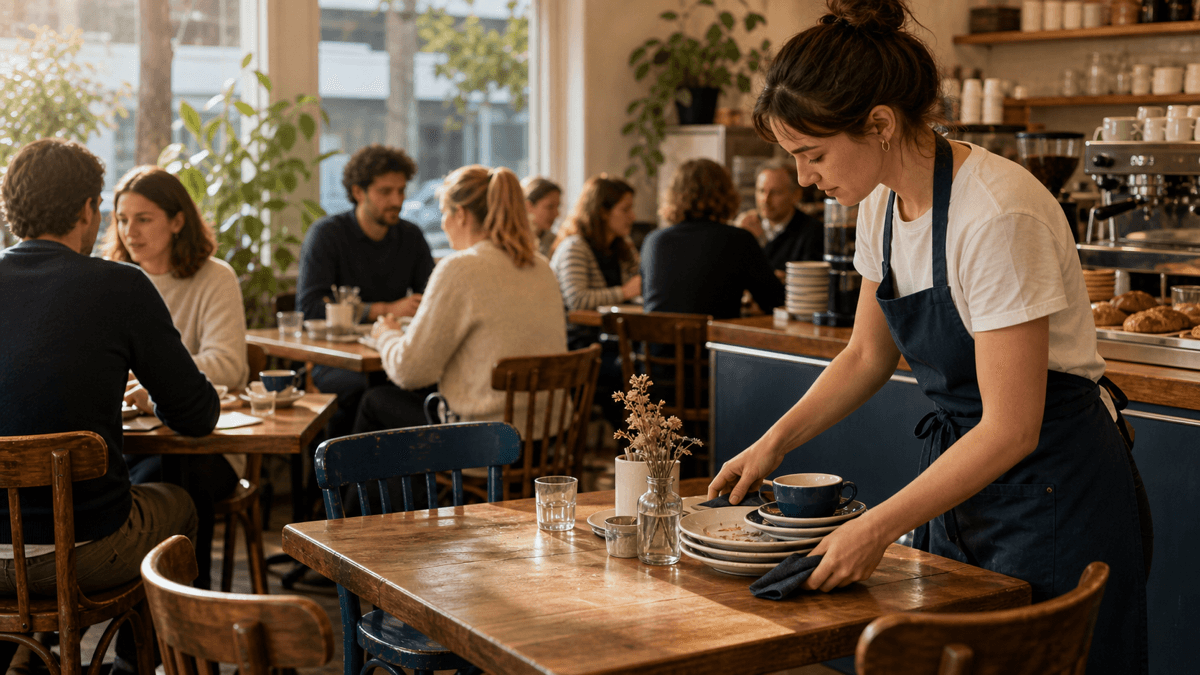
Two cafés on the same high street. Same footfall through the door. One finishes the week comfortably ahead, the other limps to payday. The difference is rarely the recipes or the coffee. It's how well each of them uses the seats they're paying rent on.
Your rent doesn't change because a table sat empty for twenty minutes at half twelve. Neither does the wage of the person standing behind the counter. Those costs are fixed whether a seat earns or not. So the seats are the asset, and how hard you work them at peak is one of the few levers you can pull without putting a single price up.
Covers, turns and utilisation, in plain terms
These three words get used loosely, so here's what they actually mean.
- A cover is one customer served. Four people at a table is four covers, not one.
- A table turn is how many times you reuse a table during a service. If a four-top seats three different groups over lunch, that table turned three times.
- Seat utilisation is how full your seats are across the day - the proportion of available seat-hours that were actually paying.
Footfall tells you how many people walked in. Covers tell you how many you served. Utilisation tells you whether the room was working hard or sitting idle. They're related, but they are not the same thing, and the gaps between them are where the money hides.
Why this matters more than raw footfall
Imagine you've got 30 seats and a busy lunch hour where every table is full and a queue is forming. Footfall looks great. But if those tables turn once and then sit half-empty from two o'clock onwards, you've earned a fraction of what the room could have delivered.
Here's the part that catches people out. Every extra cover at peak is close to pure margin. You've already paid the rent, the staff are already rostered, the lights are already on. One more sitting on a table you'd otherwise have lost doesn't add much cost at all - it nearly all drops through to profit.
That's why two cafés with identical footfall can post very different numbers. It isn't how many people they see. It's how many they seat, and how many times each seat earns before close.
If you want to ground this in your own figures, it's worth knowing how many covers you actually need each day to break even before you start chasing extra ones.
How to measure it
You don't need a clever system to start. You need three numbers.
- Covers per seat per day. Take your total covers for the day and divide by your number of seats. Track it for a fortnight and you'll have a baseline. A café doing 1.5 covers per seat has a very different room from one doing 3.
- Peak versus off-peak occupancy. Roughly, what proportion of seats are full at noon versus three o'clock? You can eyeball this with a few spot-checks over a week. The gap between the two is your opportunity.
- Average dwell time. How long does a table stay occupied? A coffee-and-cake table behaves very differently from a two-course lunch, and you need to know which you're running at which hours.
Most modern tills give you covers and your busiest times without any extra effort. If you're on a connected setup, MenuBrik pulls covers and peak times straight from your POS so you're not counting heads with a biro. The point isn't precision to the decimal - it's spotting the dead time you can't see when you're head-down in service.
Turning tables faster without rushing anyone
This is the bit people get nervous about, and rightly so. Nobody wants to be the café that hovers with the card machine before you've finished your flat white. The goal is never to push people out. It's to remove the dead time between sittings - the ten minutes a table sits dirty, the five minutes someone waits to pay, the queue that turns walk-ins away, and the booked table nobody turns up for.
A few levers that work without anyone feeling hurried:
- Get the table mix right. A room full of four-tops seating couples wastes seats all day. A sensible blend of two-tops you can push together when you need to almost always lifts covers.
- Clear fast and friendly. A table that's cleared and reset in two minutes is earning again in two minutes. A table left twenty minutes because everyone's slammed is twenty minutes of lost rent.
- Cut the order queue. Order-at-table or a QR menu means people are seated and served without standing in line, which both lifts covers and improves the experience.
- Pace the menu. Items that come out quickly at peak keep tables moving. Save the slow, fiddly dishes for quieter hours.
- Make paying painless. A card machine that comes promptly when asked, or pay-at-table, shaves minutes off every single turn.
- Staff the peak properly. None of the above works if you're short-handed at noon. Clearing, ordering and paying all slow down when there aren't enough hands, which is why staffing to your actual footfall pattern is the foundation under everything else here.
One caveat: at full brunch tilt the constraint often moves off the tables and onto the hot section, and turning a table faster achieves nothing if the next order just joins a longer ticket queue. Why the pass, not the seats, caps your brunch rush covers what to do when the kitchen is the ceiling.
A worked example
Round numbers, purely to show the shape of it.
Say you've got 20 seats and a lunch service from noon to two. At the moment your tables turn twice across that window, so you're doing 40 covers at lunch. Average spend is £12.
40 covers x £12 = £480 of lunch takings.
Now you tighten the clearing, add a QR menu to cut the queue, and put one person on resets at peak. Your tables now turn three times in the same two hours. Nothing else changed - same seats, same prices, same opening hours.
60 covers x £12 = £720 of lunch takings.
That's £240 extra a day from the same room, the same rent and broadly the same wage bill. Over a six-day week that's well over a thousand pounds, and almost all of it is margin because your fixed costs were already covered by the first two turns.
I'm not pretending every café can add a full turn. But even half of one, on the days you're actually busy, is found money.
Don't kill the dwell time that builds regulars
A word of balance, because this can be taken too far. The lingering coffee, the friend who pops in and stays an hour, the regular who treats your corner table as their office - that dwell time is part of why people come back. Strip it out and you've got a fast-food turnover model with none of the warmth that made the place work.
So be honest about when the squeeze matters. At peak, when there's a queue and tables are sitting dirty, removing dead time is the whole game. Off-peak, dwell time is fine - those quiet hours are better spent pulling in trade you're not currently getting than worrying about how long anyone stays.
And in summer, the cheapest covers you'll ever add are the ones outside. A few pavement tables can lift your seat count meaningfully for the cost of some chairs, as long as you've sorted your pavement licence before the sunny weeks arrive. If you trade in a visitor town, the summer peak is its own game entirely - making tourist season pay covers the pricing and menu side of the same squeeze.
The takeaway
You don't need more people through the door to earn more. You need the seats you've already got to work harder when it counts.
Measure covers per seat for a fortnight. Find the dead time at peak - the dirty tables, the slow pays, the queue that turns walk-ins away. Then remove it, one job at a time, without ever making a single customer feel rushed.
The footfall is the hard part, and you've already done it. Don't let half of it leak out through empty seats.
Ed O'Brien has run Hunters Cake Company for 17 years across cafés in Witney, Burford, and a bakery in Carterton, Oxfordshire. He's building Brikly - modular tools that give independent café owners the same data the big chains have, without the big chain price tag.