
The £7 lunch deal: what it really earns, and the VAT split nobody does
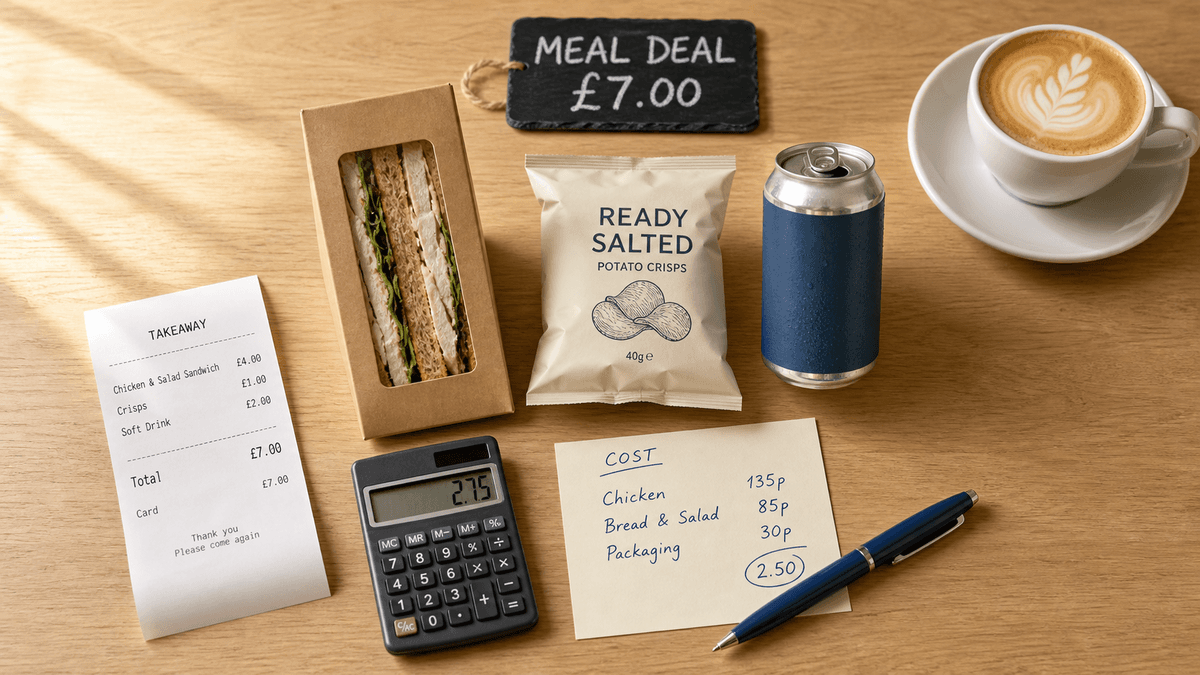
September is deal season. The schools go back, the office trade comes off holiday, and every café within a mile of yours chalks up a lunch offer. Sandwich, crisps, a drink. Seven pounds.
It looks like simple arithmetic. Add the three menu prices, knock a bit off, chalk it on the A-board.
It isn't, for two reasons. Cannibalisation: in my experience much of that volume comes from customers who were already buying. And VAT: on a takeaway deal you've sold one zero-rated item and two standard-rated ones for a single inclusive price, and something has to decide how that price splits.
Left to itself, the till decides it by accident.
A deal is not a discount. It is a new product
A discount is an existing product at a lower price. You know its cost and its margin, so you can size the giveaway in your head, and the maths is brutal but at least it's visible.
A meal deal has its own bill of materials, its own gross profit in pounds, its own VAT profile, and its own effect on everything next to it. It deserves a cost card, like any new line.
Let's build one. Illustrative numbers - swap in yours.
Your menu prices, sold separately:
- Cold sandwich: £5.20
- Crisps: £1.20
- Canned soft drink: £1.80
- Total: £8.20
Your costs:
- Sandwich: £1.55 (bread, filling, wrap, label)
- Crisps: £0.42
- Can: £0.58
- Total: £2.55
The deal price is £7.00, so you've given away £1.20 of headline price. A modest-sounding 15% off. But the number that matters isn't the discount. It's what the deal earns against what those customers did before.
Once cannibalisation is in the number
Take the takeaway version, VAT split properly (method below). At £7.00 the deal nets you £6.57 after VAT. Take off £2.55 of ingredients and you keep £4.02 of gross profit.
Compare that with what that customer might otherwise have done.
They bought all three at full price. Net turnover £7.70, cost £2.55, gross profit £5.15. Move that person onto the deal and you lose £1.13.
They bought the sandwich only. Net £5.20, cost £1.55, gross profit £3.65. Move that person onto the deal and you gain £0.37.
They weren't coming in at all. Gross profit £4.02, all of it new.
There's the business case in one line: you need roughly three trade-ups to pay for every full-price combo buyer you cannibalise.
Run it at 25 deals a day. If 10 already bought the full £8.20 combo, 12 are sandwich-only customers trading up and 3 are genuinely new, you're about £5 a day better off. Real, but no windfall. Change one assumption, so nobody new walks in and the other 15 all come from sandwich-only buyers, and you're roughly £6 a day worse off on identical volume. Across a trading year that's the difference between about £1,600 up and about £1,800 down.
Same deal, same units sold. The only variable is where the volume came from.
The bit that bites: a takeaway deal is a mixed supply
Now the tax half, and it only bites one way round.
Eat in, it's all catering. Every item, hot or cold, is standard-rated when it's consumed on your premises. One price, one rate, no apportionment, and about 74p less gross profit than the same deal taken away. The complete guide to café VAT on food and drink has the four buckets if you want the full picture.
Takeaway is where it gets interesting. A cold sandwich to take away is zero-rated. Crisps are standard-rated whatever you do with them, and so is a canned soft drink. One £7.00 price is now covering items at two different rates.
HMRC's Notice 709/1 puts it plainly at section 4.7: sell a mix of standard-rated and zero-rated items for an inclusive price to be eaten off the premises and you have to work out the tax value of each item and calculate the VAT due on the standard-rated ones. You're normally making mixed supplies, it adds, if each item can be bought separately from your menu. In a café lunch deal, they always can.
In cash: on the £7 takeaway deal above, apportioned by menu price, the VAT due is about 43p. Ring the whole £7 as standard-rated and you hand over £1.17. That's 74p a deal you never owed, or around £6,900 a year at 30 deals a day, six days a week.
Ring it all as zero-rated and the problem inverts, which is worse: you're building a liability, not just overpaying.
What the KFC dip pots ruling changed in 2026
In Queenscourt Ltd v HMRC [2026] UKUT 00195 (TCC), released on 19 May 2026, the Upper Tribunal looked at KFC takeaway meal deals run by a franchisee. The judgment describes a "boneless banquet" at £7.99 in December 2022, against £12.43 for the same items bought separately. Sound familiar?
The argument was about the pots of dip. Queenscourt said they were a separate zero-rated supply. HMRC said they were part of a single standard-rated supply of hot food, the dip just a way of better enjoying the chicken. The First-tier Tribunal agreed in 2024, holding that some elements of one transaction could be a single supply while others were treated separately.
The Upper Tribunal held that reasoning wrong in law. Every element of a multi-element transaction that would be a supply on its own must be treated as distinct and independent, unless the transaction as a whole falls into one of the narrow exceptions where the lot becomes a single supply. There is no middle option where you group some things and split others.
Queenscourt won and the dip pots were separate and zero-rated. At stake was £75,502 of dip pot VAT on meal deals from October 2015 to September 2018, plus £30,936.64 for the VAT periods running to September 2019.
This is a plain-English summary, not tax advice, and Upper Tribunal decisions can be appealed. Reworking anything historic on the back of it is one for your accountant.
Apportioning a single price the way HMRC expects
Here's the reassuring part: there's no single mandated method.
HMRC's guidance sets out two standard approaches, one based on normal selling prices and one on the costs attributable to each supply. Its valuation manual is explicit that businesses aren't obliged to use either, and that HMRC has no power to insist on a particular one. It's your job to propose a method, and your calculations have to be fair and justifiable.
For a café the selling price method is almost always the defensible one, because you already have menu prices for every component:
- Sandwich £5.20 ÷ £8.20 = 63.4% of £7.00 = £4.44 (zero-rated)
- Crisps £1.20 ÷ £8.20 = 14.6% of £7.00 = £1.02 (standard-rated)
- Can £1.80 ÷ £8.20 = 22.0% of £7.00 = £1.54 (standard-rated)
Standard-rated element: £2.56 inclusive, so VAT of £2.56 ÷ 6 = £0.43.
Before you ask: HMRC's linked goods concession, ESC 3.7 lets a genuinely minor article take the liability of the major one at a single price. But the minor article has to cost you no more than 20% of the total cost of the combined supply, and no more than £1 alongside goods for retail sale, £5 otherwise. Here the crisps and the can are 42p and 58p of a £2.55 cost, 39% between them, so a deal built from three real items isn't what it's for. HMRC's manual adds that it can't decide whether you have one supply or several, and can't be applied retrospectively.
Then the bit that makes it work: ring the deal so the till captures the split. One button called "Lunch Deal" posting £7.00 to a single tax code produces a VAT return that doesn't match your own maths. Many EPOS systems let you build a deal as a bundle of its components, or hold separate eat-in and takeaway versions. Same trap as changing the menu without changing what the till declares, and the most common place a good deal goes quietly wrong.
Building a deal that lifts the basket instead of discounting your hero
All of the above points at one design rule: build the deal around what people weren't already buying.
- Discount the attachment, not the anchor. If they were always buying the sandwich, don't give margin away on it. The gain is the crisps and the drink they'd have skipped.
- Keep your best-margin line out of it. Whatever carries your lunch trade is what you shouldn't be cutting the price of.
- Fence it to a dead hour. A deal from 2pm to 4pm sells to covers you weren't getting. One at 12:30 sells to a queue you already had.
- Keep every component on the menu separately. You need the full-price comparison, and it's what makes several separate supplies the honest reading.
- Pick components with room in them, the same logic behind lifting average spend without touching your prices.
I have watched deals do decent volume and, once somebody finally sat down with the sales mix, turn out to have mostly moved trade off a line that made more. Nobody tells you that. The till just shows a busy lunchtime.
Do this today: one deal, one page of maths
Pick the deal you're most likely to run this September. Twenty minutes, one sheet of paper.
- List the components and their individual menu prices. Add them up for your comparison price, then cost each one: ingredients, packaging, label.
- Split the deal price by menu-price share and work out the VAT on the standard-rated portion, takeaway version.
- Work out three gross profits in pounds: the deal, the full-price combo, and the hero item on its own.
- Write down the trade-up ratio. How many single-item customers must trade up to pay for one cannibalised combo buyer? More than three or four and the deal needs redesigning, not an A-board.
- Look at how your till rings it. One button and one tax code, or the components?
Our free menu profit calculator will do the margin arithmetic on the deal and on each component, and keep the saved runs together, if you'd rather skip the paper.
You can do all this by hand once. Doing it for four deals, twice a year, as supplier prices drift, is where it stops happening. CostingBrik holds each component as a costed recipe, so a deal's blended gross profit moves when your bread or crisps do, and MenuBrik reads your POS sales mix so you can see whether the deal added covers or just shuffled them. Neither is needed for the sum. They stop it going stale.
The deal that wins is the one you costed before you chalked it, and rang correctly after.
Ed O'Brien has run Hunters Cake Company for 17 years across cafés in Witney, Burford, and a bakery in Carterton, Oxfordshire. He's building Brikly - modular tools that give independent café owners the same data the big chains have, without the big chain price tag.