Payments on account: the January tax bill that catches café owners out
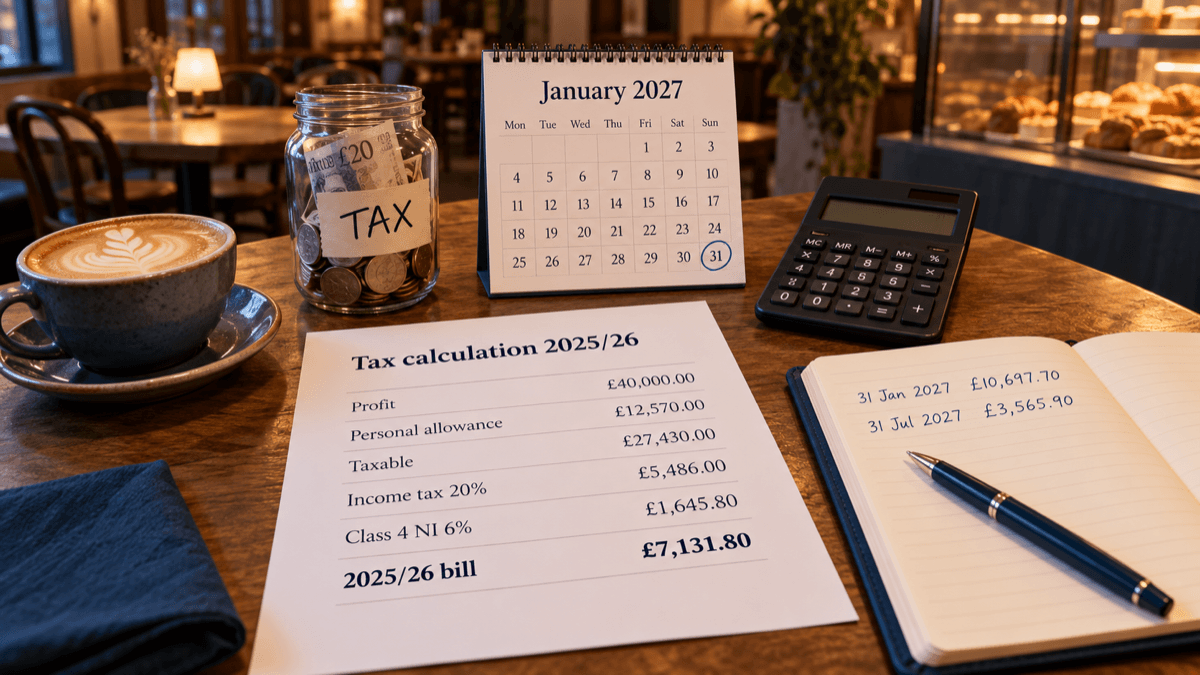
Picture a café owner who has just had her first properly good year. She trades as a sole trader, and in the 2025/26 tax year the café made £40,000 of profit. Her accountant puts the year's income tax and National Insurance at £7,131.80, and she has been putting roughly that aside.
Then the figure due by 31 January 2027 comes through, and it isn't £7,131.80. It's £10,697.70. In July there's another £3,565.90 to find.
Nobody has made a mistake. These are payments on account, and they catch out a lot of people: a June 2026 government factsheet says "approximately 1.1 million Payments on Account were missed in January 2025".
The worked example uses 2025/26 rates for England, Wales and Northern Ireland. Scotland has its own income tax bands and rates; National Insurance is UK-wide. All figures are illustrative, so ask your accountant to confirm your own.
How payments on account work
Sole traders and partners (each partner has their own bill) pay income tax and Class 4 National Insurance through Self Assessment after the tax year ends. Payments on account collect next year's tax in advance. GOV.UK sets out the rules:
- Each payment is half of last year's bill. "Each payment is half of the tax you owed last year."
- Two dates. "These payments are due by midnight on 31 January and 31 July."
- The balancing payment settles whatever is left for the year just gone, also by 31 January.
- Who escapes them. Anyone whose tax last year was under £1,000, or who paid more than 80% of it outside Self Assessment, for example through a PAYE tax code.
A sole trader whose only income is the café, with a bill of £1,000 or more, will be making them.
The catch is the first year. If you made no payments on account towards 2025/26, perhaps because 2025/26 was your first year of trading, or your 2024/25 bill was under £1,000 or more than 80% of it was collected through PAYE, then on 31 January 2027 you pay the whole 2025/26 bill plus the first half of 2026/27 in advance. GOV.UK's own example: a £3,000 bill means £4,500 in January, then £1,500 in July.
The first year, worked through
The assumptions: £40,000 is her taxable profit after expenses and capital allowances, with no other income, pension contributions, student loan or payments on account towards 2025/26. Rates are from GOV.UK's income tax and National Insurance tables.
| 2025/26 | Working | Amount |
|---|---|---|
| Profit | £40,000.00 | |
| Personal allowance | £12,570.00 | |
| Taxable at basic rate | £40,000 - £12,570 | £27,430.00 |
| Income tax at 20% | £27,430 x 20% | £5,486.00 |
| Class 4 NI at 6% | £27,430 x 6% | £1,645.80 |
| 2025/26 bill | £7,131.80 |
Class 4 is 6% on profits between £12,570 and £50,270. There's no Class 2 to pay either: with profits at or above the Small Profits Threshold (£6,845 for 2025/26 in the National Insurance table), Class 2 contributions are now treated as having been paid.
Now the payment dates:
| Due | What | Amount |
|---|---|---|
| 31 January 2027 | Balancing payment for 2025/26 (the whole bill) | £7,131.80 |
| 31 January 2027 | First payment on account for 2026/27 (half of £7,131.80) | £3,565.90 |
| 31 January 2027 | Total | £10,697.70 |
| 31 July 2027 | Second payment on account for 2026/27 | £3,565.90 |
That's 150% of one year's bill in January, the quietest month of the café year, and £14,263.60 across the two dates: exactly twice £7,131.80.
Year two is calmer
The double-up is a first-year timing effect. The 2026/27 allowance, basic-rate band and Class 4 rates match 2025/26, so here's 31 January 2028 depending on how 2026/27 goes:
| 2026/27 profit | 2026/27 bill | Paid on account | Balancing payment, 31 Jan 2028 | Next payment on account, same day |
|---|---|---|---|---|
| £40,000 | £7,131.80 | £7,131.80 | £0.00 | £3,565.90 |
| £50,000 | £9,731.80 | £7,131.80 | £2,600.00 | £4,865.90 |
| £30,000 | £4,531.80 | £7,131.80 | £2,600.00 overpaid | £2,265.90 |
The bills are (profit - £12,570) x 26%, the 20% income tax plus 6% Class 4. Flat profits and you're paying as you go. Rising profits mean a top-up and bigger payments on account. Falling profits mean you've overpaid, which is where reducing comes in.
What's in the payments, and what isn't
Payments on account cover income tax and Class 4. GOV.UK calls them "payments towards your next tax bill (including Class 4 National Insurance if you're self-employed)".
Two things are left out. HMRC's Self Assessment manual says "Capital gains tax and student loan repayments are excluded from the computation of payments on account." They're paid in full with the balancing payment. If you sold shares or other assets at a gain in 2025/26, or repay a student loan through Self Assessment, January will be higher than the example, but that extra isn't repeated in July. Gains on UK residential property work differently: they're usually reported and paid within 60 days of completing the sale.
Today's Budget doesn't change this bill
This post goes live on Budget day. The 31 January 2027 bill is for 2025/26, a tax year that ended on 5 April 2026, and the payments on account that go with it are set by section 59A of the Taxes Management Act 1970 at "50 per cent. of the relevant amount", which is based on that bill.
So the figures above don't hang on anything announced today. The 2026/27 bill, settled in January 2028, uses whatever rates apply to that year, so if anything changes for 2026/27 or later, re-run your estimate.
Estimate yours now
If you file on paper, HMRC must receive your 2025/26 return by 11:59pm on 31 October 2026, this Saturday. Online, the deadline is 11:59pm on 31 January 2027, the same as the payment (GOV.UK deadlines). Filing early doesn't mean paying early. It just means knowing.
A rough estimate takes ten minutes:
- Take your 2025/26 profit from your accounts. Profit, not turnover, and not what you drew out: a sole trader is taxed on the profit.
- Take off £12,570 and multiply by 26%. That holds up to £50,270 of profit; above it, the extra is taxed at 40% plus 2%.
- No payments on account last year? Add half again for the 31 January figure. Half the bill is your 31 July figure.
- Made payments on account last year? Take them off the bill for the balancing payment, then add half the bill as the new first payment.
If you pay yourself a fixed wage plus a quarterly profit draw, as in how much to pay yourself as a café owner, set the income tax aside before the profit draw, the same way you park the VAT.
Reducing payments on account, properly
If 2026/27 is going worse than 2025/26, you can ask HMRC to reduce your payments on account, online or by post on form SA303 (GOV.UK). The grounds include when "your business profits or other income goes down", and "You must claim by 31 January after the end of the tax year."
If her 2026/27 profit is genuinely heading for £30,000, a bill of £4,531.80, she can reduce each payment from £3,565.90 to £2,265.90 and keep £2,600.00 in the business across January and July. HMRC's manual says a reduction "is divided equally between the two payments on account" (SAM1001).
It's sensible when profit is genuinely falling and your year-to-date figures show it. It's not the answer when the bill is simply hard to pay: that's what Time to Pay is for.
If you reduce too far
Say she claims £4,531.80 but 2026/27 ends at £7,131.80 after all. Each payment should have been £3,565.90, so she's £1,300.00 short on each. HMRC charges interest on "the difference between what is actually paid and what should have been paid" (SALF305), from each payment's original due date.
At today's 7.75%, settling everything on 31 January 2028:
- £1,300 x 7.75% x 365 ÷ 365 = £100.75 on the January 2027 payment
- £1,300 x 7.75% x 184 ÷ 365 = £50.79 on the July 2027 payment
- £151.54 in total, rounded to the penny, assuming the rate holds
If you can't pay it all on 31 January
Interest. HMRC charges late payment interest at Bank of England base rate plus 4%, the basis since 6 April 2025. That's 7.75% at the time of writing (HMRC interest rates), and it follows changes in Bank Rate. It's simple interest, charged daily: amount unpaid x rate x days late ÷ 365. The whole £10,697.70 unpaid for 30 days costs £10,697.70 x 7.75% x 30 ÷ 365 = £68.14.
Penalties. GOV.UK lists penalties of 5% of the tax unpaid at 30 days, 6 months and 12 months. As Schedule 56 to the Finance Act 2009 is framed, those attach to the balancing payment; payments on account aren't in its table, so a late one costs interest. In the example, £7,131.80 still unpaid at 30 days means a penalty of £356.59, then 5% of whatever is still unpaid at 6 months and again at 12.
If you joined Making Tax Digital this April, the 31 January 2027 bill still falls under those rules: HMRC's MTD penalties guidance says "The current penalties will still apply to previous tax years." A newer late payment scheme applies from the year you join MTD, and "from April 2027, the new penalties will apply to everyone who submits a personal Self Assessment tax return".
Time to Pay. You can set up a payment plan online if you "owe £30,000 or less", are up to date with your tax returns (so file first), "have no other tax debts" and have no other HMRC payment plans. Payments go by Direct Debit, with interest at base rate plus 4%. Over £30,000, ring 0300 123 1813.
Ask early. Under paragraph 10 of Schedule 56, once HMRC agrees to defer payment, a late payment penalty that would otherwise arise between the date you ask and the end of the plan isn't charged, as long as you keep to it. A penalty that has already arisen before you ask still stands. Interest still runs.
Limited company directors
If your café is a limited company, its corporation tax isn't paid on account: for most small companies it's due 9 months and 1 day after the end of the accounting period. The sole trader versus limited company comparison covers the wider trade-offs.
Your own tax is another matter. Salary goes through PAYE. Dividends above the £500 allowance are taxed at 8.75% in the basic rate band for 2025/26 and 10.75% from 6 April 2026 (GOV.UK rates). With dividend income over £10,000, GOV.UK says "You'll need to fill in a Self Assessment tax return"; below that, if you don't already file, HMRC can use your tax code.
In Self Assessment the same tests apply: a bill of £1,000 or more brings payments on account unless more than 80% of your tax was collected at source. A director drawing mainly dividends can meet the same January double-up.
Making Tax Digital doesn't move the payment dates
If you're a sole trader whose 2024/25 return showed qualifying income over £50,000 (turnover before expenses, not profit), you're already sending quarterly updates under Making Tax Digital, with the next due on 7 November. Those updates are summaries, not payments. HMRC's MTD guidance says you still "pay your tax bill as you do now", adding "You must still do both by 31 January following the end of the tax year."
The 31 January 2027 bill is for 2025/26, on the existing annual return. The quarterly updates do give you a running profit total to check against.
Stop it being a shock next year
The fix is the same habit as the VAT sweep in the September cash flow squeeze: move the tax into a separate savings account every week, so it never sits in the current account looking like spare cash.
For the illustrative café, £40,000 of profit is £769.23 a week (rounded). The tax is about 17.8% of profit (£7,131.80 ÷ £40,000), so round up to 20% for headroom: £8,000 a year, or £153.85 a week (rounded). Once the £7,131.80 is paid, that leaves £868.20 spare. If profit is heading over £50,270, set aside more, because the extra is taxed at 42%.
From February, about 26 weekly transfers of £153.85 come to £4,000.10, covering the £3,565.90 due on 31 July with £434.20 left. The next 26 do the same for January. The first year's double-up is harder to save from a standing start, which is why it's worth knowing your figure now.
Three things make the habit stick:
- A Budget Payment Plan. HMRC lets you "make weekly or monthly Direct Debit payments towards your next Self Assessment tax bill" through a Budget Payment plan. You must be up to date with your last bill. HMRC holds the pot, whereas your own savings stay within reach in an emergency.
- Both dates in your forecast. 31 January and 31 July belong in your 13-week cash flow forecast, next to the VAT quarters and rent days. From early November, a rolling 13 weeks already reaches 31 January.
- Tax next to the budget. When you set your 2027 budget, note what tax the planned profit implies and when it's paid. For a sole trader it isn't a P&L cost, but it is cash that leaves in January and July.
This week
- Work out your 31 January and 31 July figures using the four steps above.
- File on paper by Saturday 31 October, or online before 31 January. Sooner means you know the number sooner.
- Open a separate tax account and start a weekly transfer, or set up a Budget Payment Plan.
- Put 31 January and 31 July in your 13-week forecast, and pay a few working days early.
- If profits are genuinely falling, reduce on a careful, written estimate. If you can't pay, file and ask for Time to Pay before the 30-day point.
January will always be quiet. The tax bill doesn't have to be a surprise as well.
Ed O'Brien has run Hunters Cake Company for 17 years across cafés in Witney, Burford, and a bakery in Carterton, Oxfordshire. He's building Brikly - modular tools that give independent café owners the same data the big chains have, without the big chain price tag.