
Planning for January: how to get through the quietest month
December will probably be your best month of the winter. The pre-orders are in, the Saturdays are full, and for a few weeks the bank balance looks better than it has since August.
Then January arrives with three things at once: the quietest takings of the year, December's supplier invoices, and the tax bills that HMRC has always scheduled for the month. None of it is a surprise, but the decisions that soften it needed making in November.
So this is the plan, made now, while December's money is still to come in and before the Christmas rush takes every spare hour. It works through the cash for a hypothetical café, the dates that bunch up, and the levers you can still pull.
Tax deadlines are UK-wide. Bank holidays and rent quarter days differ in Scotland, noted where they do. The holiday notice rules quoted are from the Working Time Regulations 1998, which cover England, Wales and Scotland. Northern Ireland has its own working time regulations, so check the NI guidance.
Every figure for the café below is illustrative, ex VAT unless stated, at November 2026 levels. Use your own till and bank statements.
Why plan January in November
January is quiet for everyone, not just you. NIQ's hospitality tracker, which collects sales from 117 managed restaurant, pub and bar groups, had like-for-like sales down 0.1% in January 2026, after a 2.9% rise in December. "January is always a tough month for hospitality," said NIQ's Karl Chessell, pointing to "the post-Christmas pinch and rain".
The reason to plan now rather than on 2 January is that most of the levers need notice:
- Holiday: telling staff to take leave in January needs notice by law, and more notice than the minimum is fairer.
- Shorter hours need staff agreement for anyone on contracted hours, and customers need telling.
- Ordering for the last week of December decides the size of the invoices you pay in January.
- The landlord, the bank and HMRC are all easier to talk to as a planning matter in November than as a problem in January.
The cash picture for a hypothetical café
The assumptions
This is a single-site café turning over about £350,000 a year, a rounded annual total. Its January turnover, wage rate and rota hours are the ones from the annual budget for 2027, which plans January at a small loss on paper. The November and December figures are this post's own. Cash is a different question, because the bills don't arrive in the month they belong to.
- Turnover: December £32,500, January £22,000, an average month £29,500. November was £27,500.
- Takings banked: 80% of turnover is standard-rated, so takings including VAT are turnover x 1.16.
- Suppliers: cost of sales at 31% of turnover, on 30-day terms, so each month pays the previous month's bills.
- Payroll: rota hours at £16.50 an hour fully loaded (an average £13.20 rate plus 25% on-costs, as in the budget post). November 520 hours, December 600, January 460, an average month 560. Four fifths is paid out in the month; the fifth that goes to HMRC as PAYE and NI leaves on the 22nd of the following month. That split is illustrative.
- Rent: £30,000 a year, paid quarterly in advance on the English quarter days, so £7,500 on 25 December.
- Other overheads: £2,650 a month, plus card fees at 1.5% of turnover, rounded to the nearest £10.
- The owner is a sole trader and draws £2,500 a month.
- VAT: quarters ending February, May, August and November. 16% of turnover is output VAT. The supplier and overhead lines are ex VAT, so the VAT charged on them, an illustrative £520 a month, is its own line, and the same £1,560 a quarter is reclaimed on the return.
- Self Assessment: a steady year, so the 31 January bill is the first payment on account only, an illustrative £6,000.
December, January and an average month
| Cash movement | December | January | Average month |
|---|---|---|---|
| Takings banked, incl VAT | £37,700 | £25,520 | £34,220 |
| Suppliers (last month's bills) | £8,525 | £10,075 | £9,145 |
| Payroll, incl last month's PAYE and NI | £9,636 | £8,052 | £9,240 |
| Rent | £7,500 | £0 | £2,500 |
| Other overheads and card fees | £3,140 | £2,980 | £3,090 |
| Owner's drawings | £2,500 | £2,500 | £2,500 |
| VAT paid on purchases and overheads | £520 | £520 | £520 |
| VAT return payment | £0 | £12,040 | £4,200 |
| Self Assessment | £0 | £6,000 | £1,000 |
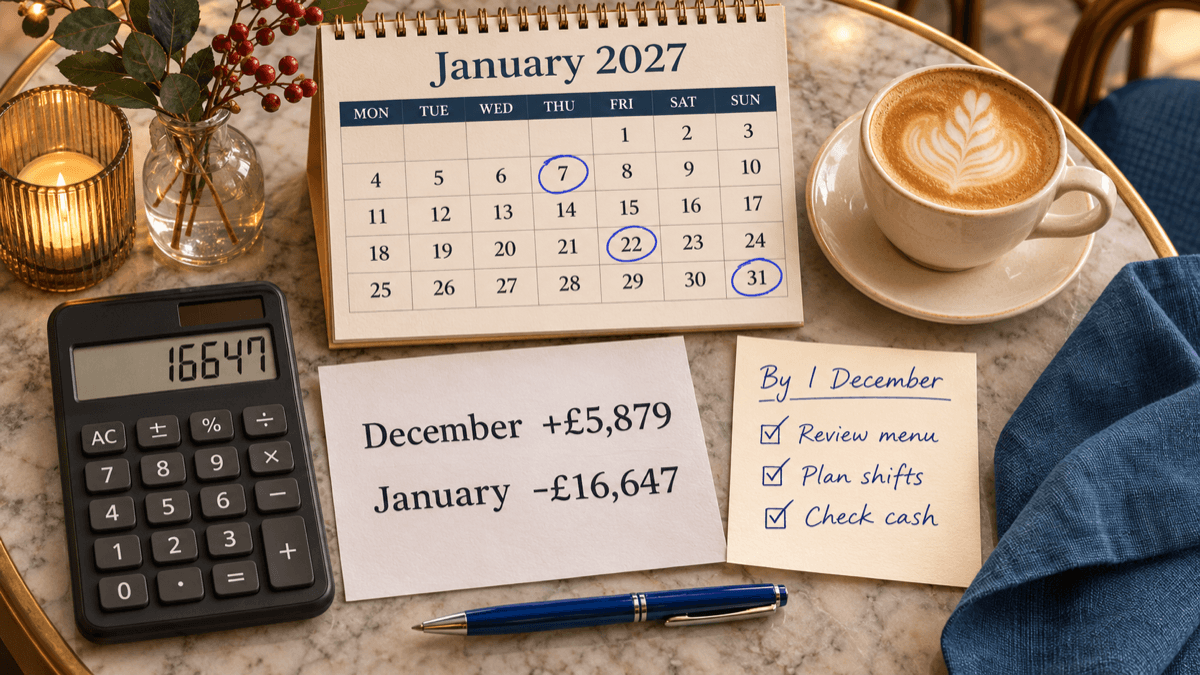
| Net cash movement | +£5,879 | -£16,647 | +£2,025 |
The average month spreads the quarterly and twice-yearly bills evenly, which is how they feel in a budget and never how they arrive.
January's payroll falls less than the rota does, because December's bigger PAYE bill (20% of £9,900, so £1,980) leaves on 22 January. January's supplier line is the highest of the three, because it's paying for December. And the VAT is the quarter from September to November: £85,000 of turnover x 16% = £13,600, less the £1,560 of VAT paid on purchases and overheads over the quarter, is £12,040, due on 7 January.
Take the two tax bills out and January's trading on its own comes to +£1,393. The month isn't the problem. The £18,040 of tax due in it is. Across December and January together this café goes £10,768 backwards, and that money has to be in the bank before the first pre-order is collected.
Your VAT stagger changes the answer
Which months your VAT quarters end in depends on your registration, and GOV.UK says your VAT online account shows when your returns are due. The deadline is "usually one calendar month and 7 days after the end of an accounting period". For this café:
| Your quarters end in | The bill nearest January | Quarter's turnover | Due | Amount |
|---|---|---|---|---|
| Jan, Apr, Jul, Oct | August to October | £92,500 | Monday 7 December | £13,240 |
| Feb, May, Aug, Nov | September to November | £85,000 | Thursday 7 January | £12,040 |
| Mar, Jun, Sep, Dec | October to December | £87,500 | Sunday 7 February | £12,440 |
August was £35,000 and September £30,000. Each amount is the quarter's turnover x 16%, less the same £1,560 of VAT paid on purchases and overheads.
The first stagger moves the pain into December, which goes £7,361 backwards, and January adds another £4,607: £11,968 over the two months. The third looks kind, with December and January together £1,272 ahead, until 7 February takes the quarter with December in it and leaves the café £11,168 down before February's own trade. Whichever stagger you're on, this café needs about £11,000 to £12,000 set aside going into the winter. The question is only which week it goes.
The bills that bunch up
Self Assessment on 31 January
If you're a sole trader or in a partnership, 31 January is the balancing payment for 2025/26 and the first payment on account for 2026/27. In a steady year it's about half of last year's bill. After a first properly profitable year it can be 150% of a year's tax, which the payments on account post works through with real figures. Read that one before you decide £6,000 is your number.
31 January 2027 is a Sunday. GOV.UK says that when the deadline falls on a weekend, "make sure your payment reaches HMRC on the last working day before", unless you pay by Faster Payments or card. In practice: pay by Friday 29 January, or by Faster Payments or card on the day.
VAT, on your stagger
Covered above. Two details. The VAT deadline doesn't move for weekends: GOV.UK says the return and payment must arrive "on or before the deadline, even if it's on a weekend or bank holiday" (VAT return deadlines). And if you pay by Direct Debit, HMRC collects "3 working days after the payment deadline", so a 7 January bill leaves your account on Tuesday 12 January.
Rent on the quarter day
A lot of commercial leases still collect rent on the traditional English quarter days. LexisNexis's glossary lists them as "25 December, 25 March, 24 June and 29 September", and notes that some leases use the modern quarter days instead, which start on 1 January. Others are monthly. Your lease decides which, and whether the rent is paid in advance or in arrears.
If yours is quarterly in advance on the old dates, the Christmas Day payment covers January to March, the quietest quarter of the year, and it's paid out of December. In Scotland the statutory quarter days are 28 February, 28 May, 28 August and 28 November, set by the Term and Quarter Days (Scotland) Act 1990 unless the lease gives its own date, so the payment that covers this winter falls on Saturday 28 November.
Christmas Day is a bank holiday, so check when your standing order actually leaves, and whether the lease says anything about non-working days.
PAYE on 22 January
GOV.UK's PAYE guidance says to pay "by the 22nd of the next tax month if you pay monthly", or by the 19th if a cheque goes by post. The 22 January payment covers the tax month from 6 December to 5 January, which is December's payroll: your busiest rota, Christmas temps included.
December's supplier bills
On 30-day terms, December's buying is January's spending. This café pays £10,075 in January for food and drink it sold in December, out of takings 32% lower. The order you place before closing for Christmas is the part you can still change.
Corporation Tax, if your year ends in March
If you trade through a limited company with a 31 March year end and profits up to £1.5 million, Corporation Tax for the year to 31 March 2026 is due "9 months and 1 day after the end of your accounting period", which is 1 January 2027. That's a bank holiday, and GOV.UK says that in that case the payment should reach HMRC "on the last working day before it", unless you're paying by Faster Payments using online or telephone banking. So Thursday 31 December.
The January calendar
From GOV.UK's bank holidays list and the tax pages above. Check your own lease, stagger and year end.
| Date | What | Who it affects |
|---|---|---|
| Fri 25 Dec | Christmas Day bank holiday. Traditional English quarter day | Everyone. Rent, on leases that use it |
| Mon 28 Dec | Boxing Day substitute bank holiday | Everyone |
| Thu 31 Dec | Last working day before Corporation Tax due on 1 January | Companies with a 31 March year end |
| Fri 1 Jan | New Year's Day bank holiday. Modern quarter day | Everyone. Rent, on leases that use it |
| Mon 4 Jan | 2 January substitute bank holiday | Scotland only |
| Thu 7 Jan | VAT return and payment for the quarter to 30 November | Feb, May, Aug, Nov staggers |
| Tue 12 Jan | That VAT Direct Debit collected | As above, if paying by Direct Debit |
| Tue 19 Jan | PAYE by posted cheque must reach HMRC | Employers paying by cheque |
| Fri 22 Jan | PAYE and NI for 6 December to 5 January | All employers |
| Fri 29 Jan | Last working day before the Self Assessment deadline | Sole traders, partners, directors |
| Sun 31 Jan | Self Assessment online return, balancing payment and first payment on account | As above |
| Sun 7 Feb | VAT for the quarter to 31 December | Mar, Jun, Sep, Dec staggers |
The levers
Rota hours to January's footfall
The cheapest January saving is the hours nobody needed. This café already plans 140 fewer hours than December, but if last January's till shows a late shift serving four people, a rota copied from October will still carry it.
Pull last January's sales by hour and day, and build the rota to that curve, the method in matching staff to footfall. January has 21 weekdays, one of them Friday 1 January, a bank holiday. Trimming one person by two hours on the other 20 is 40 hours: 40 x £16.50 = £660. Leave the Saturday rush alone. A short-staffed Saturday in January loses the customers you most need back in March.
StaffBrik, coming soon, is being built to set a turnover forecast and a target wage percentage for each week, and to warn you when the planned shifts go over it before you publish the rota.
Holiday: ask for January leave now
Holiday pay is owed whenever it's taken, so January leave doesn't cut January's wage bill. What it does is stop you paying holiday and cover at the same time in August. One barista's 30-hour week off taken in January needs no cover. The same week in August needs someone else on the rota: 30 x £16.50 = £495.
You can require it, with notice. Regulation 15 of the Working Time Regulations 1998 lets an employer tell a worker to take leave on particular days, with notice of "twice as many days in advance of the earliest day specified in the notice" as the days of leave. GOV.UK puts it as "at least twice as long as the leave they want their staff to take", and adds that "an employer cannot force a sick worker to take leave". A contract or holiday policy can change the notice.
So five days from Monday 18 January need 2 x 5 = 10 days' notice. Ten days before 18 January is Friday 8 January, and reg 15(3)(c) says the notice must be given "before the relevant date", so it has to reach staff by Thursday 7 January at the latest. That's the same (2 x 5) + 1 count the Christmas leave post uses. The fair version is asking in November, before people have planned their year, and offering choice of week. If the leave year starts on 1 January, it's next year's entitlement they're using, so say so.
Opening hours
A closed day saves wages and a little energy, and loses gross profit. For this café, two staff for eight hours on a Monday is 16 x £16.50 = £264, plus an illustrative £15 of energy, so £279 saved. At 69% gross profit, closing only wins if the day takes under £404 ex VAT (£279 / 0.69, rounded), and only if that trade doesn't simply move to Tuesday.
Run it on last January's Mondays, not your impression of them. The winter opening hours post covers the options short of closing, and the part that takes notice: anyone on contracted hours has to agree to fewer. In Scotland, Monday 4 January is a bank holiday, which may settle the first one for you.
A shorter menu, ordered to January's pars
Fewer lines means fewer ingredients on the order, less prep and less in the bin, so January is the month to cut the dishes that only made sense at Christmas. Every pound of stock on the shelves on 31 December is a pound you pay for in January and sell in February. Run stock down before the Christmas closure, and reset your pars for January from last January's sales, not December's. This café's January cost of sales should be about £6,820 (31% of £22,000), against £10,075 of December bills.
Cash: a forecast, two pots and three phone calls
- Start a 13-week forecast this week. A rolling 13-week cash flow forecast begun on Monday 23 November runs to Sunday 21 February, so 7 January, 31 January and 7 February are all on one page.
- A VAT pot. For a café that's 80% standard-rated, about 13.8p of every £1 banked is VAT (16 / 116, rounded). Move it weekly in December, when it's painless. December alone puts £5,200 of VAT in this café's till.
- A tax pot. Put the 31 January figure aside from December's takings. For the July and next January bills, HMRC's Budget Payment Plan lets you make "weekly or monthly Direct Debit payments towards your next Self Assessment tax bill", if you're up to date with the last one.
- Ring the landlord about monthly rent before 25 December. It turns £7,500 into three payments of £2,500, which leaves this café £2,500 better off at the end of January.
- Ring the bank about the overdraft limit now, not on 6 January.
- HMRC, if the numbers don't work. GOV.UK says that if you can't pay in full you may be able to set up a payment plan, and that "HMRC will check if a payment plan is affordable for you". It's a fallback, and it's easier to ask before the deadline than after.
Don't discount your way through it
A January offer feels like doing something. At this café's 69% gross profit, 20% off leaves 49p of gross profit on each original pound of sales, so it needs 0.69 / 0.49 = 1.408, or about 41% more sales, just to stand still. In the quietest month of the year, that's a big ask. The true cost of discounting has the full maths. A new reason to come in usually costs less than a price cut.
Book the maintenance, the deep clean and the training
The espresso machine service, the extraction clean and the deep clean are cheapest in lost trade in January, and engineers fill their diaries early. Book them now for a quiet Tuesday or a closed Monday, and put each one in the forecast, because they're still cash out in January. The same goes for training: a new starter, or the allergen refresher for the team you have, costs least in a week when a slow hand at the till doesn't cost you a queue.
A Veganuary special, if it suits
Only if it's built from stock you already hold. Costing a Veganuary special shows why: from your shelves it costs a few pounds to try, while a new shopping list leaves dead stock on 1 February.
By 1 December
- Find your dates. VAT stagger from your VAT account, your Self Assessment figure from your accountant, your rent day from the lease, and your Corporation Tax date if you're a company.
- Build the cash picture for December and January, with the bills in the week they leave, and find the lowest point.
- Open the VAT and tax pots and decide the weekly amount before the first big December week.
- Ring the landlord, and the bank, while it's a planning conversation.
- Pull last January's till by hour and day, and draft January's rota and opening hours from it.
- Ask staff for January leave, in writing, with choice of week.
- Agree any hours changes with contracted staff, and tell customers once, everywhere.
- Set the order for the last week of December and January's pars from last January's sales.
- Cut the January menu to what sells, and decide on a Veganuary special.
- Book the service, the deep clean and any training for the quiet weeks.
None of this makes January busier. It just means the quietest month arrives with the money for its bills already put by.
Ed O'Brien has run Hunters Cake Company for 17 years across cafés in Witney, Burford, and a bakery in Carterton, Oxfordshire. He's building Brikly - modular tools that give independent café owners the same data the big chains have, without the big chain price tag.