
Setting your café's 2027 budget (and actually reading it every month)
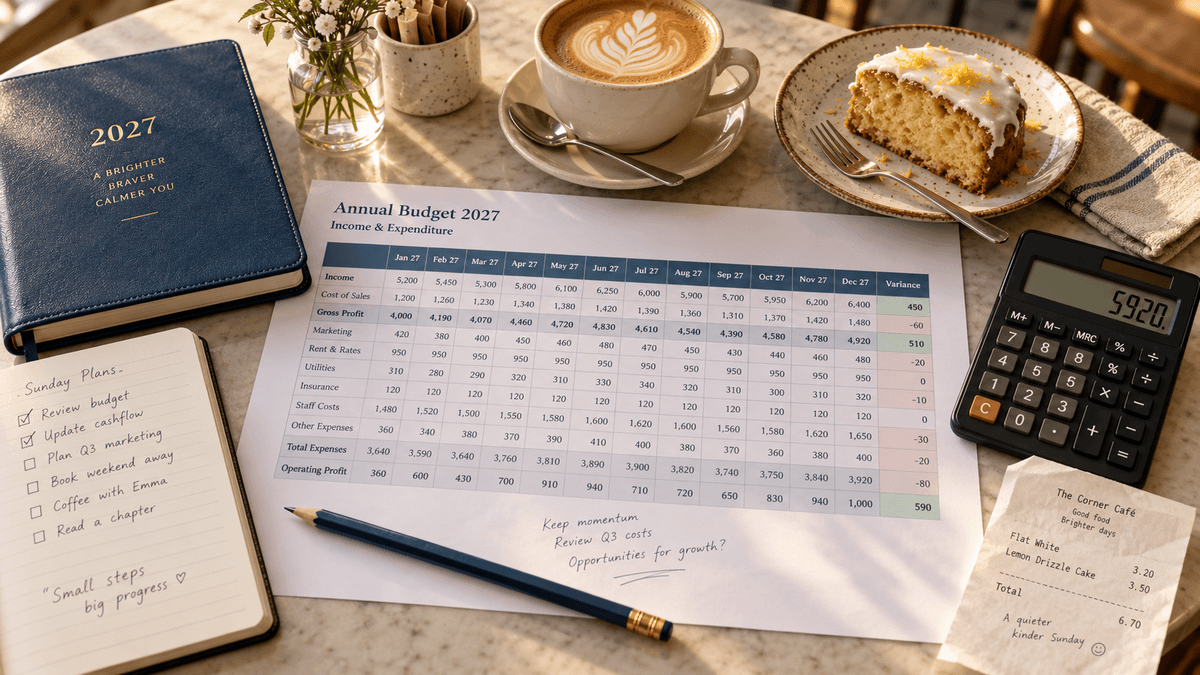
Next February, January's figures will land and they will probably show a loss. Is that a disaster? January nearly always loses money. The real question is how much it was supposed to lose, and most independent cafés cannot answer it.
Some keep a cash flow forecast and plenty run off the bank balance. Very few have a budget: twelve monthly profit targets, set once, that each month's actual figures get held against.
For years my own yardstick was the same month last year. That tells you whether you grew, not whether you earned enough to cover the April wage rise you knew was coming.
Minimum wage, National Insurance and pension rules are UK-wide. Business rates are devolved and the rates figures here are England's; bank holidays differ in Scotland and Northern Ireland.
A budget is not a cash flow forecast
The 13-week cash flow forecast post says it plainly: "A 13-week forecast is not a budget." The forecast is about cash timing, when the VAT bill, the rent quarter day and the card settlements land, rolled forward every Monday.
The budget is about profit: what each month should turn over and earn, on the same basis as your P&L, all ex VAT. Set it once and leave it alone; a yardstick that moves is not a yardstick. The forecast tells you whether you can pay Friday's wages, the budget whether the month made the money it needed to.
You need last year's monthly P&L (or till reports ex VAT), a typical rota for each month, and your contracts with their renewal dates. I will build one as I go for an illustrative counter-led café that turned over £353,000 ex VAT in 2026. Every figure reproduces from the numbers shown.
Step one: turnover by month, from last year
Start from the same months last year, never the annual total divided by twelve, because your seasonality is already in there. Then adjust for two things.
The calendar. In 2026 the whole Easter weekend sat in April, Good Friday 3 April to Easter Monday 6 April. In 2027 Easter Sunday is 28 March, and GOV.UK's bank holidays list puts Good Friday on 26 March and Easter Monday on 29 March, so the whole weekend falls in March. Copy last year across and March looks brilliant while April looks broken. The example moves £2,000 of Easter trade: March goes from £26,000 to £28,000, April from £32,000 to £30,000.
Weekends shift too: July 2027 has five Saturdays to July 2026's four, and August 2027 has four to August 2026's five. If Saturday is your best day, adjust for it. The example does not, for readability.
The price rise. Decide it now, in October, not in a panic in March. The example puts 4% on menu prices from 1 April 2027 with volumes held flat. That is an assumption: ex-VAT turnover only rises 4% if customers buy the same things and the VAT treatment holds.
So July's £35,000 becomes £35,000 x 1.04 = £36,400. January to March, before the price rise, total £73,000, April to December's £280,000 becomes £291,200, and the year comes to £364,200.
Step two: cost of sales, split food and drink
Do not copy last year's blended cost of sales. As the food versus drink GP post shows, a blended number moves with the weather before it moves with your margins, so set a GP target for each side.
The example targets 78% GP on drinks and 58% on food, with drinks 55% of sales. For January:
- Drinks: 55% of £22,000 = £12,100 at 78% GP, a cost of £2,662
- Food: 45% of £22,000 = £9,900 at 58% GP, a cost of £4,158
- Total £6,820, 31% of £22,000. Blended GP: 0.55 x 78 + 0.45 x 58 = 69.0%
I hold 69% all year for simplicity. If your mix swings hard with the seasons, set the split month by month.
Step three: wages, at two different rates
Build wages from rota hours, not last year's wage bill, which was paid at last year's rates.
January to March 2027 sit in the current pay year: £12.71 for anyone 21 and over, and GOV.UK notes "The rates change on 1 April every year."
From April, nobody knows yet. The Low Pay Commission's latest projection, in its April 2026 consultation letter, is that "a rate between £13.02 and £13.34 (or an increase of between 2.4 and 5.0 per cent) would be required in April 2027, with a central estimate of £13.18 (3.7 per cent)".
The LPC calls these figures "indicative only". Its 2026 report says "We will make our recommendation in October", and the rates are expected around the Budget on Wednesday 28 October.
So pencil in £13.18. Youth rates are harder: in its remit to the LPC, quoted in the same consultation letter, the government restates its commitment to "aligning the 18- to 20-year-old National Minimum Wage with the National Living Wage", so a young team could see more than 3.7%. The same letter gives the LPC "full flexibility" on the timing, though, and the government is reported to be looking at slowing it, as the Weekly Grind covered in September. Cost your 18-to-20 line both ways until 28 October. The minimum wage 2027 calculator runs the projection across your own team. (Update, 28 October 2026: the Government confirmed the April 2027 rates: £13.21 an hour for workers aged 21 and over, £11.27 for 18 to 20 year olds and £8.31 for 16 to 17 year olds and apprentices. The calculator now uses them.)
On-costs: about 25%
Add about 25% for employer NI, pension and holiday. Checked on a typical part-timer, 20 hours at £13.69, or £273.80 a week:
- Employer NI, 15% above £96 a week (HMRC): 15% x (£273.80 - £96) = £26.67
- Pension, 3% above £120 a week: 3% x (£273.80 - £120) = £4.61
- Holiday accrual at 12.07%: £33.05
- NI and pension on that holiday pay, which goes through payroll like any other week: 12.07% x (£26.67 + £4.61) = £3.78
That is £68.11, or 24.9%. Longer hours push it up, because less of the pay sits under the thresholds: the same sum comes to 27.3% at 30 hours a week and 28.6% at 40, so a mostly full-time team should budget nearer 28%.
The £5,000 NI threshold has applied since April 2025, and Budget 2025 said the government is "maintaining the Secondary Threshold at its current level from April 2028 to April 2031". The pension trigger and qualifying band were frozen for 2026/27, with 2027/28 not yet announced.
You pay no employer NI on under-21s and apprentices under 25 up to £967 a week, so 25% overstates them. If you are eligible for the £10,500 Employment Allowance, show it as a separate credit; the example leaves it out.
The example's wage line
The team's average rate is an illustrative £13.20 for January to March, a mix of living wage and supervisor rates. From April the whole team moves by the LPC's central 3.7%: £13.20 x £13.18 ÷ £12.71 = £13.688, so £13.69.
Staff hours, owner not included: January 460, February 460, March 540, April 560, May 580, June 600, July 660, August 660, September 560, October 520, November 520, December 600. The team is mostly part-time, so wages are hours x rate x 1.25, rounded to the nearest £10:
- January: 460 x £13.20 x 1.25 = £7,590
- July: 660 x £13.69 x 1.25 = £11,294.25, so £11,290
April to December is 5,260 hours: £86,790 at £13.20, £90,011.75 at £13.69. The rise costs £3,222. Worked the same way, the LPC's £13.02 to £13.34 range puts the team on £13.52 to £13.85 and the rise at £2,104 to £4,274.
Step four: overheads, line by line
The example's fixed overheads are £5,150 a month: rent £2,500, rates £500, energy £950, insurance £250, software and subscriptions £200, repairs £300, accountancy £150, other £300. Card fees sit on top at 1.5% of turnover.
Rent and rates come to £36,000, 9.9% of turnover, right on the 10% that the occupancy cost benchmark calls a fair target. Note any 2027 rent review.
Rates from April 2027 are not set. England's 2026/27 small business multiplier for retail, hospitality and leisure is 38.2p. Between revaluations, GOV.UK explains, "the national multipliers uprate by CPI every financial year", with the hospitality ones held 5p below.
September's inflation figure is due on 21 October (August's was 3.1%), and the Budget could change things. Until the council's bill arrives, budget this year's bill plus inflation from April, and check your cap if you are on transitional relief. The example holds £500 flat to keep the sums simple.
The rest:
- Energy. If your fixed deal ends in 2027, budget the renewal at today's quotes and step the line up from that month.
- Insurance. Budget the renewal including Insurance Premium Tax at the standard 12%.
- Subscriptions. List every direct debit and auto-renewal from a year of bank statements, with end dates and price-rise clauses.
- Card fees. Last year's card fees over last year's turnover. At 1.5%, the example's come to £5,463.
Step five: pay yourself, and leave a margin for error
Owner's pay is a line, not whatever is left. The example pays £2,500 a month, £30,000 a year: the bottom of the "£30,000 to £35,000 to replace" that the owner's pay post puts on the role at around £300,000 turnover. That is before any employer NI: a sole trader's drawings carry none, but a company director's salary does, about £3,750 on £30,000, unless the Employment Allowance covers it.
Keep it apart from staff wages. Staff here are 31.3% of turnover, inside the 28-33% counter-led band in the wage percentage benchmarks. Lump the owner in and it reads 39.6%, which is comparable with nothing.
Contingency, 1% of turnover. The boiler, the fridge seal, the week the dishwasher dies: £3,642. Unspent, it is profit.
The whole year on one page
All ex VAT and illustrative. Overheads include card fees. Wages are rounded to the nearest £10 and percentages to one decimal place; every other figure is exact.
| Month | Turnover | Cost of sales | Wages | Overheads | Owner | Contingency | Profit | Wage % | Profit % |
|---|---|---|---|---|---|---|---|---|---|
| Jan | £22,000 | £6,820 | £7,590 | £5,480 | £2,500 | £220 | -£610 | 34.5% | -2.8% |
| Feb | £23,000 | £7,130 | £7,590 | £5,495 | £2,500 | £230 | £55 | 33.0% | 0.2% |
| Mar | £28,000 | £8,680 | £8,910 | £5,570 | £2,500 | £280 | £2,060 | 31.8% | 7.4% |
| Apr | £31,200 | £9,672 | £9,580 | £5,618 | £2,500 | £312 | £3,518 | 30.7% | 11.3% |
| May | £31,200 | £9,672 | £9,930 | £5,618 | £2,500 | £312 | £3,168 | 31.8% | 10.2% |
| Jun | £33,800 | £10,478 | £10,270 | £5,657 | £2,500 | £338 | £4,557 | 30.4% | 13.5% |
| Jul | £36,400 | £11,284 | £11,290 | £5,696 | £2,500 | £364 | £5,266 | 31.0% | 14.5% |
| Aug | £36,400 | £11,284 | £11,290 | £5,696 | £2,500 | £364 | £5,266 | 31.0% | 14.5% |
| Sep | £31,200 | £9,672 | £9,580 | £5,618 | £2,500 | £312 | £3,518 | 30.7% | 11.3% |
| Oct | £28,600 | £8,866 | £8,900 | £5,579 | £2,500 | £286 | £2,469 | 31.1% | 8.6% |
| Nov | £28,600 | £8,866 | £8,900 | £5,579 | £2,500 | £286 | £2,469 | 31.1% | 8.6% |
| Dec | £33,800 | £10,478 | £10,270 | £5,657 | £2,500 | £338 | £4,557 | 30.4% | 13.5% |
| Year | £364,200 | £112,902 | £114,100 | £67,263 | £30,000 | £3,642 | £36,293 | 31.3% | 10.0% |
Gross profit is £251,298, and £251,298 - £114,100 - £67,263 - £30,000 - £3,642 = £36,293, a 10.0% net margin after paying the owner.
Look at the top two rows. This café is planned to lose £610 in January and break even in February, so a fixed rule like net profit below 3% for two months running goes off every winter. The budget answers the better question: was this January worse than January was meant to be?
If you run several sites from a central kitchen, decide how the kitchen charges the cafés before setting site budgets, or every site's GP target rests on a number that might move.
The 20-minute monthly check
When the month's figures are in, put three columns next to the budget: actual, variance in pounds, variance in percentage points. It is the first 20 minutes of the monthly numbers review, not a replacement.
Three numbers first, in this order:
- Turnover against budget, in pounds and per cent. It explains half of what follows.
- GP% against target, in points, then pounds. The margin is the part that is yours.
- Wage % against target, in points, then pounds, with the turnover effect taken out.
Points tell you what went wrong. Pounds tell you whether it matters.
A January, worked through
| Illustrative January | Budget | Actual | Variance |
|---|---|---|---|
| Turnover | £22,000 | £20,900 | -£1,100 (-5.0%) |
| Cost of sales | £6,820 | £6,900 | +£80 |
| Gross profit | £15,180 (69.0%) | £14,000 (67.0%) | -£1,180 (-2.0 pts) |
| Wages | £7,590 (34.5%) | £7,800 (37.3%) | +£210 (+2.8 pts) |
| Overheads | £5,480 | £5,620 | +£140 |
| Owner's pay | £2,500 | £2,500 | £0 |
| Contingency | £220 | £0 | -£220 (unspent) |
| Profit | -£610 | -£1,920 | -£1,310 |
On the cost lines a plus means over budget, which is bad; on turnover, gross profit and profit a minus is bad. Actual profit is £20,900 - £6,900 - £7,800 - £5,620 - £2,500 = -£1,920, and the variance reconciles: -£1,180 - £210 - £140 + £220 = -£1,310. Percentages are rounded to one place.
Turnover is 5.0% down. With no price rise until April, that is 5.0% down on last January too. January 2027 swaps one of January 2026's Thursdays for a Sunday, so if Sunday is your better day, like for like it is slightly worse.
GP is down £1,180, but most of that is volume. £1,100 of lost sales at 69% accounts for £759. At 69%, £20,900 should have made £14,421; it made £14,000. That £421 is the 2.0-point drop in margin, and it is the one to chase: waste, a supplier price rise not yet in the recipes, portions, or a cold month tipping the mix towards food.
Wages are up 2.8 points, but only £210. At budget, £7,590 on £20,900 would still be 36.3%, so 1.8 points is the lower turnover and 1.0 point is the extra £210. The rota did not come down when trade did.
When to act
My rules of thumb, not industry standards:
- Turnover 5% or more below budget in a month, or below budget two months running
- GP 2 points or more below target in one month, or 1 point or more two months running
- Wage % 2 points or more over target, then split out how much is just lower turnover
- Any overhead line more than 10% over budget, if that is more than about £100
This January trips the first three. That does not mean panic: it means the margin gets looked at this week, and the rota before the next one.
The weekly habit underneath it
A monthly check catches a wage problem four weeks late, which is why the wage percentage benchmarks post says "The single biggest mistake I see is operators looking at wage % on the monthly P&L." Turn each month's turnover and wage percentage into weekly targets and check them every Monday.
We're building StaffBrik, coming soon, to take those two numbers as each week's budget: a turnover forecast and a target wage percentage. Its Weekly Wage Report will then set each rota week's actual labour against that budget and mark it Over, On track or Under.
This week
- Pull last year's P&L by month, turnover ex VAT.
- Move Easter from April to March, and count your July and August Saturdays.
- Decide the price rise and set separate GP targets for drinks and food.
- Build the wage line from rota hours: £12.71 to March, £13.18 from April, plus about 25% (nearer 28% for a mostly full-time team).
- List every renewal date: energy, insurance (with 12% IPT), subscriptions, rent review.
- Put the budget next to your 13-week forecast: profit on one, cash on the other.
- Diary 21 and 28 October. The first brings the September inflation figure that business rates normally rise by; the second should confirm the wage rates. Revisit the wage line that week.
A budget will not make January busier. It tells you, in 20 minutes on a Sunday in February, whether January was the plan or the problem.
Ed O'Brien has run Hunters Cake Company for 17 years across cafés in Witney, Burford, and a bakery in Carterton, Oxfordshire. He's building Brikly - modular tools that give independent café owners the same data the big chains have, without the big chain price tag.