
Credit notes: the money your suppliers owe you
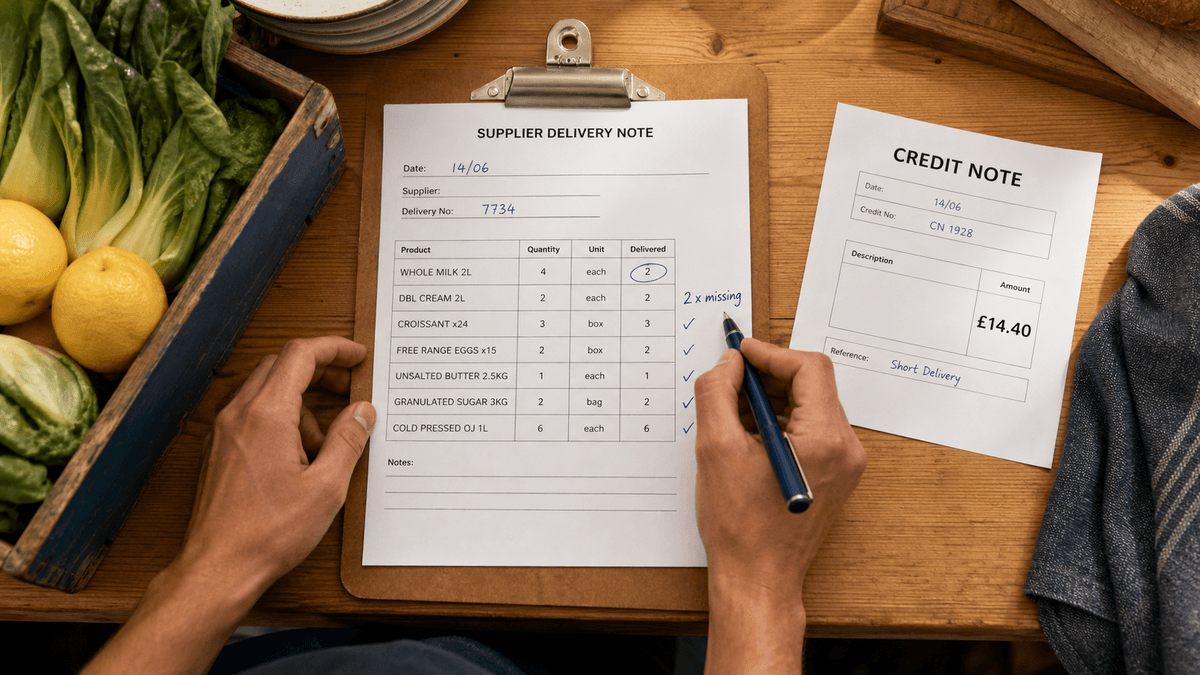
You spotted the short. Two cases of milk light on Tuesday, you rang the depot, someone friendly said "no problem, we'll sort it," and you got back on the floor feeling like you'd handled it.
That credit note never came. Or it came three weeks later, landed in a pile of paperwork, and got paid over without anyone noticing it was a refund you'd already earned.
This happens quietly, constantly, in almost every café. Suppliers owe you money for goods you never got or were overcharged for, and most of it is never claimed. Not because operators are careless, but because a busy kitchen is the perfect place for a small, invisible debt to disappear.
When a credit is actually owed
A credit note is your supplier's written admission that they owe you money back. You're entitled to one every time you paid, or are about to pay, for something you didn't properly receive. Four situations cover almost all of it.
- Short delivery. You ordered 6, the invoice bills 6, the crate had 4. The invoice is generated from the order, not from what physically came off the van, so it will happily charge you for the two that never arrived. That gap is owed back to you.
- Damaged or out-of-temperature goods. Crushed bread, a split bag of flour, a leaking tub, or chilled stock that turned up warm and had to be refused. If it's not usable, you didn't receive it, whatever the note says.
- A substitution at a higher price. They were out of your usual 2.5kg cheddar so they sent a premium block at a premium price, or swapped your house beans for a dearer line. A like-for-like swap is fine. A swap that costs you more without your say-so is a credit.
- The invoice price doesn't match the agreed price. You negotiated a rate, or you're on a standing price list, and the invoice quietly bills something higher. This is the same family of problem as a pack that shrank while the price held steady: the money leaks through the line detail, not the headline total, so a quick glance at the invoice never catches it.
None of these is necessarily anyone being dishonest. Depots are busy, packers make mistakes, price files fall out of sync. But every one of them is real money, and none of it comes back on its own. Worth keeping the two straight, too: credit notes are what your supplier owes you, while credit terms are the days they give you to pay, and it's the second one that gets accounts stopped.
Claim at the door, not from a drawer
The strongest claim you will ever make is the one you make while the driver is still on your forecourt. Everything after that is harder.
This is why the goods-in check, matching what physically arrived to what you ordered before you pay, is where every credit claim actually begins. A short you catch during the unload is a two-minute conversation. The same short discovered at 3pm is a phone call, an email, a hunt for evidence, and a fortnight of chasing.
So when something's wrong, build the claim on the spot:
- Photograph it. Ten seconds on your phone. The light crate, the crushed loaf, the leaking tub, the label showing the wrong pack size. Timestamped photos win arguments that "he said, she said" loses every time.
- Write it on the delivery note. Don't sign clean and complain later. Write the discrepancy on the note before you sign: "2 x milk short", "cheddar substituted, not ordered", "1 bread crate crushed". Note it on your copy and the driver's.
- Get the driver to initial it. A discrepancy the driver has initialled is a discrepancy the supplier has already half-acknowledged. It turns your word against theirs into a shared record.
That annotated, initialled, photographed note is your claim. A clean signature is the supplier's defence.
There's a reason delivered wholesale is where this discipline pays off. When you drive to the cash and carry or grab a top-up from the supermarket, you check the goods in the aisle and there's nothing to dispute after the fact. Delivered stock is different: it arrives on someone else's word, with a paper trail attached, which is exactly what makes it claimable. It's one of the quiet trade-offs in how you split your buying between delivered suppliers and a cash-and-carry run. The delivery you didn't watch being loaded is the one you have to check hardest.
The claims log and the weekly chase
Catching the problem is only half the job. The other half is making sure someone actually pays you back, and that means the claim can't live in your head or on a sticky note by the till.
Keep a dead-simple claims log. A notebook page or a spreadsheet with a handful of columns:
- Date of the delivery
- Supplier and delivery note number
- What was wrong and the amount you reckon you're owed
- Who you told, and when
- Status: raised, credit promised, credit received, reconciled
That's it. No app required. The log exists to do one thing: stop a promised credit from being quietly forgotten.
Then, once a week, give it ten minutes. Go down the list and chase anything that's still open. A credit promised two weeks ago and not yet arrived gets a follow-up email quoting the delivery note number. A supplier who knows you keep a list and check it is a supplier whose credits turn up.
Here's the rule that makes the difference: a claim is not made until it is chased. Raising it once and hoping is how most café credits die. The ten-minute weekly chase is what turns a note in a drawer into money in the bank.
Reconciling the credit when it finally lands
Say the chase works and the credit note arrives. You're still not done, because a credit note is a piece of paper, not a payment. It only becomes money when it's correctly set against what you paid.
Credit notes are slippery for a few reasons. They often arrive weeks after the invoice they relate to, on a separate document, sometimes on a different statement cycle. They rarely repeat the original invoice number in an obvious place. And they land in the same paperwork pile as everything else, so they're easy to file and forget, or worse, to overlook entirely while you pay the original invoice in full.
So close the loop properly:
- Match the credit note back to the original invoice. Find the invoice it corrects, confirm the amount matches what you claimed, and mark both in your log as reconciled.
- Make sure it actually reduces what you pay. A credit note only helps if it comes off a payment. Check it's been deducted from the supplier statement, or that you've short-paid the original invoice by the credited amount. Catching the ones that never got applied is the main prize in reconciling the month-end statement. A credit note sitting unapplied while you pay the full invoice is a refund you earned and then handed straight back.
- Watch for the credit that never arrives at all. This is where your log earns its keep. If a promised credit is still open a month later, that's the one to escalate.
This is where seeing your invoices at the line-item level, rather than just filing paper, changes everything. When pattern-learning invoice processing reads every line and charge off each document, a credit you're owed but never received stops being invisible, because the shortfall is sitting right there against the original bill instead of buried in a drawer. The whole point is that the gap becomes obvious instead of quietly settling into your costs.
The second rule, then: a credit note is not money until it is reconciled. Filing it feels like closing the loop. It isn't. Applying it is.
What the unclaimed leak actually costs
Individually, these amounts feel too small to fuss over. A short case here, a few pence a kilo there, a premium substitution nobody flagged. That's exactly why they slip. Add them up over a year and the picture changes.
Say your stock buying runs at £6,000 a month. That's £72,000 a year going out to suppliers. Now say shorts, damages, wrong substitutions and small price errors quietly account for somewhere between 1% and 2% of that, which is a modest, realistic range for a café that isn't checking closely.
- At 1%, that's £720 a year owed to you.
- At 2%, it's £1,440 a year.
That's money you already earned by ordering and paying for stock. It's not a discount to negotiate or a cost to cut. It's a refund you're entitled to that's currently being left on the table because nobody counted, nobody chased, and nobody reconciled. On the margins most independents run, £1,000 or more of clawed-back credits drops almost entirely to the bottom line.
And there's a compounding effect worth naming. A short that clears your back door unclaimed doesn't just cost you that stock. It inflates your recorded purchases, which quietly distorts your food cost and makes your figures lie to you when you go looking for where the money went.
Getting this money back doesn't take a system. It takes three habits that fit inside the day you already have: check at the door and build the claim on the spot, keep a one-page log and chase it for ten minutes a week, and reconcile every credit note against the invoice it corrects before you pay. Brikly's CostingBrik does the downstream half, reading each invoice line by line and tracking supplier prices as they move, so a credit you're owed can't hide behind a tidy-looking total. But the counting, the chasing and the closing of the loop are yours.
Remember the two rules and you'll claim back most of what leaks. A claim is not made until it is chased. A credit note is not money until it is reconciled.
Ed O'Brien has run Hunters Cake Company for 17 years across cafés in Witney, Burford, and a bakery in Carterton, Oxfordshire. He's building Brikly - modular tools that give independent café owners the same data the big chains have, without the big chain price tag.