
Your busiest hours are your worst margin: what the weekend brunch rush really earns
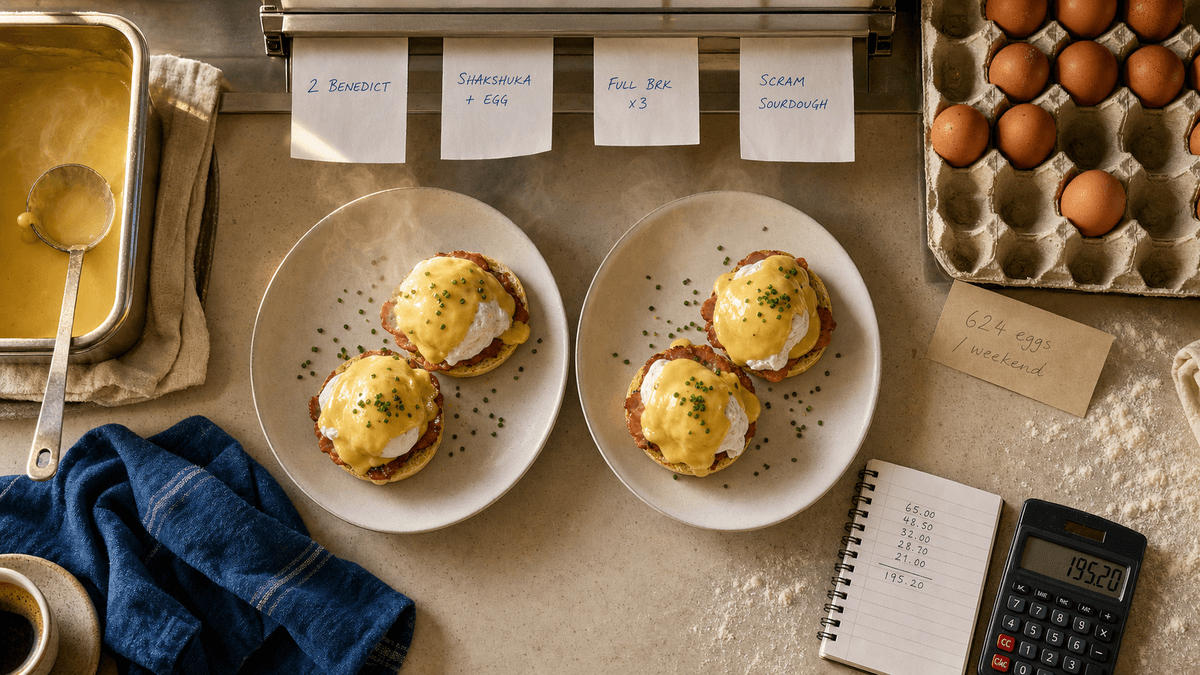
Saturday, quarter past ten. Every table is full, there are three people waiting by the door, the pass is stacked and the card machine hasn't stopped since half nine. It is the best hour of your week by a mile, and it feels like it.
Then the month closes and the numbers don't quite say what the room said. The turnover is there. The profit isn't, not in the proportion you expected.
That gap is not an accounting error. Your busiest hours are usually your worst-margin hours, and the reason is sitting on the plate.
The plate is the problem, not the queue
Every other trading hour in your week is led by a cup. Coffee is a generous line: a flat white sits somewhere in the 75 to 80% gross profit range once you've paid for beans, milk and a cup. The pastry alongside it is heavier, but it's a passenger, not the main event.
Weekend brunch is the one daypart where that flips. The main line is a plate. Eggs, sourdough, bacon, avocado, smoked salmon, hollandaise. Real food cost, on real crockery, made to order by a real person on a hot section. Those dishes land nearer 55 to 65%, and at brunch they are the mix, not the accompaniment.
So the busiest hour of your week is the hour where the cheapest thing you sell has stopped being what you mostly sell. That's the inversion: highest takings, lowest blended margin, all at once.
Saturday 10am against Tuesday 10am
I set out the arithmetic for this in the piece on profit per trading hour after wages, which deliberately pointed the lens at the thin hours at the edges of the day. This is the same lens turned the other way, at the hour you're proudest of.
Round numbers, and the gross profit percentages here are illustrative blends rather than anybody's real menu. Assume a fully loaded wage of £16 an hour.
| Saturday 10-11am | Tuesday 10-11am | |
|---|---|---|
| Takings | £320 | £110 |
| What sold | Benedicts, big breakfasts, shakshuka, coffees alongside | flat whites, two pastries, one toastie |
| Blended gross profit | 61% | 77% |
| Gross profit earned | £195.20 | £84.70 |
| Staff rostered | 4 | 2 |
| Wage cost | £64 | £32 |
| After wages | £131.20 | £52.70 |
| Per labour hour deployed | £32.80 | £26.35 |
Look at the three gaps in turn. On the till, Saturday is 2.9 times the Tuesday hour. After gross profit, it's 2.3 times. After wages, it's 2.5 times. And per hour of labour you put into it, it's 1.2 times.
The queue said three times better. The books say about a fifth better per pair of hands.
Now watch how easily it tips. Put a fifth person on that Saturday hour, which is exactly what happens when the pass is stacked and someone has to run plates, and the gross profit is unchanged at £195.20 against £80 of wages. That's £115.20 after wages, or £23.04 per labour hour - below the quiet Tuesday coffee hour you'd never have thought to look at.
The bit nobody costs: your egg concentration
Here's what makes brunch different from every other service you run, and it isn't the labour.
At coffee hour your cost is spread across beans, milk, flour and butter. If one of them moves, three others don't. At brunch, one volatile input sits inside most of your top-selling lines at the same time. The Benedict, the full breakfast, the shakshuka, the omelette, the scrambled on sourdough, the French toast, and the hollandaise sitting under two of them.
That's concentration risk, and it behaves exactly like the cocoa spike did for brownies and mochas, only worse, because cocoa touched a handful of lines and eggs touch nearly all of them.
Work out your actual exposure
Three numbers. Eggs per plate, plates per weekend, pence per egg.
Say your Saturday and Sunday brunch service puts out 260 egg-containing plates between them. Average 2.4 eggs a plate once you count what goes into the hollandaise, not just what lands visibly on the toast. That's 624 eggs a weekend. At 28p each, that's £174.72 of egg going out of the door across two mornings.
Now move the price and see what it does to gross profit, since none of this can be recovered unless you change something:
| Per-egg move | Cost per weekend | Over a year |
|---|---|---|
| +5p | £31.20 | £1,622 |
| +10p | £62.40 | £3,245 |
| +20p | £124.80 | £6,490 |
If your two brunch mornings take around £2,400 between them, that 10p move is 2.6 percentage points straight off your brunch gross profit, and the 20p move is over five points. No dish changed. No portion changed. Nobody complained. The margin just left.
For scale: an ordinary tight winter is the 5p end. A genuine supply shock is what the 20p row is there for, and if you lived through cocoa you know supply shocks are not hypothetical.
The UK levers worth knowing
- Track the price per egg, not per pack. This is where it hides. A tray of 30 at £8.40 is 28p an egg. The same tray at £9.30 is 31p. Your invoice line reads "free range eggs, medium, tray of 30" both times, so the increase is invisible unless you divide. That 3p is £18.72 a weekend and getting on for £1,000 a year.
- Know your spec, and know what your board claims. Free range and barn are different prices and different products. If your menu, your window or your socials say free range, you are locked to that spec and can't quietly take the cheaper line when it pinches. Labelling rules around housing orders have been shifting in recent years, so read what's actually printed on the box rather than assuming.
- Expect autumn and winter to be the awkward months. UK avian flu risk climbs with wild bird migration through the back end of the year, and England had a national housing order imposed in November 2025. Housing measures squeeze free-range supply and wholesale prices move about accordingly. Prices eased again through spring 2026, but planning on the spring figure holding through December is optimistic.
- Have the supplier conversation armed with your real volume. "Can you do better on eggs" is a weak ask. "I take 620 eggs a weekend, call it 32,000 a year, all free range medium" is a completely different conversation, and it's a number you now have.
Recipe levers that don't cheapen the plate
You can cut exposure without anyone noticing, which is the whole trick.
- Portion discipline on the third egg. Two eggs, plated properly, beat three eggs plated in a hurry. If a customer wants a third, it's a paid add-on, not a default the kitchen throws on when it's busy.
- Share the sauce. One hollandaise batch feeding three menu lines is less waste, less prep and one yield to control instead of three. Over-ladled hollandaise is the brunch equivalent of the over-poured mocha: invisible per plate, painful per weekend.
- Let one dish showcase eggs rather than every dish contain them. A brunch board where all seven lines are egg-based is a menu with a single point of failure. Two strong headliners that don't touch an egg give you somewhere to steer customers when the price runs away, and they broaden the appeal anyway.
At brunch, the pass is the ceiling, not the seats
One more thing that changes at peak, and it changes what advice works.
Most of the time your constraint is the room, which is why measuring table turn and covers per seat is the right lever for a busy lunch. At full brunch tilt, the constraint moves off the tables and onto the hot section. Turning a table faster achieves nothing if the next order simply joins a longer ticket queue.
So think in plates per hour the pass can physically produce. Time it on a genuinely busy Saturday: count the plates that leave between ten and eleven and you have your real ceiling, not your hoped-for one.
Then make menu decisions that respect it. Two dishes needing the same pan for the same six minutes compete for that ceiling rather than adding to it, so weight the brunch board towards the plates worth the pass time. Your top lines by sales mix tell you what people actually order, and the free Menu Profit Calculator tells you what each of those plates is genuinely worth once it's costed.
The takeaway
- Your highest-turnover hour is very likely your lowest-margin hour, because at brunch the main line is a plate rather than a cup.
- Judge the peak per labour hour, not per till total. A four or five-handed brunch hour can earn less per pair of hands than a quiet Tuesday coffee hour.
- Do the egg sum this week: eggs per plate, times plates per weekend, times pence per egg. Then move the pence and see what falls out.
- Track the per-egg price off every invoice, not the pack price, because pack price hides the drift. That's exactly the drift CostingBrik is built to surface, so a 3p move shows up the week it lands rather than in next year's accounts.
- At peak, count plates per hour off the pass before you try to turn another table.
Brunch is worth running. It fills the room, it makes the place feel alive and it brings people in who'd never come on a Tuesday. Just don't let a full room stand in for a healthy one. Do the sums on your best hour with the same suspicion you'd bring to your worst.
Ed O'Brien has run Hunters Cake Company for 17 years across cafés in Witney, Burford, and a bakery in Carterton, Oxfordshire. He's building Brikly - modular tools that give independent café owners the same data the big chains have, without the big chain price tag.