
Who's allowed to place supplier orders in your café?
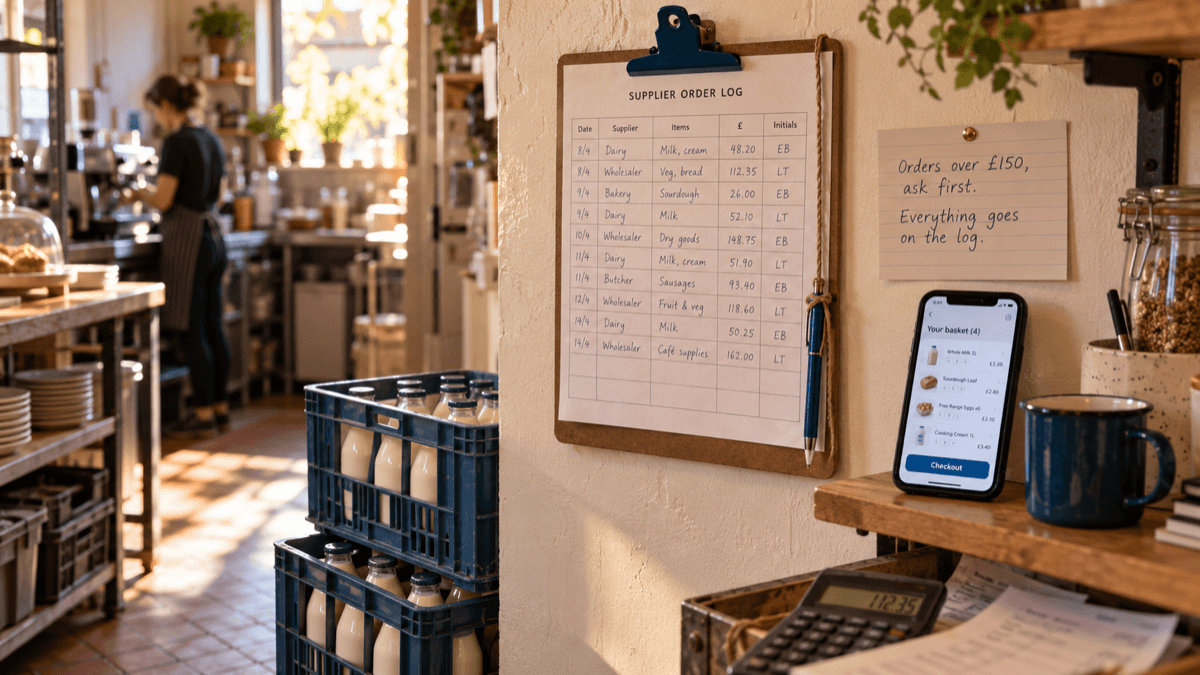
It's Saturday morning and there are two crates of milk by the back door where there should be one. Your supervisor added milk to the dairy app on Thursday night. Your weekend lead, not knowing, rang the depot on Friday and asked for the same again.
Neither of them did anything wrong. Both of them saw the milk was low and acted. The problem is that nobody decided who orders milk.
Three weeks later an invoice turns up from the flour supplier you moved away from in the summer. Someone still had the rep's number in their phone.
Everyone can order, nobody is checking
In a small café, ordering grows up informally. When you start out, you do it all, so there's no question of who's allowed. Then you take on a manager, a weekend lead, a baker who orders her own butter, and the job spreads without anyone sitting down to decide how.
Count the ways an order can get placed in your business today:
- The supplier app or web portal, often logged in on two or three phones.
- A phone call to the depot or the rep.
- An email or a WhatsApp to the baker or the greengrocer.
- The driver at the door, asking "same again Thursday?"
- A standing order set up a year ago that nobody has looked at since.
- The rep's visit, where a "try this new line" quietly becomes an order.
- An online shop with a saved card, for syrups, cups or cleaning kit.
Each route is fine on its own. Together, they mean money leaves the business on the word of whoever happened to notice something was low. And in practice, a supplier treats an order from anyone at your café as an order from you. They deliver it, and they invoice it.
Four ways loose ordering costs you money
None of these are dramatic. That's the problem. They're small enough to be ignored and frequent enough to add up.
Top-up orders that skip the par
You've set par levels on your main lines so that each order tops stock up to a number, not a feeling. That only works if the person ordering uses the par.
The impulse top-up skips it. Someone walks past the dry store on a Wednesday, thinks the oats look low, and adds a case to the next order. They didn't count, didn't check the par, and didn't know the main order already had oats on it. The par is still there on the sheet. It just wasn't used.
Two people, one milk order
The duplicate is the most common one, and the easiest to fix. Here's the Saturday above with some illustrative numbers.
The weekend needs about 28 two-pint bottles. The supervisor orders 24 through the app on Thursday, the weekend lead rings through another 24 on Friday. At an illustrative £1.15 a bottle:
- Ordered: 48 bottles, £55.20
- Used over the weekend: 28 bottles, £32.20
- Left over on Monday: 20 bottles, £23.00
If the following week's order is cut back to soak up the surplus, you lose very little. If it isn't, because the person ordering on Monday doesn't know about Saturday either, some of those 20 bottles go past their date. Bin 10 and that's £11.50 gone, plus the shelf space and the faff.
£11.50 isn't a crisis. But the same thing happens with pastries, with bread, with salad, and it happens because the system allows it, not because anyone was careless. A café doing that once a fortnight across a few fresh lines is losing a few hundred pounds a year to a question nobody answered.
Ordering from a supplier you've stopped using
You did the work. You trimmed your supplier list, moved the flour onto your main wholesaler's weekly drop, and closed the account in your head. Nobody told the team, or somebody wasn't in that week.
So the old supplier gets a phone call. Here's what one order of four 16kg bags of flour might cost, illustratively:
- Old supplier: 4 x £14.20 = £56.80
- Your current wholesaler: 4 x £11.90 = £47.60
- Difference on the flour: £9.20
- Carriage, because £56.80 is well under the old supplier's minimum: £6.50
- Cost of the mistake: £15.70, on one order
And the account is alive again. That means another invoice to process, another statement to reconcile and another payment to set up, which is exactly the admin you were trying to get rid of.
The old price, or the wrong product
The quieter version is ordering from the right supplier at the wrong price. Staff order from a printed price list from the spring, or by habit pick the branded line you stopped buying in favour of the own-label one. Or they order a small top-up on a day it falls below the free-delivery threshold, and the carriage charge and small-order surcharge wipe out any point in having ordered early.
None of these shows up until the invoice arrives. By then the goods are on the shelf and the money is spent.
A simple sign-off rule
You don't need purchase orders, approval software or a procurement policy. You need four decisions, written on one page and pinned up where the orders get placed.
1. Named orderers, per supplier
For each supplier, write down who orders and who covers when they're off. Two names, no more.
| Supplier | Orders | Backup |
|---|---|---|
| Dairy | Sam | Priya |
| Broadline wholesaler | You | Sam |
| Bakery | Priya | Sam |
| Greengrocer | Sam | You |
| Coffee roaster | You | Priya |
| Packaging, cleaning | You | (none) |
Names illustrative. The point isn't hierarchy. It's that when the milk looks low, everyone knows whose job it is, and everyone else's job is to tell that person, not to order it themselves.
2. A £ limit above which you approve
Routine orders from a named orderer on the normal day don't need you. You've already approved them, in effect, by setting the par and choosing the supplier.
What needs a quick text to you first:
- Any single order over a set amount. Pick a number that sits above a normal order for your biggest regular supplier. For many small cafés something like £150 to £250 works; set yours from what a normal week actually looks like.
- Any supplier not on the list. No new accounts, and no reopening old ones, without you.
- Any new product, including the rep's "try this".
- Any order on a day that isn't the order day, because that's where duplicates and carriage charges come from.
The limit isn't about trust. It's a tripwire. If something unusual is happening, you'd rather hear about it before the van turns up than when the invoice does.
3. Order days
Fix the day and rough time each supplier gets ordered. Dairy on Monday and Thursday by 2pm, wholesaler on Tuesday, roaster every other Wednesday.
Order days do two jobs. They stop the drip of small reactive orders that miss the free-delivery threshold. And they make it obvious when something's off: an order placed on a Saturday for a Tuesday supplier is a question worth asking.
4. One shared order log
Every order goes in one place. A clipboard on the back-room wall, a shared note on the team phone or a single tab in a spreadsheet. It doesn't matter which, as long as there's only one.
| Date | Supplier | Ordered by | What (or "see app") | Approx £ | Due | Checked in by |
|---|---|---|---|---|---|---|
| Mon 19 Oct | Dairy | Sam | Usual, plus 6 oat | £64 | Tue | Priya |
| Tue 20 Oct | Wholesaler | You | See app | £212 | Thu | |
| Thu 22 Oct | Dairy | Priya | Usual | £58 | Fri |
The log is what kills the duplicate. Before anyone orders, they look at the log. If milk is already on it, they don't order milk.
It takes about 20 seconds per order to fill in. You don't need every line written out, because the supplier's app or confirmation email already has that. You need who, which supplier, roughly how much, and when it's due.
Supplier accounts and who has the logins
Most of the ordering in a modern café happens through apps and portals, so the sign-off rule is only as good as the logins behind it.
Have a look at who can currently get into each supplier account. It's often more people than you'd guess: the manager who left last year still has the dairy app on her phone, the shared password is on a sticky note in the office, and your own login is the one everyone uses because it has the saved card.
A few habits help:
- Keep a list of every supplier login, who has it and when it was last changed. Your password manager, or a page in the back of the order book that lives in your office.
- Use individual logins where the portal allows them. Some supplier portals let you add users, sometimes with ordering limits. Ask your rep what theirs does. A named login means the order history tells you who ordered.
- Change shared passwords when someone leaves, the same day you take back their keys.
- Tell each supplier, in writing, who is allowed to order. A short email to the rep or the depot: "Orders for our account come from Sam, Priya or me." Some suppliers will put a note on your account. Ask them to check with you if an order comes in from anyone else.
- Review standing orders every few months. A standing order is an order you approved once and then forgot. Menus change, and the standing order doesn't.
- Take saved cards off online shops where you can, or limit them to one login you control.
The same instinct protects you on the payment side too. A supplier email telling you their bank details have changed should only ever be acted on by named people, after a phone call to a number you already hold. Ordering and paying are two ends of the same account. Both deserve a short list of who's allowed.
Joining up the order, the delivery and the invoice
Here's why all this matters beyond the odd wasted crate. An invoice should match an order someone authorised.
That's the chain:
- Someone on the list placed the order, on the right day, and it went on the log.
- Someone checked the delivery against it at the door. The goods-in check compares what arrived with what the delivery note says and what you ordered. If there's no record of the order, that third leg is missing, and the check shrinks to "does the note match the crates?"
- Someone approved the invoice against both. Before the bill gets paid or goes to your bookkeeper, it gets a quick look: is this a supplier we use, was there an order on the log, does the total look like the order, and are the prices what we expected?
Without step one, steps two and three are guesswork. You can't spot an order nobody should have placed if you don't know which orders were meant to be placed.
Step three is also where the strays get caught. The invoice from the supplier you'd dropped. The price that went up 12% with no warning. The extra case nobody remembers ordering. If you see every invoice and receipt in one place, those stand out quickly.
This is the bit CostingBrik helps with. It doesn't place orders. But every invoice and receipt you photograph, email or upload gets read line by line, and the prices are tracked by supplier over time. So a supplier you haven't used in months, or a line that's suddenly dearer than last time, is visible rather than buried in a pile of paper.
What about emergencies?
You will run out of milk at 11am on a bank holiday Monday at some point. The rule shouldn't stop someone nipping to the supermarket for four bottles.
So write the emergency exception into the rule, rather than pretending it won't happen:
- Anyone on shift can buy what's needed to keep trading today, up to a small amount.
- They keep the receipt and put it with the invoices, not in their pocket.
- It goes on the log like any other order, marked as a top-up.
The log then tells you something useful. One emergency milk run a month is life. One every week is a par level that's too low or an order day in the wrong place, and that's worth fixing.
Making it stick without becoming the office manager
When I started out I was the only person who ordered anything, so none of this was a question. The moment I wasn't, it became one, and I learned that the fix isn't more control. It's fewer, clearer decisions.
A few things make the difference between a rule that lasts and one that's forgotten by November:
- Explain why. "Two of us ordered milk and we binned £11 of it" lands better than "new ordering policy". Your team doesn't want to waste stock either.
- Make the right thing the easy thing. The log lives where the ordering happens, with a pen tied to it. If it's in the office upstairs, nobody will use it.
- Don't punish the person who ordered in good faith. If someone duplicates an order, the system let them. Fix the system.
- Check the log against the invoices once a month. Ten minutes. Any invoice with no matching line on the log is a conversation, not a telling-off.
What to do this week
You can have all of this in place by Friday.
- List every supplier you ordered from in the last three months. From your invoices and bank, not your memory.
- Put two names against each one: who orders, and who covers.
- Set the order day for each supplier, fitted around their drop days and minimums.
- Pick your £ limit and write down the four triggers for a text to you: over the limit, new supplier, new product, off-day order.
- Start the log. A clipboard and a pen is enough. Pin the one-card rule beside it.
- Audit the logins. Who has each app and password? Change any that someone who's left still knows.
- Email each supplier with the names allowed to order on your account.
- Next month, match the log to the invoices. Anything on an invoice that isn't on the log is the first thing to ask about.
Who orders is one of those questions that seems too small to bother deciding. But every invoice you pay started as an order someone placed, and if you can't say who was allowed to place it, you can't tell when one shouldn't have been.
Ed O'Brien has run Hunters Cake Company for 17 years across cafés in Witney, Burford, and a bakery in Carterton, Oxfordshire. He's building Brikly - modular tools that give independent café owners the same data the big chains have, without the big chain price tag.