
The autumn switch: planning your September menu in August
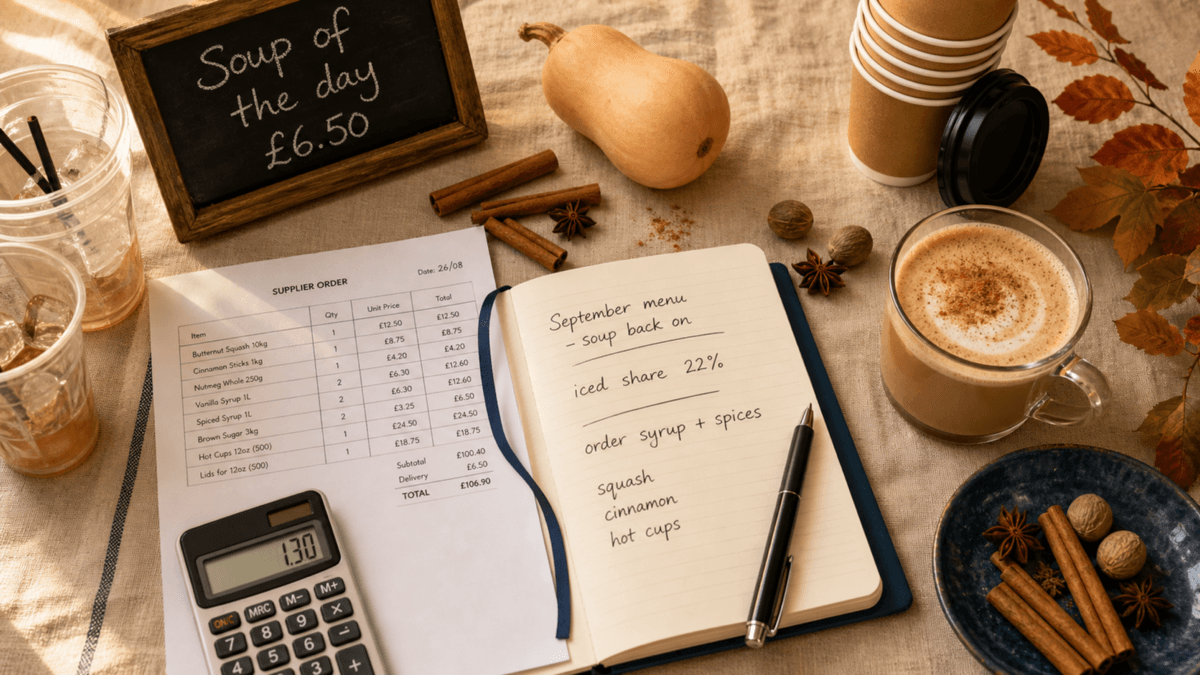
There is a Tuesday in early September when it goes cold. Not dramatically. Just fourteen degrees and grey, and suddenly nobody wants an iced latte.
If you are ready for it, that Tuesday is the best day of your month. Soup goes on, the spiced drinks land, the cabinet fills with something warm, and your average spend jumps because people order a bowl and a coffee instead of a cold drink and nothing.
If you are not ready, you spend three weeks selling a summer menu to people who have stopped wanting it. You bin syrup. You have 800 clear cold cups in the cellar and no hot cup stock. And the autumn menu lands in October, a month late.
The difference is decided now, in August, while it is quiet enough to think. This is the mirror image of the summer menu shift you planned back in May, and it runs on the same discipline that makes festive planning in July pay off in December.
Switch on the till data, not the calendar
The single biggest mistake is picking a date. "Autumn menu goes live 1 September" sounds organised, but the weather does not read your diary. Some years the heat holds into late September. Some years it turns in the last week of August.
What you actually need is one number, tracked weekly.
Iced drinks as a share of total drinks sold.
Pull it every Monday morning for the week just gone. In a typical UK independent, that share peaks somewhere around 30 to 40 percent of drinks in a hot August week. By mid-October it is usually back under 10 percent, and most of that is people who drink iced coffee in February anyway.
The shape of the fall matters more than the absolute number:
- Two consecutive weeks of decline, with the second under roughly 20 percent, is your signal to start the switch.
- One bad week is weather noise. Do not react to a single rainy Bank Holiday.
- Still above 25 percent in mid-September? Hold the iced line another fortnight. The money is telling you something.
Do the same check on food. Cold sandwiches and salads versus hot plates. That ratio turns a week or two behind the drinks, and it tells you when the bain-marie earns its keep again.
The delist and run-down plan
Delisting feels like reducing choice. It is not. It is freeing up fridge space, prep time and cabinet frontage for things that will actually sell in October.
Off the board by late September, in most cafés:
- Frappés and blended drinks. Slow to make, high labour at the bar, and they fall off a cliff the moment it turns.
- Marginal iced SKUs. The watermelon cooler, the third iced tea, the smoothie that sold four a week. Keep the iced latte and one other for the warm October days.
- Cold lunch lines needing daily fresh prep. Grab-and-go salads waste heavily once footfall softens.
The part that matters financially is the run-down, not the delist. Syrup bottles half full, clear cups by the sleeve, straws, fruit purees. Binning it is a straight cash write-off.
So plan backwards from your switch week. Count every summer-only line in mid-August, divide by weekly usage to get weeks of cover, and push anything with more cover than you have weeks left. Order nothing else in that category unless you genuinely run dry.
Push the surplus with a proper special rather than a blanket discount. The mechanics of a special that clears at-risk stock without giving away margin apply exactly here. A "last of the summer" board in the final week clears the puree and signals the new menu at the same time.
The bring-backs, and why soup earns its place
Soup is the quietest margin star you have
People underrate soup because it feels cheap and old fashioned. Run the numbers and it is usually the best item on an autumn menu.
A working example from a Monday batch:
- Ingredients for a batch of butternut squash and sage soup: roughly £9.00 all in. Squash, onion, stock, cream, oil, herbs.
- Yield: 10 portions at 350ml.
- Ingredient cost per bowl: £0.90.
- Add sourdough and butter at roughly £0.35, and a bowl garnish at £0.05.
- Served cost: £1.30 per bowl.
Sell it eat-in at £6.50 including VAT. At 20 percent that is £5.42 ex VAT, which is the number your gross profit should always be measured on.
Gross profit: £5.42 minus £1.30 equals £4.12 a bowl, or roughly 76 percent GP.
Now put your panini next to it. Sold at £4.20 including VAT, so £3.50 ex VAT, with an ingredient cost around £1.55 once you count bread, filling, cheese and the paper. Gross profit £1.95, or about 56 percent.
Same customer, same five minutes of service. The soup makes more than twice the cash gross profit, and it uses trim, ends and squash that came in cheap because it is in season. Sell twelve bowls a day for the eight weeks from late September and that is roughly £1,900 of extra gross profit against selling the same twelve as paninis.
That is the whole argument for getting the soup on early.
The rest of the autumn list
- Spiced hot drinks. Chai, spiced latte, a proper hot chocolate with one good topping rather than three mediocre ones.
- Warming traybakes. Apple and cinnamon, sticky ginger, pear and almond. Denser bakes hold better in the cabinet than summer fruit tarts, so waste drops too.
- One hot plate. A jacket, a pie, a hash. Something that justifies a lunchtime visit in the rain.
Keep it tight. Three or four new things done properly beat nine done half well.
Pumpkin spice for an indie, honestly costed
You do not need to ape the chains and you should not try to out-market them. But the season is real money and the maths is friendlier than people assume.
Per serve, on a spiced latte:
- Syrup at roughly £9.50 a litre trade, 10ml a pump, so 9.5p a pump. Two pumps is 19p.
- Cream and a dusting of spice: about 11p.
- Added cost: 30p. Charge a 50p premium and you are ahead, but only just.
The 50p premium is not where the money is. The trade-up is.
A spiced latte at £4.60 including VAT is £3.83 ex VAT, with a served cost near £0.75, so £3.08 gross profit. The americano that customer would otherwise have bought at £2.90 is £2.42 ex VAT on a 35p cost, so £2.07. You are about £1 better off per switched drink.
Sell a modest 25 spiced drinks a day across an eight to ten week window and that is roughly 1,500 drinks, or £1,300 to £1,500 of extra gross profit for a season. On a single syrup line. That is worth doing properly.
Two practical notes. At two pumps a drink, a litre covers 50 servings, so 1,500 drinks is about 30 bottles. And the window genuinely closes: spiced drinks fade around the third week of November when everyone switches to the festive line, so do not over-order in October.
Order in August, because the lead times are real
August is when your suppliers still have capacity and September is when they do not.
- Squash and root veg. British squash comes good from late September. Talk to your greengrocer now about volume so you are not on the wholesale spot price in week one.
- Spices. Cinnamon, ginger, nutmeg, cardamom. Cheap, easy to forget, and everyone orders in the same fortnight.
- Syrups. Spiced and seasonal syrups sell out at distributors by late September, every year. Order in August and take the season in one drop if you have the storage.
- Cups and packaging. Hot cups, lids, sleeves, and the lidded pots if you do takeaway soup. Check what you actually have before you assume.
Get the orders placed the week you read this. It costs nothing to be early.
Recost everything before you reprint
This is the step almost everyone skips. Last year's menu file is sitting there, the prices look fine, and reprinting is one click.
Do not do it. Ingredient prices have moved over the summer, and rarely downwards. Dairy, coffee, cocoa and butter have all shifted this year. A soup that costed at 90p a bowl last September might be £1.15 now, and the traybake that hit 68 percent GP might be sitting at 59.
Before anything goes to print, pull your latest invoice prices, recost each recipe at today's numbers, check the gross profit ex VAT against your target for that category, and then reprice, change the spec, or drop the item.
Doing that on twelve items in a spreadsheet takes most of a Sunday. It is exactly where CostingBrik earns its place, holding the current invoice price for every ingredient and recosting the whole autumn list in one pass. And once the menu is live, MenuBrik shows the mix shift week by week, so the iced share you were tracking by hand is just sitting there on a Monday morning.
Telling people, without making a meal of it
Three things, none of them expensive:
- The chalkboard. "Soup is back" outperforms almost any other five words on an A-board in October.
- Socials. One decent photo of the first soup, one of the spiced latte, posted the morning it launches.
- The staff briefing. Ten minutes before service on switch day. What is on, what is off, what it tastes like, and the one line each person says when a customer hesitates.
That last one is the whole marketing budget for most independents. A team that has tasted the soup sells far more of it than a team that has only read the board.
What to do, and when
This week: Start the weekly iced-share number. Count your summer stock. Place the syrup, spice and packaging orders.
Mid August: Draft the autumn menu. Recost every line at current invoice prices. Talk to your greengrocer about squash.
Late August: Finalise prices and get the print done. Write the run-down specials. Set up the new till buttons, and check the VAT rule on every new button before it sells.
First week of September: Watch the number. Soft launch soup and one spiced drink. Brief the team.
When the number breaks 20 percent: Full switch. Summer lines off, autumn board up, chalkboard changed.
It is not clever. It is just done in August rather than October, which is worth about a month of trading every single year.
Ed O'Brien has run Hunters Cake Company for 17 years across cafés in Witney, Burford, and a bakery in Carterton, Oxfordshire. He's building Brikly - modular tools that give independent café owners the same data the big chains have, without the big chain price tag.