
Black Friday and Small Business Saturday: should independents join in?
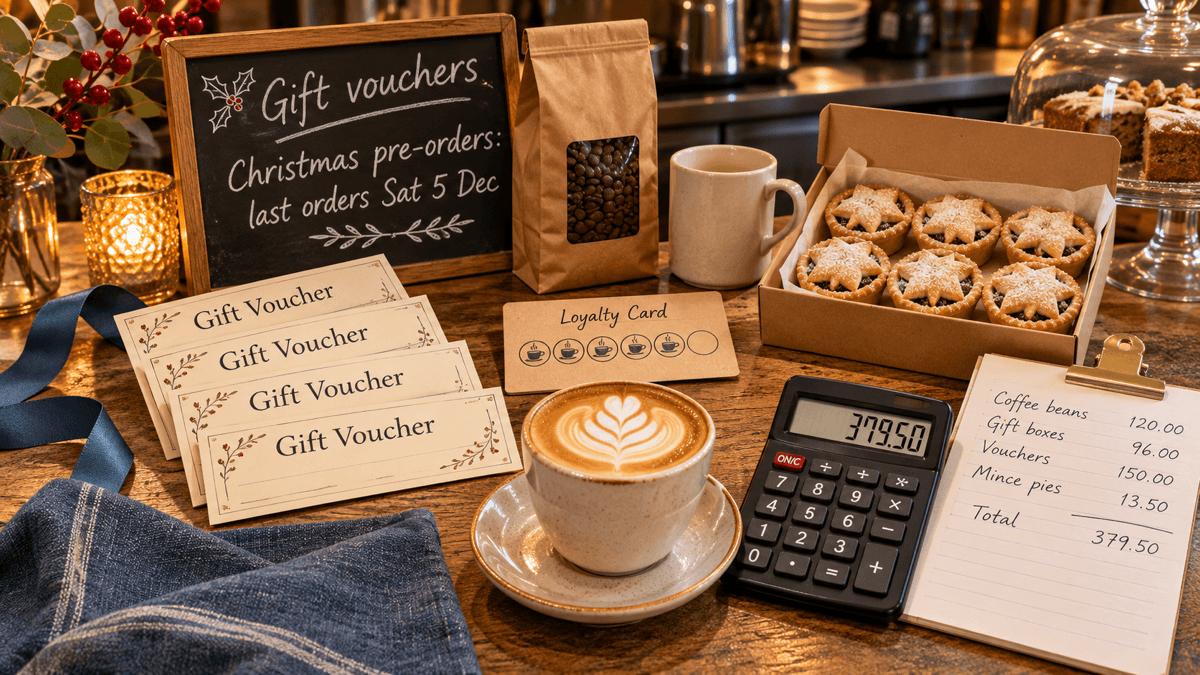
Some time next week, someone on your team will ask whether you're "doing anything for Black Friday". Every chain in town will have a sign up, your inbox will be full of percentages, and doing nothing can feel like opting out of the busiest shopping day of the year.
For most independent cafés, bakeries and pubs, a Black Friday discount is a way of paying customers to do what they were going to do anyway. The day brings shoppers onto the high street whether you discount or not. The money-off mostly goes to people who'd have bought from you at full price.
That doesn't mean sitting the season out. It means running offers that bring cash forward or add margin, not ones that cut it, and then using Small Business Saturday a week later for what it's actually good at.
(Dates: Black Friday is Friday 27 November 2026 and Small Business Saturday UK is Saturday 5 December 2026. VAT points are HMRC rules and apply UK-wide. Prices, costs and volumes in the worked examples are illustrative.)
What Black Friday actually does to a high street
Black Friday is a retail event. The hospitality effect is a side effect: people out shopping get hungry and cold.
- Footfall jumps on the day. MRI Software's count up to 1pm on Black Friday 2025 showed high street footfall 14.8% above the previous Friday, though still 3% below Black Friday 2024.
- Food and drink rides along. Barclays reported food and drink transactions 28.9% above an average day in 2025 on Black Friday, as shoppers hit the high street. Square says restaurant transactions among its UK sellers rose 28% between Black Friday and Cyber Monday 2024, on the back of busier retail.
- Shoppers are sceptical. In the same Barclays survey, 68% doubted the real value of the deals and 44% said they no longer look forward to the day as much as they used to. Which? tracked 175 products from the 2024 sales and found 83% were the same price or cheaper at least once outside the sales window.
Be honest about what those figures can and can't tell you. None of them is café-specific, Barclays doesn't split "food and drink" into cafés versus supermarkets, and a late-November Friday is usually busier than an average day of the year anyway. But the direction is clear enough: the shoppers come because of the shops. You get the extra footfall without lifting a finger, and nobody in the queue for your flat whites is there because of 20% off.
The maths: what 20% off needs to stand still
The true cost of discounting post sets out the rule. A discount comes entirely out of your gross profit, because your costs don't move. To earn the same gross profit you need:
Extra sales to stand still = discount ÷ (gross margin - discount)
Here it is on three illustrative items, at VAT-inclusive menu prices with VAT taken off before the GP is worked out.
A flat white at £3.60
£3.60 is £3.00 ex VAT. Say it costs you 75p in beans, milk and cup: a 75% GP and £2.25 of gross profit a cup.
At 20% off it's £2.88, or £2.40 ex VAT. The cost is still 75p, so you keep £1.65. To make the same £2.25 x 100 cups, you'd need to sell 137 cups instead of 100: 36% more, just to be where you'd have been anyway.
A toastie at £7.20
£6.00 ex VAT, £2.10 of ingredients, a 65% GP and £3.90 a toastie. At 20% off you keep £2.70, and you need 44% more toasties to stand still.
Buy one get one free
BOGOF is worse than "50% off" because you make two of everything. On the flat white, a customer pays £3.00 ex VAT for two cups that cost you £1.50, so you keep £1.50 per customer instead of £2.25. You need 50% more paying customers, each walking out with two cups: three times the milk, three times the time on the machine.
| Illustrative item | GP | 20% off: extra sales needed | BOGOF: extra paying customers needed | BOGOF: units you make |
|---|---|---|---|---|
| Flat white, £3.60 | 75% | 36% | 50% | 3x |
| Slice of cake, £4.20 | 70% | 40% | 75% | 3.5x |
| Toastie, £7.20 | 65% | 44% | 117% | 4.3x |
Anything at 50% GP or below can't break even on BOGOF at all, because the free item costs more than the margin on the paid one.
Most of the discount goes to people who'd have come anyway
The uplift tables assume every sale is the same. The bigger problem is who gets the discount.
Say you normally sell 200 flat whites on a late-November Friday. That's 200 x £2.25 = £450 of gross profit. You run 20% off and it works better than most: 30 extra customers, a 15% lift.
- 230 cups at £1.65 = £379.50 of gross profit
- You're £70.50 down on a day with more customers in it
- The discount totals 230 x 60p = £138 ex VAT, and £120 of that went to the 200 people who'd have paid full price
The usual comeback is "but they'll buy a pastry too". Give every one of the 30 new customers a croissant at £3.00 (£2.50 ex VAT, 70p to make, £1.80 of gross profit). That adds £54 and you're still £16.50 behind, having made 30 more coffees and 30 more croissants in a busier shop. In practice not every newcomer buys a pastry, and some of the "new" ones are regulars who moved Saturday's coffee to Friday.
The discount also lingers. A regular who paid £2.88 on Friday notices £3.60 on Monday, and you've taught everyone who follows you that it's worth waiting for the next one.
If you advertise a deal, keep it honest
If you run anything with a deadline, end it when you said you would. The CMA's November 2025 enforcement drive looked at misleading time-limited offers, including whether sales "ended when they said they would", and it can now fine businesses up to 10% of global turnover. A café isn't its target, but "ends Sunday" on the board should mean Sunday.
What works instead: bring cash forward, add margin
The better Black Friday offers share two traits. The customer pays full price, or pays now for something you deliver later. And whatever you give away costs you the ingredients, not the menu price.
Gift vouchers, with a January bonus
Plenty of Black Friday shoppers are starting their Christmas lists, and a voucher is the easiest present on your counter. The gift card post covers the accounting: voucher money is a liability until it's spent, not turnover, and at Hunters about 20% of vouchers are never redeemed.
The VAT works in your favour too. A typical café voucher can be spent on a sit-in coffee (standard-rated) or a takeaway loaf (zero-rated), so it's a multi-purpose voucher, and HMRC's business promotions notice says VAT is due when it's redeemed, not when you sell it. On breakage it's explicit: "If the voucher is never used there is no VAT to be brought to account." One caveat: a voucher for one specific thing at one VAT rate, such as afternoon tea for two served in the café, may be a single-purpose voucher, with VAT due when you sell it. Check with your accountant if you sell those.
To give the weekend a hook without a discount, add a bonus:
- "Buy £30 of vouchers by Sunday 29 November, get a £5 January card."
- The January card is £5 off a spend of £10 or more, from 4 January to 28 February 2027. Print the dates on it.
What it costs depends on how it's used:
- It brings a January visit you wouldn't have had. Someone spends £12 (£10 ex VAT) and pays £7 (£5.83 ex VAT). At a 70% blended GP, that food cost you about £3, so you're £2.83 better off on a cold Tuesday, and people rarely spend exactly £10.
- It replaces a visit they'd have made anyway. You lose the £5 off their bill: about £4.17 ex VAT, in January rather than now.
- It's never used. It costs nothing.
For VAT, a money-off coupon you issue and redeem yourself is simple: the notice says "you need only include any payment received from the customer in your daily gross takings". Meanwhile the £30 is in your bank in November, and the cost lands in your quietest weeks, when you have spare tables and staff on the rota anyway.
Gift bundles at full price
Many of the people walking past on Black Friday are buying presents. Put two or three ready-made gifts by the till: a bag of your beans in a gift box, a box of six mince pies, a small hamper. The retail post covers costing them like a recipe, packaging and labour included.
Price the bundle at the sum of its parts. The box, the ribbon and the fact that someone else has done the thinking are the value. You don't need a discount on top.
Mind the VAT. Beans to take home are zero-rated and a mug is standard-rated, and HMRC's food products notice names "coffee supplied with a mug" and "food hampers" as mixed supplies, where the price usually has to be split between the rates. If a bundle mixes food and non-food, ask your accountant how to split it before you print the price.
Christmas pre-orders: the last-call weekend
If your Christmas book has been open since September, as the Christmas pre-orders post suggests, the Black Friday weekend is a natural last call. Cakes and hampers close in the first week of December, so put a hard date on the board and on your socials: "Christmas cakes: last orders Saturday 5 December". A deadline does the job a discount would, and the deposit arrives now.
A free extra, not money off
If you want something that feels generous, give a thing, not a percentage.
20% off a flat white costs you 60p ex VAT out of margin. A free mince pie looks like £2.20 of value to the customer. On the mince pie costing, it costs you about 28p in ingredients, or 45p with the labour. The customer gets more, and you give less.
There's a catch, and it's the same one as before: hand it to every cup buyer and the regulars still get most of it. Two hundred free pies at 45.4p is £90.80. Tie the extra to something that grows the basket instead:
- A free mince pie with any boxed half-dozen
- A free filter coffee with any bag of beans
- Free gift wrapping on anything from the retail shelf
On VAT, HMRC treats the price paid as covering both items, so where the "free" item carries a different rate from the one bought, the notice says you'll usually have to apportion. Eat-in coffee and cake are both standard-rated, so there's nothing to split. A hot takeaway drink (standard-rated) with a cold takeaway pie (zero-rated) is a different matter.
Double stamps
If you already run a stamp card, double stamps over the weekend is a gentle nudge that costs far less than a discount.
On a card where nine stamps earn a free coffee, each stamp is worth a ninth of a cup. On the £3.00 ex VAT flat white with 75p of ingredients, an extra stamp costs you at most 33p (if the free cup replaces one they'd have paid for) and about 8p (if it's an extra visit). That's a third or less of the 60p a 20% discount gives away, it's paid later, in product, and some cards never get finished.
It still goes mostly to regulars, as the loyalty post warns about any stamp scheme. The difference is that it pulls their next visit closer rather than marking down the one they're already making.
The decision table
| Offer | What it costs you | What it brings in | Verdict |
|---|---|---|---|
| 20% off everything | 20% of the price on every sale, including regulars. Needs 36-44% more sales to stand still | A few extra customers on a day that's busy anyway | Skip |
| BOGOF on drinks or food | Half the money for twice the cost. Needs 50-117% more paying customers | Volume, queues, waste if you over-prep | Skip |
| Gift vouchers plus a January £5-off card | The £5 off, paid in January, only when used | Cash now, January visits, some breakage | Do it |
| Gift bundles at full price | Packaging and a bit of labour | Extra margin from gift shoppers | Do it |
| Pre-order last call | Nothing beyond a sign | Deposits now and a December production plan | Do it |
| Free extra with a bigger purchase | Ingredient cost of the extra | A bigger basket, without resetting your prices | Do it, tied to a basket |
| Free extra with every coffee | Ingredient cost, mostly on regulars | Goodwill | Only if you cap it |
| Double stamps | 8p to 33p a cup, paid later | An earlier next visit from regulars | Good if you have a card |
If you're determined to run a discount, the true cost of discounting post explains the cases where one earns its place: clearing stock that's otherwise binned, a quiet daypart, or a trial of something new. Black Friday is none of those for most cafés.
Small Business Saturday: Saturday 5 December
Small Business Saturday UK runs on the first Saturday in December, which this year is 5 December 2026. It's backed by American Express, which started the US version in 2010, and it describes itself as "a year-round national movement" as much as a date. The campaign says more than 10 million people shopped small on the day in 2024, spending £634 million. That's an estimate from survey research, not till data, but it shows the scale of the attention.
Unlike Black Friday, the message suits an independent: shop local, not shop cheap. Nobody expects a discount on Small Business Saturday.
What the organisers offer
- A marketing pack. You request it on the marketing pack page after accepting the terms. The 2026 pack has dated and undated logos, social media graphics with suggested posts, a print-ready A3 poster and a one-page guide.
- The Nation's Favourite Businesses. The campaign's spotlight on individual small firms, long known as the SmallBiz100, appears this year as the Nation's Favourite Businesses. Featured businesses get social media and press coverage, and some have been invited to receptions at Downing Street. The 2026 list is already live, so treat it as one to apply for next year.
- The Out And About tour. The team is visiting Birmingham, Belfast, Manchester and Glasgow between 10 November and 1 December, mostly free morning sessions run with BT on cyber security.
- A newsletter and a webinar series, both linked from the campaign's home page.
I couldn't find a free directory listing on the campaign site this year, so don't count on the campaign sending customers to you. It provides the badge and the moment. The footfall is up to you and your neighbours.
Use it locally, without a discount
Run a trail with your neighbours. Get three to six independents on your street to agree a simple trail card: the butcher, the bookshop, the florist, you. A stamp at each, a small guaranteed reward at the last stop (a hot chocolate, a mince pie), and each shop's customers walk through the others' doors. If you'd rather a prize draw, keep entry free, a stamp for popping in with no purchase needed. The Gambling Commission's guidance on free draws sets out the rules, and warns that if you don't meet them "you may be running an illegal lottery".
Feature your local suppliers. Small Business Saturday is about the chain of small businesses, not just the shopfront. Put your roaster, dairy, miller or veg grower on the board for the day: "Today's milk is from a farm six miles away". Offer a free taste of the jam you stock or the new roast. It costs a few pence a sample, it gives your suppliers something to share, and it reminds customers why you cost more than a chain.
Make it a community moment. A school choir at 11, a collection point for the local food bank, mulled apple juice for the first people in the queue, a late opening if your town's Christmas lights are that weekend. None of it is a discount, and all of it gives the local paper and the town's Facebook group a reason to mention you.
Tell people in the right places. Put the poster in the window from the Monday before, use the pack's social graphics, and add a Google Business Profile post for the day. Tag your trail partners so their followers see you.
A week after Black Friday is also good timing for everything in the section above. The voucher bonus, the gift bundles and the pre-order last call all work just as well on Small Business Saturday, and they suit its message better: buy your Christmas presents from people you know.
This week
- Cost your top ten items at current supplier prices, and write the GP next to each. You can't judge any offer without it.
- Run the uplift sum on anything you're tempted to discount: discount ÷ (GP - discount). If the answer is "a third more sales", skip it.
- Print the voucher offer by Friday 20 November: £30 of vouchers by Sunday 29 November earns a £5-off January card, valid 4 January to 28 February 2027, dates printed on it.
- Build two or three gift bundles at full price, costed with packaging, and check the VAT split on any that mix food and non-food.
- Put a pre-order last-call date on the board and your socials.
- Choose one free extra, tied to a bigger purchase, or double stamps if you run a card.
- Request the Small Business Saturday pack and talk to three neighbouring businesses about a trail by Friday 20 November.
- Count afterwards: vouchers sold, bundles sold, pre-orders taken and January cards redeemed. Next November's decision deserves real numbers.
Black Friday will be busy whatever you do. The trick is to let the shoppers come, sell them something worth giving, and keep your prices where they belong.
Ed O'Brien has run Hunters Cake Company for 17 years across cafés in Witney, Burford, and a bakery in Carterton, Oxfordshire. He's building Brikly - modular tools that give independent café owners the same data the big chains have, without the big chain price tag.