
Costing mince pies, stollen and Christmas cake before you price them
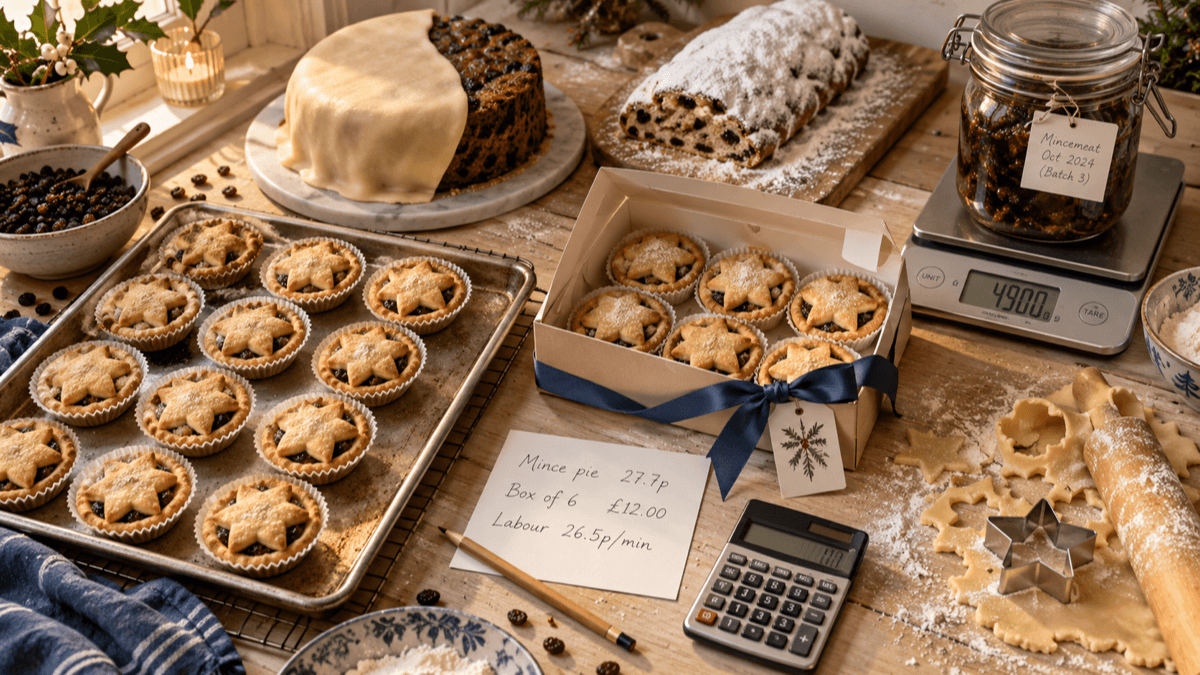
The pre-order sheet is on the counter and the prices on it were set the way they are set in most cafés: last year's figure, plus 20p because everything has gone up. Nobody has opened a calculator. The mince pies sold out last year, so they must be fine.
They might be. But a festive bake is three or four recipes stacked on top of each other, with a box around it and a lot of fiddly hand work, sold at two different VAT rates depending on where the customer eats it. Last year plus 20p cannot see any of that.
So here is the costing, done properly, in mid-October while the price on the sheet can still change. Every figure is an illustrative UK trade price, ex-VAT. Swap in your own invoices and the method holds.
Start with the mincemeat, because it is in everything
Mincemeat is a sub-recipe: you make a batch, jar it, and spoon it into pies, slices and whatever the special is. As the sub-recipe costing post sets out, you cost the batch once, weigh what comes out, and use it as a single ingredient.
| Ingredient | Quantity | Cost |
|---|---|---|
| Raisins (£3.20/kg) | 1,000g | £3.20 |
| Sultanas (£3.40/kg) | 1,000g | £3.40 |
| Currants (£3.60/kg) | 500g | £1.80 |
| Mixed peel (£4.00/kg) | 300g | £1.20 |
| Bramley apple, grated (750g bought at £1.60/kg) | 600g | £1.20 |
| Vegetable suet (£5.20/kg) | 500g | £2.60 |
| Dark muscovado (£2.40/kg) | 750g | £1.80 |
| Lemons and oranges, zest and juice | 2 each | £1.20 |
| Mixed spice (£16.00/kg) | 20g | £0.32 |
| Brandy (£14.00/litre) | 150ml | £2.10 |
| Batch cost | £18.82 |
It goes into the jars at about 4,900g, once you have scraped the bowl and some of the brandy has gone. £18.82 ÷ 4,900g = £3.84 a kilo, or 9.6p for the 25g that goes into one pie.
Homemade or a catering tub?
Bought-in mincemeat in a catering tub at an illustrative £2.80 a kilo is 7.0p a pie. So the homemade version is dearer on ingredients alone, which surprises people, because commercial mincemeat leans on cheaper sugars to bulk it out.
Then add the time. Weighing, grating, mixing and jarring that batch is about 35 minutes. At £15.93 an hour fully loaded for a team member on the National Living Wage, which is 26.5p a minute, that is £9.28, or 4.7p a pie across 196 pies.
Homemade: 14.3p a pie. Bought in: 7.0p. On 1,000 pies the difference is £73. That is not a reason to stop making it. Good mincemeat is what makes someone come back for the second box. But it is a quality decision, and it is worth knowing that is what it is.
Pastry: cost the dough you sell, not the dough you roll
A batch of sweet shortcrust:
- Plain flour, 1,000g at £0.70/kg: £0.70
- Butter, 500g at £7.20/kg: £3.60
- Icing sugar, 200g at £1.40/kg: £0.28
- Eggs, 2 at 23p: £0.47
- Salt and zest: £0.10
£5.15 for about 1,800g of dough. A 30g base and a 15g star lid is 45g a pie, so on paper the batch makes 40.
It does not. You roll, cut, gather the offcuts and roll again. By the third roll the pastry is tough enough that you stop, and the last scraps go in the bin or get baked off for the staff. Add the bits stuck to the bench and the pin, and a batch that should make 40 makes about 34.
- £5.15 ÷ 40 = 12.9p a pie, the comfortable number
- £5.15 ÷ 34 = 15.1p a pie, the real one
It is the same trap as costing a sponge on 12 cuts when you sell 10, which the cake and traybake costing post calls the single most common cake-pricing mistake. Count what came off the tray once, for one batch, and use that.
One mince pie, costed
| Line | Cost (ex-VAT) |
|---|---|
| Pastry, at 34 a batch | 15.1p |
| Homemade mincemeat, 25g | 9.6p |
| Egg wash and a dusting of sugar | 1.0p |
| Fluted paper case | 2.0p |
| Ingredients | 27.7p |
| Hands-on labour, 40 seconds at 26.5p a minute | 17.7p |
| All in | 45.4p |
The 40 seconds comes from timing a session: 120 star-topped pies in 80 minutes of rolling, cutting, filling, topping, washing and de-tinning. Time your own. A team that has done it for years will beat that, and a new starter will not.
Same shelf price, two different pies
Now sell it for £2.20. What you actually keep depends on where it gets eaten.
A cold mince pie to take away is zero-rated: HMRC's food products guidance zero-rates cakes and pastries as ordinary bakery, so the whole £2.20 is yours. Eaten in, it is a supply in the course of catering and standard-rated, so you keep £2.20 ÷ 1.20 = £1.83.
- Takeaway: £2.20 - 27.7p = 87.4% GP, £1.75 a pie after labour
- Eat-in: £1.83 - 27.7p = 84.9% GP, £1.38 a pie after labour
The fiddly bits, valued per minute
The star lid is the cheap version. Everything prettier costs time, and time is the ingredient nobody weighs.
- Full lid, hand-crimped: about 15 seconds more a pie, so 6.6p
- Lattice top: about 45 seconds more, so 19.9p, and a lattice pie carries 37.6p of labour against 27.7p of ingredients
- Marzipan on a Christmas cake: about 12 minutes, £3.19 a cake
- Icing and decorating it: about 18 minutes, £4.78 a cake
Six hundred lattice pies instead of star-topped ones is £119 of extra wages for the same price on the sheet. That might be exactly the right call if lattice is what you are known for. It is the wrong call if nobody decided it.
Keep the gross profit figure on ingredients and put labour on the line beneath it, which is how valuing prep time after the GP figure works. GP stays comparable across every recipe you hold, and the expensive minutes stay visible instead of disappearing into the wage bill.
The box of six: the ladder and the box
Six singles at £2.20 is £13.20. The box needs to be cheaper or nobody buys it, but the box itself costs money, and it is the line that gets forgotten.
- A window box with an insert for six: £0.55
- A ribbon or a printed sticker: £0.12
- One minute to fill, close and label it: 26.5p
That is 67p of packaging, or 11p a pie, before the minute. Same discipline as costing the cup, lid and box per sale: the box is an ingredient.
A box of six goes out of the door, so it is takeaway and zero-rated. Here is the ladder:
| Price | You keep (ex-VAT) | Ingredients and packaging | GP before labour | Per pie after labour | |
|---|---|---|---|---|---|
| Single, eaten in | £2.20 | £1.83 | 27.7p | 84.9% | £1.38 |
| Single, takeaway | £2.20 | £2.20 | 27.7p | 87.4% | £1.75 |
| Box of six | £12.00 | £12.00 | £2.33 | 80.6% | £1.39 |
| Box of six, "six for five" | £11.00 | £11.00 | £2.33 | 78.8% | £1.22 |
The interesting row is £12.00. Each pie in the box earns almost exactly what a single eaten in at the table earns, because the VAT you do not charge on takeaway pays for the box and the discount between them.
Drop to "six for the price of five" at £11.00 and every pie earns 16p less than the eat-in single. That is still a profit. It is just a promotion, and it should be priced as one on purpose rather than because £11 felt round.
Christmas cake: whole, and by the slice
An 8-inch round, iced, boxed for a pre-order.
| Line | Cost (ex-VAT) |
|---|---|
| Cake: dried fruit, cherries, peel, butter, muscovado, eggs, flour, ground almonds, spice, brandy | £11.25 |
| Covering: apricot jam, 500g marzipan, 600g ready-to-roll icing | £5.37 |
| Decoration | £0.40 |
| Cake drum, box and ribbon | £1.95 |
| Ingredients and packaging | £18.97 |
| Labour, 49 minutes a cake in a 12-cake session | £13.01 |
| Oven share for a long, slow bake | £0.50 |
| All in | £32.48 |
The 49 minutes is 12 to mix and tin, 4 to feed it over the weeks, 12 for marzipan, 18 for icing and decorating and 3 to box. Labour comes to about two thirds of the ingredients and packaging, and the marzipan and icing alone are 30 minutes, worth more than the marzipan and icing themselves.
At last year's £45, zero-rated as a whole cake to take away, that is 57.8% GP and £12.52 after everything. At £48 it is 60.5% and £15.52. Three pounds on the sheet is the difference between a Christmas cake that pays for the baker's afternoon and one that just about covers it.
The same cake by the slice
Fruit cake cuts cleanly and keeps for weeks, so the yield is kind: 16 cuts, 15 sellable. No board, box or topper on the counter cake.
- Ingredients: £16.62 ÷ 15 = £1.11 a slice
- Labour, 46 minutes: £12.21 ÷ 15 = 81p a slice
- At £4.20 eaten in, £3.50 ex-VAT: 68.3% GP, £1.58 after labour
That is a long way below the 80% a Victoria sponge makes. The fix for the counter cake is simple: marzipan and ice the top only. On an 8-inch cake about 7.5cm deep, the top is roughly 40% of the surface. That saves about £3.22 of covering and 18 minutes of work, or 53p a slice, and takes the slice to £2.11 after labour. Nobody eating it with a coffee misses the sides.
Stollen: the quiet earner
A batch of four 750g loaves: strong flour, butter, milk, eggs, yeast, rum-soaked fruit, peel, almonds, a 125g marzipan log in each and a heavy dusting of icing sugar. £13.04 a batch, £3.26 a loaf, with the marzipan alone 23% of it. About 60 minutes of hands-on work across the four, so 15 minutes, or £3.98, a loaf.
- Whole loaf at £14.00 in a cello bag with a label (35p): 74.2% GP before labour, £6.41 after it
- By the slice, 10 sellable from a loaf, at £3.20 eaten in: 32.6p of ingredients and 39.8p of labour against £2.67 ex-VAT, so 87.8% GP and £1.94 a slice after labour
Slice for slice, stollen out-earns a fully covered Christmas cake on the counter, at a lower price. The catch is that cut stollen dries out in two or three days, so cut one loaf at a time and keep the rest whole.
The prices that move
Butter, dried fruit and almonds are three of the most volatile lines in festive baking, and they have moved in both directions in recent years. I am not going to guess where they land this December. The only price that matters is the one on your last invoice, so re-cost when it changes, not when you remember to.
Two habits help. Re-cost the moment a butter or fruit invoice lands, which is the job CostingBrik does automatically, recalculating every recipe that uses the ingredient. And buy against the order book: taking Christmas pre-orders with deposits tells you in October how much fruit and marzipan you need, so you can buy it at October's prices. Because whole cakes and boxes of pies are zero-rated takeaway, there is no VAT to work out on those deposits either.
A mince pie and a coffee
The obvious festive deal is a mince pie with a gingerbread latte. Eaten in, both halves are standard-rated and the sum is simple. Taken away, it is a hot drink at 20% and a cold pie at 0% sold for one price, and HMRC expects you to split that price between the two, on cost or market value, to work out the VAT on the drink.
Cost the drink as carefully as the pie. Costing the Christmas drinks menu found that a rushed build gives back up to half the festive uplift on a latte, and a deal discount on top of a heavy-handed drink can leave very little.
Do this before the price goes on the sheet
- Cost the mincemeat as a batch and decide, on purpose, whether homemade earns its time.
- Count the pies off one batch of pastry. Not the number the recipe says, the number on the tray.
- Time one session of pies and one cake, from scales to box, and put a per-minute figure on the lattice and the icing.
- Price the box with the box in it. 67p is 11p a pie.
- Check both VAT columns. The same £2.20 is £2.20 to take away and £1.83 at the table, and £1.83 warmed.
At Hunters the Christmas cake gets costed once, in September or early October, before the first order is taken, because whatever goes on the sheet is the price we hold until Christmas Eve. An hour now is cheaper than a December spent finding out.
Ed O'Brien has run Hunters Cake Company for 17 years across cafés in Witney, Burford, and a bakery in Carterton, Oxfordshire. He's building Brikly - modular tools that give independent café owners the same data the big chains have, without the big chain price tag.