
Your bakery feeds your cafés. Who pays for the flour?
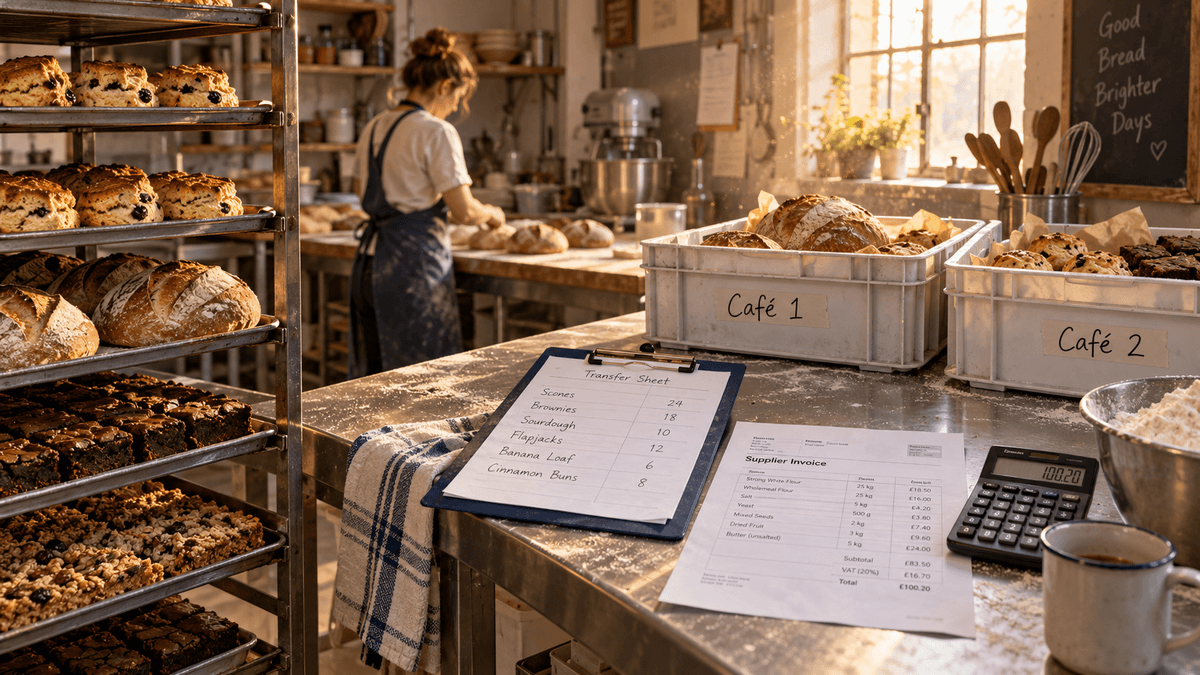
The flour arrives at the bakery. The scones are sold in the cafés. The cost has to make the same journey as the cake, and in most hub-and-spoke businesses it doesn't.
Until it does, each café's gross profit is a number nobody earned. In the post on why the same recipe costs a different amount at each site I said that, in my experience, the transfer line between sites is more often missing or counted twice than it is right. This is the longer answer: three ways to charge your cafés for what the hub makes, what each one hides, and how to pick.
How we do it at Hunters
Hunters is two cafés and a production bakery. Most of our supplier deliveries come to the bakery in Carterton, and we run what each café needs out to it ourselves. Even the cleaning chemicals arrive on one invoice and get split.
In our books, the shared cost-of-sales bills are kept untracked, not allocated to any site, and divided between the sites by their share of turnover. One journal, the business total is right, and nobody spends Monday morning arguing about flour.
It is honest about the business and silent about the sites. By construction it pushes every site towards the same food cost percentage, so it cannot tell me which café is generous with the butter or which one bins more at close. It's the right choice for plenty of businesses. It's just worth knowing what it can't see.
The problem in plain numbers
An illustrative week, all figures ex VAT. Café A turns over £6,000 and Café B £4,000, so £10,000 between them. The hub sells nothing outside. Everything comes through the hub: £3,000 of cost-of-sales bills, so the business runs at 30.0% food cost. Assume the hub holds the same stock on Sunday night as on Monday morning, and both cafés sell the same mix of food and drink.
The question is how that £3,000 gets to the cafés.
Method one: split by turnover
This is what we do: each café takes a share of the bills equal to its share of turnover.
| Turnover | Share | Cost charged | Food cost | Gross profit | |
|---|---|---|---|---|---|
| Café A | £6,000 | 60% | £1,800 | 30.0% | £4,200, 70.0% |
| Café B | £4,000 | 40% | £1,200 | 30.0% | £2,800, 70.0% |
| Business | £10,000 | £3,000 | 30.0% | £7,000, 70.0% |
What it gets right. One journal a month, an exactly right total, nothing to argue about.
What it hides. Both cafés show 30.0% because the method says so. If one café over-portions or over-orders, the cost is spread across both, and the better-run café quietly pays part of the other's bill. Strictly, a split only levels the costs that go through it, so the more that comes through the hub, the closer the sites get to identical.
Method two: charge at ingredient cost
Put an order sheet on the hub door and write down what each café takes. Cost every hub item once at its recipe ingredient cost, the way you'd cost a batch once and use it as an ingredient. Goods the hub only passes along, such as milk or coffee beans, go across at invoice cost per unit. At the end of the week it's quantity times cost, per café.
Same week, same £3,000:
| Turnover | Charged from order sheet | Food cost | Gross profit | |
|---|---|---|---|---|
| Café A | £6,000 | £1,650 | 27.5% | £4,350, 72.5% |
| Café B | £4,000 | £1,250 | 31.25% | £2,750, 68.75% |
| Hub, production waste and trim | £100 | -£100 | ||
| Business | £10,000 | £3,000 | 30.0% | £7,000, 70.0% |
£1,650 + £1,250 + £100 = £3,000, and £4,350 + £2,750 - £100 = £7,000. Same business, same total. But the cafés are now 3.75 points apart, not level.
Where Café B's gap came from
At Café A's ratio, Café B would have taken 27.5% x £4,000 = £1,100. It took £1,250, so £150 more. In this illustration, a two-week bin log and some spot weighing found it: £95 of unsold bakes binned at close, and £55 of heavier portioning, more butter and jam with the scones and more cheese in the toasties, which shows up as more stock ordered from the hub.
Now look back at method one. Café A's charge fell from £1,800 to £1,650, and that £150 is two things: £60, its 60% share of the hub's £100 of waste, and £90, its 60% share of Café B's extra £150. That's £90 a week of another café's bin and generous hands, or £4,680 a year at 52 weeks, and the split hid it completely.
The causes are the usual multi-site ones, and so is the fix: planning production against what actually sells, a gram weight on the card, or pricing for it if the gap is structural.
What the hub looks like
The hub keeps its £100 of failed bakes, trim and over-production, plus its own labour, rent share, energy and van. It shows as a cost centre, a cost with no income, which is honest as long as everyone reads it that way. That £100 is also the hub's yield check: if the card says 48 scones and the batch gives 45, the gap stays where somebody can fix it.
Method three: a standard transfer price
The fuller version is an internal price list: ingredient cost, plus hub labour, plus a share of hub overheads, set from the recipe costs and reviewed quarterly. The cafés see full cost and the hub roughly breaks even.
ACCA's technical article on transfer pricing puts it the accountants' way: at full cost the producing unit "can aim to break even", and full standard cost is better still. Elsewhere it argues for standard rather than actual costs "so that efficiencies and inefficiencies stay within the divisions responsible for them".
A slow bake day is the hub's problem, and its small weekly surplus or shortfall shows how it did against standard.
Two items, priced in full
Illustrative. Say the hub carries £300 a week of overheads, its share of rent, energy and the van, and makes about 1,500 items a week for the two cafés. £300 ÷ 1,500 = 20p an item: crude, but it's a start.
Labour uses the loaded £15.90 an hour, the rounded figure from the make-or-buy break-even sum, and the brownie figures come straight from that post.
- Scone. Ingredients 32p. A batch of 48 takes 60 hands-on minutes: £15.90 ÷ 48 = £0.33125, rounded to 33p. Plus 20p of overhead: 85p.
- Brownie. Ingredients £8.65 a tray ÷ 12 good squares = 72p, rounded. The five-tray session is 105 minutes, £27.83 of labour for 60 squares: £0.4638, rounded to 46p. Plus 20p: £1.38.
Sold eaten in at £3.00 and £3.60 including VAT, so £2.50 and £3.00 net:
| Net price | At ingredient cost | Gross profit | At transfer price | Gross profit | |
|---|---|---|---|---|---|
| Scone | £2.50 | £0.32 | £2.18, 87.2% | £0.85 | £1.65, 66.0% |
| Brownie | £3.00 | £0.72 | £2.28, 76.0% | £1.38 | £1.62, 54.0% |
Fully loaded, the scone drops 21.2 points and 53p, and the brownie 22 points and 66p a square.
At £1.38 the brownie now costs a café more than the £1.20 bought-in square in the make-or-buy post, so a manager judged on these figures would buy in. But the hub's rent and van don't go away if one café stops taking brownies, and on ingredients and labour alone the hub's square is £1.18, so that call belongs to the business, not the café.
The shortcut is cost plus a set percentage, but a flat mark-up follows the ingredients, not the effort. At plus 50%, the scone, whose labour outweighs its ingredients, goes across at £0.32 x 1.5 = 48p, 37p under its full 85p, while the brownie at £0.72 x 1.5 = £1.08 is only 30p under its £1.38.
The risks
The first is arguing. The café manager thinks 85p for a scone is daylight robbery; the baker thinks 60 minutes for 48 is optimistic. ACCA says a transfer price should "be perceived as being fair", which in practice means setting it from the recipe cost and one timed batch, dating the price list, and changing it quarterly, not after every bad week.
The second is comparability.
And it is not a wholesale price. Selling to other businesses is a different sum: wholesale sits at roughly 50 to 60% of retail because the buyer needs a margin of their own. Charge your own cafés wholesale rates and you've moved the profit to the hub and made the cafés look thin.
How to choose
- Method one if you only need the business total, your cafés are similar, or the books are done by one person on a Sunday. It's a perfectly good default.
- Method two if you want honest café food costs for very little extra admin. For most small hub-and-spoke operators, this is the one I'd start with.
- Method three if you want to know whether the hub earns its keep against buying in, or the hub also sells to outside customers and needs its own figures.
Whichever you pick, ACCA's other test applies: a transfer price should "encourage divisions to make decisions which maximise group profits". No manager should be able to improve their own figures by, say, over-ordering at a cheap internal price.
Waste and returns: write the rules down
Whatever the method, put these at the top of the order sheet:
- Production waste stays at the hub. Failed bakes, trim, and anything baked that no café asked for.
- Unsold items stay with the café that ordered them. It made the call on quantity.
- No credits for returns. If a café sends unsold stock back and the hub credits it, the hub is carrying the café's over-ordering.
- Café to café, log it. Surplus moved between cafés goes on the sheet at the same cost.
Shared consumables
Cleaning chemicals, packaging, cups and napkins delivered to the hub are pass-through goods, like the milk and coffee beans in method two. Send them across at invoice cost per case or bottle taken, or agree a simple usage split once and stick to it. Never mark them up, whichever method you use.
VAT, briefly
If the bakery and cafés belong to one legal person under one VAT registration, moving cakes between them is not a sale: there is nobody else to sell to, and an internal recharge is not payment. A supply excludes "anything done otherwise than for a consideration" (section 5 of the VAT Act 1994), and HMRC says even transactions between separately registered divisions of the same corporate body "are not considered to be supplies for VAT purposes" (VAT Notice 700/2).
If the bakery is a separate company, charging the cafés is a real supply unless the companies are in a VAT group, where supplies between members "are normally disregarded". Most cakes, scones and bread are zero-rated food, but chocolate-covered biscuits, confectionery and recharged chemicals or packaging are not, so ask your accountant before you set it up.
How to start: four weeks in parallel
Don't change the accounts. Run method two alongside the split for four weeks, with the hub's top items costed once, ingredients only; the free recipe costing calculator will do that at the bench. Count the hub's main lines each week, or stock changes end up in the hub's figure, and compare four-week totals, because deliveries never match use in a single week.
If the cafés land within a point of each other, the split is telling the truth and you can keep it. Three or four points apart, and you have a café to visit. Those thresholds are my judgement, not a rule. Check the mix first, though: a café that sells more coffee and less food runs a lower food cost on mix alone, so compare food lines with food lines before you go looking for the bin.
Where we're heading
Hunters still runs on the turnover split, and it does the job it was chosen for. But we aim to move to more accurate per-site costings, tracking what actually leaves the bakery for each café rather than a percentage split. It's one of the things I'm building Brikly to help with, and it isn't there yet.
What exists today is the step before: in Brikly a site can be marked as a central delivery point, so goods, consumables and equipment delivered there are shared across sites rather than counted as that site's cost, and the bill goes to your accounting platform without a location, ready to split however you already do.
This week
- Write down how you charge your cafés now. If the answer is "we don't", that's method one by default.
- Cost the ten items the hub sends out most, ingredients only.
- Put an order sheet on the hub door on Monday, with the four waste and returns rules at the top.
- Agree how shared consumables move, always at invoice cost.
- In four weeks, put both sets of café figures side by side.
The flour has to land somewhere. Make sure it lands on the café that used it.
Ed O'Brien has run Hunters Cake Company for 17 years across cafés in Witney, Burford, and a bakery in Carterton, Oxfordshire. He's building Brikly - modular tools that give independent café owners the same data the big chains have, without the big chain price tag.