
Costing a Christmas sandwich: turkey yield, the extras and the eat-in VAT gap
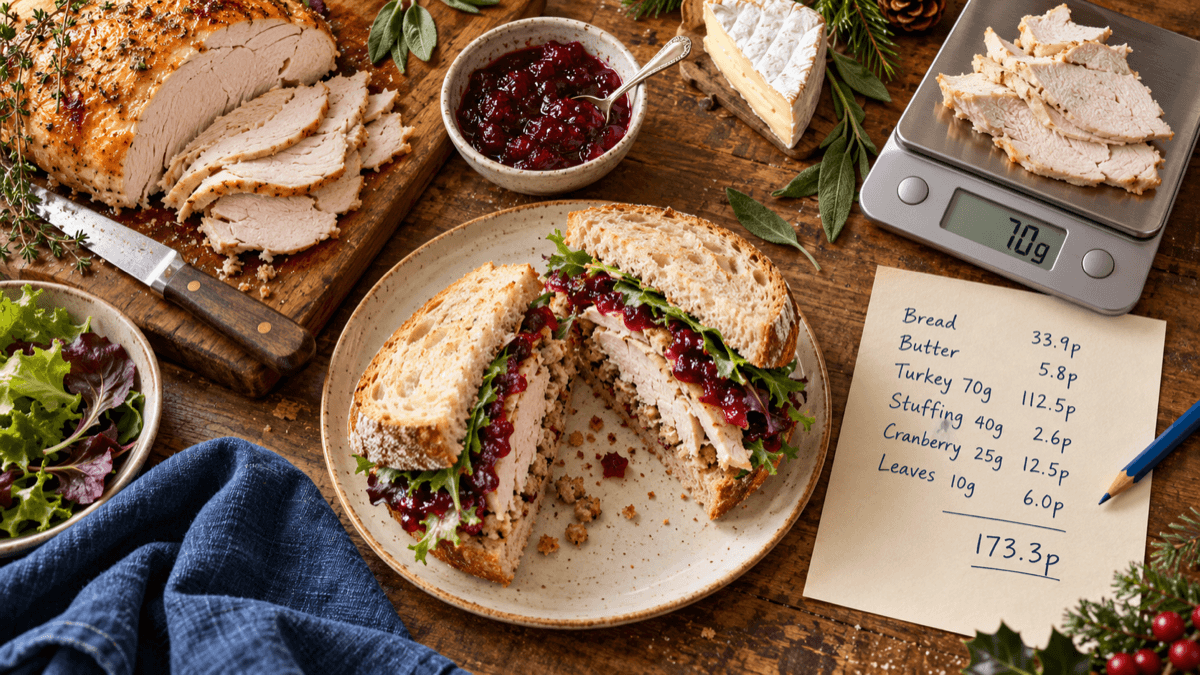
Seventy grams of turkey, priced off the invoice for a 2kg crown at £9.00 a kilo, is 63p. Once that crown has been roasted, skinned, lifted off the bone and carved, the 70g in the sandwich costs 112.5p. A crown that weighs enough for 28 sandwiches in the box makes 16 on the board.
Then two customers pay the same £6.50 for the finished sandwich. One takes it away, one sits down, and on the one who stays the café keeps 94p less.
In between sit the stuffing, cranberry, thicker bread and window wedge, a few pence each. Here's the lot, costed for a hypothetical café: turkey, stuffing and cranberry, with a brie and cranberry beside it.
VAT, the National Living Wage and Natasha's Law labelling apply across the UK. The food safety guidance quoted is the FSA's Safer Food, Better Business, which covers England and Wales; Northern Ireland uses the FSA's Safe Catering guidance, and Scotland has its own regulator, Food Standards Scotland.
None of the prices below come off a real invoice: they're illustrative UK trade prices, ex VAT, at October 2026 levels. Labour is 26.5p a minute, the fully loaded rate on the £12.71 National Living Wage worked out in the post on putting prep time beside your recipe cost. The April 2027 rate hadn't been set when this was written, and this run ends long before then.
The turkey: price per kilo is not price per sandwich
Start with a 2kg frozen turkey crown at £9.00 a kilo, so £18.00 on the invoice. Trade crown prices mostly sit behind wholesaler logins, so that is my illustrative figure, and it's the cheap end: a fresh free-range crown costs a good deal more.
A crown is breast on the bone, with skin. What goes in the sandwich is carved breast, skin off. The best published yield I can find is the US Department of Agriculture's Food Buying Guide, which puts bone-in turkey breast at "1 lb AP = 0.57 lb cooked turkey without skin". AP means as purchased. So 57% of what you paid for ends up as usable meat.
Think of it as two cuts. The oven takes about 25%, in line with the 25 to 30% a roast joint loses in the post on cooking loss and finished yield. Then bone, skin and carving trim take about 24% of what's left. That split is my illustration, not the USDA's, but it lands in the same place:
- 2,000g x 0.75 = 1,500g out of the oven
- 1,500g x 0.76 = 1,140g of carved meat
- £18.00 / 1.14kg = £15.79 per usable kilo
The spec is 70g of turkey a sandwich. 1,140g / 70g = 16.3, so a crown gives 16 portions and a 20g scrap for the carver. £18.00 / 16 = 112.5p of turkey a sandwich, the figure used throughout. That's 2p more than 70g at £15.79 a kilo (110.5p), because you paid for the scrap too.
Then the work. Unwrapping, seasoning, probing, resting, carving, portioning, chilling and washing the tray is about 20 minutes hands-on a crown: £5.30 at 26.5p, or 33.1p a portion. The oven runs about 100 minutes (a common rule of thumb for a crown is 40 minutes a kilo plus 20, at 180°C, but cook to temperature, not to the clock, as below). I've costed that as an illustrative 54p oven share, about 2kWh at 27p a kWh (use your own unit rate), so 3.4p a portion.
Roast it, or buy it cooked and sliced?
Pre-cooked sliced turkey breast costs more per kilo, an illustrative £16.20, but it loses nothing: 70g out of the bag is 70g in the sandwich. Weighing out and tubbing takes about a minute per 14 portions, so 1.9p each. Your supplier's slices may well cost less.
| Per 70g portion | Roast crown | Pre-cooked sliced |
|---|---|---|
| Price per kilo as bought | £9.00 | £16.20 |
| Usable yield | 57% | 100% |
| Price per usable kilo | £15.79 | £16.20 |
| Turkey | 112.5p | 113.4p |
| Hands-on labour | 33.1p | 1.9p |
| Oven share | 3.4p | none |
| All in | 149.0p | 115.3p |
On the invoice the crown looks 44% cheaper per kilo. Per usable kilo it is 2.5% cheaper, and per portion, with the scrap counted, under 1%: within a penny a sandwich. Cost the 20 minutes and the oven, and the crown is about 34p a sandwich dearer: around £87 across the 259 turkey sandwiches in the ordering example below.
On these numbers, at 16 portions a crown, the crown only matches pre-cooked once it drops to about £6.30 a kilo (on turkey alone the break-even is £9.07).
That is not a verdict. Your own roast eats differently from slices out of a bag, the carcass makes a stock I've valued at nothing, and a pre-cooked product can bring its own allergens, which would change your list. It's a decision, and now it has a price.
The build card
The bread is a thick-sliced 800g bloomer at £2.37, with 14 usable slices once the crusts go: two slices for 33.9p. Dearer than a thin sandwich loaf, but a festive sandwich in a window wedge has to look the part.
| Line | Turkey, stuffing and cranberry | Brie and cranberry |
|---|---|---|
| Bread, 2 thick slices | 33.9p | 33.9p |
| Butter, 8g at £7.20/kg | 5.8p | 5.8p |
| Turkey, 70g (roast crown) | 112.5p | |
| Brie, 40g at £11.00/kg | 44.0p | |
| Sage and onion stuffing, 40g | 2.6p | |
| Cranberry sauce, 25g at £5.00/kg | 12.5p | 12.5p |
| Salad leaves, 10g at £6.00/kg | 6.0p | 6.0p |
| Ingredients | 173.3p | 102.2p |
| Napkin (both ways) | 0.7p | 0.7p |
| Eat-in cost | 174.0p | 102.9p |
| Wedge 13.0p and label 1.0p (takeaway only) | 14.0p | 14.0p |
| Takeaway cost | 188.0p | 116.9p |
A few notes on the lines:
- Stuffing is a sub-recipe. 340g of dry sage and onion mix at £2.60 a kilo plus a litre of boiling water makes about 1.34kg (weigh yours): 88.4p a tray, about 66p a kilo made, so 40g is 2.6p. Add ten minutes' hands-on time, £2.65 over 33 portions or 8.0p each, and it still beats ready-cooked stuffing balls at 26.5p for the same 40g.
- Leaves at £6.00 a kilo is my own illustrative figure. Use your invoice.
- If you call the brie one vegetarian, buy a brie made with vegetarian rennet, and check the cranberry sauce label too.
- Packaging follows costing the cup, lid and box per sale: the napkin goes out either way; the window wedge (13.0p, a case of 500 at £65 ex VAT) and label (my estimate, 1.0p) only go out with takeaway and grab-and-go.
- Swap the butter for 10g of mustard mayonnaise at about 2.5p and you save 3.3p, but add egg and mustard to the allergen list.
Then hold the spec. At £15.79 a usable kilo, every extra 10g of turkey is 15.8p. A generous 90g on the busiest Saturday adds 31.6p a sandwich (20g at £15.79 a kilo), about a third of the 97.7p more the festive version earns over your regular sandwich to take away, before labour (worked out below).
In CostingBrik, the stuffing and the roast crown can each be a sub-recipe with a finished weight, and a Takeaway only tick on the wedge, with takeaway VAT set to zero-rated, shows the dine-in and to-go margins side by side.
One price, three different sandwiches
The VAT rules, as they stand ahead of the Budget on 28 October, are in HMRC's VAT Notice 709/1:
- Cold to take away: zero-rated. "Cold takeaway food and drink is zero-rated, as long as it's not of a type that's always standard-rated".
- Eaten in: 20%. "You must always charge VAT at the standard rate if you make a supply of food and drink for consumption on the premises that it's supplied in".
- Toasted: 20%, in or out. The notice's Test 2 covers food that has "been heated to order", and its examples include "toasted bread, sandwiches, panini, teacakes and similar items".
Both sandwiches at £6.50. Net prices and costs are rounded to the penny (£6.50 / 1.2 = £5.4167, shown as £5.42).
| At £6.50 | Net price | Cost | Cash GP | GP% |
|---|---|---|---|---|
| Turkey, cold to take away | £6.50 | £1.88 | £4.62 | 71.1% |
| Turkey, eaten in | £5.42 | £1.74 | £3.68 | 67.9% |
| Turkey, toasted to take away | £5.42 | £1.88 | £3.54 | 65.3% |
| Brie, cold to take away | £6.50 | £1.17 | £5.33 | 82.0% |
| Brie, eaten in | £5.42 | £1.03 | £4.39 | 81.0% |
| Brie, toasted to take away | £5.42 | £1.17 | £4.25 | 78.4% |
The toasted rows reuse the cold takeaway cost, so they leave out the toasting time, the energy and any hot-food box. The true figures are a little lower.
Cold to take away, the whole price is yours, so the turkey sandwich keeps £4.62 even after 14p of wedge and label. Eaten in, it keeps £3.68. That's a 94p gap: £1.08 of VAT you don't owe on the takeaway, less the 14p of packaging it needs.
Toast it and the takeaway advantage disappears. A "Christmas dinner toastie" to take away keeps £3.54, less than the cold one eaten in, because it carries both the VAT and the box. Cold cranberry doesn't rescue it either: section 4.6 says that if you sell hot food with a cold ingredient as a single item, "the whole supply is standard-rated."
A wrapped sandwich from the grab-and-go fridge eaten at a table is eat-in too, wedge and all: £3.54 again.
None of this works unless the till knows which was which. Section 3.3 says that if you can't tell the liability at the point of sale, "you must keep satisfactory evidence to support a fair and reasonable apportionment." Separate eat-in, takeaway and toasted keys are the easy evidence. Bundle the sandwich with crisps or a drink and you're apportioning across rates, which the lunch deal post works through.
The brie one is the quiet earner. At the same £6.50 the brie and cranberry keeps 71p more than the turkey, whichever way it goes out, because 44.0p of brie costs far less than 70g of properly yielded turkey.
Against the sandwich it replaces
Plenty of festive sandwiches go to people who'd have bought a sandwich anyway, so the useful number is what it earns over your regular one. The regular sandwich in the lunch deal post sells at £5.20 and costs £1.55 including its wrap and label. Add the same 0.7p napkin the festive card carries and it's 155.7p, keeping 364.3p cold to take away (70.1%).
Eaten in, take off its wrap and label. That post doesn't split them out, so my assumption is the same 14p as the festive wedge and label. That leaves 141.7p against a net price of 433.3p (£5.20 / 1.2, to one decimal), keeping 291.6p (67.3%). At the same precision, the festive turkey eaten in keeps 367.7p (541.7p - 174.0p).
The festive one also takes more work: a minute more at the board (26.5p), the stuffing tray (8.0p), and the roast and carve (33.1p) and oven (3.4p), 71.0p in all. With pre-cooked turkey it's 26.5p, 8.0p and 1.9p of tubbing, 36.4p, plus 0.9p more turkey. The after-labour rows take those off the before-labour figures, rounded to the penny.
| Extra cash per sandwich, festive turkey over regular | Takeaway | Eaten in |
|---|---|---|
| Before labour (462.0p v 364.3p; 367.7p v 291.6p) | +97.7p | +76.1p |
| After labour, roast crown | +27p | +5p |
| After labour, pre-cooked turkey | +60p | +39p |
The festive sandwich sells for £1.30 more than the regular one, which is £1.08 of net price eaten in (£1.30 / 1.2). Take off 32.3p more in ingredients (174.0p against 141.7p) and 71.0p of extra work, and about 5p is left. Almost all of the extra goes on ingredients and time, unless the roasting fills a quiet hour. If that looks thin, the lever is price: every 10p on the board adds 10p taken away and 8.3p eaten in.
Allergens: the festive build adds to the list
A festive sandwich picks up allergens a ham sandwich doesn't, and which ones depends entirely on the products you buy. Read every label, but expect something like this:
- Stuffing: a bread-based mix brings wheat gluten, ready-made balls may add oats, and sausage-meat or stock-based stuffings can bring sulphites or celery, which the FSA's allergen technical guidance says includes celeriac.
- Pre-cooked turkey: a coating, glaze or flavouring can bring gluten or something else from the 14. Don't assume the crown is plain turkey either: a frozen or "enhanced" crown can carry added ingredients, so read that label too.
- Cranberry sauce: a plain one may declare none of the 14, but sauces made with wine or port, and some chutneys and vinegars, can carry sulphites. Those count above 10mg per kilo or per litre as total sulphur dioxide under the same guidance.
- Bread: wheat gluten, and some bloomers also declare soya or a may-contain for another cereal.
- Brie and butter: milk. Mayonnaise: egg, plus mustard if it's mustard mayo.
All of it goes on your ingredient-level allergen matrix before the board goes up, and any December supplier swap means reading the new label.
Then the label on the sandwich. One made ahead and wrapped for the fridge on the premises where it's sold is prepacked for direct sale (made at a central kitchen for another site, it needs full prepacked labelling instead), and GOV.UK's PPDS guidance is plain: "If you prepack food in anticipation of consumer orders, these products will require PPDS labelling", meaning the name of the food and a full ingredients list with allergens emphasised.
One made to order is not: "Food made to order and food placed into packaging at the consumer's request is not PPDS." Allergen information still has to be there for it, and the FSA's technical guidance says it "must be easily accessible and accurate".
With bread, stuffing, sauce and a spread each bringing their own ingredients, a festive label is a long one. Natasha's Law and PPDS labels covers keeping them current.
Roast to the calendar
Cook, chill, three days
GOV.UK's cooking guidance for food businesses says: "Standard advice is to cook food until it has reached a core temperature of 70°C for 2 minutes." Probe the thickest part of the crown.
Cooling is where a big joint goes wrong, and the FSA's Safer Food, Better Business pack for caterers gives no number of minutes. It says: "If you have cooked food that you will not serve immediately, chill it down as quickly as possible and then put it in the fridge." It also says: "Avoid cooking large quantities of food in advance, unless you need to."
One of its cooling options is "Cut joints of meat in half." For a crown, that means lifting the two breasts off the bone once rested, not chilling it whole.
Then the clock. The same pack: "High risk ready to eat foods should be kept for a maximum of 3 days in total (day of cook/opening + 2) unless you have evidence that it is safe to keep them for longer." Roast on a Monday, and Wednesday is the last day you use that turkey. Label every tub with the roast date. A sensible rule on top: a made sandwich's use-by never goes past its shortest-lived ingredient.
Order to a number
Say the sandwich runs the last four weeks before Christmas: Friday 27 November to Christmas Eve, Thursday 24 December. That's 28 days, or 24 trading days for a café closed on Sundays. Illustrative, for a café selling 18 festive sandwiches a day, 60% of them turkey (use last year's till count, or an honest guess):
- 432 sandwiches: 259 turkey and 173 brie.
- Roast days: 10.8 turkey sandwiches a day is about 32 every three trading days, so two crowns a roast. Roasting Mondays and Thursdays suits a Sunday closer: start on Thursday 26 November for the opening Friday and Saturday. After the last two-crown roast on Monday 21 December, Christmas Eve needs a one-crown top-up.
- Crowns: eight roasts of two plus one is 17 crowns, 272 portions for 259 sandwiches. Put the defrost days on the calendar, and ask your supplier now whether they'll hold a crown price and your delivery dates.
- Stuffing: 259 x 40g = 10.4kg made. One tray per two-crown roast and a third of a tray for Christmas Eve is 8.33 x 340g, about 2.8kg of dry mix: one 3kg bag.
- Brie: 173 x 40g = 6.9kg, seven 1kg wheels. At 7.2 sandwiches a day (288g) a wheel lasts about three and a half days, so if the label says three once opened, buy smaller wheels.
- Bread: 864 slices / 14 = 62 loaves, so 8 cases of 8.
- Cranberry: 432 x 25g = 10.8kg, so five 2.5kg tubs.
This week
- Weigh one crown raw, roasted and carved, and use your yield, not mine.
- Cost both turkey routes all in, labour and oven included, and choose on purpose.
- Fill in the build card, with and without the wedge. The free recipe costing calculator will do the sums.
- Check the till has separate eat-in, takeaway and toasted keys for the festive sandwich.
- Update the allergen matrix and the PPDS label before the board goes up.
- Put the roast days on the calendar and order to a number for 27 November to 24 December.
The festive sandwich will probably sell whatever you charge. Cost it first, so you know what the extra £1.30 on the board is actually paying for.
Ed O'Brien has run Hunters Cake Company for 17 years across cafés in Witney, Burford, and a bakery in Carterton, Oxfordshire. He's building Brikly - modular tools that give independent café owners the same data the big chains have, without the big chain price tag.