
Packaging is an ingredient: costing the cup, lid, box and bag per sale
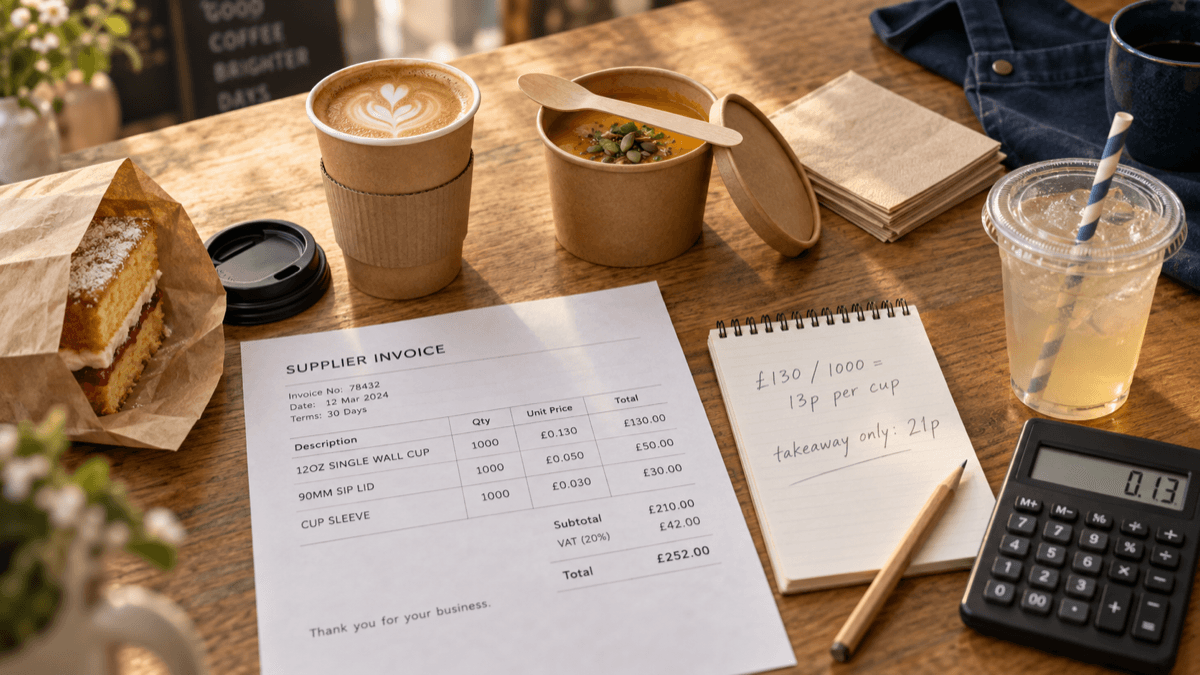
Open the cost card for your flat white. The milk is in there to the millilitre and the coffee to the gram, weighed on a scale that probably cost more than the grinder.
Now look for the cup. In most cafés it is not there.
Nor is the lid, the sleeve, the napkin, the bag the cake went into or the box the sandwich left in. All of it goes out of the door on every takeaway sale, all of it was paid for, and none of it is in the number you use to set your prices.
That is not carelessness, it is a filing problem. Packaging arrives from a different supplier, in cases of 500 or 1,000, and gets coded to sundries. It never touches a recipe. So the cup sits in your overheads instead of your cost of sale, and every takeaway margin on your menu is a few pence better on paper than in the bank.
The fix is the one that works for a house sauce: stop treating packaging as an overhead and start treating it as an ingredient.
The build: case price divided by units
Costing a batch takes four steps: cost the batch, weigh the yield, divide, then use the result as a line in the parent recipe. That is the method in costing a sauce or sponge once and using it as an ingredient, and packaging works the same way with one happy difference.
There is no cooking loss. A case of 1,000 cups yields 1,000 cups. Step two is not a weighing job, it is reading the number printed on the box.
Start with a takeaway hot drink bundle. Illustrative UK 2026 trade prices, ex-VAT.
| Item | Per sale | Cost |
|---|---|---|
| Single-wall hot cup (case of 1,000, £130.00) | 1 | 13.0p |
| 90mm sip lid (case of 1,000, £50.00) | 1 | 5.0p |
| Cup sleeve (case of 1,000, £30.00) | 1 | 3.0p |
| Napkin (case of 2,000, £14.00) | 1 | 0.7p |
| Takeaway only subtotal | 21.0p |
The napkin sits apart deliberately. It goes out whether the customer sits down or walks off, so it belongs in both costs. The cup, lid and sleeve only exist because the drink is leaving.
And the cold bundle, for an iced coffee or a cold brew.
| Item | Per sale | Cost |
|---|---|---|
| Clear cold cup (case of 1,000, £150.00) | 1 | 15.0p |
| Flat lid (case of 1,000, £55.00) | 1 | 5.5p |
| Paper straw (case of 2,000, £20.00) | 1 | 1.0p |
| Napkin (case of 2,000, £14.00) | 1 | 0.7p |
| Takeaway only subtotal | 21.5p |
Do the same for everything else that leaves your counter wrapped. A cake slice: bag or box, napkin, fork if you give one. Soup: pot, lid, spoon, bag. A sandwich: box, label, napkin. Five bundles cover almost everything an independent café sells, and when the cup price moves you change one line and every takeaway drink is right that afternoon.
Do not build these from a price list or from memory. Pull the last invoice from your disposables supplier and divide the case price by the units in the case. Every figure above is illustrative. Yours will be different, and yours is the one that counts.
The same drink, two ways
This is where packaging stops being a rounding error. It behaves very differently on hot items and cold ones, because of VAT.
The rules, set out in full in the summer VAT split on iced coffee and takeaway cake:
| Item | Eat-in VAT | Takeaway VAT |
|---|---|---|
| Hot drinks (coffee, tea, hot chocolate) | 20% | 20% |
| Iced coffee, iced latte, cold brew (barista-made) | 20% | 0% |
| Cake, brownies, cold pastries | 20% | 0% |
| Cold sandwich, cold wrap, cold salad | 20% | 0% |
| Toasted sandwich, hot panini, soup, hot pasty | 20% | 20% |
Hot drinks carry 20% either way. Cold takeaway items drop to zero. Hold that thought.
Everything below assumes you are VAT-registered. If you are under the threshold there is no VAT to remove, so you keep the full till price either way and packaging is the only difference.
The flat white, at £3.60
Illustrative, ex-VAT, on the same trade prices as the cup size price ladder: espresso beans £22.00/kg, whole milk £1.05/litre.
An 18g dose is 39.6p. A 130ml pour of milk is 13.65p. The drink costs 53.25p to make whichever way it goes out, and at £3.60 including VAT you keep £3.60 / 1.2 = £3.00 whichever way it goes out.
- Dine-in: 53.25p plus the 0.7p napkin = 53.95p. Gross profit £2.4605, or 82.0%.
- Takeaway: 53.95p plus 21.0p of cup, lid and sleeve = 74.95p. Gross profit £2.2505, or 75.0%.
The takeaway sale earns exactly 21.0p less, because packaging is the only thing that changed. Seven points of gross profit poured into a cup, on every takeaway coffee you sell.
The cold brew, at £3.80
Illustrative again. A batch of 250g of filter beans at £13.00/kg is £3.25, brewed at 1:8 and pressed out to about 1.7 litres of concentrate. That is £0.0019 per ml, so a 150ml serve of concentrate over ice and water is 28.7p.
- Dine-in, in a glass: you keep £3.80 / 1.2 = £3.1667. Cost 28.7p plus the napkin, 29.4p. Gross profit £2.8727, or 90.7%.
- Takeaway: cold takeaway is zero-rated, so you keep the full £3.80. Cost 29.4p plus 21.5p of packaging, 50.9p. Gross profit £3.2910, or 86.6%.
The takeaway version shows a worse percentage and banks 41.8p more cash. Check it the other way: the VAT you did not hand over is £3.80 minus £3.1667, which is 63.3p, less 21.5p of packaging, leaving 41.8p. It ties out.
Same café, same minute, roughly the same 21 pence of packaging. On the flat white it is simply gone. On the cold brew the zero-rating hands back 63.3p, so takeaway still wins comfortably.
Where EPR and the plastics rules land
Two things have pushed packaging prices up, and neither arrives as a bill with your name on it.
The first is Extended Producer Responsibility. Your supplier pays a fee per tonne of packaging placed on the market and builds it into their prices. As I found when working out what EPR is actually costing cafés, it does not land as a line called "EPR fee." It lands as a quietly higher price on the same cup you have been buying for years.
The tell is a unit cost that moves while the pack size and the product stay the same. A small café doing 80 to 120 takeaway drinks a day is looking at roughly £25 to £40 a month of it, a busier independent doing 200 to 300 drinks plus food-to-go nearer £50 to £80.
You almost certainly have nothing to report yourself. Below 25 tonnes of packaging a year there is no obligation at all, whatever your turnover, and an independent café is nowhere near 25 tonnes.
The second is the single-use plastics rules, and here it matters which nation you are in. In England, single-use plastic cutlery and single-use polystyrene food and drink containers and cups have been banned since 1 October 2023, under the Environmental Protection (Plastic Plates etc. and Polystyrene Containers etc.) (England) Regulations 2023. Plastic drinks stirrers were already banned. Rules differ in Scotland, Wales and Northern Ireland.
Two things the ban does not do. It does not touch plastic-lined paper cups or ordinary plastic cold cups, because only polystyrene that has been through a foaming process is in scope. And it does not ban plates, bowls and trays outright: they are restricted, with an express exemption when the item is filled at the counter.
Where it did move unit costs is containers and cutlery. Defra's appraisal, dated 21 April 2023, put the average polystyrene food and drink container at 5p an item against 15p for the paper alternative, and plastic cutlery at 2p against 3p for wooden. Plates went the other way: 4p for plastic, 3p for paper. So the swap was expensive on containers, not on everything.
In Scotland, a charge on single-use drinks cups has been proposed but is not in force. The consultation closed on 14 November 2024, the analysis was published on 12 June 2025, and the proposal was at least 25p on every single-use cup regardless of material. No regulations have been made, so there is nothing to collect yet.
One honest note: I could not find a trade body or regulator giving a typical café buying price for a takeaway cup. Defra's figures are market averages for a policy calculation, not a buying price.
Cutting the line without annoying anybody
Once packaging is a costed line you can manage it. None of this is about being stingy in front of a customer.
Lids on request. Somebody drinking at the table outside does not need one, and on the illustrative build that is 5p a time.
Sleeves only where they earn it. A cup going 30 seconds to a car needs less protection than one going on a train.
Right-size the box and stop double-bagging. A second bag because the first looked flimsy is the packaging equivalent of a heaped scoop.
Cost the reusable-cup discount properly. A customer bringing their own cup saves you 21.0p of cup, lid and sleeve on the illustrative build, though the napkin still goes out. The discount itself is a price cut at the till on a standard-rated drink, so divide it by 1.2 before comparing it to an ex-VAT saving.
| Discount at the till | Net turnover given up | Packaging saved | Net per drink |
|---|---|---|---|
| 20p | 16.67p | 21.0p | +4.33p |
| 25p | 20.83p | 21.0p | +0.17p |
| 30p | 25.00p | 21.0p | -4.00p |
A 20p discount works, 25p is break-even to a fraction of a penny, and 30p loses money on every cup. At 60 reusable-cup drinks a week the 20p version is about £2.60 a week, roughly £135 a year. Real, small, and worth being honest about rather than selling to yourself as a big win.
The trap underneath it: on a zero-rated cold takeaway drink there is no VAT to remove, so the discount costs you the full amount. A 25p discount against 21.5p of packaging saved loses 3.5p a cup. The same offer that works on a latte quietly loses money on a cold brew.
CostingBrik keeps packaging where it belongs: costable consumables sitting alongside your ingredients, counted rather than weighed, with cost per unit worked out from the case price and the units per case. Each consumable row in a recipe carries a takeaway-only tick, so a recipe shows a dine-in cost and a to-go cost side by side. It is theoretical margin until your till tells you which sale was which, but it beats a cost card with no cup in it.
What to do this week
- Pull the last disposables invoice. Not a price list, not a quote. The one you paid.
- Divide each case price by the units in the case. Write the pence next to the line, and check the count on the box while you are there.
- Build four or five bundles. Hot drink, cold drink, cake, soup, sandwich.
- Split them into both and takeaway-only. Napkins and cake cases go out either way. Cups, lids and bags do not.
- Attach a bundle to every recipe that needs one, then look hardest at your hot drinks. That is where the pence go with nothing coming back.
- Re-check your reusable-cup discount against the packaging it actually saves, in net terms.
The cup is not a sundry. It is the last ingredient in the recipe, it leaves the building with every takeaway sale, and on a hot drink it is worth about a fifth of a pound of your margin. Put it on the card.
Ed O'Brien has run Hunters Cake Company for 17 years across cafés in Witney, Burford, and a bakery in Carterton, Oxfordshire. He's building Brikly - modular tools that give independent café owners the same data the big chains have, without the big chain price tag.