
The drinks fridge: what a can earns, and the deposit return scheme coming in 2027
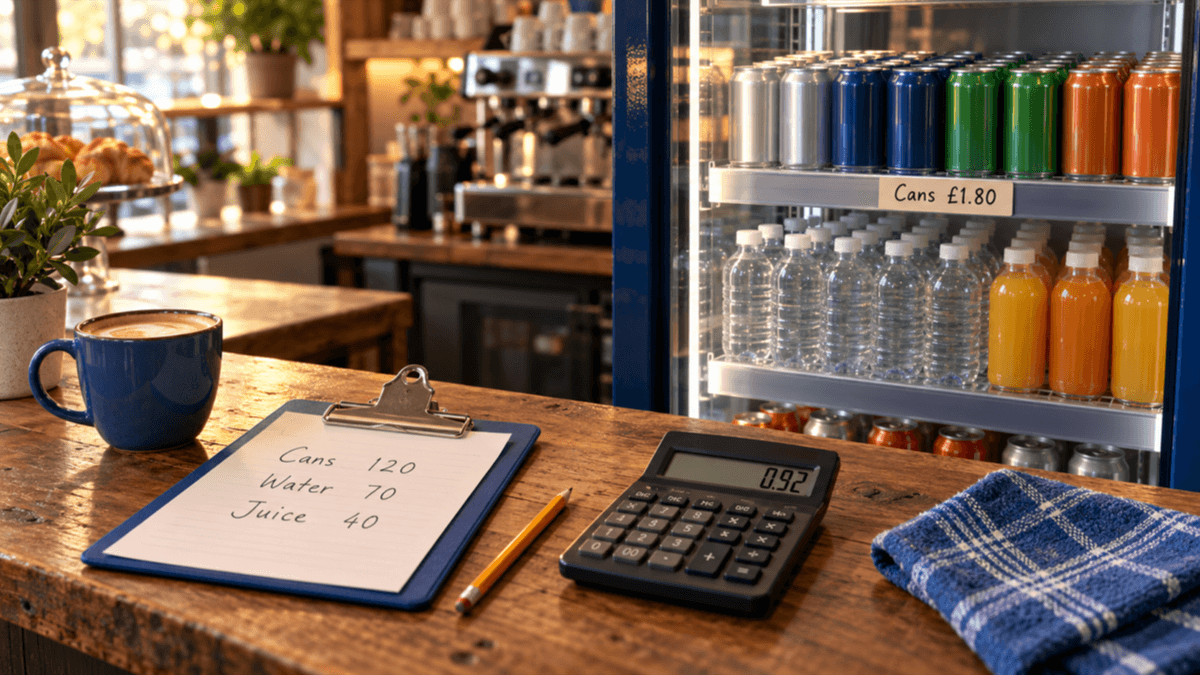
A case of 24 cans comes off the van, goes in the chiller and sells at £1.80 each. No recipe, no prep, no barista. Of everything on the menu, the drinks fridge feels most like free money.
It isn't free, and it isn't much. A can keeps 92p, a flat white £2.77, and the fridge runs all night, takes a square metre of floor, ties up cash and quietly bins the juice nobody bought.
From 1 October 2027, the cans and PET plastic bottles in your fridge also fall under a deposit return scheme, at 20p each in England, Scotland and Northern Ireland. That's about eleven months away, with detail still to come. Here's what the fridge earns, how to tidy it, and what the scheme will and won't ask of a café, based only on what's published.
Three deposit schemes start on 1 October 2027, all run by one organisation: England and Northern Ireland, Scotland, and Wales. Duties quoted below are from the England and Northern Ireland regulations, and I've flagged where Scotland and Wales differ. VAT rules are UK-wide.
Every café figure below is illustrative: a hypothetical café, October 2026 prices, costs ex VAT.
What a can actually earns
HMRC's VAT Notice 701/14 makes "Other beverages" standard-rated, listing carbonated drinks and "Mineral, table and spa waters held out for sale as beverages", and its basic foodstuffs summary puts "Juice and juice concentrates" at the "Standard rate". None of them is zero-rated to take away, so every line here is the shelf price divided by 1.2, eat in or take away.
The can is the one from the £7 lunch deal post: £1.80 on the menu, 58p from the wholesaler. Water and juice are my illustrative figures, as trade prices mostly sit behind wholesaler logins. The flat white is from the line-by-line flat white P&L, where beans, milk, waste and cup come to 56p.
| Line | Shelf price | Net ex VAT | Cost ex VAT | Cash GP | GP% |
|---|---|---|---|---|---|
| Can of soft drink, 330ml | £1.80 | £1.50 | £0.58 | £0.92 | 61.3% |
| Bottled water, 500ml | £1.50 | £1.25 | £0.33 | £0.92 | 73.6% |
| Bottled fruit juice, 250ml | £3.00 | £2.50 | £1.20 | £1.30 | 52.0% |
| Flat white, for comparison | £4.00 | £3.33 | £0.56 | £2.77 | 83.2% |
You need three cans to earn what one flat white does (£2.77 / £0.92 = 3.01). Take off the coffee's 105 seconds of barista time, 46p at the 26.5p a minute used below (rounded), and it's still two and a half (£2.31 / £0.92 = 2.51). Per minute of barista time a can often wins, as the flat white post found. Per customer, the coffee wins comfortably.
Inside the fridge, percentages mislead: water has the best GP% and earns the same 92p as the can, while juice has the worst GP% and the most cash. And the 58p is only as good as your last invoice. In CostingBrik, cans and bottles sit in your ingredients costed per item, with a "Price change detected" alert on the invoice line when the case price moves.
What the fridge costs to run
Say the hypothetical café sells 120 cans, 70 waters and 40 juices a week, 230 drinks:
- Net turnover: 120 x £1.50 + 70 x £1.25 + 40 x £2.50 = £367.50
- Cost: 120 x £0.58 + 70 x £0.33 + 40 x £1.20 = £140.70
- Cash GP: £110.40 + £64.40 + £52.00 = £226.80 a week, a blended 61.7%
Over 52 weeks that's £19,110.00 net, £11,793.60 of cash GP and £22,932.00 through the till with VAT. Then the costs no cost card shows:
| Fridge cost, illustrative year | Workings | Cost |
|---|---|---|
| Juice binned out of date | 2 bottles a week x £1.20 x 52 | £124.80 |
| Electricity | 3 kWh a day x 365 = 1,095 kWh at 27p | £295.65 |
| Restocking, rotating, ordering | 90 minutes a week x 26.5p x 52 | £1,240.20 |
| Floor space | 1 square metre at £500 | £500.00 |
| Card fees | 1.6% of £22,932.00 | £366.91 |
| The chiller | £720 ex VAT over 5 years | £144.00 |
| Total | £2,671.56 |
That leaves £9,122.04 a year after the fridge's own costs and before the rest of your overheads. The hidden costs come to 22.3p a drink (£2,671.56 / 11,960 drinks a year), about a quarter of what a can earns.
- Electricity: 3 kWh a day is my assumption; the energy label gives rated use in test conditions, and a door opened all lunchtime uses more. 27p a unit is illustrative, as in our recent costing posts: use your own rate.
- Labour, the biggest line, is unloading, rotating, facing up and ordering. £15.93 an hour fully loaded is the £12.71 National Living Wage plus £1.53 holiday, £1.43 employer NI and 26p pension on a 30-hour week: 26.55p a minute, rounded down to 26.5p to match our other posts. It's only extra cash if it adds paid hours.
- Floor space is an allocation: the flat white post's £30,000 of rent and rates over an illustrative 60 square metre café is £500 a metre, and the fridge and its door swing take about one.
- Card fees assume all card, at the flat white post's 1.6%. Waste is two mango juices a week, from the range count below.
Stock isn't a cost until it's binned, but it is cash: two weeks' cover is £281.40. Par levels apply here too: cans and water can run looser, short-dated juice tight.
Tidy the range: count, cut the tail
The problem is rarely the total. It's the tail: lines that arrived with a rep's offer or one customer's request and never left. Smaller menus make more money for the same reasons, and the same test works: under five a week is a candidate to go.
Count a week by line. Cans and water come in cases of 24, juice in 12s:
| Line | Sold a week | Weeks a case lasts |
|---|---|---|
| Cola, can | 44 | 0.5 |
| Sugar-free cola, can | 36 | 0.7 |
| Lemonade, can | 16 | 1.5 |
| Sparkling orange, can | 12 | 2.0 |
| Ginger beer, can | 6 | 4.0 |
| Cream soda, can | 4 | 6.0 |
| Sparkling lime, can | 2 | 12.0 |
| Still water | 48 | 0.5 |
| Sparkling water | 18 | 1.3 |
| Flavoured water | 4 | 6.0 |
| Orange juice | 18 | 0.7 |
| Apple juice | 10 | 1.2 |
| Green juice | 6 | 2.0 |
| Berry juice | 4 | 3.0 |
| Mango juice | 2 | 6.0 |
The bottom five are a third of the range and 7.0% of the drinks (16 of 230). Between them they earn £17.00 a week: ten cans and waters at 92p, six juices at £1.30.
The last column is where it hurts. A can taking twelve weeks to sell a case is slow cash; a juice taking six is a bin. If juice arrives with three weeks on the date (check yours), mango sells six of each case and bins six: two sold and two binned a week, earning £2.60 and binning £2.40. That's the fridge's whole waste line. Berry is next: its case lasts exactly as long as its date, so one slow week means a bin.
Cut all five, and:
- if nobody switches, you lose £17.00 of cash GP a week and save £2.40 of juice: £759.20 a year down;
- if everyone switches like for like, you lose nothing, save £124.80 a year of juice, and free five facings for the lines that run out on a Saturday.
You're betting most of those customers want a cold drink, not that one. Keep the price ladder to two or three steps, here £1.50, £1.80 and £3.00. Tail lines bring odd prices, and each is another till button and shelf ticket to change when the deposit arrives.
The deposit return scheme: what's confirmed
- The law. The Deposit Scheme for Drinks Containers (England and Northern Ireland) Regulations 2025 "come into force on 1st October 2027". Scotland moved to the same date under its 2025 amendment regulations, and the Welsh regulations, approved by the Senedd in March 2026, also start in October 2027.
- What's in. GOV.UK's guidance (England and Northern Ireland, last updated January 2025) covers single-use bottles and cans made wholly or mainly from aluminium, steel or PET plastic, from 150ml to three litres. It leaves out HDPE, "the material used to make milk bottles". Cartons aren't made of any of those, so I read them as out.
- Glass. Out in England, Northern Ireland and Scotland. In Wales it's in, but for four years glass is "exempt from labelling and carry a zero-pence deposit", in the Welsh Government's words, until October 2031 by Exchange for Change's reckoning.
- Who runs it. UK Deposit Management Organisation Limited "was appointed as the DMO in May 2025", says Defra. It trades as Exchange for Change, runs Scotland's scheme too, and Wales appointed it on 20 August 2026.
- The deposit. In April 2026 Exchange for Change confirmed "a flat 20p deposit will be applied on all in-scope containers" for the schemes it runs in England, Scotland and Northern Ireland. That's its decision, not a figure in the law: regulation 59 has it set the level, and regulation 60 lets it change it on at least three months' notice.
Not yet published: how collections from cafés will work; HMRC's VAT regulations; final transition rules (Exchange for Change's guidance is provisional, and Wales's is to follow); how voluntary return point applications work; and the deposit on Welsh cans and PET bottles. Exchange for Change's April announcement doesn't mention Wales, so treat the Welsh deposit as unconfirmed.
What it asks of a café
No return point
The return point duty falls on a "groceries retailer", which the regulations say "does not include" "a coffee shop whether or not it is selling food and drinks which may be consumed on the premises" or "a hospitality venue such as a bar, restaurant or club". Exchange for Change's FAQ agrees: "hospitality businesses don't have to operate return points". If your bakery shop also sells general groceries, read the definition yourself.
You can volunteer, with Exchange for Change's authorisation. Selling drinks earns no handling fee: the 3p a container at manual return points is "a payment made to retailers who operate a return point".
Takeaway: charge it
Regulation 28 starts simply: "A scheme supplier must charge a customer a deposit for each deposit item". A café selling cans is a scheme supplier, so a takeaway can is £1.80 plus 20p, £2.00, with the 20p refunded at a return point, not by you.
Where you display deposit items, regulation 26 wants the price without the deposit, "the deposit level", the price with it, a statement that you must charge it and how to get a refund: £1.80, 20p, £2.00. Drinks drunk in where you've opted out take regulation 29's signs instead.
Don't absorb it. Cutting the can to £1.60 to hold the total at £1.80 drops the net price to £1.33 and cash GP from 92p to 75p (both rounded). If all 120 cans a week went out as takeaways, that's £1,040.00 a year (20p / 1.2 x 120 x 52), or £624.00 at the 60% takeaway share used below.
Drunk in: your choice, mostly
Regulation 28(2) is the hospitality exception. At "mixed retail or on-sale premises", which a café selling cans to drink in and take away is, a supplier "may decide not to charge a deposit" on drinks for immediate consumption, and can change its mind "at any time". GOV.UK's guidance, naming cafés, puts it as "you may choose to only apply the deposit to drinks sold to take away".
- Opened cans still count. Containers that staff open before serving are "to be treated as being securely closed" (regulation 8(5)).
- So do outside tables. On the premises includes "an area in close proximity" where seating is provided, or which customers "habitually use" (regulation 8(7)).
- Opting out needs a sign. Regulation 29 requires "a statement that the scheme retailer is not required to charge a deposit" for drinks consumed on the premises, and "a statement requesting that empty containers are not removed from the premises", shown "clearly and accessibly".
Exchange for Change will collect stored empties "free of charge", though some venues "will need to register with Exchange for Change so they can receive a collection"; in England and Northern Ireland you can take them to a return point instead. The FAQ gives Welsh venues the same choice over charging.
Scotland differs. Its regulations lift the duty to charge on drinks sold "exclusively for consumption on the premises of sale" (regulation 5), and a hospitality retailer "must retain for collection" the empties from drinks sold to drink in (regulation 20A). The FAQ goes further: where a drink will definitely be drunk on the premises, a deposit "should not be charged". Not charging on drinks drunk in satisfies both.
Opting out isn't free
Retailers must "pay the deposit to producers or wholesalers when purchasing the drinks", says GOV.UK, so a case of 24 cans carries £4.80. If the juices are in PET, all 230 drinks a week here are deposit items, £46.00 a week, and two weeks' stock grows from £281.40 to £373.40, about a third more cash on the shelf.
Charge the customer and the 20p is theirs: not your cost, not your sale. Opt out and it only comes back when the empty is collected or returned. If 40% is drunk in (92 containers a week) and one in ten leaves in a bag, that's £1.84 a week, or £95.68 a year, plus room for a week of empties. I couldn't find anything published on the customer who says "drinking it here" and walks out with it, so ask before you ring it up.
The till, and VAT still to come
Give the deposit its own till line. Fold it into the can's price and your reports count someone else's 20p as drinks turnover. A new line is exactly the catalogue edit that sits outside your tax rules until someone sets it, as the till VAT audit post explains.
HMRC's July 2026 policy paper says that under the existing rules "the deposit amount is disregarded for the purpose of determining the value of supplies of scheme products", which fits treating the 20p as not your sale. But "There is no secondary legislation covering the VAT treatment of these schemes at present."
What HMRC proposes to change is who accounts for VAT on deposits never refunded: the scheme administrator, not the drinks makers and importers, through Finance Bill 2026-27 and later regulations, once the schemes start. It expects a "negligible impact" on the 40,000 to 50,000 businesses affected, who will still need "to code the VAT deposit correctly in their records". How a café does that awaits the regulations: set the line up with your accountant and till provider once they land.
What you can sell
After launch, regulation 24 says a scheme supplier "must not supply a deposit item" without the scheme logo and a return code, and regulation 23 bars unregistered producers' items, so stick to your usual wholesaler. Old stock is outside the rules: regulation 2 disapplies them for drinks "first supplied in any part of the United Kingdom before 1st October 2027".
Exchange for Change's provisional transition guidance says drinks filled before then "can still be sold after 1 October 2027", with no deposit or logo. Its test is when the drink was filled, the regulation's when it was first supplied. For a while the fridge may hold both, told apart by the logo.
Packaging EPR: no change for you
EPR packaging fees reach most cafés only through supplier prices, and cans and PET drinks bottles already sit outside them: the EPR regulations leave out "drink containers made of any material other than glass". A backstop would bring them back, into producers' obligations from 1 January 2028 and disposal fees from the 2028 to 2029 assessment year, but only if no deposit scheme is running anywhere in the UK on 1 January 2028. With the schemes due in October 2027, it shouldn't bite. Glass bottles stay in, as do your cups, lids and bags.
Producers will pay Exchange for Change a per-container fee instead: 0p until December 2028, then a projected 0.6p a can and 2.3p a PET bottle, to be reconfirmed in May 2027. If that reaches you at all, it'll be in the case price.
Now, and in 2027
This winter: trim the fridge, and ask your wholesaler how deposits will show on invoices and your till provider how it will handle a deposit line.
Through 2027: watch for collection details, HMRC's VAT regulations and the final transition guidance. Decide on opting out, register with Exchange for Change if you'll want collections, and set up the till line and signs.
From 1 October 2027: the deposit goes on every takeaway can and PET bottle with the logo, and opted-out table empties stay on the premises for collection.
This week
- Count a week of fridge sales by line, from the till or a tally on a clipboard.
- Cost every line ex VAT: shelf price divided by 1.2, less the invoice cost. The free menu profit calculator will do the sums.
- Mark anything under five a week and check how long a case lasts against its date.
- Cut or swap the tail, then watch the fridge's total for a month.
- Write your price ladder on one line: two or three prices.
- Put 1 October 2027 in the diary and ask your wholesaler and till provider the two deposit questions.
In the hypothetical café, the fridge clears £9,122.04 a year after its own costs: worth having, if less than the till suggests. From next October it handles other people's 20p as well.
Ed O'Brien has run Hunters Cake Company for 17 years across cafés in Witney, Burford, and a bakery in Carterton, Oxfordshire. He's building Brikly - modular tools that give independent café owners the same data the big chains have, without the big chain price tag.