
Hot holding and reheating: the 63°C rule for soup, pasties and sausage rolls
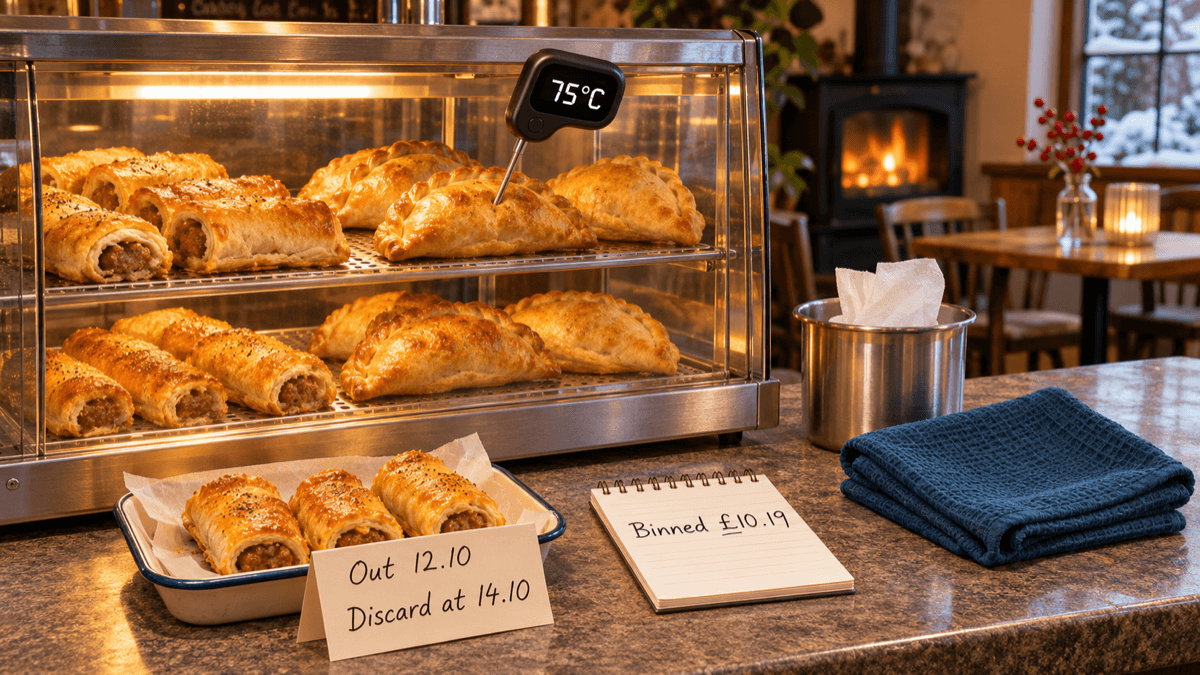
Picture the counter at ten to three on a quiet Tuesday. The lunch rush finished an hour ago, you close at four, and there are still five sausage rolls and four pasties sitting under the warm lights of the hot cabinet. You already know most of them are heading for the food waste bin at close.
Once the weather turns, hot food starts doing real work on a café menu - soup in the kettle, pasties and sausage rolls on the counter, beans or chilli in the bain-marie. This is the winter partner to our heatwave cold chain post. Below is what the law actually requires, what Environmental Health expects to see in your daily routine, how to keep your probe accurate, and what that half-full cabinet at 3pm is quietly costing you.
A quick note on geography: the main regulations below apply in England, with matching rules in Wales and Northern Ireland. Scotland handles a few details differently, so there's a separate section for Scottish cafés below. I've referenced the FSA's Safer Food, Better Business (SFBB) pack throughout; Northern Ireland uses Safe Catering and Scotland uses CookSafe.
What the law actually says
England, Wales and Northern Ireland: 63°C and the two-hour rule
Under Schedule 4 of the Food Safety and Hygiene (England) Regulations 2013, cooked or reheated food that is on display or waiting to be served must be kept at or above 63°C if holding it lower would allow harmful bacteria or toxins to grow. In practice, that covers almost everything you put in a café hot cabinet or soup kettle. Wales has the same rule in the Food Hygiene (Wales) Regulations 2006, and Northern Ireland in the Food Hygiene Regulations (Northern Ireland) 2006.
The regulations do include a two-hour exemption. If hot food drops below 63°C while on display or out for service, you have a legal defence provided it has been out for less than two hours and hasn't already been put out for service earlier. You only get that window once.
The important catch is that the burden of proof sits with you. As the FSA's guidance on temperature control legislation points out, if you rely on the two-hour rule, you have to be able to show an EHO when the food came out. Once the two hours are up, GOV.UK's cooking guidance is blunt about what happens next: chill it down to 8°C or below as quickly as you can, or throw it away.
Scotland: different wording, and 82°C for reheating
The Food Hygiene (Scotland) Regulations 2006 are drafted slightly differently. The strict statutory offence around holding food above 63°C doesn't apply in the same way to food exposed for sale, so for a counter hot cabinet the expectation to hold above 63°C comes from the general food safety duty and Food Standards Scotland's CookSafe temperature control guidance. There is also no automatic two-hour tolerance period written into Scottish law, so if you trade in Scotland, don't build your service around a two-hour counter display without checking with your local authority first.
Reheating is stricter in Scotland and written straight into the regulations: any food that has already been heated and is reheated for sale must reach a core temperature of at least 82°C, unless reaching 82°C would spoil the food's quality (in which case CookSafe accepts validated alternatives such as 70°C for 2 minutes). Just like the rest of the UK, CookSafe's rule is to reheat a finished dish once only.
Day-to-day habits in the kitchen
The law gives you the numbers, and the FSA's Safer Food, Better Business pack turns them into four straightforward habits:
- Preheat the kit first. Turn the cabinet or bain-marie on early enough that it is up to temperature before the first tray goes in. Putting hot pastry into a lukewarm box drags the core temperature down straight away.
- Only put piping-hot food in. Everything going into hot holding needs to be thoroughly cooked or reheated first.
- Don't try to heat food in a warmer. Hot cabinets and soup kettles are designed to hold heat, not bring cold food up through the danger zone.
- Probe the food, not the dial. The thermostat on a hot cabinet reads air temperature near the sensor, which tells you very little about a sausage roll sitting by the front glass after the door has been opened forty times at lunch. Clean and disinfect the probe, push it into the centre of the thickest part, and test the item in the coolest corner.
If a check comes back under 63°C, SFBB gives you two ways to save it: reheat the food thoroughly back to a safe temperature and return it to hot holding (provided it hasn't been reheated already), or chill it down safely to use later. If you can't do either, bin it.
How that looks across typical café kit
- Soup kettle: Bring the soup up to temperature on the hob or in a combi oven, probe it, and only then pour it into the preheated kettle. Keep the lid on, give it a stir before probing the middle, and reheat smaller amounts as the kettle runs low so the chilled batch left in the fridge is still good for tomorrow. We went through the batch and cooling maths in our post on costing soup of the day.
- Pie and pasty cabinet: Move trays straight from the oven into the cabinet. Smaller items like sausage rolls lose heat much faster than a dense steak pasty when the doors keep opening, so probe a sausage roll near the front during your busiest hour.
- Jacket potatoes: If they were baked this morning and went straight into the oven warmer, they haven't been reheated yet. If you baked them yesterday, chilled them and reheated them today, they've used their one reheat, so anything unsold at close has to go. Probe the middle of the biggest potato.
- Toasties: Made to order, there's nothing to hot hold. If you pre-toast and keep them warm for a lunch grab-and-go rush, the 63°C rule applies.
- Bain-marie: Heat beans, chilli, curry and rice properly before filling the wells. Rice deserves extra care - SFBB specifically warns to either keep it hot until service or chill it down as fast as possible, because the bacterial spores in rice can survive normal cooking and reheating.
Reheating: once only, and all the way through
In England, Wales and Northern Ireland, there isn't a single reheating temperature written into the statute, so EHOs look to GOV.UK and SFBB guidance. Both say the same two things: reheat food until it is piping hot all the way through, and only reheat it once.
SFBB lists several safe time-and-temperature combinations that prove food is hot enough:
- 80°C for at least 6 seconds
- 75°C for at least 30 seconds
- 70°C for at least 2 minutes
- 65°C for at least 10 minutes
- 60°C for at least 45 minutes
In a busy café kitchen, 75°C for 30 seconds is usually the easiest standard to train staff on, because nobody wants to stand over a pasty with a stopwatch for two minutes. If you reheat in a microwave, stir halfway through and probe in a few different places to make sure there are no cold patches, then serve it immediately or move it straight into hot holding.
That "once only" rule is what decides what happens to leftovers at close. Food cooked fresh this morning and held hot hasn't been reheated, so you can safely chill it down if it's still in good condition. Food cooked yesterday and reheated for today's service is done at close.
Looking after your probe
All of those numbers are meaningless if your thermometer is reading four degrees high. SFBB recommends checking probe accuracy regularly - monthly if the manufacturer doesn't specify an interval - and its four-weekly review asks whether probes have been calibrated and recorded in the last four weeks.
The test takes five minutes:
- Iced water check: Fill a glass mostly with crushed ice, top up with a little cold water, stir, and wait a minute. Your probe should read between -1°C and 1°C.
- Boiling water check: Put the probe tip into a pan of water at a rolling boil, keeping the tip clear of the bottom and sides of the pan. It should read between 99°C and 101°C.
Write down both readings, the date, and who ran the check. If the probe falls outside either range, don't try to mentally adjust for it - replace it or send it back to the manufacturer to be calibrated.
Between calibration checks, hygiene matters just as much as accuracy. Wipe and disinfect the probe before it goes into food and again afterwards, and keep an eye on the tub of probe wipes - once the lid gets left open and they dry out, they stop disinfecting properly. Checking that the probe works and wipes are in stock sits on your daily opening list, and logging your hot-hold and reheating readings goes into your closing checks.
It's worth actually walking new staff through this rather than assuming they've done it before. Where the probe lives, what temperature they're looking for, and which sheet it gets written on belong in the first two weeks of staff induction. Consistent, believable temperature logs are also one of the quickest ways to protect your score when you look at what really moves a food hygiene rating. We're currently building SafetyBrik - our free food safety Brik, coming soon - to take this off clipboards, with hot-hold logs checked against 63°C alongside reheating and monthly probe calibration records.
What that 3pm hot cabinet actually costs
Keeping the food safe is one thing; keeping a hot cabinet profitable is another. Most of the money lost on hot food disappears in the final hour of trading because nobody wanted to run short over lunch.
Here is how the numbers look for a typical independent café on a quiet Tuesday (using illustrative UK trade prices, ex VAT, at November 2026 levels):
- House-made sausage roll: 95p of ingredients, plus about 2.5 minutes of prep time rolling them at 26.5p a minute (66p in direct labour). Priced at £4.20 on the board, which leaves £3.50 after 20% VAT.
- Bought-in steak pasty: A wholesaler case of 20 frozen unbaked 283g pasties lists at £42.55, or £2.13 each (indicative account price), with almost no prep labour. Priced at £4.95 on the board, leaving £4.125 net of VAT.
Both carry 20% VAT whether eaten in or taken away (more on VAT below).
| Per item | House sausage roll | Bought-in pasty |
|---|---|---|
| Selling price (inc. VAT) | £4.20 | £4.95 |
| VAT at 20% | £0.70 | £0.825 |
| Net selling price | £3.50 | £4.125 |
| Ingredient or bought-in cost | £0.95 | £2.13 |
| Gross profit | £2.55 (72.9%) | £1.995 (48.4%) |
Scenario 1: One big bake at 11am
Most cafés default to baking everything in one hit before lunch so the team doesn't have to think about the oven during service. Say you bake 12 sausage rolls and 8 pasties at 11am. By 3pm you've sold 7 rolls and 4 pasties, leaving 5 and 4 in the cabinet. You sell one more of each before closing at 4pm, and the remaining stock goes in the bin:
- 4 sausage rolls at £0.95 = £3.80
- 3 pasties at £2.13 = £6.39
- Total binned at stock cost: £10.19 (or £12.84 once you include £2.65 of rolling time on those four sausage rolls)
Scenario 2: Splitting the bake
Take the exact same Tuesday and the exact same customers, but split the bake into two smaller trays. Put 6 sausage rolls and 3 pasties in for 11am. As soon as the cabinet drops to two of each, fire the second tray: 4 sausage rolls and 3 pasties.
You bake 10 rolls and 6 pasties in total, make the same 8 and 5 sales, and only have 2 rolls and 1 pasty left at close:
- 2 sausage rolls at £0.95 = £1.90
- 1 pasty at £2.13 = £2.13
- Total binned at stock cost: £4.03 (or £5.36 including £1.33 of rolling time)
That one small change saves £6.16 a day in stock alone - £36.96 over a six-day week, or £1,848 a year across 50 trading weeks before you even count the labour. Everything you didn't bake stays safely in the fridge or freezer for Wednesday.
The trick is triggering the second tray off what's left in the cabinet rather than waiting for a set time of day. Frozen pasties take around 45 to 55 minutes to bake, so if you wait until you're down to the last one, you'll have an empty shelf for nearly an hour.
Running out vs throwing away
Looking at the unit economics makes it obvious why you shouldn't treat every item in the cabinet the same way:
- On a house sausage roll, missing a sale costs you £2.55 in gross profit, while binning one costs £0.95 in ingredients (or £1.61 with rolling time). You would have to bin almost three sausage rolls to lose as much money as missing a single sale.
- On a bought-in pasty, missing a sale costs you £1.995 in gross profit, while binning one costs £2.13. Throwing away one unsold pasty actually hurts you 13.5p more than running out of it.
So it pays to keep sausage rolls well stocked through the afternoon, while running much tighter on bought-in pasties. On a thinner-margin bought-in line, selling out at 3:45pm is the cheaper outcome. It's the same principle we use when planning bakery production around daily footfall: track what gets binned by day of the week for two weeks, then set Tuesday's bake from Tuesday's numbers rather than Saturday's.
What about the cabinet's electricity?
It's easy to worry about the power bill on a heated display, so it's worth putting the two numbers side by side. A typical 1,330W three-tier countertop warmer cycles its element on and off once it reaches temperature. Assuming it averages roughly 1 kWh per hour across the day including warm-up (a cheap plug-in energy monitor will give you your exact figure in a week), at 27p per kWh:
- 10:30am to 4pm (preheated for an 11am first tray): 5.5 kWh = £1.49 a day (£1.485)
- 8am to 5pm (switched on at opening and left on till close): 9 kWh = £2.43 a day
Trimming those empty morning and late-afternoon hours saves 94.5p a day, or £283.50 over 300 trading days - worth folding into your wider habits for cutting the café energy bill. Still, look at the contrast: running the cabinet all day costs £2.43, whereas one over-baked tray puts £10.19 straight into the bin. The electricity bill is minor compared with the waste.
Using the two-hour rule properly
Food sitting inside a working hot cabinet at 63°C or above isn't on a two-hour countdown. The two-hour window is for hot food that leaves temperature control - for instance, a tray of sausage rolls set out on the counter to speed up a Saturday lunch rush, or a hot buffet put out for a private hire.
If you use that window, keep it simple and watertight:
- Label the tray with both times. A quick sticker reading "Out 12.10" and "Discard at 14.10" takes two seconds and gives you proof if an EHO walks in. Because the law says less than two hours, treat the discard time as a hard cut-off.
- Don't top up an old tray. Never tip fresh hot food on top of food that's already been sitting out. Once they're mixed, you've lost track of when the older pieces left the cabinet.
- Keep the backup hot in the kitchen. For a private hire or busy counter rush, put out smaller platters and swap them for fresh ones from the hot hold rather than laying everything out at 12:30pm and having to bin half of it at 2:30pm.
- Only use the window once. Anything still left after two hours has to be discarded. If you pull food back before the two hours are up, SFBB allows you to either reheat it thoroughly back into hot holding (counting as its one reheat) or chill it down rapidly.
For food that stays inside a 63°C cabinet, there is no legal time limit, though pastry dries out long before safety becomes an issue. Setting a house rule - say three hours in the cabinet before it comes off sale - keeps the quality up and naturally pushes the kitchen towards baking little and often.
A quick word on VAT
Anything sold from a heated cabinet or under heat lamps counts as hot takeaway food and attracts 20% VAT, whether the customer eats in or takes it away. HMRC's VAT Notice 709/1 explicitly puts pasties kept warm in heated cabinets or under lamps in the standard-rated bracket.
The only way a takeaway pasty or sausage roll stays zero-rated is if it is baked off, left to cool naturally on an ambient tray, handed over in a plain paper bag, and not marketed as hot. We cover the full breakdown of hot vs ambient food in our UK café VAT guide. Make your call on food safety and customer experience first, then make sure your till buttons match the VAT rate that follows.
Five quick things to check this week
- Test your probe in iced water and boiling water, log the readings, and set a monthly reminder to repeat it.
- Probe the coolest item in your hot cabinet during peak lunch rather than trusting the thermostat dial, and check that your tub of probe wipes hasn't dried out.
- Make "reheat once" obvious by the hob and microwave so everyone on shift knows which leftovers can be chilled and which have to go at close.
- Try splitting your 11am bake into two trays for a week, using a count in the cabinet to trigger the second batch, and jot down what goes in the bin each afternoon.
- Stick out/discard labels on anything taken out of hot holding, especially for counter rush trays or private-hire buffets.
If you want to see what each binned sausage roll or pasty is actually costing your margin before you tweak your bake numbers, you can plug your ingredients into our free recipe costing calculator.
Ed O'Brien has run Hunters Cake Company for 17 years across cafés in Witney, Burford, and a bakery in Carterton, Oxfordshire. He's building Brikly - modular tools that give independent café owners the same data the big chains have, without the big chain price tag.