
Markets, festivals and pop-ups: is the stall worth the Saturday?
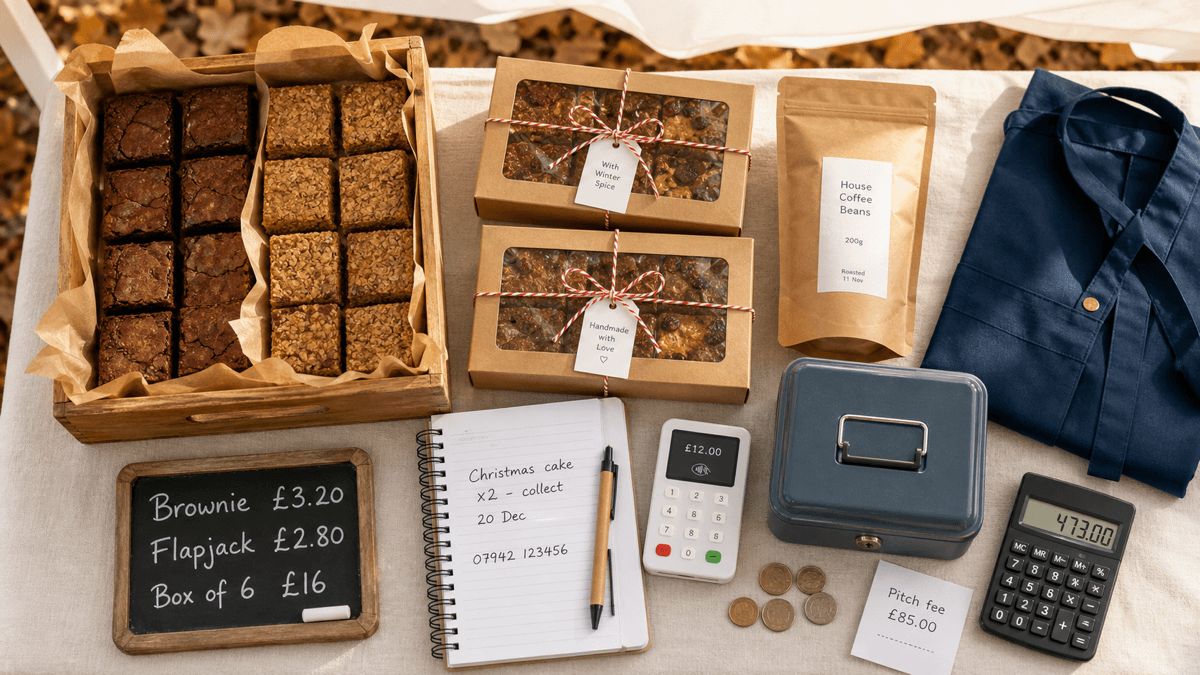
The Christmas market email lands in August, which is its own small comedy.
Eighty-five pounds for a Saturday pitch, applications close in three weeks, and by the second paragraph you can already picture it. Bunting. Mulled wine. Two hundred people walking past your brownies with money in their pockets.
Whether that stall makes you any money is decided before you pack the van. So here is the sum to run before you hit reply.
And it is live now, not in November. The good Christmas markets and the bigger food festivals take applications in August and September, and the well-run ones fill up. Same as getting festive planning done while it is still warm, the decision lands months before the day does.
Make sure the email really comes from the organiser. On 18 September 2026 BBC Wales reported that dozens of traders had received professional-looking emails claiming to be from food festivals, with the request for money coming only after several emails had gone back and forth. Before you pay a pitch fee, find the festival's own website yourself, not through the email, and contact them there. More in the 28 September Weekly Grind.
What a stall day actually costs
Most people count the pitch fee and stop. The pitch fee is usually the smallest number on the list.
- The pitch. A local weekly market might be a few tens of pounds. A food festival or a proper Christmas market can run to several hundred, and some take a percentage of takings on top. Read the terms, not just the headline rate.
- Kit, amortised. Gazebo, weights (organisers will insist, and rightly), trestle tables, cloths, crates, display stands, a lockable cash tin. Several hundred pounds of one-off spend that you should spread across the season, not the first outing.
- Insurance. Your existing public liability policy usually already covers occasional off-site trading, but the organiser wants a certificate and a minimum cover level. Check yours before you assume, and check the cover amount matches what they ask for.
- Stock and packaging. Boxes, bags, greaseproof, labels. Higher per unit than your counter, because everything has to survive a car boot.
- Fuel, parking and the pitch you cannot park next to. Some sites make you unload and move the van half a mile away.
- Card payments. A reader with an offline mode and a backup plan for when the signal dies, which at an outdoor event it will. Transaction fees are typically somewhere around 1.5 to 1.75 percent for tap and go, but check what your provider currently charges.
- A cash float if you take cash, plus the discipline of counting it twice.
And then the line everyone leaves out.
What sells from a stall with no kitchen
Assume no power, no water and no hot service. That is the default at most pitches, and it rules out more than you would think.
What travels and sells:
- Traybakes and cut bakes. Brownies, flapjacks, blondies, cookies. Sturdy, sliceable, priced for an impulse buy.
- Whole cakes to order. Put an order book on the table with a pen and dates. This is often worth more than the day's cash.
- Boxed and gift lines. The same thinking as selling retail bakes, beans and merch off your own shelf applies here, and a market crowd is in a buying-a-present mood in a way your morning coffee queue simply is not.
- Take-home coffee beans. High value, zero waste, and they carry your name into somebody's kitchen for a fortnight.
Hot drinks are the trap. They need power, water, waste disposal and often a different (dearer) pitch class, and they turn a simple table into a mobile catering unit with all the paperwork that implies. Skip them for your first outing. If the day works, upgrade later with your eyes open.
The admin, briefly
Not glamorous, but the organiser will ask and the environmental health officer might turn up.
Your existing food business registration typically covers occasional trading away from your premises, but tell your EHO what you are doing and check whether they want anything extra. It is a five minute email that saves a bad conversation later.
Anything you pack in advance and sell from the table is PPDS. That means a full ingredients list on the label with the 14 allergens emphasised, plus the product name. Cut to order in front of the customer and the rules differ, but nobody cuts brownies to order in the rain, so plan for labels.
Organisers will usually want your public liability certificate, your food hygiene rating and sometimes a risk assessment. Get that folder together once and reuse it all season.
The worked example: is £85 worth a Saturday?
Illustrative UK numbers, ex-VAT, for a decent local Christmas market. Yours will differ. The method is the point.
You take £600 on the day. That is a good, believable number for a busy pitch with strong stock and a queue at eleven o'clock.
| Line | Cost |
|---|---|
| Cost of goods at around 30% | £180 |
| Pitch fee | £85 |
| Labour: 10 hours at roughly £14/hr loaded | £140 |
| Packaging, boxes, bags, labels | £18 |
| Fuel and parking | £25 |
| Kit amortised across the season | £15 |
| Card fees | £10 |
| Total cost | £473 |
Contribution: £127.
Which is fine. It is not nothing. But it is not the number in your head when you read the words "two hundred people walking past your brownies".
Now compare it with staying at home
Here is the comparison nobody makes. That same Saturday, the café still opens. You are either standing at a table in a field or you are on your own counter, and the ten hours of skilled labour got spent either way.
If your absence means paying an extra shift to cover you, call it £120 to £140 of cover. Put that against £127 of stall contribution and the market day is roughly break-even. If the person on the stall would otherwise have been at home unpaid on a rota gap, it looks a lot better.
So the honest answer is: a good stall day at a fair pitch fee is a break-even-to-slightly-positive use of a Saturday, judged on takings alone.
If takings alone were the whole story, most operators would stay home. They are not the whole story.
What actually changes the answer
Four things, and they are the reason people keep doing markets.
Every buyer is a local who now knows where you are. Two hundred conversations in a day, most of them with people who live within ten miles. That is cheaper and warmer than any advertising you could buy, and the ones who liked the brownie tend to turn up on a Tuesday.
The order book. Christmas cakes, celebration cakes, "do you do office platters?", "would you supply our shop?". A single wholesale enquiry or a handful of festive orders can be worth more than the day's till. This is where a market quietly feeds the two off-site revenue lines that actually scale: catering and corporate orders and supplying bakes wholesale to other businesses. Take names and numbers, not just compliments.
It soaks up spare bakery capacity. If your oven and your bakers have quiet hours mid-week, stall stock costs you ingredients and very little else. Same argument as wholesale: it makes sense on capacity you were never going to use, and much less sense when you are already flat out.
It is the cheapest product testing lab you will ever get. You will learn more about a new line in six hours at a market than in six weeks on your own counter, because the crowd has no loyalty to you and no habit to fall back on. If a bake does not sell to a stranger in a good mood with cash in hand, it probably is not the price.
Treat the first one as paid research
Do not let the first stall decide anything on vibes. Set the pass mark before you go, and make it a low one: break even on the day.
Then track what the day actually generated over the following three months:
- Orders taken on the stall and fulfilled later
- Enquiries that traced back to it, wholesale or catering
- New faces in the café who mention where they saw you
- What you learned about pricing, packing and which lines travel
Write those hours down honestly while you remember them, load and unload included. A stall day that looks like a modest win on takings can look like a very good week's marketing once the order book pays out, and it can also look like an expensive Saturday if nothing follows.
The one number that has to be right underneath all of this is your cost per unit. If your traybake cost is a guess from last spring, so is the whole calculation, and a market is exactly the setting where you price on gut and find out in January. CostingBrik keeps recipe costs current off the invoices you already receive, so the stall maths starts from a real number rather than a hopeful one.
Say yes to the pitch because you have run the sum and the second-order value is worth it. Say no because the Saturday is worth more at home. Both are respectable. Saying yes because the email had bunting in it is the one to avoid.
Ed O'Brien has run Hunters Cake Company for 17 years across cafés in Witney, Burford, and a bakery in Carterton, Oxfordshire. He's building Brikly - modular tools that give independent café owners the same data the big chains have, without the big chain price tag.