
Petty cash and the supermarket dash: the receipts that never reach your books
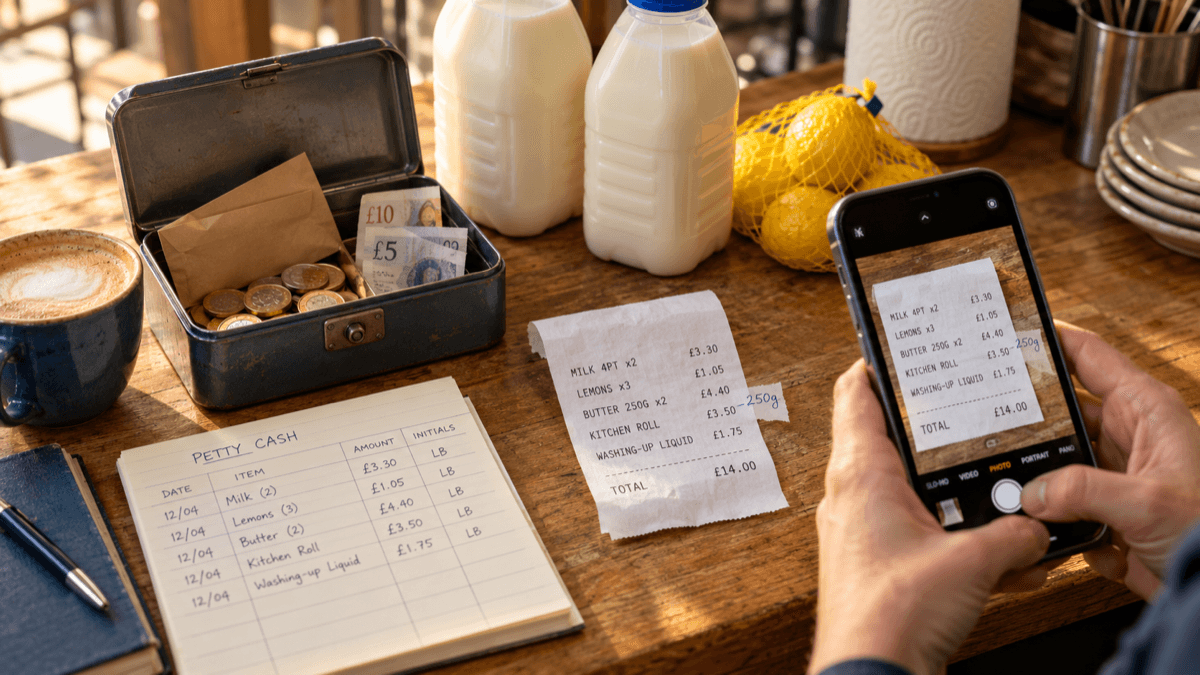
It's twenty to eleven on a Thursday. The dairy drop came up two cartons short, the lemon drizzle needs lemons, and the queue is out the door. Someone takes a £20 note from the till, runs to the supermarket and comes back fifteen minutes later with milk, lemons, a couple of packs of butter, some kitchen roll and £6 change.
Nothing about that is a problem. It's what keeps a café open.
The problem is what happens next. The £6 goes back in the drawer. The receipt goes in an apron pocket, or on the shelf by the coffee machine, or straight in the bin. By the end of the week nobody remembers it, and £14 of real spending has vanished from your books.
This is not a lecture against the supermarket
I've written before about where your café should buy, between wholesaler, cash and carry and supermarket. The short version: a well-run café uses all three. For small quantities the supermarket is often the cheapest place to get something, and it's always the fastest.
Two pints of milk on a Thursday morning do not justify a minimum order from your dairy. Three lemons do not justify a case. Buying them at retail is a perfectly sensible decision.
What isn't sensible is letting that spending live outside your system. A supermarket run that's captured is a cost you can see and manage. A supermarket run that isn't is a small leak, and small leaks that happen twice a week add up.
Six ways a £14 receipt goes missing
1. The receipt is lost, or it fades
Most till receipts are printed on thermal paper. Heat, light and time fade it, so a receipt left in a coat pocket or on a sunny office windowsill can be close to blank by the time anyone looks at it. The shoebox you promise to sort at month end is full of receipts that will be hard to read by the time you do.
2. The cash comes out of the till float
Taking a note from the till is the quickest way to pay, and it causes the most confusion later. At cashing up the drawer is £14 short, and unless someone left a note, it looks like a mistake or worse. Lots of the phantom variance I talk about in daily cashing up and till variance is exactly this: the float being raided for petty cash.
Even when someone does leave a note, you now have a supplies cost tangled up with your takings. Your sales figure is wrong, your cash figure is wrong, and the cost is nowhere.
3. Someone pays on their own card and never claims it back
A manager pops out on her lunch break and pays on her own debit card. She means to claim it. She doesn't. Or the owner uses a personal card because it's quicker, and the spending never gets recorded as a business cost at all.
That's unfair on the member of staff, and it quietly distorts your numbers. Costs that never reach your books make your profit look higher than it really is, and that profit is the figure your tax is worked out on. In effect you pay tax on milk you bought and never claimed.
4. The VAT is never reclaimed
If you're VAT registered, some of what's on that receipt carries VAT you're entitled to claim back. Most food doesn't. HMRC's food VAT guidance says "Most food of a kind used for human consumption" is zero-rated, which covers your milk, lemons and butter.
The exceptions are where the VAT hides on a supermarket receipt. Standard-rated items include:
- Confectionery, "apart from cakes and some biscuits"
- Crisps and "roasted or salted nuts and some other savoury snack products"
- Soft drinks: lemonade, cola, mixers, cordials and squashes, and bottled water sold as a drink
- Ice cream
- Anything that isn't food: cleaning products, kitchen roll, bin bags, foil, cling film, batteries
An aside that confuses people: the food you buy is usually zero-rated even though you charge VAT when you sell it as catering. That's normal. What matters is the rate on the receipt.
The good news is that a supermarket receipt can count as valid evidence. HMRC's VAT Notice 700 allows a simplified, "less detailed" VAT invoice where the supply is £250 or less. It must show the seller's "name, address and VAT registration number", "the time of supply (tax point)", "a description which identifies the goods or services supplied", and "for each applicable VAT rate, the total amount payable, including VAT, and the VAT rate". Most big supermarket receipts are built to do this. The detail is in what makes a valid VAT invoice, including what to do when a receipt falls short.
But none of that helps if the receipt is in the bin.
5. The price never reaches your recipe costs
Your recipe costs are only as good as the prices behind them. If your milk price comes from the dairy invoice and a third of your milk actually comes from the supermarket, your flat white is being costed on a price you don't always pay.
Sometimes the supermarket price is higher, sometimes it's lower. Either way, your costing doesn't know, and your gross profit on paper drifts away from your gross profit in the bank.
6. The receipt doesn't say what size anything was
This one catches out even the tidy operators. Wholesale invoices give you a pack size: 12 x 2L, 10kg, case of 6. Supermarket receipts often don't. You might see:
- "MILK 4PT" (fine, you can work with that)
- "LEMONS X3" (three lemons, but how much juice and zest?)
- "BUTTER" with no weight at all
- "KITCHEN ROLL" with no count of rolls
A price with no quantity can't become a cost per gram or per millilitre. So even when the receipt survives, half the lines are no use to your costing.
What that £14 receipt actually contains
Here's the Thursday run as an illustrative receipt, using made-up but realistic prices.
| Line | Qty | Price | VAT rate |
|---|---|---|---|
| Milk 4pt | 2 | £3.30 | Zero |
| Lemons | 3 | £1.05 | Zero |
| Unsalted butter 250g | 2 | £4.40 | Zero |
| Kitchen roll 4 pack | 1 | £3.50 | Standard |
| Washing-up liquid | 1 | £1.75 | Standard |
| Total | £14.00 |
The zero-rated food comes to £8.75. The standard-rated lines come to £5.25 including VAT, and at 20% the VAT inside a VAT-inclusive price is one sixth, so that's £0.88 of reclaimable VAT (£5.25 ÷ 6 = £0.875).
Eighty-eight pence doesn't sound worth chasing. Now make it twice a week for a year:
- 104 runs at £14 = £1,456 of spending that needs to reach your books
- 104 x £0.88 = £91.52 of VAT you could have reclaimed, and that's before the bigger standard-rated runs for cleaning chemicals or bin bags
- Every milk and butter price on those receipts that never makes it into your recipe costs
None of these numbers is dramatic on its own. Together, they're the difference between books you can trust and books that are roughly right.
A simple petty cash system that works in a café
You don't need software or a policy document for this. You need a tin, a rule and twenty minutes a month.
Use a separate float, kept topped up to a fixed amount
Keep petty cash completely separate from the till. A fixed sum, say £100, lives in its own tin or zipped bag, and the till float is never touched for purchases.
The standard way to run it is called the imprest system, and it's simpler than it sounds. The rule: at any moment, cash in the tin plus receipts in the tin always equals £100. When you top it up, you put back exactly what the receipts add up to, no more and no less.
An illustrative fortnight:
| Date | What | Spent |
|---|---|---|
| Thu | Milk, lemons, butter, cleaning | £14.00 |
| Sat | Eggs and cream | £8.60 |
| Tue | Bin bags, foil, sponges | £21.35 |
| Thu | Milk and oranges | £6.20 |
| Total | £50.15 |
The tin should now hold £49.85 in cash and four receipts adding up to £50.15. You top it up with £50.15 to bring it back to £100, and the four receipts go off to be processed.
If the tin only holds £47.85, you're £2 out. That's usually a receipt that didn't come back or change counted wrong, and you've found it in a fortnight rather than at year end.
Give the tin an envelope and a log
Inside the tin, an envelope for receipts and a slip of paper with four columns: date, what, how much, initials. It takes ten seconds to fill in and it means a missing receipt still leaves a trace.
If someone genuinely loses a receipt, they write it on the log and initial it. That's not VAT evidence, but it keeps the cash balanced and keeps the cost in your books.
Photograph the receipt the same day
This is the habit that does most of the work. Before the receipt goes in the envelope, someone takes a photo of it, flat, whole and readable, with the store name and VAT number in shot.
HMRC's guidance on keeping VAT records says that if "the image is retained and contains all the detail required for VAT purposes", you don't need to keep the original, unless it's needed for another purpose. A clear photo taken on the day beats a faded original found in March. Records generally need to be kept "for at least 6 years", so the photo needs to live somewhere sensible, not just on someone's phone.
Two small additions that make the photo much more useful:
- Write the pack size on the receipt if it's missing. "Butter, 250g" in biro next to the line takes five seconds.
- Or take a second photo of the pack when it's something you don't usually buy.
One card for supplies, not five
If you'd rather not handle cash, a single business debit card for supplies works just as well, kept in the office or with whoever's running the shift. Every payment shows on the business bank account, so nothing hides on a personal card.
The receipt still matters. The bank statement tells you £14 left the account. Only the receipt tells you it was milk, lemons and kitchen roll, and which part carried VAT.
If someone does use their own card, make paying them back the norm, not a favour. Refund them from the tin against the receipt, or put it through as an expense claim that week. Nobody should be out of pocket for keeping your café open.
Decide who's allowed to do a top-up run
A top-up run is an unplanned order by another name. Whoever's allowed to take £20 to the supermarket should be the same people you trust to place supplier orders, with the same limits. A shift lead buying milk because the drop was short is fine. A new starter buying a £40 bag of coffee because they couldn't find the delivery is a different conversation.
It also helps to agree what the run is for. Emergencies and genuine gaps, yes. If the same thing ends up on a supermarket receipt every week, it belongs on a proper order instead.
Reconcile it once a month
Once a month, count the tin, add up the receipts, check the log, and top it up. Then check the receipts have all reached the books, coded to the right places: food and drink to cost of sales, cleaning and sundries to their own lines.
It slots easily into a weekly bookkeeping routine as part of the monthly hour. While you're at it, read the month's receipts as a list. Three supermarket milk runs a week is telling you something about your dairy order.
Where the receipts go once they're photographed
The photo is the hard part. After that, a receipt still needs typing in, splitting by VAT rate, coding, and matching to the ingredients in your recipes, which is exactly the job that slips.
This is what CostingBrik does with supermarket receipts as well as wholesale invoices: you photograph the receipt, it reads the lines, tracks the prices against your ingredients so your recipe costs see what you actually paid, and sends a draft bill to Xero or QuickBooks with the receipt attached. You still decide what it means. You just don't have to type it.
But any decent system only works if the receipt reaches it. That part is the tin, the photo and the habit.
The takeaway
The supermarket dash isn't the problem. A £14 run for milk and lemons is a sensible, cheap way to get through a short delivery. The problem is when it disappears from your books.
- Never pay for supplies out of the till float. Keep a separate petty cash tin with a fixed amount.
- Run it on imprest: cash plus receipts always equals the float, and you top up exactly what was spent.
- Photograph every receipt the same day, whole and readable, and write the pack size on it if it's missing.
- Use one card for supplies and pay staff back promptly when they use their own.
- Claim the VAT on the standard-rated lines: cleaning, paper goods, soft drinks, confectionery and crisps.
- Reconcile the tin monthly and read the receipts as a list. Repeat runs for the same item are an ordering problem.
Every receipt that reaches your books makes your costs, your VAT and your profit figure a bit more honest. The ones that don't are just money you can't see.
Ed O'Brien has run Hunters Cake Company for 17 years across cafés in Witney, Burford, and a bakery in Carterton, Oxfordshire. He's building Brikly - modular tools that give independent café owners the same data the big chains have, without the big chain price tag.