
Turning the school holidays into family trade without denting your margin
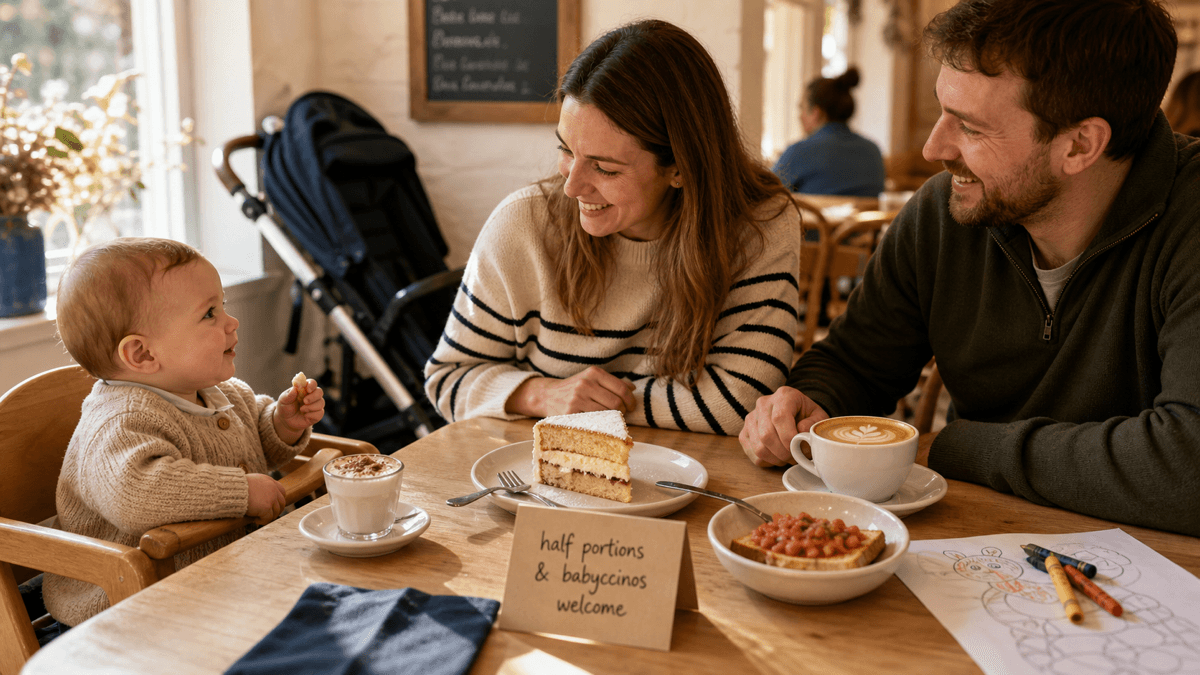
For six weeks from late July, the shape of your day changes. The commuters thin out, the school run vanishes, and in walks a different customer: a parent with two kids, a buggy, and a whole morning to fill.
Handled well, this is some of the best trade of the year. Handled badly, it is a scrum of jammed doorways, tired toddlers and one shared babyccino on a table that should be turning three covers.
The instinct is to reach for a kids menu. Resist it. The family trade you want in August is won on readiness and pacing, not on a discounted offer that quietly bleeds your margin.
Why August families are worth more than tourists
If you trade in a visitor town, you already know the summer rush brings strangers who spend once and never return. The whole tourist-season playbook is built around that single fact: you win on the one transaction because there is no second one.
School-holiday families are the opposite. These are mostly local parents, off work or juggling childcare, looking for somewhere to land within a few miles of home. Get it right in August and you are not banking one visit. You are auditioning for the other forty-six weeks of the year.
That flips the payoff logic entirely. With a tourist, you push spend hard on the one visit because it is all you will ever get. With a local family, the babyccino you get right in August is the reason they choose you over the chain in October, and again at half term, and again for the birthday party. The margin you are protecting is not just today's ticket. It is a regular.
So the goal in August is not to extract the most from each family. It is to be the café that families find genuinely easy, so they keep coming back once the schools go in.
Get the room ready before you touch the menu
Most cafés lose family trade before a single order is taken. The parent scans the room from the doorway, does the maths on manoeuvring a buggy and a toddler through it, and walks on. None of this shows up in your sales data, because the sale never happened.
Before you think about what families eat, make the room work for them.
Count your high chairs, then check them
Two high chairs is not enough for a busy August morning. Families cluster, and a group of three mums will arrive with three little ones between them. If you turn one away because you are a chair short, you have often lost all three.
Then look at the chairs you have. A wobbly clip, a cracked tray, a strap that no longer fastens, these are the details a parent clocks in a second and quietly judges. Cheap to replace, expensive to ignore. Give them a proper wipe-down between uses too, because a crumb-covered tray tells a parent everything about how you run the place.
Make the door and the floor buggy-friendly
A buggy is a wheelbarrow with a baby in it. If your entrance has a step, a heavy self-closing door and a tight turn, you have built an obstacle course for exactly the customer you are trying to win.
You cannot always move a wall, but you can:
- Keep a clear route from door to a couple of accessible tables
- Prop or wedge the door at busy family times where it is safe to
- Agree a buggy parking spot, a corner or a bit of wall, so prams are not blocking the flow
- Reserve the roomier tables near the window for the pushchair crowd at peak
Sort somewhere to change a nappy
You do not need a fitted baby-change suite. You need a clean, flat surface, a bin, and to have thought about it before a parent asks with a wriggling one-year-old and a full nappy. Even a fold-down mat in an accessible loo, mentioned on a small sign, turns a stressful moment into a reason a parent trusts you. The cafés that get chosen by mum-and-baby groups are almost always the ones that solved this quietly.
Serve children well without a separate menu
Here is where operators talk themselves into trouble. They decide family trade needs a printed children's menu, separately priced, ideally cheap. Before long a six-week footfall pattern has triggered a permanent, margin-eroding fixture.
I have made the full case elsewhere for why an indie café should not bolt on a loss-leading kids' menu, and that post covers the VAT mechanics too, so I will not repeat the maths here. The short version: a distinct kids' menu is a chain's tool, and copying it costs you far more than it earns.
You can serve children brilliantly without one. The trick is mechanics, not a menu.
Split an adult dish
Most café mains split cleanly into two child portions, or one child plus a bit extra for a parent. Beans on toast, a bowl of pasta, half a jacket potato, a round of sandwiches cut small. You are not creating a new product or a new price line. You are plating an existing dish differently and charging for a plate.
Because it is the same dish off the same costed recipe, your margin is intact. There is no new VAT code, no reprint, no retraining on which items qualify for what. It is a portion decision made at the pass, the way it has always been done in a real kitchen.
Offer a half portion off the board
A "small" version of something you already make, sold at a sensible fraction of the full price, does everything a kids' menu does with none of the baggage. A half bowl of soup, a single crumpet, a mini version of the bake. It reads as thoughtful to a parent and it stays entirely inside your existing costings.
Price the half at more than half. A small portion carries almost the same plating, service and wash-up as a large one, so charging exactly 50% quietly hands away margin. Costing each component properly is what tells you where that line sits, and it is the difference between a half portion that helps and one that leaks.
Let the babyccino do the emotional work
The babyccino is the single best-value thing on your counter. Frothed milk, a dusting of chocolate, pennies of cost, and a toddler who feels like a grown-up with a coffee. It is not really about the drink. It is about the parent seeing that you get it, and it opens the door to the add-on that actually pays.
That add-on is the whole game. A babyccino rarely walks in alone. It comes with a flat white for mum, a slice of cake to share, a bake for the older one. Getting that attach right lifts the family ticket far more reliably than any discount, and it does it while the family feels looked after rather than upsold. The margin comes from the plate of cake and the second coffee, not from squeezing the children's food.
Pace the family lunch surge
The family rush does not arrive when your normal lunch does. With the whole household off school, the pattern shifts: a mid-morning wave of coffee-and-babyccino stops, and a lunch that lands early and lingers. Families eat at half eleven because a three-year-old will not wait until one, and then they stay, because there is nowhere they need to be.
That does two things to your operation. It pulls your peak forward, and it slows your table turns right down. A family of four settling in for ninety minutes is lovely trade, but it is not the same seat maths as a quick solo lunch.
Plan for it:
- Prep the family favourites early. If beans, pasta and jacket potatoes are what sells to this crowd, have them ready before eleven, not scrambling at noon.
- Staff the shoulder, not just the middle. Your family peak may hit at 11:30 and 12:00, ahead of your usual lunch line. Check your own data before you set the rota, because the holiday curve is not the term-time one.
- Accept the longer dwell and price the room for it. Slower turns are fine if the ticket is right. A family lingering over two coffees, a shared cake and two child plates is earning its table. One babyccino for ninety minutes is not, which is exactly why the attach matters.
Don't confuse this with the afternoon lull
One trap worth naming. The pre-school-run parent trade, the babyccino-and-a-quick-coffee crowd in the quiet hours, is a real and useful segment, but it belongs to a different problem. I have covered positioning your café for who is free in the quiet afternoons separately, and toddler groups and parents-before-pickup live there.
August family trade is a different animal. It is a genuine daytime surge, not a way to fill a dead hour, and the risk is under-preparing for a busy morning rather than finding customers for an empty one. Keep the two straight, because the levers are opposite: one is about capacity and pace, the other is about drawing people in when the room is empty.
The takeaway
The school holidays hand you six weeks of local families sizing you up. Win them and you are not banking a summer spike, you are recruiting the regulars who carry you through the quiet winter months.
You do that with readiness, not discounts. Count your high chairs and check they are not falling apart. Make the door and the floor work for a buggy. Sort somewhere to change a nappy before someone has to ask. Serve children out of your existing kitchen with split plates and half portions, so your margin stays whole. Then let the babyccino open the door to the cake and the second coffee that actually pay.
Get the room right and the rest follows. A family that had an easy morning with you in August is the one that walks past the chain and comes to you in October. That is the real prize, and it costs you a bit of thought, not a dented margin.
Ed O'Brien has run Hunters Cake Company for 17 years across cafés in Witney, Burford, and a bakery in Carterton, Oxfordshire. He's building Brikly - modular tools that give independent café owners the same data the big chains have, without the big chain price tag.