
Supplier deliveries over Christmas: cut-offs, double drops and what's in the fridge when you shut
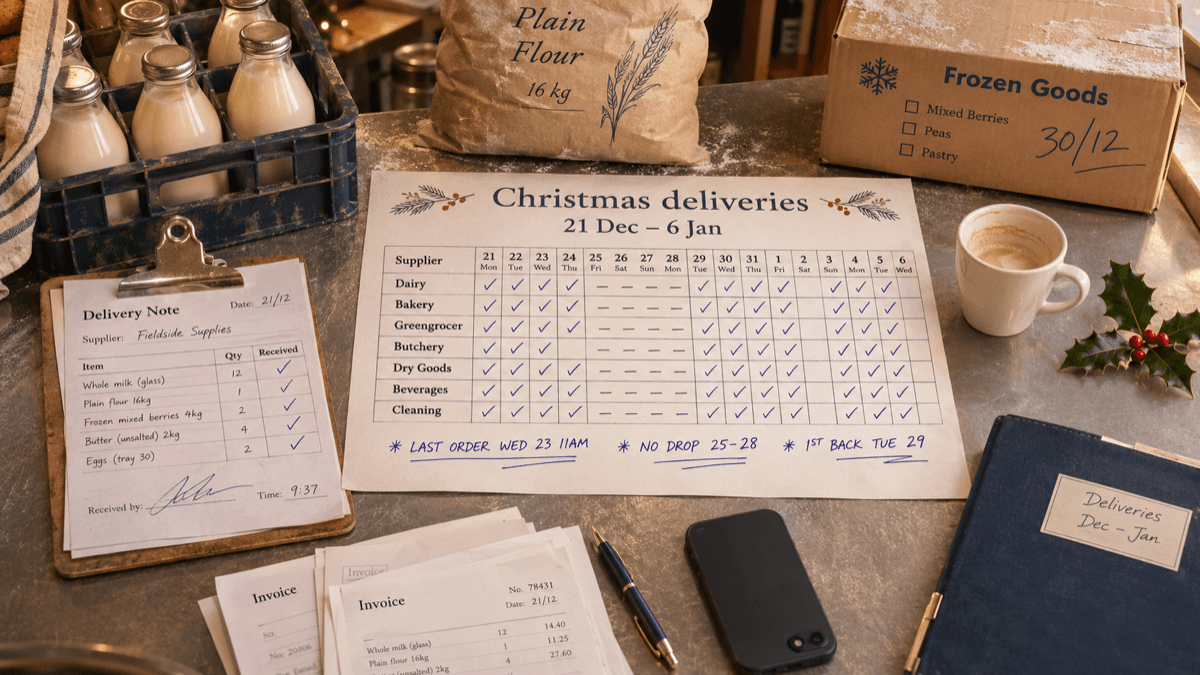
Every supplier you use has already decided its Christmas: which days the vans run, when the order office shuts, and when it opens again. Too often the first you hear of it is a photocopied sheet in a crate a week before the last order date.
By then you're planning three weeks of stock around someone else's dates with a few days' notice. Then January brings the rest: a delivery charge on a small restart order, a price list you never saw, and no credit for the milk that was short on Christmas Eve.
This is the supplier side of the festive break. Get every calendar in writing now, put them on one page, size each drop by the days you'll actually trade, decide what to run down, freeze or give away before you shut, and read the first invoices of the year line by line.
(Bank holiday dates: all UK nations, from GOV.UK. Food hygiene rules quoted: England, Wales and Northern Ireland, with Scotland's difference noted. VAT: UK-wide.)
The calendar your suppliers are working to
Christmas Day 2026 is a Friday, so the Boxing Day bank holiday moves to the Monday. GOV.UK's bank holiday list gives:
- Friday 25 December: Christmas Day, all UK nations.
- Monday 28 December: Boxing Day (substitute day), all UK nations. Saturday 26 December is not a bank holiday this year.
- Friday 1 January 2027: New Year's Day, all UK nations.
- Monday 4 January 2027: 2 January (substitute day), Scotland only.
For a supplier, that's two long weekends a week apart, each running Friday to Monday for anyone who doesn't work Saturdays. Expect earlier cut-offs, fewer drops and some deliveries moved to unusual days. In Scotland, Monday 4 January may be one more day with no van.
Your own opening days come first, because they decide what you need. If you haven't settled them yet, run each day from Christmas Eve to 2 January on profit after wages before you order anything. The suppliers' calendars then decide when it can arrive.
Ask every supplier, in writing, this week
Not just the broadline wholesaler. Every account: dairy, greengrocer, butcher, bread, coffee roaster, drinks, packaging, the flour merchant, cleaning chemicals. Send one email to each with five questions:
- Last order before Christmas: the date and time, and which delivery it lands on.
- No-delivery days: every date between Thursday 24 December and Monday 4 January with no drop.
- Office and portal hours: when the order desk closes and reopens, which tells you when the first order back has to go in.
- First drop back: the date, and whether your normal delivery days change for the first week of January.
- January prices: whether a new price list is coming, and the date it applies from.
A phone call that ends with "should be fine" isn't a calendar. The written reply is also your evidence later, if a January invoice bills a price nobody told you about.
That last question matters more than it looks. One foodservice supplier's terms of trade say plainly: "Prices are fixed on the day of delivery, not when the goods are ordered." On terms like those, an order you place on 23 December for delivery on 5 January is billed at January's price. Check your own suppliers' terms for the same line.
Cancel the standing orders, date by date
Dairy and bread often run on standing orders that turn up whether you're open or not. Cancel each closed day in writing and ask for a reply confirming it.
A van at a locked door is never free. It either leaves crates on the step, where chilled stock warms up and anyone can help themselves, or drives off and charges you to come back. One catering supplier's terms say a failed delivery means "a redelivery fee will be required to have the order sent out a second time".
Put every supplier on one page
Here's how the replies might look for a hypothetical business: a town café plus a small production bakery that bakes for it. Both close from 2pm on Christmas Eve until Tuesday 29 December, and again on New Year's Day. Every supplier and date below is illustrative.
| Supplier | Normal drops | Last order | Last drop | No drops | First drop back | Order first drop by |
|---|---|---|---|---|---|---|
| Dairy (milk, cream, butter) | Mon to Sat | Wed 23, 11am | Thu 24 | Fri 25 to Mon 28, Fri 1 | Tue 29 | Thu 24 (office shut 25 to 28) |
| Fruit and veg | Mon to Sat | Wed 23, 2pm | Thu 24 | Fri 25 to Mon 28, Fri 1 | Tue 29 | Thu 24 |
| Broadline wholesaler (chilled, frozen, dry, packaging) | Tue and Fri | Mon 21, 4pm | Wed 23 | Thu 24 to Tue 29, Thu 31 to Mon 4 | Wed 30, then Tue 5 Jan | Mon 28 on the portal |
| Coffee roaster (courier) | Tue, weekly | Thu 17, for Tue 22 | Tue 22 | Roastery shut 24 Dec to 3 Jan | Wed 6 Jan | Mon 4 Jan |
| Flour and bakery merchant | Alternate Thursdays | Mon 14 | Thu 17 | Next scheduled drop, Thu 31, cancelled | Thu 7 Jan | Mon 4 Jan |
Three things jump out once it's on one page:
- The first day back is fed by the dairy and the greengrocer. The wholesaler doesn't come until Wednesday 30, so Tuesday 29 runs on what they bring plus whatever survived in the freezer. Anything chilled from the wholesaler's Wednesday 23 drop has to last until Tuesday 29, or it isn't on Tuesday's menu.
- Some first orders back have to be placed before you shut. The dairy and greengrocer are closed from 25 to 28 December, so Tuesday's order goes in on Christmas Eve, before you lock up.
- The real double drops are the quiet suppliers. Coffee has to stretch from 22 December to 6 January. Flour has to stretch three weeks instead of two. Nobody thinks about either until the bakery is scraping the last sack.
Print it, pin it by the ordering sheet, and give a copy to whoever places orders when you're off.
Size each drop by trading days, not calendar days
The par level formula still does the work: daily usage times days to cover, plus a buffer, minus what's on hand. At Christmas, "days to cover" is the bit that goes wrong.
Count trading days, not calendar days, and weight each one by how busy it will be. Use the takings forecast from your opening-days plan: a normal day is 1.0, a short or quiet day is less, a busy one more.
Worked example: the wholesaler's Wednesday 30 drop
Wednesday 30's drop has to last until Tuesday 5 January. That's six calendar days, which feels like nearly double a normal drop. Here's what it really covers:
| Day | Open? | Weight |
|---|---|---|
| Wed 30 Dec | Yes | 1.0 |
| Thu 31 Dec | Until 3pm | 0.6 |
| Fri 1 Jan | Closed | 0 |
| Sat 2 Jan | Yes | 1.1 |
| Sun 3 Jan | Yes | 0.9 |
| Mon 4 Jan | Yes, quiet | 0.7 |
| Total | 4.3 |
A normal Friday drop covers Friday to Monday: 1.0, 1.2, 1.0 and 0.8, or 4.0. So the "double drop" is really about 8% bigger than a normal weekend. Order it as six days and you'll be binning chilled stock on 6 January.
Here's how a few lines work out for both sites together, with a 15% buffer. The usage figures are illustrative.
| Line | Use per normal day | x 4.3, plus 15% | On hand Tue 29 | Order |
|---|---|---|---|---|
| Frozen croissants (cases of 60) | 40 | 198 | 45 | 3 cases (180) |
| Mature cheddar (2.5kg blocks) | 1.1kg | 5.4kg | 1.5kg | 2 blocks (5kg) |
| Sliced cooked ham (1kg packs) | 0.9kg | 4.5kg | 0 | 5 packs, then the check below |
| 12oz takeaway cups (cases of 1,000) | 180 | 890 | 1,400 | None |
Four checks before you confirm any line
- Shelf life. The date on the pack has to reach the last day the drop covers, and so does the opened life. If the ham's use-by is 3 January, or an opened pack only keeps three days, the par doesn't matter. Order less, or freeze a pack the day it arrives, labelled with the date.
- Fridge and freezer space. Count the shelves before you order. A freezer already holding the festive bake bank won't take three more cases.
- Cash. Bigger drops mean bigger invoices, and they arrive in a month of heavier wages. More on that below.
- The minimum. Trimming a drop to the trading days can push it below the free-delivery threshold. Sometimes paying the carriage is cheaper than padding the order with stock you'll bin.
The genuine double drops
The coffee roaster's Tuesday 22 delivery has to cover the café until Wednesday 6 January. Weighting the days the same way (22, 23, the half day on 24, then 29, 30, the short 31st, 2, 3, 4 and 5 January) gives about 8.5 trading days against a normal week's 7.
At an illustrative 16kg a week, that's 2.3kg a day, so 8.5 days plus 10% comes to about 22kg in one delivery. Ask your roaster how long they'd stand behind the beans, and keep them sealed and somewhere cool.
Flour works the same way, except the extra needs pallet space in the dry store as well as cash. Long-life lines are where you can afford a bigger buffer: the cost is shelf space and money tied up, not the bin.
December's cash pinch
December pays for a lot at once: the pre-Christmas drops, the coffee and flour doubles, the year's heaviest wage bill, and any festive premiums. If your VAT quarter ended on 31 October, the payment is due one calendar month and seven days later, according to GOV.UK's VAT deadlines. That's 7 December.
Then the invoices for December's bigger drops come due, on 14 or 30-day terms, in the quietest weeks of January. Put each one on your 13-week cash flow forecast now, on the date it's due, not the date it arrives.
Before you shut: run it down, freeze it or give it away
In our example, the café closes at 2pm on Christmas Eve and doesn't open again until Tuesday 29. Everything in the fridges goes into one of three piles.
Run it down
Anything whose use-by falls before you reopen, plus every opened pack: milk, cream, sliced meats, made-up fillings, salad, cut fruit, fresh-cream cakes. Plan the last two days around clearing it. Shrink the counter, put the leftovers into a special, and size the final bake so the trays are empty by two.
Order the 23rd and 24th deliveries for Christmas Eve's half day only. A full Thursday order for a café that shuts at 2pm is four days of waste.
Freeze it
GOV.UK's chilling and freezing guidance is short: "freeze fresh food before its use-by date and note the date you froze it", and "label everything you freeze". Defrost in the fridge when you need it.
Freeze on the 23rd, while things are at their best, not at 2pm on Christmas Eve. The freezer works as a production tool for un-iced sponge, traybakes, raw scone and cookie dough, bread and soup. It doesn't work for fresh cream, salad or anything that has already done two days on the counter. And leave room for the frozen lines coming on Wednesday 30.
Give it away
The Food Standards Agency's guidance on food donation draws the line at the date mark. Food "cannot be sold, redistributed or consumed after the use-by date", unless it was frozen or cooked before that date and relabelled. Food with a best before date "can be legally sold, redistributed, and consumed after this date", if it's still good enough to give. WRAP's surplus food redistribution guidance, written with the FSA and Defra and updated in November 2024, covers the relabelling.
Then pick a route, and set it up now rather than on Christmas Eve:
- Staff first. Decide the rule in advance so the last hour isn't a free-for-all.
- A surplus app on the final afternoon. Apps like Too Good To Go mop up what's left at a small price. They're a clearance channel, not a substitute for ordering less.
- Olio's volunteers. Its Food Waste Heroes programme collects from food businesses. Olio says charities get first call on surplus, and its volunteers take what's left, "like same-day use-by food".
- A community fridge. Hubbub's Community Fridge Network lists over 700 across the UK, taking surplus from local businesses as well as supermarkets. Ring yours before the 24th to check they're open and have room.
The fridges themselves
Decide which fridges stay on. Empty the rest, clean them, switch them off and prop the doors open so they don't go mouldy.
For the ones that stay on, check the temperature as you leave and again first thing when you're back. GOV.UK says chilled food "must be kept at 8°C or below", a legal requirement in England, Wales and Northern Ireland and a recommendation in Scotland, and advises setting fridges to 5°C or below. If you come back to a warm fridge and can't say how long it's been warm, the stock goes in the bin.
The first invoices of January
The first week back brings three kinds of surprise. All three can be caught before you pay.
Small restart orders and the minimum
January starts quiet, so the first orders back are small, and small orders fall under the free-delivery threshold. A £110 order with an illustrative £15 carriage charge has 13.6% added to it before anyone touches a croissant.
The fixes are the same as any week, just more pressing: combine the first two orders, skip a drop, or move a line to the supplier you're already above the minimum with. Minimum orders and delivery charges are part of the landed cost, so cost them like any line.
Prices dated 1 January
This year the January price list deserves a proper read. The BRC's October shop price monitor put food inflation at 2.9%, with ambient food up to 3.2% from 2.2% in September, and its chief executive said "the dam is starting to break" on costs retailers have been absorbing. The ONS put food and non-alcoholic drink inflation at 1.3% in September, but noted that the Food and Drink Federation expects food inflation "to arrive later and persist for longer".
Neither tells you what your supplier will charge, but together they suggest a January letter is likely. So check the first invoice from each supplier against December's prices for your top 20 lines, and against the January price list you asked for in writing. If your invoices go through CostingBrik, a line whose price has moved since the last invoice shows a "Price change detected" alert, which makes the check quicker. Either way, re-cost the dishes that use anything that moved.
Credits for anything short
The festive drops are the biggest of the year, so a short on one costs more. And the window to claim is short. One catering supplier's terms say to "report any damages, shortages, errors to us within 24 hours", and if there's no time to check, "this must be stated on the delivery note". Another's terms want shortages claimed at the depot "on the day of delivery", and warn that claims "made against invoices signed unchecked, may not be honoured".
So a short in Christmas Eve's drop that you find on 29 December is five days out of time. Count the Thursday 24 delivery at the door, however busy you are. If something's missing and the office has already shut, email the claim straight away so it carries a timestamp, and write it in your claims log. Credit notes are money your suppliers owe you, but only if the claim is made in time and chased.
Before the year closes: a December invoice and credit check
Give this half an hour in the week of 14 December, while account managers are still at their desks.
- Chase every open claim. Anything in the claims log that's promised but not credited gets an email quoting the delivery note number. A claim nobody chases before Christmas tends to be forgotten by January.
- Check each credit note against HMRC's list. VAT Notice 700 says a valid credit note shows, among other things, the number and date of the original VAT invoice. A credit note that doesn't quote it is hard to match, and easy to lose.
- Send back the crates and pallets. Some terms charge for crates kept and not returned, and the festive drops leave the most of them behind.
- Watch the invoice that straddles the year. Under the 14-day rule, an invoice issued within 14 days of delivery takes its tax point from the invoice date. So a 30 December drop invoiced on 4 January lands in January for VAT, which matters if your quarter ends on 31 December. In your own management figures, the stock still belongs to December.
- Diary the December statement. It arrives in early January. Reconcile it against your invoices and credit notes before you pay it, which is where a credit that never got applied turns up.
The template
Copy this into a spreadsheet, one row per supplier, and fill it in as the replies come back.
| Column | What goes in it |
|---|---|
| Supplier and account number | |
| Account manager and holiday cover | Name and mobile |
| Normal drop days | |
| Last order before Christmas | Date, time and which drop it lands on |
| Last drop | |
| No-drop days, 24 Dec to 4 Jan | Every date |
| Standing orders cancelled | Dates, and the confirmation email |
| Order desk closed | From and to |
| First order back | When it must be placed |
| First drop back | |
| Minimum order and carriage | |
| New prices from | Date, and whether you have the list |
| Claim window | Hours, from their terms |
| Trading days covered by each festive drop | Weighted |
This week
- Email every supplier the five questions: last order, no-drop days, office hours, first drop back and January prices.
- Cancel standing orders for every closed day, in writing, and keep the confirmations.
- Build the one-page calendar as the replies arrive, and mark the drops that cover a closure.
- Weight each festive drop by trading days, then size it with your pars, checking shelf life, space, cash and the minimum.
- Set up a giveaway route now: a surplus app, Olio or your nearest community fridge.
- Plan the last two days before each closure to clear chilled stock, and freeze on the 23rd, not the 24th.
- Chase open claims in the week of 14 December, and diary the January statement and price checks.
Your suppliers' Christmas is already decided. Yours goes better when it's written on the same page.
Ed O'Brien has run Hunters Cake Company for 17 years across cafés in Witney, Burford, and a bakery in Carterton, Oxfordshire. He's building Brikly - modular tools that give independent café owners the same data the big chains have, without the big chain price tag.