
Should you open between Christmas and New Year? Run the numbers day by day
Somewhere in the second week of December, a regular will ask whether you're open between Christmas and New Year. You'll say "same as last year": a decision made twelve months ago, on a different calendar.
The festive fortnight is the one stretch where trade turns inside out. Cafés near offices go quiet once the last work do ends, while town-centre and visitor-town cafés can have some of their best days of the winter. And each of the ten days from Christmas Eve to 2 January has its own staffing problem: who's free, who's owed a day off, who expects time and a half.
So decide each day, not the fortnight, on what it's likely to earn after wages: open, short hours or closed.
(Bank holiday dates: all UK nations, from GOV.UK. Employment rules: Great Britain.)
The 2026 calendar, and the day that isn't a bank holiday
Christmas Day 2026 is a Friday, which pushes the Boxing Day bank holiday to the Monday. GOV.UK sets out the rule: "If a bank holiday is on a weekend, a 'substitute' weekday becomes a bank holiday, normally the following Monday."
- Friday 25 December: Christmas Day, a bank holiday across the UK.
- Saturday 26 December: Boxing Day on the calendar. GOV.UK lists Monday 28 as the Boxing Day bank holiday and does not list Saturday 26.
- Monday 28 December: Boxing Day (substitute day), a bank holiday across the UK.
- Friday 1 January 2027: New Year's Day, a bank holiday across the UK.
- Saturday 2 January 2027: Scotland's 2 January holiday falls on a Saturday, so its substitute day is Monday 4 January, outside the fortnight. The rest of the UK has no 2 January holiday.
The one to circle is Saturday 26. Customers will treat it as Boxing Day. A contract that gives staff the bank holidays will usually be read as meaning Monday 28, not Saturday 26, so check the wording.
Line up last year's till against this year's days
Last year's till is the best forecast you have, but it's on the wrong days: Christmas Day 2025 was a Thursday.
The shape is close, though. Both years give anyone in a weekday job a four-day break (Thursday to Sunday last year, Friday to Monday this year), then two working days, then New Year's Eve. So match each day by its place in the break, which this year means the same date, then note where the weekday or the bank holiday has moved. The exception is the final Saturday, matched by weekday, because 2 January 2026 was a working Friday outside Scotland.
| This year | Match it to | What's changed |
|---|---|---|
| Thu 24 Dec | Wed 24 Dec 2025 | Christmas Eve, the last working day before the break |
| Fri 25 Dec | Thu 25 Dec 2025 | Christmas Day, a bank holiday both years |
| Sat 26 Dec | Fri 26 Dec 2025 | A bank holiday last year, a plain Saturday now. Cross-check Sat 27 Dec 2025 |
| Sun 27 Dec | Sat 27 Dec 2025 | A Saturday last year. Cross-check Sun 28 Dec 2025 |
| Mon 28 Dec | Sun 28 Dec 2025 | Last day of the break, now a bank holiday. Cross-check Mon 29 Dec 2025 |
| Tue 29 Dec | Mon 29 Dec 2025 | First day back at work |
| Wed 30 Dec | Tue 30 Dec 2025 | The day before New Year's Eve |
| Thu 31 Dec | Wed 31 Dec 2025 | New Year's Eve, a day later in the week |
| Fri 1 Jan | Thu 1 Jan 2026 | New Year's Day, a bank holiday both years |
| Sat 2 Jan | Sat 3 Jan 2026 | First Saturday of the year, matched by weekday |
Next to each of last year's days, note three things:
- Were you open, and when? A day you were shut tells you nothing about demand. A day you closed at two only tells you about the morning.
- The weather. A wet Boxing Day and a bright one are different days.
- Anything unusual. A road closure, one person on through illness, an event in town.
Pull it by hour, not just the daily total. The total tells you whether to open; the hours tell you when.
Run each day on profit after wages
The advice for winter opening hours was to treat December as its own month. Between Christmas and New Year, treat each day as its own, using the method from profit per trading hour after wages:
- Expected takings, ex VAT, from last year's matched day, adjusted for what you know.
- Times the blended gross profit % for the day's likely mix. A Christmas Eve of coffees and boxed mince pies runs higher than a Boxing Day of lunches.
- Minus fully loaded wages for the hours and people you'd actually need.
- Minus a small energy allowance for each open hour.
If your recipes are in CostingBrik with sales volumes from your till or your own weekly estimates, its documented Margin Analysis page gives a GP% weighted by how many of each item you sell, a sensible starting blend to adjust for the festive mix.
Below, wages are £15.93 an hour fully loaded: the National Living Wage of £12.71 plus holiday, employer NI and pension, at the 2026/27 rates that apply this December. Energy is about £2.40 an hour, the 9kWh at 27p used in the winter opening hours post (use your own unit rate). Rent and rates are left out, because you pay them whether you open or not.
Ten days at an illustrative town-centre café
A hypothetical café on a market-town high street, normally open 8 to 4 Monday to Saturday and 10 to 3 on Sundays. Takings are ex VAT and invented for the example. The blended GP is 70% on Christmas Eve and 68% on every other day. Each row is the version of opening the owner tested; the last column is the decision.
| Day | Hours, staff | Takings | Gross profit | Wages | Energy | Left over | Decision |
|---|---|---|---|---|---|---|---|
| Thu 24 Dec | 8-2, 3 | £780 | £546.00 | £286.74 | £14.40 | £244.86 | Short hours |
| Fri 25 Dec | Not tested | Closed | |||||
| Sat 26 Dec | 10-4, 3 | £690 | £469.20 | £286.74 | £14.40 | £168.06 | Short hours |
| Sun 27 Dec | 10-3, 2 | £330 | £224.40 | £159.30 | £12.00 | £53.10 | Open |
| Mon 28 Dec | 10-3, 2 at time and a half | £330 | £224.40 | £239.00 | £12.00 | -£26.60 | Closed |
| Tue 29 Dec | 10-3, 2 | £290 | £197.20 | £159.30 | £12.00 | £25.90 | Short hours |
| Wed 30 Dec | 10-3, 2 | £250 | £170.00 | £159.30 | £12.00 | -£1.30 | Short hours: one person, 10-2 (see below) |
| Thu 31 Dec | 9-1, 2 | £240 | £163.20 | £127.44 | £9.60 | £26.16 | Short hours |
| Fri 1 Jan | Not tested | Closed | |||||
| Sat 2 Jan | 8-4, 3 | £720 | £489.60 | £382.32 | £19.20 | £88.08 | Open |
Gross profit is takings times GP% (£780 x 70% = £546.00 on Christmas Eve). Wages are hours times people times £15.93 (6 x 3 x £15.93 = £286.74). Energy is hours times £2.40.
The table assumes the wages go if you close: the team aren't on the rota yet, or the closed days are annual leave or bank holidays their contract already gives them off. If you'd pay someone whether you open or not, their wages drop out of the comparison, and opening only has to beat the energy and any premium.
Christmas Eve: shut at two
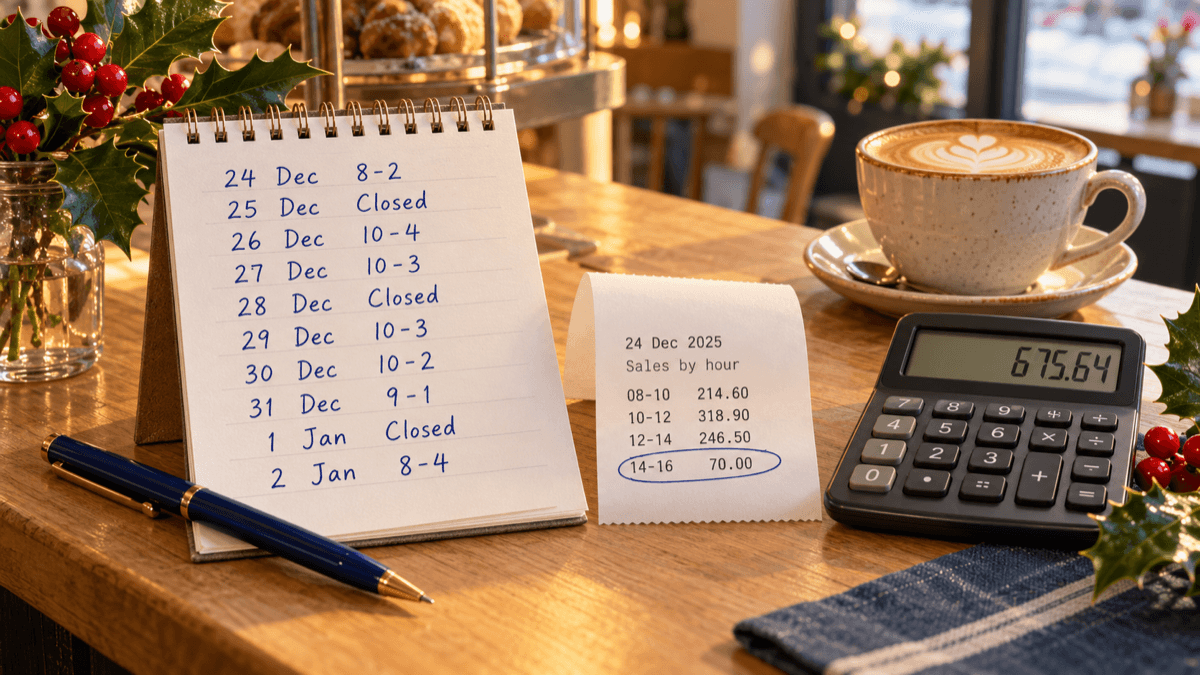
Last year's till took £70 on Christmas Eve between 2pm and 4pm. The third person finishes at two either way, so staying open means two people for two more hours: £49.00 of gross profit (£70 x 70%), against £63.72 of wages (2 x 2 x £15.93) and £4.80 of energy. That's minus £19.52, and everyone wants to be home anyway.
Boxing Day is a Saturday, at normal rates
Last year it was a bank holiday Friday. This year the bank holiday is on the Monday, so the row uses £15.93, unless you've promised a premium for "Boxing Day" rather than for "bank holidays". The 10am start is the till talking: neither last year's Boxing Day nor the Saturday after it took anything worth having before ten.
Monday 28: the premium decides it
Say this café has always paid time and a half on bank holidays: 1.5 x £15.93 = £23.895, rounded to £23.90 an hour. That slightly overstates it, because the holiday share of the £15.93 doesn't usually grow with a one-off premium, but it doesn't change the answer. Two people for five hours at the rounded rate is £239.00 (5p less unrounded) against £159.30, so the premium alone costs £79.70. It turns a day that would leave £53.10, like Sunday, into minus £26.60, and this café closes.
That rests on the table's assumption. If you'd owe the two of them a normal day's pay either way, only the premium and the energy are extra, and opening comes out £224.40 - £79.70 - £12.00 = £132.70 ahead of closing.
There's no legal duty to pay a premium, but whether you owe one comes down to your contract wording and what you've always done. Under "plus bank holidays" wording, whoever works the Monday is usually owed a day in lieu, unless the contract says you pay for it instead. That moves a paid day off rather than adding one, and the £15.93 already prices in holiday, so the figures stand.
Options short of closing
Wednesday 30 at minus £1.30 isn't a reason to close. It's a reason to open smaller: one person, counter-only, 10 to 2, with coffee, cake and a few sandwiches but no hot food. Say takings drop to £210. At 68%, that's £142.80 of gross profit, minus £63.72 of wages (4 x £15.93) and £9.60 of energy, which leaves £69.48. One person only works if they can safely open, serve, cash up and lock up alone. If not, it's two people or closed.
A reduced menu helps on all of these days: fewer lines to order, to run down before a closed day and to throw away.
With Wednesday reworked, the seven trading days leave £244.86 + £168.06 + £53.10 + £25.90 + £69.48 + £26.16 + £88.08 = £675.64 after wages and energy, before rent and everything else that's due whatever you decide. Five of the seven trading days are on short hours, because the edges of these days are where the money leaks.
Staff: availability, fairness and closed days
No law gives anyone the day off, or extra pay, on a bank holiday
GOV.UK says "Your employer does not have to give you paid leave on bank or public holidays", and Acas says whether someone works one is "up to their employer". The contract, and what you've done in previous years, decides the rest.
Ask early, and rotate
Availability is usually the real limit: students go home, parents lose childcare, and whoever worked Boxing Day last year will remember. Ask everyone for their availability across all ten days at once, in writing, with a date you'll decide by. Then use a rule that survives comparison with last year: volunteers first, rotate Boxing Day and New Year's Eve, and note who worked what.
If you need to stop people booking leave, the notice dates for refusing or blocking Christmas leave come first: a blackout of 18 to 31 December has to be sent by Thursday 3 December at the latest (Thursday 19 November on the cautious reading), and refusing a week's leave from Sunday 20 December by Saturday 12 December.
Closed days aren't free
If someone was due to work and you close, they're usually owed normal pay unless their contract has a lay-off clause, the same rule as closing for snow or storms. That's the case where the table's wages drop out.
Instead, you can usually require annual leave, subject to the contract and any custom and practice. Acas says employers can "shut over Christmas" and have staff use holiday, "even if in previous years" they stayed open, with at least twice the days as notice. Add one day to be safe and a single closed day needs three days' notice. On a "plus bank holidays" contract, Friday 25, Monday 28 and Friday 1 are already named days off and can't be charged to annual leave as well.
Payment for shifts cancelled at short notice isn't in force yet: the government's timeline, updated on 22 October, says its timing "will be updated following the consultation process". Contracts and habit still bind, and a shift cancelled on 23 December is remembered.
Supply: order for trading days, not calendar days
Your suppliers will settle their Christmas before you settle yours. Ask each one this week for their delivery calendar and last order dates, in writing. Expect earlier cut-offs, and don't assume anyone delivers on a bank holiday.
Then use the takings column as your order sheet. Sunday 27 at £330 needs less than half of Christmas Eve's milk and bread, and with Friday and Monday closed, one drop may have to carry three trading days.
Run stock down before every closed day: cream, cut sandwiches and salad must sell by close or still be in date when you reopen. Plan Christmas Eve's bake so the trays are empty at two, and watch two festive leftovers:
- Uncollected pre-orders. If your pre-order policy holds orders until close on Christmas Eve and then releases them, those cakes are counter stock for the days after. Bake less for the counter.
- Festive specials. Pick their last day now and buy to it. The margin on a properly costed Christmas sandwich disappears if the turkey outlives the special.
Tell customers once, everywhere
Decide by the end of November, then publish all ten days at once.
- Google Business Profile special hours for every date from 24 December to 2 January, including the days at normal hours. Google's special hours help says to confirm hours for official holidays "even if they're the same as your regular hours". Closing seven or more days in a row? Google says to mark the business temporarily closed instead.
- The door, in the first week of December: every date on one sign, at eye level.
- Your website and socials: the website the same day as Google, socials when the sign goes up and again on Christmas Eve.
- Pre-order collection slips: print the hours on them.
This week
- Pull last year's till for 24 December 2025 to 3 January 2026, by hour, noting your hours, the weather and anything odd.
- Line it up by place in the break, and flag Saturday 26, Monday 28 and Saturday 2 January.
- Run each day: takings ex VAT, times blended GP%, minus loaded wages and energy. Note whether the wages go if you close, then mark it open, short hours or closed.
- Read one contract: "plus" or "inclusive" bank holidays, and any premium you've promised or always paid.
- Ask the team for availability across the ten days, all at once, with a decision date.
- Ask every supplier for their Christmas delivery calendar and last order dates.
- Diary the first week of December for Google, the website and the door sign.
Last year's hours were an answer to last year's calendar. This year's deserve ten decisions of their own.
Ed O'Brien has run Hunters Cake Company for 17 years across cafés in Witney, Burford, and a bakery in Carterton, Oxfordshire. He's building Brikly - modular tools that give independent café owners the same data the big chains have, without the big chain price tag.