
Private hire in a café: minimum spend, room fee, or both?
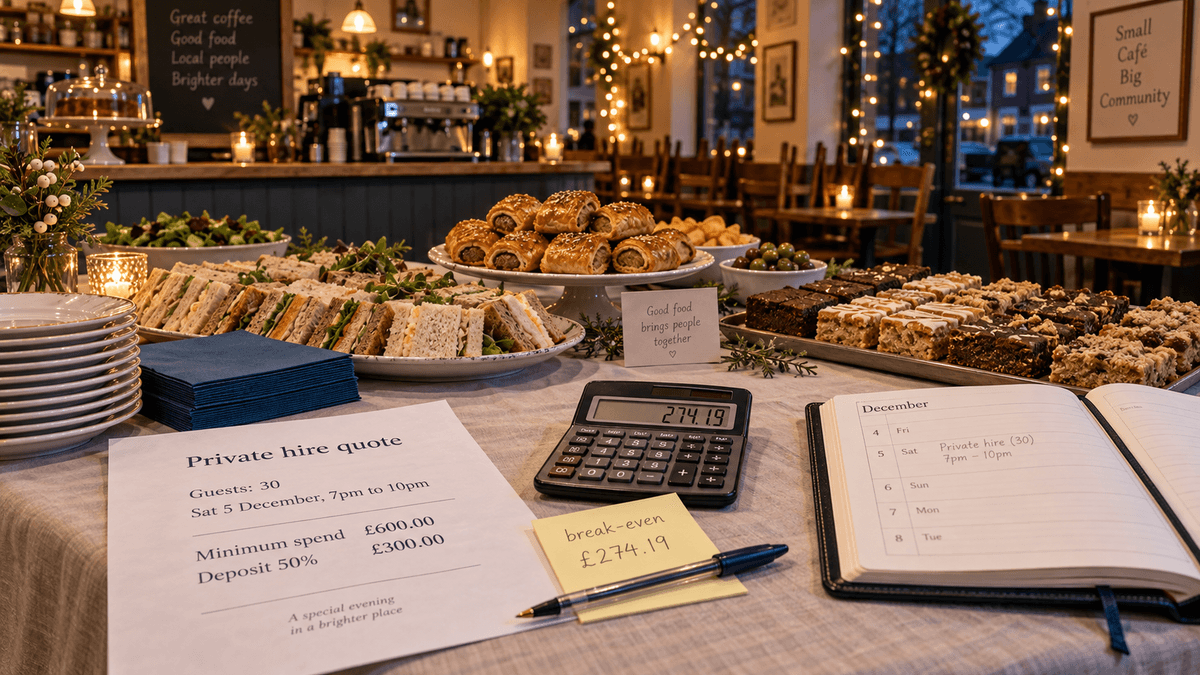
A nearby office wants your café for its Christmas do: thirty people, Saturday 5 December, 7pm to 10pm, after you close. The enquiry ends with one question: "What would you charge for the room?"
Most cafés answer with a round number. In July I said to have a costed per-head offer ready before the office-party enquiries start. This is the sum behind it.
VAT, insurance and consumer cancellation rules are UK-wide. Licensing is England and Wales plus a Scotland note; Northern Ireland licensing is not covered. The sums assume standard VAT accounting, not the Flat Rate Scheme; if you are not VAT registered, gross is net. Plain English, not tax or legal advice.
What opening the evening costs you
All figures are illustrative. Two staff, each on for 4.5 hours: 45 minutes' set-up, the three-hour party, 45 minutes' clean-down. Pay the whole shift, not just the party.
At the loaded National Living Wage hour of £15.93 from the make-or-buy break-even sum, that is 2 x 4.5 x £15.93 = £143.37. Add an assumed £12.00 for heating, lights and the dishwasher (read your own meter): the evening costs £155.37 before anyone eats. If one of the two is you, your hours count too.
The buffet is £18 a head including VAT. Eat-in catering is standard rated, so divide by 1.2 for net: £15.00. Cost of sales at 32% is £4.80 a head, leaving a 68% contribution towards the evening. Cost it as a recipe in CostingBrik so £4.80 is your number, not a guess.
Break-even spend: £155.37 / 0.68 = £228.49 net, or £274.19 including VAT. Below that, you are paying to host.
Four ways to charge the same party
Same 30 guests, same buffet:
- A. Room fee plus food. £150 for the room, buffet on top.
- B. Minimum spend. £600 including VAT; if they order less, the host tops it up.
- C. Per-head package. £22 a head: the £18 buffet plus £4 for the room.
- D. Fee credited against spend. £150 for the room, taken off the final bill.
All standard rated, room fee included.
| Model | Customer pays (inc VAT) | Net of VAT | Food cost | Profit after labour and energy |
|---|---|---|---|---|
| A. £150 fee + £540 buffet | £690 | £575.00 | £144.00 | £275.63 |
| B. £600 minimum, £540 ordered, £60 top-up | £600 | £500.00 | £144.00 | £200.63 |
| C. £22 x 30 | £660 | £550.00 | £144.00 | £250.63 |
| D. £150 credited against £540 | £540 | £450.00 | £144.00 | £150.63 |
Every row works the same way. Check A: £690 / 1.2 = £575.00, less £144.00 of food (30 x £4.80) and £155.37, leaves £275.63.
Now numbers drop to 20 by the final-numbers deadline, so food costs £96.00:
- A: £510, or £425.00 net. Profit £173.63.
- B: still £600, or £500.00 net, with the top-up now £240. Profit £248.63.
- C: £440, or £366.67 net. Profit £115.30.
- D: £360, or £300.00 net. Profit £48.63.
Three things follow.
- A room fee earns most when numbers hold; a minimum spend protects you when they fall. Of the four, only B earns more at 20.
- Or do both: a minimum that includes the room. Set it at the buffet plus the room: £540 + £150 = £690. That matches A's £275.63 at 30 guests and earns £323.63 at 20. At 30, a £600 minimum adds just £50 net over the buffet alone.
- A per-head package needs a final-numbers clause, so a party that confirms 30 at the deadline and brings 20 still pays for 30 portions.
Daytime hire: the cost is the trade you turn away
For a lunchtime baby shower, staff and energy are already paid; the cost is the gross profit your walk-ins would have made.
Take the 12-1pm hour from the worked day in profit per trading hour after wages: £160 at 65% is £104.00, or £104.00 / 1.2 = £86.67 net if, as usual, the till includes VAT. Add an assumed 1-2pm of £140 at 65%: £91.00, or £75.83 net. Two hours cost £162.50 of gross profit.
Walk-ins earned a blended 65%; the hire earns the buffet's 68%. So it needs £162.50 / 0.68 = £238.97 net, or £286.76 including VAT to stand still, before counting regulars turned away.
VAT: the room fee is probably not VAT-free
HMRC's Notice 742 treats "hiring out a hall or other accommodation for meetings or parties" as an exempt licence to occupy land, but not party facilities where the supplier does more, "for example by assisting with entertainment and arranging catering".
It adds that where a licence comes with other services as one supply, "the nature of the overarching supply" decides the treatment. Your staff serving your food in your room is catering, so the safe default is standard rated: £150 including VAT is £125 net. A bare room with no food or staff may be exempt; if you have opted to tax the building, it is standard rated anyway. Ask your accountant.
The top-up is part of the agreed price for the evening, so treat the £60 as VATable: £50 net, £10 VAT. Calling it compensation rarely helps: HMRC's VATSC05930 says a payment for making a supply available that the customer did not fully use will "normally be further consideration", even "if it is described as damages".
Deposits. Take 50% of the £600 minimum at booking and the £300 carries £50.00 of VAT, due on the return covering the day it lands, or the invoice date if earlier. As the December no-show deposits guide sets out, a retained deposit stays VATable. A separate, genuinely refundable damage deposit is usually outside VAT; ask your accountant.
Licensing: the bar, 11pm and the DJ
Alcohol. In England and Wales, selling it needs a premises licence or a temporary event notice, and wine inside a package price, or a bar tab the host settles, is still a sale. A TEN costs £21, covers fewer than 500 people including staff, and needs 10 clear working days' notice to the council: for Saturday 5 December, by Friday 20 November. Individuals get 5 a year (50 with a personal licence), and a premises 15 notices and 21 days.
BYO. Letting guests bring their own, even for a corkage fee, is generally not licensable, as you are not selling the alcohol. Check with your council's licensing team and your premises licence conditions.
Late night refreshment. Hot food or hot drink supplied to the public from 11pm to 5am is licensable under Schedule 2 of the Licensing Act 2003, BYO or not. It is exempt where the public are not admitted and everyone served is in a listed category, such as one employer's staff and their guests; where it is genuinely free; or where your council has designated an exemption. A family birthday is in no listed category, and coffee in a package price is not free. Running late? Stop hot food and hot drinks at 11pm unless you are licensed.
Entertainment. At a private event not open to the public, music is licensable only if provided for a charge and with a view to profit. A host who books and pays the DJ directly is usually fine; sell a package including the DJ and the charge runs through you, so it may count. If so, the recorded-music exemption needs a premises licence (not a TEN) for on-sales of alcohol, and runs only 8am to 11pm with 500 or fewer present. On a TEN, add regulated entertainment to the notice.
Copyright is separate: check with PPL PRS that your music licence covers evening functions and DJs. A DJ's personal streaming account is not a licence.
Scotland has no TENs: the equivalent is your Licensing Board's occasional licence, up to 14 days, open only to premises or personal licence holders and voluntary organisations. Selling food after 11pm may need a late hours catering licence if your council requires one; ask its licensing team.
Tell your insurer before the first deposit
Many policies ask you to report a material change, and the Insurance Act 2015 duty of "a fair presentation of the risk" applies again when you renew or vary cover. Evening trading with alcohol, a DJ and a full room may well be material, so tell your insurer or broker before the first deposit. Check your public liability limit, and ask any DJ or entertainer the host books for their own cover.
Put the terms in writing
Send them with the quote, before the customer is bound:
- Final numbers by a fixed date, charged on confirmed numbers.
- Finish time: when guests leave, and no hot food or hot drinks after 11pm unless you are licensed for late night refreshment.
- Music-off time: 11pm unless your premises licence or TEN covers entertainment later.
- Damage and cleaning: what counts, and the charge in pounds.
- Cancellation on a dated sliding scale, stated in pounds.
- Whether the fee or deposit comes off the bill.
- BYO, allowed or not, and any corkage.
- Entertainers: who books them and who pays.
A family booking a birthday for a set date has no 14-day cancellation right: it is catering or leisure (regulation 28). Your charge binds them only if fair: proportionate to your likely loss and given before booking. The office is a business, so consumer rules do not apply, but a charge out of all proportion to your loss can still be challenged as a penalty.
This week
- Cost one evening: staff from set-up to clean-down, energy, food per head.
- Find your break-even spend and decline anything under it.
- Pick a model: a room fee if numbers hold, a minimum spend if they wobble, or both, as a minimum that includes the room.
- Email your insurer and diary a TEN deadline for any party with a bar.
- Send written terms with every quote.
The office that emails first in October books whoever replies with a clear number. Make yours one you have worked out.
Ed O'Brien has run Hunters Cake Company for 17 years across cafés in Witney, Burford, and a bakery in Carterton, Oxfordshire. He's building Brikly - modular tools that give independent café owners the same data the big chains have, without the big chain price tag.